August 2026

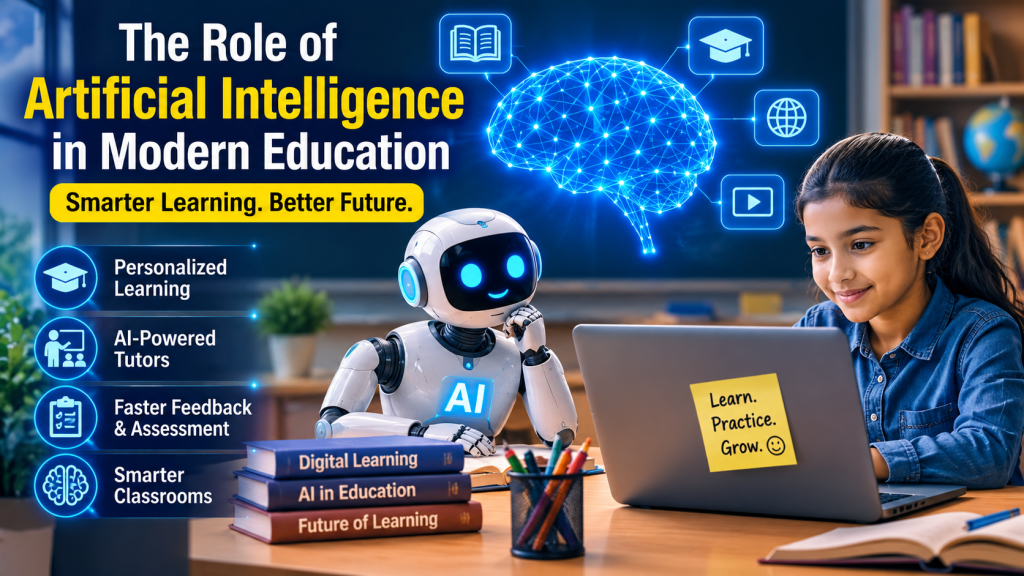
Artificial intelligence transforming modern education with AI-powered learning
Education

The Role of Artificial Intelligence in Modern Education

Introduction Artificial intelligence is becoming an important part of modern education. From personalized learning platforms to AI-powered educational tools, artificial intelligence is changing how students learn and how teachers plan, deliver, and support education. In 2026, AI is moving beyond simple automation. Educational institutions are exploring AI to provide more personalized learning experiences, support teachers, improve accessibility, and help students develop skills for a rapidly changing digital world. However, successful AI adoption requires responsible use, human oversight, and a clear focus on educational outcomes. What Is AI in Education? AI in education refers to the use of artificial intelligence technologies to support teaching and learning. These technologies can analyze information, recognize patterns, generate content, provide recommendations, and assist users with educational tasks. AI can be integrated into learning platforms, educational applications, assessment systems, virtual tutors, and other digital tools. Unlike traditional digital tools that mainly provide fixed content, AI-powered systems can adapt their responses based on user interactions and available data. This makes AI useful for creating more responsive and personalized learning experiences. How AI Is Transforming Education AI is transforming education by helping students learn more effectively and giving teachers new ways to support their learners. From personalized learning and AI tutoring to automated assessment and content creation, AI can support different stages of the educational process. 1. Personalized Learning Students have different learning styles, abilities, and levels of understanding. AI-powered learning platforms can analyze student performance and recommend appropriate content, exercises, and learning activities. This can help students receive support based on their individual learning needs and progress at their own pace. 2. AI-Powered Virtual Tutors AI-powered virtual tutors can provide students with explanations, examples, practice questions, and instant feedback. These tools can be available at any time, allowing students to review concepts and ask questions outside traditional classroom hours. 3. AI Is Supporting Teachers AI can also support teachers by helping with lesson planning, creating learning materials, generating practice questions, and organizing educational content. By reducing time spent on repetitive tasks, AI can allow teachers to focus more on classroom interaction, mentoring, and supporting individual students. 4. Faster Feedback and Assessment AI-powered assessment tools can help analyze student responses and provide faster feedback. Teachers can use these insights to identify areas where students may need additional support and adjust their teaching strategies accordingly. 5. Improved Accessibility AI can help make education more accessible by supporting tools such as speech recognition, text-to-speech, translation, and adaptive learning systems. These technologies can help learners with different abilities and language needs access educational content more effectively. Benefits of AI in Education When used responsibly and with clear educational goals, artificial intelligence can provide several benefits for students, teachers, and educational institutions. AI can make learning more personalized, efficient, accessible, and interactive. Personalized Learning Experiences AI can analyze learning patterns and recommend content based on individual student needs. This can help learners focus on areas where they need additional practice and progress at a suitable pace. Time-Saving for Teachers AI can assist teachers with repetitive tasks such as preparing learning materials, generating practice questions, and organizing information. This can give educators more time to focus on teaching and student interaction. Instant Support and Feedback AI-powered educational tools can provide students with immediate responses, explanations, and feedback. This can help learners identify mistakes and understand concepts without always having to wait for a formal classroom session. Better Accessibility AI-based tools can support translation, speech recognition, text-to-speech, and other accessibility features. These capabilities can make educational content easier to access for learners with different needs. Data-Driven Insights AI can help educational platforms analyze learning data and identify patterns in student performance. Teachers and institutions can use these insights to understand learning gaps and make more informed educational decisions. Challenges and Risks of AI in Education Although AI offers significant opportunities in education, its use also comes with challenges. Educational institutions need to consider privacy, accuracy, bias, academic integrity, digital access, and the importance of maintaining human involvement in the learning process. Data Privacy and Security AI-powered educational systems may process student information and learning data. Schools and technology providers need appropriate security and privacy practices to protect sensitive information and use data responsibly. Accuracy and Reliability AI systems can sometimes generate incorrect, incomplete, or misleading information. Students and teachers should verify important information and use human judgment rather than relying on AI responses without evaluation. Academic Integrity Easy access to AI tools can create challenges related to plagiarism, cheating, and excessive dependence on generated content. Educational institutions need clear guidelines that encourage students to use AI as a learning aid while continuing to develop their own knowledge and critical thinking. Digital Inequality Not every student or institution has equal access to AI-powered tools, reliable internet, or suitable devices. Unequal access can create differences in learning opportunities and needs to be considered when introducing AI into education. Human Oversight AI should support teachers rather than replace human judgment. Teachers play an important role in understanding students, providing guidance, encouraging creativity, and creating meaningful learning environments. The Future of AI in Education The role of artificial intelligence in education is expected to grow as AI technologies become more capable and accessible. Future learning environments may include AI-powered tutors, adaptive learning systems, intelligent assessment tools, and personalized educational platforms that respond to individual student needs. However, the future of AI in education should focus on collaboration between technology and people rather than replacing teachers. Effective use of AI will require responsible implementation, teacher training, strong data protection, clear policies, and continued emphasis on creativity, critical thinking, and human interaction. AI and the Changing Role of Teachers As AI takes on more repetitive and administrative tasks, teachers may have more opportunities to focus on mentoring, discussion, creativity, problem-solving, and personalized support. The teacher’s role can evolve from simply delivering information to guiding students in how to understand, evaluate, and apply knowledge. Conclusion Artificial intelligence is changing modern education by creating new ways for students to learn and

Technology in education with students using digital learning tools
Education

How Technology Is Transforming Education in 2026

Introduction Technology in education has become an important part of modern learning. From digital classrooms and online learning platforms to artificial intelligence and personalized learning tools, technology is changing how students access information, interact with teachers, and develop new skills. In 2026, the focus is no longer simply on putting more devices into classrooms. The bigger goal is to use technology in ways that improve learning, support teachers, increase accessibility, and help students develop the skills they need for the future. What Is Educational Technology? Educational technology, often called EdTech, refers to the use of digital tools and technologies to support teaching and learning. It includes online learning platforms, educational applications, learning management systems, digital classrooms, interactive tools, artificial intelligence, and digital assessment solutions. Educational technology can include: Online learning platforms Educational applications Learning management systems Digital classrooms Interactive whiteboards Video-based learning Artificial intelligence tools Learning analytics Virtual and augmented reality Digital assessment tools How Technology Is Transforming Education Technology is changing education in many ways, from making learning more accessible to helping teachers create more engaging and personalized learning experiences. Some of the most important changes can be seen in digital learning, artificial intelligence, personalized education, interactive learning, smart classrooms, and online collaboration. 1. Digital Learning Has Made Education More Accessible One of the biggest changes brought by technology is the growth of digital learning. Students can now access educational content through computers, tablets, and smartphones. Online courses, recorded lectures, digital textbooks, educational videos, and interactive learning platforms allow learners to study from different locations and at different times. 2. Artificial Intelligence Is Supporting Teaching and Learning Artificial intelligence is becoming one of the most significant developments in education. AI-powered tools can help generate learning materials, provide explanations, support research, assist teachers with lesson planning, and offer personalized learning experiences. 3. Personalized Learning Is Becoming More Practical Every student learns differently. Some students understand concepts quickly, while others may need additional explanations and practice. Technology can help create more personalized learning experiences by analyzing student progress and recommending appropriate resources, exercises, or learning paths. 4. Interactive Learning Makes Education More Engaging Traditional textbooks remain valuable, but digital tools can add more interactive elements to the learning experience. Students can learn through educational videos, simulations, interactive quizzes, digital presentations, virtual experiments, and gamified learning activities. These methods can make difficult concepts easier to understand by allowing students to see, explore, and practice concepts rather than only reading about them. 5. Smart Classrooms Are Changing the Learning Environment Smart classrooms combine traditional teaching methods with digital technologies. Teachers can use interactive displays, multimedia content, online resources, digital assessments, and collaborative platforms to make lessons more engaging. Technology can support teachers in explaining complex concepts and creating a more interactive learning environment for students. 6. Online Collaboration Is Connecting Learners Technology has made collaboration easier for students and teachers. Students can work together on projects using online documents, communication platforms, virtual classrooms, and shared digital workspaces. This allows learners to collaborate from different locations while developing important skills such as communication, teamwork, problem-solving, and digital literacy. 7. Technology Is Helping Teachers Too The impact of educational technology is not limited to students. Teachers can use digital tools to organize course materials, create assessments, track student progress, communicate with learners, and prepare lessons. Technology can support teachers with preparation and administrative tasks while allowing them to focus more on teaching and student interaction. Benefits of Technology in Education When implemented thoughtfully, technology in education can provide several benefits for students, teachers, and educational institutions. Greater Accessibility Digital resources can make educational content available to learners beyond traditional classrooms. Students can access lessons, study materials, and educational resources from different locations. Flexible Learning Technology allows students to access lessons and learning resources according to their schedules and individual learning needs. This flexibility can be especially useful for students who prefer learning at their own pace. Personalized Education Digital learning platforms can use student progress and performance information to recommend suitable resources and activities. This can help create learning experiences that better match individual needs. Better Engagement Interactive videos, quizzes, simulations, digital presentations, and other learning tools can make lessons more engaging and help students understand difficult concepts more effectively. Improved Collaboration Digital platforms make it easier for students and teachers to communicate, share resources, and work together on projects, even when they are in different locations. Development of Digital Skills Regular use of educational technology can help students develop digital skills that are increasingly important for higher education, employment, and everyday life. Challenges of Using Technology in Education While technology offers many benefits, its use in education also comes with certain challenges. Schools and educational institutions need to address these challenges to ensure that technology improves learning rather than creating new problems. Digital Divide Not every student has equal access to smartphones, computers, reliable internet connections, or other digital resources. This digital divide can create differences in learning opportunities between students. Screen Time Excessive screen time can affect students’ attention and overall learning experience. Technology should therefore be used purposefully, with a healthy balance between digital activities and other forms of learning. Privacy and Security Educational platforms may handle student information and other sensitive data. Schools and technology providers need to follow appropriate privacy and security practices to protect this information. Overdependence on Technology Students should not become completely dependent on digital tools for learning and problem-solving. Developing independent thinking, creativity, and critical thinking skills remains essential. Teacher Training Teachers need appropriate training and support to use new technologies effectively. Providing training can help educators understand how to integrate digital tools into their teaching without allowing technology to distract from learning objectives. The Future of Technology in Education The future of education is likely to involve a combination of human teaching and carefully selected technologies. Artificial intelligence, adaptive learning platforms, digital classrooms, learning analytics, and immersive learning experiences may become increasingly common. However, technology alone cannot solve every educational challenge. The most effective

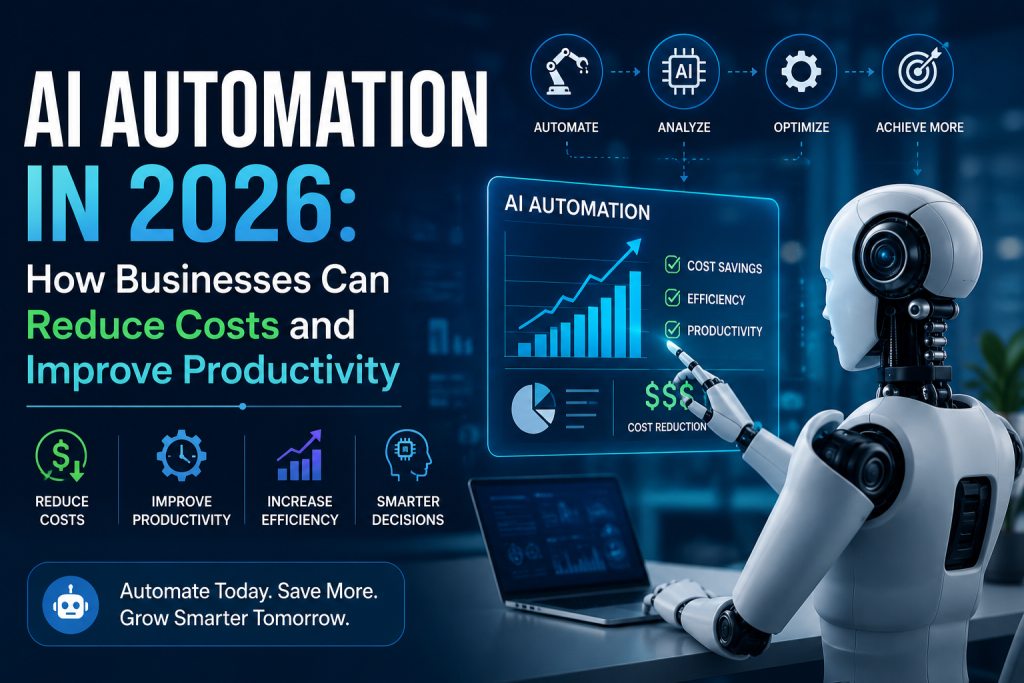
AI automation in 2026 helping businesses reduce costs and improve productivity
AI + Digital Transformation

AI Automation in 2026: How Businesses Can Reduce Costs and Improve Productivity

Artificial Intelligence is rapidly changing the way businesses operate. In 2026, AI automation is moving beyond simple chatbots and repetitive task automation. Businesses are increasingly using AI-powered systems to analyze information, automate workflows, assist employees, improve customer experiences, and make faster decisions. For organizations dealing with increasing operational costs, large amounts of data, and repetitive processes, AI automation can provide a practical way to improve efficiency without continuously increasing manual workloads. From customer support and sales to finance, human resources, software development, and business analytics, AI automation is becoming an important part of modern digital transformation. What Is AI Automation? AI automation combines artificial intelligence with automated workflows to perform tasks that traditionally require human intervention. Traditional automation usually follows predefined rules: Input → Rule → Action → Result AI automation can work with more flexible processes: Data → AI Analysis → Decision → Automated Action → Evaluation This allows automated systems to handle information, identify patterns, make recommendations, and trigger appropriate actions based on changing situations. For example, a traditional workflow might automatically send the same email to every new customer. An AI-powered workflow could analyze customer information, identify their interests, personalize the message, update the CRM, and schedule a follow-up automatically. This makes AI automation more adaptable to modern business processes. Why AI Automation Matters in 2026 Businesses are under constant pressure to improve productivity while controlling operational costs. Employees often spend significant amounts of time performing repetitive activities such as: Entering data Responding to routine emails Updating CRM systems Preparing reports Scheduling meetings Processing documents Answering common customer questions Monitoring business metrics Managing repetitive administrative workflows AI automation can reduce the amount of manual work involved in these processes. The goal is not simply to automate everything. Instead, businesses can use AI to automate suitable tasks while allowing employees to focus on activities that require creativity, strategic thinking, communication, and human judgment. Some major benefits include: Reduced repetitive work Improved employee productivity Faster business processes Lower operational overhead Faster customer responses Better data utilization Improved decision-making Scalable workflows 24/7 automated operations How AI Automation Helps Businesses Reduce Costs Reducing costs does not always mean reducing employees. In many cases, businesses can reduce operational costs by improving how existing resources are used. AI automation can help organizations achieve this in several ways. 1. Reduce Repetitive Manual Work Employees can spend hours performing repetitive tasks that follow predictable patterns. AI automation can handle many of these processes automatically. For example: Manual Process: Employee receives request → Reads information → Updates system → Sends response → Creates follow-up task Automated Process: Request received → AI analyzes request → System updated → Personalized response sent → Follow-up created This allows employees to spend more time on higher-value work. 2. Improve Operational Efficiency Manual processes often involve multiple systems and departments. For example, processing a new customer may require information to be entered into: CRM Email platform Accounting system Project management software Customer support platform Analytics system AI automation can coordinate these systems and reduce unnecessary manual data entry. 3. Reduce Errors Manual data entry and repetitive processing can result in mistakes. AI-powered workflows can validate information, identify inconsistencies, and trigger alerts when something requires human attention. This can help reduce the operational cost associated with avoidable errors and rework. 4. Improve Resource Utilization Businesses can use automation to handle routine processes while employees focus on more complex responsibilities. Instead of hiring additional resources for every increase in workload, organizations can automate suitable processes and scale operations more efficiently. 5. Provide 24/7 Support AI-powered systems can operate outside normal business hours. Customer questions, internal requests, monitoring activities, and other automated processes can continue even when employees are unavailable. This can improve service availability without requiring a larger support team to work around the clock. How AI Automation Improves Productivity Cost reduction is only one side of AI automation. The larger opportunity is improving productivity. Faster Task Completion AI systems can process large amounts of information quickly and automate workflows that previously required multiple manual steps. Less Administrative Work Employees can spend less time on repetitive activities such as documentation, scheduling, reporting, and data entry. Better Access to Information AI-powered systems can help employees search internal information and retrieve relevant data using natural language. Faster Decision Support AI automation can analyze business information and highlight trends, anomalies, and important changes. This gives teams faster access to information needed for decision-making. Improved Collaboration Automated workflows can notify the right team members, create tasks, update systems, and share information automatically. This reduces delays caused by manual communication between departments. AI Automation in Customer Support Customer support is one of the most practical areas for AI automation. Businesses can use AI-powered systems to handle routine customer interactions and automate support workflows. Common applications include: Answering frequently asked questions Tracking orders Checking account information Creating support tickets Categorizing customer requests Routing issues to the appropriate department Scheduling appointments Providing personalized responses Escalating complex issues to human agents For example, when a customer submits a support request, an AI system can understand the request, retrieve relevant information, categorize the issue, and either provide an answer or route the request to a human support professional. This can reduce response times while allowing support teams to focus on more complex customer problems. AI Automation in Sales and Marketing Sales and marketing teams manage large amounts of customer and prospect information. AI automation can help reduce administrative workloads across the sales process. A sales automation workflow can: Identify potential leads. Collect relevant customer information. Qualify prospects. Update CRM records. Generate personalized outreach. Schedule follow-ups. Notify sales representatives. Track engagement. Generate performance reports. Marketing teams can also use AI automation for: Content planning Audience segmentation Campaign analysis Lead scoring Customer research Trend identification Personalized communication Performance reporting The objective is not to remove human involvement from sales and marketing. Instead, automation can handle administrative tasks so professionals can focus on relationships, creativity, and strategy. AI Automation in Finance and Accounting Finance

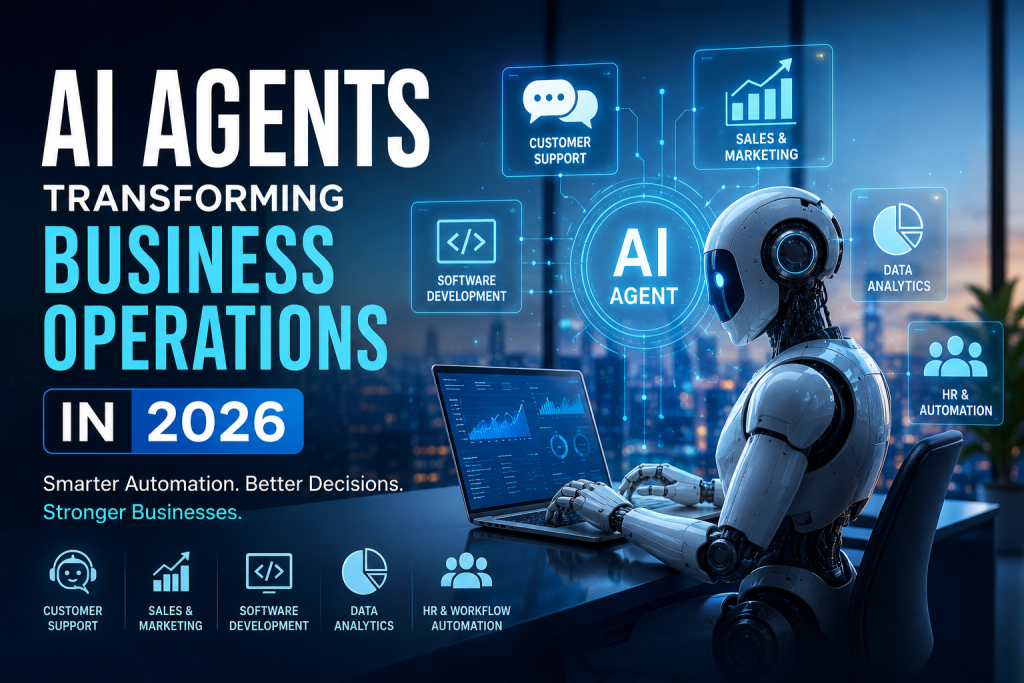
AI Agents Transforming Business Operations in 2026
Artificial Intelligence

How AI Agents Are Transforming Business Operations in 2026

Artificial Intelligence has moved far beyond chatbots and simple automation. In 2026, businesses are increasingly adopting AI agents that can understand goals, make decisions, use digital tools, and complete multi-step tasks with minimal human intervention. Unlike traditional software automation, which generally follows predefined rules, AI agents can analyze information, determine the next action, interact with different systems, and adapt their approach based on the situation. From customer service and sales to software development, finance, human resources, and data analysis, AI agents are changing how organizations operate and make decisions. For businesses looking to improve productivity, reduce operational costs, and deliver better customer experiences, AI agents are becoming an important part of the modern digital transformation strategy. What Are AI Agents? AI agents are intelligent software systems designed to achieve specific goals by combining artificial intelligence with reasoning, decision-making, and tool usage. Traditional automation generally follows a fixed sequence: Input → Rule → Action → Result AI agents can operate more dynamically: Goal → Analyze → Plan → Use Tools → Take Action → Evaluate → Adapt For example, instead of simply responding to a customer’s question, an AI-powered customer service agent could: Understand the customer’s request. Retrieve relevant customer information. Check an order or account status. Determine the appropriate solution. Update the required system. Respond to the customer. Escalate the issue to a human when necessary. This ability to perform multiple connected tasks makes AI agents particularly valuable for modern businesses. Why AI Agents Matter for Businesses in 2026 Businesses generate enormous amounts of data and perform thousands of repetitive processes every day. Employees often spend valuable time searching for information, updating systems, preparing reports, responding to routine queries, and managing repetitive workflows. AI agents can help automate many of these processes while allowing employees to focus on more strategic and creative work. Some of the biggest advantages include: Higher productivity Faster business processes Reduced repetitive work 24/7 operational support Improved customer experiences Faster decision-making Better utilization of business data Scalable automation The biggest shift is that businesses are moving from simply using AI as an assistant to using AI as an active participant in business workflows. AI Agents in Customer Support Customer support is one of the most practical applications of AI agents. Traditional chatbots usually provide answers based on predefined flows or a limited knowledge base. Modern AI agents can understand context and interact with business systems to resolve more complex requests. An AI customer service agent can: Answer product-related questions Track orders Check account information Handle appointment scheduling Create support tickets Recommend relevant solutions Escalate complex issues to human agents This allows businesses to provide faster support without requiring employees to manually handle every routine request. AI Agents for Sales and Marketing Sales teams spend significant amounts of time researching prospects, updating CRM records, writing emails, and following up with leads. AI agents can automate many of these activities. A sales AI agent can help: Identify potential leads Analyze customer information Qualify prospects Generate personalized outreach Schedule meetings Update CRM systems Track follow-ups Analyze sales performance Marketing teams can also use AI agents to analyze campaigns, generate content ideas, segment audiences, and identify trends. Instead of replacing sales and marketing professionals, AI agents can act as intelligent assistants that reduce administrative work and allow teams to focus on relationships and strategy. AI Agents in Software Development Software development is another area experiencing rapid AI adoption. AI coding assistants are already helping developers generate code, explain existing code, identify bugs, write tests, and improve documentation. AI agents take this concept further by supporting multi-step development workflows. For example, an AI development agent could: Analyze a development requirement. Create an implementation plan. Generate or modify code. Run tests. Identify errors. Suggest fixes. Update documentation. This does not eliminate the need for developers. Instead, it allows development teams to spend more time on architecture, product decisions, security, and complex engineering problems. AI Agents for Data Analysis and Business Intelligence Modern businesses collect data from websites, applications, CRM platforms, financial systems, marketing platforms, and other sources. The challenge is turning this data into actionable insights. AI agents can help business teams interact with their data using natural language. For example, a business manager could ask: “Why did our sales decrease this month?” An AI-powered system could analyze sales data, compare it with previous periods, identify unusual patterns, and present possible reasons. AI agents can support: Automated reporting Data exploration Trend detection Forecasting KPI monitoring Anomaly detection Business recommendations This can make data-driven decision-making more accessible to non-technical teams. AI Agents in Human Resources HR departments handle many repetitive processes, including employee queries, onboarding, documentation, scheduling, and internal requests. AI agents can provide employees with instant access to company information and automate administrative workflows. Common applications include: Employee onboarding Leave and policy queries Internal knowledge management Interview scheduling Candidate screening assistance HR document management Employee support With appropriate security and human oversight, AI agents can help HR teams reduce administrative workloads while improving employee experiences. AI Agents for Business Process Automation One of the most important applications of AI agents is connecting different business systems. A business may use separate platforms for CRM, accounting, email, customer support, project management, inventory, and analytics. AI agents can potentially coordinate workflows across these systems. For example, when a new customer signs up, an automated workflow could: Create CRM record → Send welcome email → Create onboarding task → Notify sales team → Update analytics This type of intelligent workflow automation can reduce manual data entry and improve operational efficiency. AI Agents vs Traditional Automation Traditional automation remains extremely useful, especially when processes are predictable and rules are clearly defined. However, AI agents provide additional flexibility when workflows involve changing information or require reasoning. Traditional Automation AI Agents Rule-based Goal-oriented Fixed workflows Dynamic workflows Predictable inputs Can handle variable inputs Limited decision-making AI-assisted reasoning Usually predefined actions Can select tools and actions Best for repetitive rules Best for complex workflows The two approaches are not

AI Is Eating Software: Why "Writing Code" Is Being Replaced by "Expressing Intent"
Artificial Intelligence

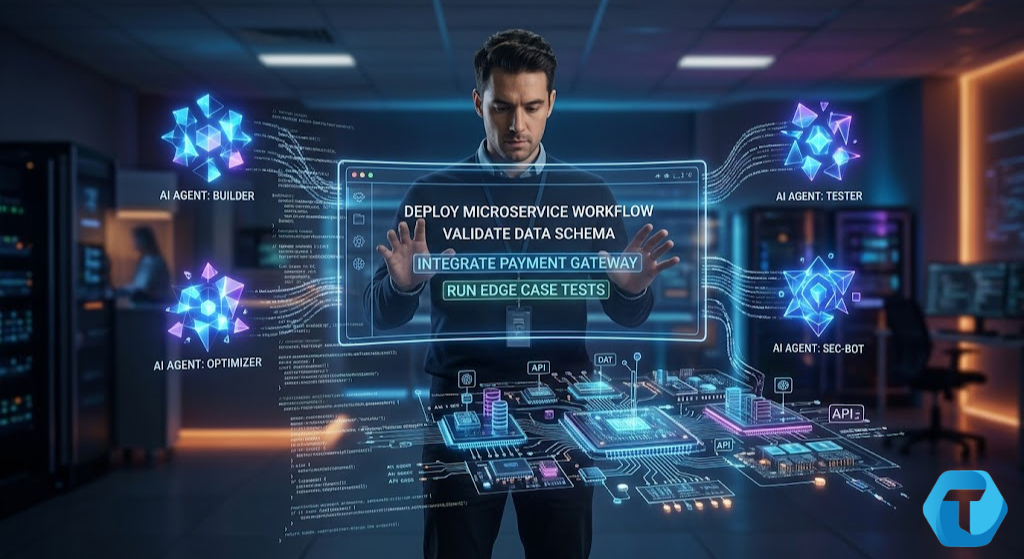
AI Is Eating Software: Why “Writing Code” Is Being Replaced by “Expressing Intent”

AI Is Eating Software: Why “Writing Code” Is Being Replaced by “Expressing Intent” For decades, the mark of a elite software engineer was syntax fluency. We valued the developer who memorized standard library calls, mastered complex language idioms, and typed out hundreds of lines of clean boilerplate before lunch. Code was the ultimate currency of software creation, and the developer’s primary tool was the keyboard. That era is quietly coming to an end. Marc Andreessen famously declared over a decade ago that “software is eating the world.” Today, artificial intelligence is eating software itself. But AI is not merely automating mechanical keystrokes or making code auto-complete faster; it is fundamentally altering the abstraction layer of technology. The primary unit of software engineering is shifting from writing code to expressing intent. When developers spend less time typing out function bodies and more time orchestrating autonomous multi-agent systems, the entire discipline undergoes a tectonic shift. We are witnessing the birth of Intent-Driven Development (IDD)—where human genius focuses on architecture, context, and validation, while machine intelligence handles the mechanical translation into working software. Part 1: The Death of the Syntax Artisan To understand where software engineering is heading, we must examine where it has been. Computer science is a relentless history of ascending abstraction layers. We evolved from toggling physical switches on punch cards to assembly language, from assembly to procedural C, and from C to garbage-collected, expressive languages like Python, Rust, and TypeScript. Every leap in abstraction was initially met with fierce skepticism. Compiler pioneers were told that high-level languages would make programmers lazy or yield inefficient machine code. Yet, higher abstractions allowed engineers to build distributed cloud platforms, global real-time networks, and complex operating systems that would have been mathematically impossible if everyone still manually managed memory pointers. ┌─────────────────────────────────────────────────────────────────────────┐ │ The Evolution of Code Abstraction │ ├─────────────────────────────────────────────────────────────────────────┤ │ Era 1: Hardware Ops ──> Physical Switches & Punch Cards │ │ Era 2: Low-Level ──> Assembly & Direct Memory Management │ │ Era 3: High-Level ──> C, Java, Python (Manual Syntax Mechanics) │ │ Era 4: Intent-Driven ──> Natural Language Specs & AI Agent Execution │ └─────────────────────────────────────────────────────────────────────────┘ Generating code syntax is no longer an engineering bottleneck. Modern Large Language Models (LLMs) and autonomous agent networks do not just assist with line completion; they synthesize entire microservices, draft comprehensive unit tests, and refactor monolithic codebases in seconds. When the marginal cost of writing syntax approaches zero, syntax loses its status as a competitive moat. The artisan who takes pride solely in typing out boilerplate REST endpoints or standard UI components faces an existential realization: typing syntax was always just a low-fidelity medium for communicating human thought to machines. Part 2: The Three Pillars of Intent-Driven Development If syntax generation is delegated to autonomous AI agents, what constitutes the core workflow of the modern software team? Intent-Driven Development replaces manual implementation with three foundational pillars: Capability Dimension Traditional Development Intent-Driven Development Primary Skill Memorizing syntax & API methods Context engineering & system architecture Execution Medium Manual code writing in an IDE Declarative specifications & prompt design Quality Control Manual code reviews & PR checks Automated verification loops & guardrails Output Metric Lines of Code (LOC) committed Speed & accuracy of verified feature delivery 1. Context Engineering AI models are only as effective as the context fed into them. Instead of writing raw logic, engineers focus on building rich, structured context architectures. This includes maintaining clear repository maps, dependency graphs, domain schemas, and historical design records so that AI agents possess deep, accurate domain knowledge before executing a single task. 2. High-Precision Specification (Declarative Architecture) Expressing intent is not about throwing vague, lazy English prompts at a chatbot. It demands declarative precision. Engineers define exact API contracts, state machine transitions, edge-case boundaries, and performance budgets using formal specs, system prompts, and structured schemas. 3. Automated Guardrails and Verification Because probabilistic AI models can hallucinate or introduce subtle edge-case bugs, Intent-Driven Development relies on non-negotiable verification loops. Human engineers construct automated environments—combining static analysis, property-based testing, fuzzing, and sandbox security constraints—that continuously test machine-generated code before it touches production. Part 3: The New Role of the Developer: System Orchestrator In an intent-driven ecosystem, the developer’s day-to-day identity shifts from a code builder to a system orchestrator. ┌────────────────────────────────────────────────────────┐ │ Intent-Driven Orchestration Flow │ ├────────────────────────────────────────────────────────┤ │ 1. Human Architect defines Intent & Context Specs │ │ │ │ │ ▼ │ │ 2. Specialized AI Agents assemble code & test suites │ │ │ │ │ ▼ │ │ 3. Automated Guardrails run security & stress tests │ │ │ │ │ ▼ │ │ 4. Human Specialist audits diff & authorizes release │ └────────────────────────────────────────────────────────┘ Instead of grinding through sprint tickets line by line, the modern engineer manages a team of specialized AI agents: The Architectural Agent: Scaffolds modular file structures based on system specifications. The Implementation Agent: Writes concrete, production-ready code aligned with existing codebase patterns. The Red-Teaming Agent: Intentionally attempts to break the newly generated code with security exploits and edge-case inputs. The Documentation Agent: Keeps API documentation and system diagrams continuously synchronized in real-time. The human engineer remains elevated at the top of this chain, making high-leverage decisions: evaluating trade-offs between latency and infrastructure cost, enforcing compliance and security boundaries, and aligning software capabilities with real business goals. Part 4: The Engineering Manager’s Playbook: Re-tooling Teams for the AI Era For technology leaders, the transition to Intent-Driven Development presents an organizational challenge. Traditional engineering management metrics—like Lines of Code (LOC) written, PR volume, or commit frequency—become useless when a developer can generate thousands of lines of functional code in minutes. To successfully lead engineering teams through this transformation, managers must execute three strategic pivots: 1. Measure “Velocity of Intent” Shift performance evaluations away from raw output toward Velocity of Intent—how effectively an engineer converts a complex business requirement into an airtight specification, orchestrates its machine generation, and verifies its safe deployment. 2. Treat Context as a First-Class Code Asset System prompts, architectural decision records

Scroll to Top