Author name: Raghav

AI Is Eating Software: Why "Writing Code" Is Being Replaced by "Expressing Intent"
Artificial Intelligence

AI Is Eating Software: Why “Writing Code” Is Being Replaced by “Expressing Intent”

AI Is Eating Software: Why “Writing Code” Is Being Replaced by “Expressing Intent” For decades, the mark of a elite software engineer was syntax fluency. We valued the developer who memorized standard library calls, mastered complex language idioms, and typed out hundreds of lines of clean boilerplate before lunch. Code was the ultimate currency of software creation, and the developer’s primary tool was the keyboard. That era is quietly coming to an end. Marc Andreessen famously declared over a decade ago that “software is eating the world.” Today, artificial intelligence is eating software itself. But AI is not merely automating mechanical keystrokes or making code auto-complete faster; it is fundamentally altering the abstraction layer of technology. The primary unit of software engineering is shifting from writing code to expressing intent. When developers spend less time typing out function bodies and more time orchestrating autonomous multi-agent systems, the entire discipline undergoes a tectonic shift. We are witnessing the birth of Intent-Driven Development (IDD)—where human genius focuses on architecture, context, and validation, while machine intelligence handles the mechanical translation into working software. Part 1: The Death of the Syntax Artisan To understand where software engineering is heading, we must examine where it has been. Computer science is a relentless history of ascending abstraction layers. We evolved from toggling physical switches on punch cards to assembly language, from assembly to procedural C, and from C to garbage-collected, expressive languages like Python, Rust, and TypeScript. Every leap in abstraction was initially met with fierce skepticism. Compiler pioneers were told that high-level languages would make programmers lazy or yield inefficient machine code. Yet, higher abstractions allowed engineers to build distributed cloud platforms, global real-time networks, and complex operating systems that would have been mathematically impossible if everyone still manually managed memory pointers. ┌─────────────────────────────────────────────────────────────────────────┐ │ The Evolution of Code Abstraction │ ├─────────────────────────────────────────────────────────────────────────┤ │ Era 1: Hardware Ops ──> Physical Switches & Punch Cards │ │ Era 2: Low-Level ──> Assembly & Direct Memory Management │ │ Era 3: High-Level ──> C, Java, Python (Manual Syntax Mechanics) │ │ Era 4: Intent-Driven ──> Natural Language Specs & AI Agent Execution │ └─────────────────────────────────────────────────────────────────────────┘ Generating code syntax is no longer an engineering bottleneck. Modern Large Language Models (LLMs) and autonomous agent networks do not just assist with line completion; they synthesize entire microservices, draft comprehensive unit tests, and refactor monolithic codebases in seconds. When the marginal cost of writing syntax approaches zero, syntax loses its status as a competitive moat. The artisan who takes pride solely in typing out boilerplate REST endpoints or standard UI components faces an existential realization: typing syntax was always just a low-fidelity medium for communicating human thought to machines. Part 2: The Three Pillars of Intent-Driven Development If syntax generation is delegated to autonomous AI agents, what constitutes the core workflow of the modern software team? Intent-Driven Development replaces manual implementation with three foundational pillars: Capability Dimension Traditional Development Intent-Driven Development Primary Skill Memorizing syntax & API methods Context engineering & system architecture Execution Medium Manual code writing in an IDE Declarative specifications & prompt design Quality Control Manual code reviews & PR checks Automated verification loops & guardrails Output Metric Lines of Code (LOC) committed Speed & accuracy of verified feature delivery 1. Context Engineering AI models are only as effective as the context fed into them. Instead of writing raw logic, engineers focus on building rich, structured context architectures. This includes maintaining clear repository maps, dependency graphs, domain schemas, and historical design records so that AI agents possess deep, accurate domain knowledge before executing a single task. 2. High-Precision Specification (Declarative Architecture) Expressing intent is not about throwing vague, lazy English prompts at a chatbot. It demands declarative precision. Engineers define exact API contracts, state machine transitions, edge-case boundaries, and performance budgets using formal specs, system prompts, and structured schemas. 3. Automated Guardrails and Verification Because probabilistic AI models can hallucinate or introduce subtle edge-case bugs, Intent-Driven Development relies on non-negotiable verification loops. Human engineers construct automated environments—combining static analysis, property-based testing, fuzzing, and sandbox security constraints—that continuously test machine-generated code before it touches production. Part 3: The New Role of the Developer: System Orchestrator In an intent-driven ecosystem, the developer’s day-to-day identity shifts from a code builder to a system orchestrator. ┌────────────────────────────────────────────────────────┐ │ Intent-Driven Orchestration Flow │ ├────────────────────────────────────────────────────────┤ │ 1. Human Architect defines Intent & Context Specs │ │ │ │ │ ▼ │ │ 2. Specialized AI Agents assemble code & test suites │ │ │ │ │ ▼ │ │ 3. Automated Guardrails run security & stress tests │ │ │ │ │ ▼ │ │ 4. Human Specialist audits diff & authorizes release │ └────────────────────────────────────────────────────────┘ Instead of grinding through sprint tickets line by line, the modern engineer manages a team of specialized AI agents: The Architectural Agent: Scaffolds modular file structures based on system specifications. The Implementation Agent: Writes concrete, production-ready code aligned with existing codebase patterns. The Red-Teaming Agent: Intentionally attempts to break the newly generated code with security exploits and edge-case inputs. The Documentation Agent: Keeps API documentation and system diagrams continuously synchronized in real-time. The human engineer remains elevated at the top of this chain, making high-leverage decisions: evaluating trade-offs between latency and infrastructure cost, enforcing compliance and security boundaries, and aligning software capabilities with real business goals. Part 4: The Engineering Manager’s Playbook: Re-tooling Teams for the AI Era For technology leaders, the transition to Intent-Driven Development presents an organizational challenge. Traditional engineering management metrics—like Lines of Code (LOC) written, PR volume, or commit frequency—become useless when a developer can generate thousands of lines of functional code in minutes. To successfully lead engineering teams through this transformation, managers must execute three strategic pivots: 1. Measure “Velocity of Intent” Shift performance evaluations away from raw output toward Velocity of Intent—how effectively an engineer converts a complex business requirement into an airtight specification, orchestrates its machine generation, and verifies its safe deployment. 2. Treat Context as a First-Class Code Asset System prompts, architectural decision records
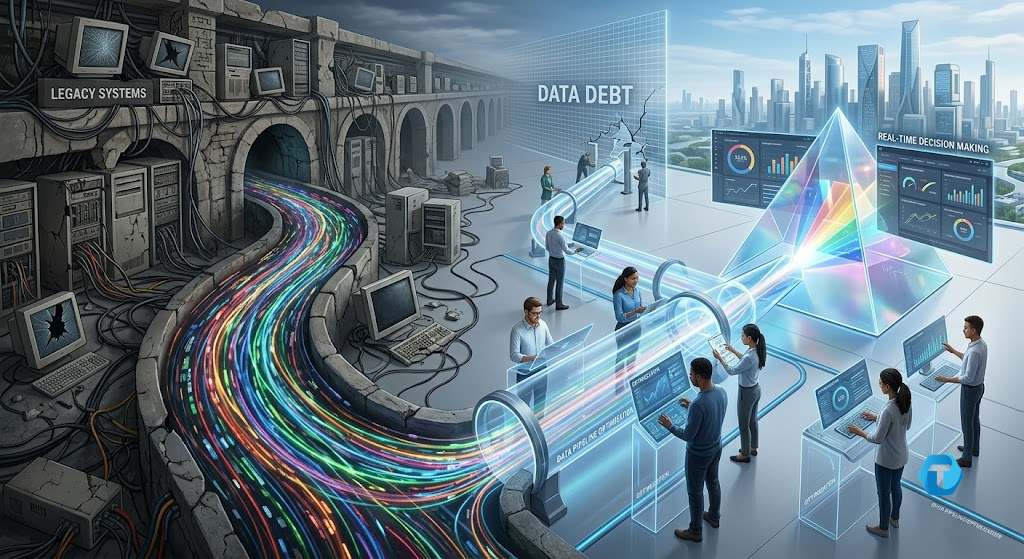
Data pipeline optimization and real-time data streaming architecture graphic
Technology & Innovation

Tackling Data Debt: A Strategic Blueprint for Data Pipeline Optimization and Real-Time Decision Making

Tackling Data Debt: A Strategic Blueprint for Data Pipeline Optimization and Real-Time Decision Making Every scaling enterprise eventually reaches a critical tipping point where its most valuable asset becomes its primary operational bottleneck. You see it in executive dashboards that take hours to refresh, cloud infrastructure invoices that balloon without explanation, and data engineering teams spending eighty percent of their week patching broken ETL scripts. This silent accumulation of architectural band-aids, shortcut queries, and unmonitored dependencies is what technical leaders call data debt. For Chief Data Officers, Lead Data Engineers, and BI Managers, data debt is not merely a backend inconvenience—it directly hampers your company’s ability to capitalize on fresh operational signals. When marketing needs immediate insights on campaign conversions, or risk management demands sub-second fraud detection, legacy batch infrastructure collapses under the pressure. Our team at Techotd frequently meets enterprise leaders whose analytics stacks were built for yesterday’s daily batch routines rather than today’s event-driven demands. Eliminating this structural drag requires a comprehensive strategy centered on data pipeline optimization—turning fragile, slow processing flows into resilient, low-latency pipelines that power confident, real-time decision making across the business. The Invisible Drag of Data Debt on Modern Engineering Teams Data debt rarely accumulates overnight during a single catastrophic project failure. Instead, it creeps into enterprise systems through dozens of everyday tactical compromises. A marketing team requests an urgent ad-hoc report, so a developer writes a quick SQL script directly against a production database. Six months later, four downstream dashboards and two financial reporting tools quietly depend on that unmonitored, undocumented script. Multiply this pattern across fifty departments and hundreds of microservices, and you inevitably end up with a tangled “spaghetti architecture” that nobody dares to touch. Historically, enterprise data infrastructure relied heavily on traditional night-time batch processing. Relational databases staged raw records, scheduled cron jobs executed heavy SQL transformations during off-peak hours, and pre-aggregated data marts served static morning reports. That model worked well when business operations moved at a daily or weekly rhythm. Today, however, business operations run continuously, and waiting twelve hours for updated inventory levels or user activity logs creates unacceptable competitive lag. When growing enterprises attempt to force legacy batch systems to support real-time demands without undertaking root-cause refactoring, several severe operational pain points surface: Pervasive Data Latency: Crucial business units are forced to make high-stakes choices using stale information. By the time supply chain anomalies, customer churn triggers, or transaction anomalies appear on executive dashboards, the opportunity to mitigate the issue has already passed. Runaway Cloud Infrastructure Costs: Unoptimized SQL transformations running on modern cloud data warehouses without proper partitioning, clustering, or materialization strategies burn through compute credits at an alarming rate. Schema Drift Instability: When upstream application teams modify database schemas without cross-team coordination, downstream pipelines fail silently. This introduces subtle errors into reporting layers and severely damages leadership’s trust in data accuracy. Engineering Fatigue and Turnover: Senior data engineers spend their time firefighting broken jobs, debugging fragile dependencies, and performing manual backfills instead of architecting innovative machine learning capabilities. A structured initiative focused on data pipeline optimization is the only sustainable path out of this cycle. By decoupling ingestion from heavy transformations and removing redundant computation paths, technical leaders can eliminate historical debt while establishing an agile, real-time analytics baseline. How It Works in Practice: Engineering a High-Throughput Real-Time Pipeline Transforming fragile legacy data flows into robust, continuous pipelines requires moving away from rigid, monolithic batch jobs toward an event-driven, decoupled processing model. When our architects at Techotd evaluate enterprise data platforms, we emphasize modularity, horizontal elasticity, and strict data contracts right at the point of ingestion. Here is how modern high-throughput architectures function in production: 1. Event-Driven Ingestion and Change Data Capture (CDC) Rather than executing resource-intensive polling queries against production transactional databases every night, modern architectures capture record changes in near-real-time. Using  and distributed streaming platforms like Apache Kafka or Redpanda, operational events—such as a completed order or an updated customer profile—are published to dedicated stream topics the moment they occur. This eliminates heavy database locks on operational systems while capturing precise audit histories. 2. Stream Processing and In-Memory Transformations As events flow into the streaming broker, distributed engines like Apache Flink or Spark Streaming transform, validate, and enrich the data on the fly. Instead of landing raw data into storage and running heavy SQL queries later, stream processors compute running aggregates—such as rolling ten-minute transaction totals or dynamic risk scoring—with sub-second latency. 3. Decoupled Storage and Materialization Layers Storage strategies must reflect how downstream applications consume information. Key-value lookups for operational applications should land in ultra-fast caches like Redis or DynamoDB, whereas long-term analytical trends belong in columnar lakehouse storage like Snowflake, BigQuery, or Databricks. Effective data pipeline optimization ensures data is converted into efficient columnar formats like Apache Parquet or Iceberg before hitting storage layers. 4. Idempotency and Pipeline Observability Continuous pipelines must tolerate network blips, late-arriving events, and schema changes without crashing. Building pipelines for idempotency guarantees that processing the exact same event multiple times yields identical final states. Furthermore, incorporating automated data observability into your data pipeline optimization strategy allows engineering teams to track end-to-end data lineage, detect schema drift instantly, and flag quality anomalies before they impact business users. +————————–+ | Operational Databases | +————————–+ | v (CDC / Debezium) +————————–+ | Apache Kafka Topics | +————————–+ | v +————————–+ | Apache Flink Stream Ops | +————————–+ | +——+——+ | | v v +———–+ +————+ | In-Mem | | Columnar | | Cache | | Lakehouse | +———–+ +————+ Strategic Impact & Measurable Value for Executive Leaders Refactoring your core data infrastructure is far more than a technical housekeeping project; it directly transforms enterprise operational economics and market agility. For Chief Data Officers and BI Managers, investing in systematic data pipeline optimization converts back-office engineering improvements into direct financial savings and strategic advantages. Consider the tangible executive value achieved through modernized pipeline architectures: Significant Infrastructure Spend Reduction: By eliminating duplicate data processing routes, optimizing query execution logic,

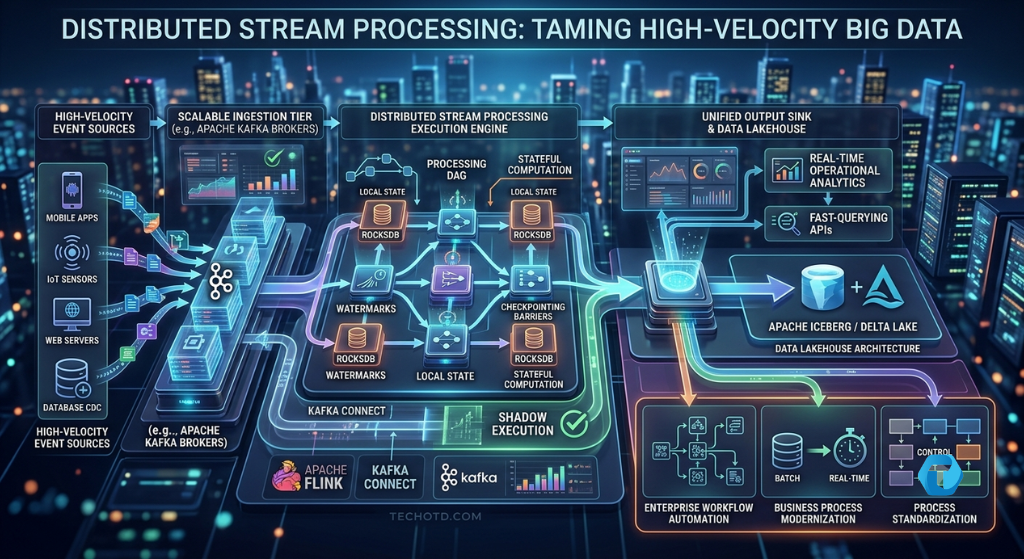
Distributed Stream Processing Architecture Diagram with Kafka and Flink
Big Data

Distributed Stream Processing Architectures: Taming High-Velocity Big Data Streams

In modern enterprise data environments, the traditional paradigm of nightly batch processing is rapidly becoming an operational liability. As business domains demand instantaneous decision-making—ranging from high-frequency fraud detection in financial clearinghouses to predictive telemetry in autonomous IoT fleets—data must be computed continuously at the moment of creation. Implementing distributed stream processing allows organizations to transition from passive historical reporting to proactive, low-latency execution engines operating on continuous data streams. Part 1: The Paradigm Shift from Batch Decoupling to Continuous Streams Historically, enterprise data architectures relied on monolithic Extract, Transform, Load (ETL) pipelines that executed on scheduled intervals. While batch systems like MapReduce or traditional SQL data warehouses served historical analytics well, they introduced a structural latency window ranging from hours to days. In high-velocity environments, this temporal delay dilutes the operational value of telemetry data. According to market intelligence from International Data Corporation (IDC), over 30% of global data generated across connected networks is real-time in nature. Furthermore, financial sector benchmark studies demonstrate that credit card fraud detection models lose up to 70% of their predictive utility if analytical scoring exceeds a 200-millisecond window. The core challenge of Big Data is no longer merely managing massive volume; it is solving for extreme velocity without compromising transactional correctness. Transitioning from static datasets to continuous event streams requires moving away from disk-bound tabular storage toward append-only log primitives. Rather than querying state that sits at rest, distributed stream processing flips the computing paradigm: queries remain persistent and long-running within memory while unbounded data flows continuously through them. Part 2: The Core Anatomy of Distributed Stream Processing To process millions of incoming events per second with sub-second response times, streaming platforms decouple ingestion, compute, and state management into specialized distributed tiers. At the ingestion boundaries, high-throughput partitioned message logs—such as Apache Kafka or Apache Pulsar—serve as the durable event bus. These brokers utilize sequential append-only disk writes to achieve multi-gigabyte ingestion speeds while providing deterministic offset management for message replays. Directly downstream sits the execution engine. Modern distributed stream processing engines utilize Directed Acyclic Graph (DAG) query planners to distribute partition-level workloads across worker clusters. Unlike stateless microservices, streaming compute nodes maintain local physical state in high-performance key-value stores (such as RocksDB embedded directly within host memory). By retaining local state buffers, stream engines eliminate the network round-trip overhead traditionally incurred when querying remote databases during event enrichment. This enables stateful compute operations—such as sliding temporal aggregations, multi-stream joins, and sessionization—to execute with microsecond locality. Part 3: Overcoming Latency, Out-of-Order Events, and State Consistency Operating a continuous compute engine across non-deterministic distributed networks presents severe architectural trade-offs, specifically regarding time domains, network jitter, and node failures. 1. Disentangling Event Time from Processing Time In distributed networks, the moment an event occurs in the physical world (Event Time) rarely aligns perfectly with the moment it arrives at the processing server (Processing Time). Network latency, device disconnects, and mobile queue backups cause messages to arrive out of order. Advanced distributed stream processing frameworks resolve this by utilizing watermarks—heuristic markers embedded into the stream stream that signal temporal completeness. Watermarks allow stateful windows to progress deterministically based on event timestamps rather than volatile wall-clock server times. 2. Guaranteeing Exactly-Once Processing Semantics In the event of hardware failures or worker crashes, stream processing systems must recover state without dropping events (at-most-once failure) or duplicating calculations (at-least-once failure). Achieving true exactly-once semantics (EOS) requires two structural synchronization mechanisms: Asynchronous Barrier Checkpointing: Based on variants of the Chandy-Lamport algorithm, lightweight snapshot barriers flow alongside data records through the DAG, persisting execution state to durable object storage without blocking pipeline throughput. Two-Phase Commit (2PC) Sink Operators: Ensuring that state writes to external sinks (such as transactional databases or storage layers) commit synchronously with the engine’s internal checkpoint offsets. Part 4: Architectural Blueprint: Integrating Kafka, Flink, and the Data Lakehouse Building a enterprise-grade real-time analytical ecosystem requires orchestrating message brokers, stream processors, and unified storage formats into a cohesive topology. A battle-tested production blueprint structures data flow across four decoupled layers: Ingestion Tier: Edge telemetry, application logs, and database Change Data Capture (CDC) streams are published to partitioned topics in Apache Kafka. Stream Processing Tier: Distributed engines like Apache Flink or Spark Structured Streaming consume topic partitions, applying windowed transformations, machine learning inference models, and real-time alerts. Speed Layer Storage: Low-latency key-value stores (such as Redis or Apache Cassandra) store the immediate results of streaming aggregations for real-time dashboarding and API querying. Unified Storage Tier: Stream sinks flush immutably transformed event logs into open table formats like Apache Iceberg or Delta Lake. This unifies streaming and batch analytics under a cohesive Data Lakehouse architecture. By deploying this decoupled topology, enterprise data teams eliminate brittle point-to-point integrations and establish a unified streaming backbone capable of serving both operational applications and offline machine learning pipelines. Key Takeaways for Distributed Stream Processing Unlocking real-time intelligence requires moving beyond ad-hoc data pipelines toward disciplined architectural patterns. Adopting scalable distributed stream processing allows engineering organizations to process unbounded event streams with mathematical correctness, guaranteeing state consistency despite cluster failures. By coupling stateful streaming compute with open table storage formats, enterprises can systematically eliminate operational latency, reduce infrastructure overhead, and drive automated decision systems at scale. Frequently Asked Questions (FAQ) What is the difference between batch processing and distributed stream processing? Batch processing executes queries on bounded, historical datasets stored at rest on fixed time schedules. In contrast, distributed stream processing executes long-running, continuous queries over unbounded event data in motion, delivering low-latency results within milliseconds of event generation. How do stateful stream processors maintain recovery during node failures? Stateful stream engines maintain internal state locally in high-performance embedded key-value stores (e.g., RocksDB) while periodically taking distributed, non-blocking snapshots using checkpoint algorithms. If a worker node crashes, the system recovers state by resetting execution offsets to the latest valid checkpoint and replaying subsequent message logs. Why is event time critical in real-time streaming pipelines? Event time reflects the exact epoch timestamp when an action occurred at

Enterprise Workflow Automation 4-Phase Roadmap Diagram
Business Intelligence, Digital Transformation

Beyond the Patchwork: A Phased Roadmap to Enterprise Workflow Automation

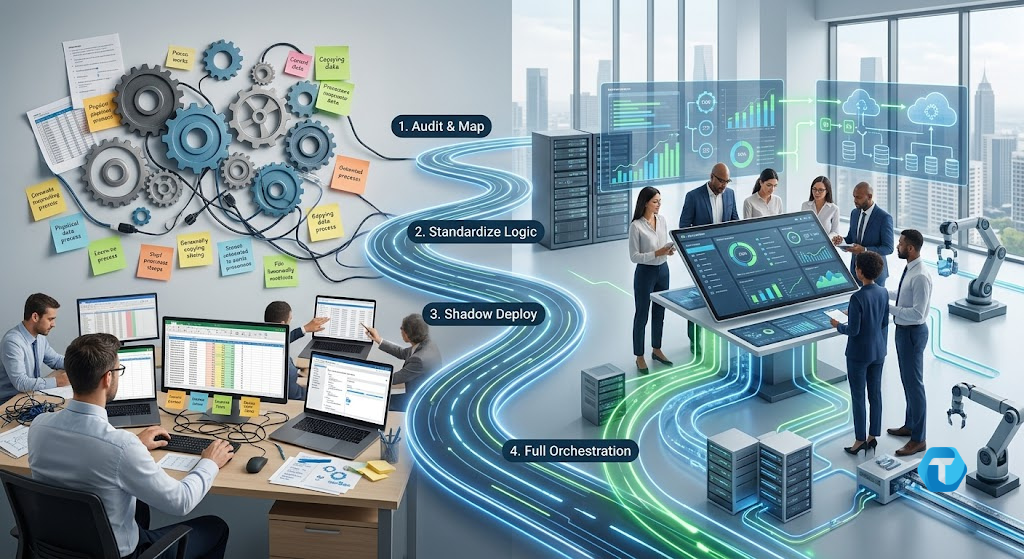
Beyond the Patchwork: A Phased Roadmap to Enterprise Workflow Automation Modern organizations often struggle with fragmented processes that drain valuable time and human energy. Implementing enterprise workflow automation allows businesses to replace manual tasks with streamlined, resilient software pipelines, ensuring operational velocity, accuracy, and enterprise scalability. Imagine hiring a world-class architect, handing them a hard hat, and then ordering them to spend eight hours a day carrying individual bricks back and forth across a muddy construction site. Sounds absurd, right? Yet, inside almost every modern enterprise, a remarkably similar tragedy unfolds every single day. Behind multi-million-dollar tech stacks lies an unspoken corporate secret: our highest-paid knowledge workers are routinely forced to act as expensive human APIs. Senior engineers, financial analysts, operations leads, and HR managers log in every morning not to innovate, but to act as digital couriers. They manually copy data from Spreadsheet A, reformat it for Database B, cross-reference it against PDF Invoice C, and broadcast a Slack alert to Manager D. We hire brilliant minds for their strategic judgment, yet we consume their bandwidth with low-cognitive, high-friction administrative glue. How many hours did your best talent spend playing “digital courier” this week? And more importantly, what is this invisible waste costing your business? The Trap of the “Duct-Tape” Quick Fix When leaders finally recognize this operational drain, the initial impulse usually triggers a secondary disaster: brittle, hasty automation. An eager manager writes a custom Python script, wires up an unmonitored webhook, or deploys a quick point-solution to bridge the gap. For a few months, everyone celebrates. But then the inevitable happens: The script’s author leaves the company. An upstream software vendor silently updates its API schema. An unexpected edge case slips through undetected. The result? The duct tape snaps. The automation breaks silently, leaving the organization with catastrophic data drift, missed financial reconciliations, or severe compliance failures. Automating enterprise operations is not an impulse software purchasing decision—it is an architectural discipline. To transition from fragile manual interventions to resilient, enterprise-grade operations, organizations must abandon ad-hoc patches in favor of a structured, phased modernization roadmap. Part 1: The Spectrum of Process Maturity Before building a bridge, an engineer must assess the terrain. Automating a process before it is understood or standardized does not eliminate operational friction—it merely accelerates chaos at machine speed. Where do your core operations sit on the maturity scale? Maturity Level Phase Name How Data & Logic Flow Human Role Level 0 Ad-Hoc Manual Fragmented across spreadsheets, emails, and notes. The human is the data conduit. Level 1 Standardized Documented rules and repeatable sequences. Human executes steps predictably. Level 2 Assisted Scripted macros or local triggers handle routine sub-tasks. Human manually triggers and verifies execution. Level 3 Orchestrated End-to-end API workflows with automated state management. Human acts as a system governor (HITL). Level 4 Adaptive Event-driven, telemetry-monitored, self-healing pipelines. Human focuses purely on strategy and continuous tuning. The Four Pillars of Sustainable Automation To build an automated system that survives real-world chaos, your architecture must rest on four fundamental pillars: Deterministic Boundaries: Identical inputs must yield identical, predictable outputs every single time, without silent variance. Auditability: Every transaction, data transformation, and state change must leave a persistent, timestamped audit trail. Graceful Degradation: When an upstream dependency fails, the workflow must safely freeze, isolate the infected record, and alert stakeholders—never corrupt downstream databases. Decoupled Architecture: Business logic must remain independent of specific software tools. Swapping out your CRM should never collapse your financial reconciliation backbone. Part 2: Enterprise Workflow Automation — A 4-Phase Roadmap Attempting a high-risk “big bang” overhaul of enterprise workflows is a recipe for operational failure. Mature organizations progress methodically through four distinct execution phases: ┌────────────────────────────────────────────────────────┐ │ Enterprise Modernization Roadmap │ ├────────────────────────────────────────────────────────┤ │ Phase 1: Friction Audit & Mapping ──> Uncover debt │ │ │ │ │ ▼ │ │ Phase 2: Process Standardization ──> Refine logic │ │ │ │ │ ▼ │ │ Phase 3: Low-Risk Shadow Deploy ──> Parallel runs │ │ │ │ │ ▼ │ │ Phase 4: Full Orchestration ──> Scale & monitor │ └────────────────────────────────────────────────────────┘ Part 3: Auditing Friction and Standardizing Logic Phase 1: The Friction Audit & Value Mapping Not every manual task deserves to be automated. High-variability tasks that occur twice a year are often best left to human judgment. To pinpoint high-impact targets, evaluate internal workflows across three criteria: [ Workflow Evaluation Matrix ] High Candidates ──> High Volume + Strict Rules + Structured Data (e.g., Daily Invoice Processing) Low Candidates ──> Low Volume + Subjective Logic + Unstructured Data (e.g., Quarterly Custom Contract Reviews) Before writing a single line of code, quantify the damage using the Total Process Friction Cost (TPFC) formula: TPFC = (Monthly Volume × AHT) × Hourly Rate + Error Overhead Where AHT is the Average Handling Time in hours, Hourly Rate is the blended hourly cost of staff, and Error Overhead accounts for the financial cost of manual remediation. Rule of Thumb: Prioritize processes where the calculated TPFC is high and the rule determinism is absolute. Phase 2: Process Standardization The Golden Rule of Automation: Never automate a process you haven’t first simplified on paper. Stripping a process down to its raw data mechanics requires mapping three vital elements: The Exact Trigger: What event initiates execution? (e.g., A webhook firing on a closed-won CRM deal, or a CSV file landing in an S3 bucket). Input-to-Output Schema: What fields are strictly mandatory? What happens when a field is missing? Edge-Case Isolation: Document every historic anomaly. If 5% of incoming invoices lack a tax ID, map explicit programmatic fallback rules before building the pipeline. Part 4: Shadow Execution and Full Orchestration Phase 3: Low-Risk Shadow Deployment What is the safest way to test a commercial aircraft’s new autopilot system? You don’t remove the pilots on day one. You run the autopilot in parallel, comparing its decisions against the human captain’s actions in real time. In process modernization, this is called Shadow Execution. Trigger Event ───► [ Human Operator ] ────►

Scroll to Top