Introduction
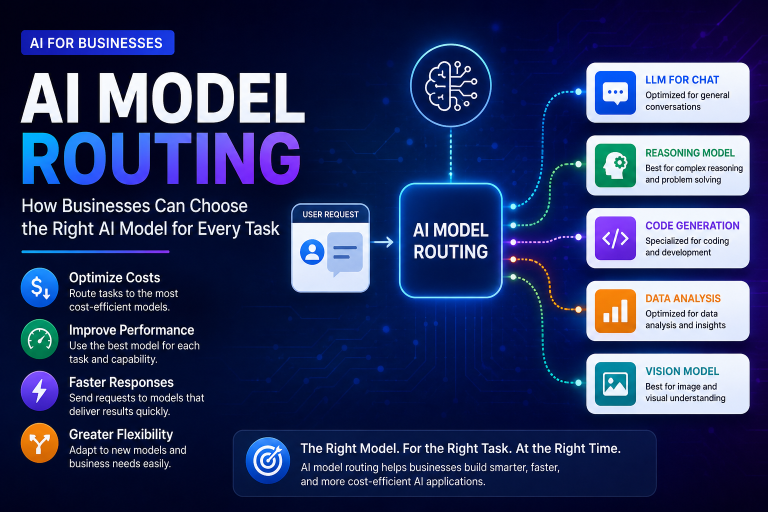
Businesses are increasingly using artificial intelligence for customer support, content creation, data analysis, software development, and decision-making. However, not every AI task requires the same type of model. Different AI models can vary in capability, speed, cost, and specialization.
Using a single AI model for every task can increase costs and may not always provide the best balance between performance and efficiency. As organizations adopt multiple AI models, they need a smarter way to decide which model should handle each request.
AI model routing helps businesses direct AI tasks to the most suitable model based on factors such as complexity, cost, speed, capability, and business requirements. This approach can help organizations improve performance while using AI resources more efficiently.
What Is AI Model Routing?
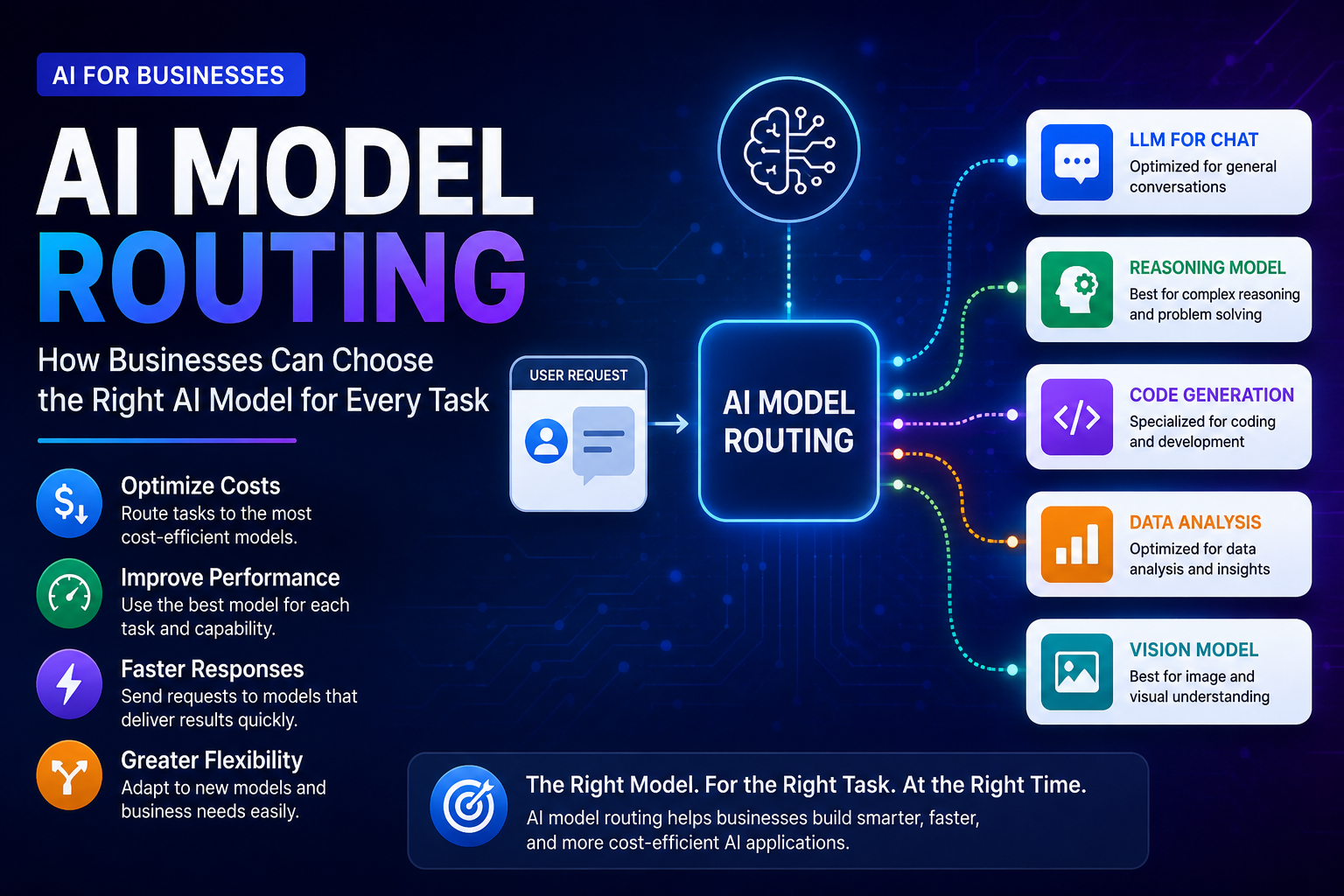
AI model routing is the process of directing an AI request to the most suitable model based on the requirements of a specific task. Instead of sending every request to the same model, an AI system can evaluate factors such as task complexity, required accuracy, response speed, cost, and model capabilities.
Why One AI Model Is Not Always Enough
AI models are designed with different strengths. Some models may be better for complex reasoning, while others may provide faster responses, lower costs, coding capabilities, or multimodal features. Using one model for every situation can therefore be inefficient.
How AI Model Routing Works
An AI model routing system analyzes the requirements of an incoming request and selects an appropriate model. Simple tasks may be directed to efficient models, while more complex tasks can be routed to advanced models with stronger reasoning or specialized capabilities.
Key Factors Used in Model Selection
AI model routing can consider factors such as task type, complexity, expected output quality, response time, cost, available models, and specific business requirements. These factors help determine which model is the most suitable for a particular request.
By matching AI workloads with appropriate models, businesses can create more flexible AI systems that balance performance, speed, and cost.
Why AI Model Routing Is Becoming Important for Businesses
As businesses adopt more AI tools and models, managing which model is used for each task is becoming increasingly important. Organizations may use different models for language processing, reasoning, coding, data analysis, and multimodal applications, creating a need for more efficient AI model management.
Growing Number of Available AI Models
Businesses now have access to a growing range of AI models with different capabilities, performance levels, and pricing structures. Choosing the same model for every workload can limit flexibility and increase unnecessary costs.
Balancing Performance and Cost
More advanced AI models can provide stronger capabilities for complex tasks, but they may also require more computing resources or have higher usage costs. AI model routing can help businesses balance performance requirements with the cost of AI operations.
Improving Response Speed
Some AI applications require fast responses, such as customer support systems and real-time business tools. Routing suitable requests to faster models can help improve responsiveness while reserving more powerful models for tasks that require advanced capabilities.
Supporting Multiple AI Use Cases
A single organization may use AI for many different purposes, including content processing, software development, analytics, customer service, and internal automation. AI model routing can help manage these diverse workloads more effectively.
How AI Model Routing Works in Practice
In practice, AI model routing works by evaluating an incoming request and determining which available model is most suitable for handling it. The routing decision can be based on predefined rules, performance requirements, cost limits, or automated evaluation systems.
Step 1: Understanding the Request
The AI system first analyzes the incoming request to understand its type and requirements. For example, a request may involve summarization, reasoning, coding, data analysis, image understanding, or another specialized task.
Step 2: Evaluating Task Requirements
The routing system can evaluate factors such as task complexity, required response speed, expected accuracy, available budget, and security or privacy requirements. These factors help determine the level of AI capability needed.
Step 3: Selecting the Appropriate Model
Based on the evaluation, the system selects a suitable AI model. Simple or repetitive tasks may be handled by smaller and more efficient models, while complex reasoning or specialized tasks may be directed to more advanced models.
Step 4: Processing the Request
The selected AI model processes the request and generates a response. The result can then be returned directly to the user or passed to another application, workflow, or business system.
Step 5: Monitoring Results and Performance
Businesses can monitor response quality, processing time, model usage, and cost after requests are completed. This information can help organizations improve routing decisions and optimize their AI systems over time.
By continuously evaluating AI workloads and model performance, businesses can make AI model routing more accurate, efficient, and aligned with changing business requirements.
Key Benefits of AI Model Routing for Businesses
AI model routing can help businesses build more flexible and efficient AI systems. By selecting models based on the requirements of each task, organizations can improve how they use AI resources while maintaining the level of performance required for different business applications.
1. Better Cost Optimization
Not every request requires the most advanced or expensive AI model. AI model routing can direct simpler tasks to efficient models and reserve more powerful models for complex workloads, helping businesses reduce unnecessary AI spending.
2. Improved Performance
Different AI models have different strengths. Routing tasks to models that are better suited for specific capabilities, such as reasoning, coding, language processing, or multimodal analysis, can help improve overall application performance.
3. Faster Response Times
Businesses can route time-sensitive requests to models that provide faster responses. This can improve the user experience for applications such as customer support, internal tools, and real-time AI services.
4. Greater Flexibility
A multi-model approach allows organizations to adapt as AI technologies change. Businesses can add, replace, or evaluate models without redesigning their entire AI strategy around a single provider or model.
5. Better AI Resource Management
AI model routing provides greater control over how models and computing resources are used. Organizations can create policies that align model selection with business priorities such as cost, performance, speed, privacy, or security.
Common AI Model Routing Strategies
Businesses can use different AI model routing strategies depending on their technical requirements, available models, budget, and performance goals. The routing approach may range from simple predefined rules to more advanced systems that automatically evaluate each request.
1. Rule-Based Routing
Rule-based routing uses predefined conditions to select an AI model. For example, a business may send simple text summarization tasks to a smaller model while routing complex reasoning tasks to a more advanced model.
2. Cost-Based Routing
Cost-based routing focuses on selecting a model that can complete a task within an acceptable budget. The system may prefer lower-cost models when they can provide sufficient quality and use more expensive models only when additional capability is required.
3. Performance-Based Routing
Performance-based routing selects models according to factors such as response quality, accuracy, reliability, or task-specific capabilities. Businesses can use this approach when maintaining a required level of output quality is more important than minimizing cost.
4. Latency-Based Routing
Latency-based routing prioritizes response speed. Requests that require real-time or near-real-time results can be directed to models and infrastructure that are capable of producing responses quickly.
5. Hybrid AI Model Routing
A hybrid approach combines multiple routing factors such as cost, performance, response speed, privacy, and business rules. This allows organizations to make more balanced routing decisions based on the specific requirements of each AI workload.
As AI environments become more complex, businesses may combine several routing strategies to create systems that are flexible enough to adapt to changing workloads and business priorities.
AI Model Routing vs Using a Single AI Model
Businesses can build AI applications around a single model or use multiple models through an AI model routing approach. While a single-model strategy can be simpler to implement, it may not always provide the best balance between cost, performance, speed, and flexibility.
Using a Single AI Model
A single-model approach sends most or all AI requests to the same model. This can simplify application development and management, particularly when an organization has limited AI use cases. However, using one model for every task may result in higher costs or unnecessary use of advanced capabilities.
Using Multiple AI Models
A multi-model approach allows businesses to use different models for different workloads. Organizations can select models based on their strengths, such as reasoning, coding, speed, language processing, or multimodal capabilities.
The Role of AI Model Routing
AI model routing provides the decision-making layer between incoming requests and available models. Instead of manually selecting a model for every application or workflow, the routing system can apply rules or evaluation criteria to choose an appropriate model automatically.
Which Approach Is Better?
The best approach depends on the size and complexity of an organization’s AI environment. A single model may be sufficient for simple and focused use cases, while AI model routing can become more valuable as businesses use multiple models, applications, and workloads.
For growing enterprise AI environments, a routing approach can provide greater flexibility by allowing organizations to balance quality, cost, speed, and technical requirements across different AI workloads.
Challenges of AI Model Routing
Although AI model routing can provide greater flexibility and cost efficiency, implementing a multi-model AI environment can also introduce technical and operational challenges. Businesses need to manage multiple models, evaluate their performance, and ensure that routing decisions remain aligned with business requirements.
Managing Multiple AI Models
Using multiple AI models can increase the complexity of an organization’s AI environment. Teams may need to manage different providers, APIs, pricing structures, capabilities, and technical requirements.
Maintaining Consistent Output Quality
Different models may produce different types and levels of output quality. Businesses need to evaluate whether routing decisions maintain consistent performance and ensure that users receive reliable results across different AI applications.
Monitoring Costs and Performance
AI model routing requires continuous monitoring of model usage, costs, response times, and output quality. Changes in pricing, model performance, or workload patterns may require organizations to adjust their routing strategies.
Security and Data Privacy Requirements
Businesses must consider where data is processed when routing requests between AI models and providers. Sensitive information may require specific security controls, privacy policies, or restrictions on which AI services can be used.
Avoiding Overly Complex Systems
A routing system should solve a real business or technical problem. Adding too many models or complex routing rules can increase maintenance requirements and make AI systems more difficult to manage.
A successful AI model routing strategy requires businesses to balance flexibility with simplicity and ensure that the benefits of using multiple models outweigh the additional complexity.
Best Practices for Implementing AI Model Routing
Businesses can achieve better results from AI model routing by creating a clear strategy before adding multiple models to their AI environment. The goal should be to match AI capabilities with real business requirements rather than using multiple models simply because they are available.
Start With Clear AI Use Cases
Organizations should first identify the AI tasks they want to support and understand the requirements of each use case. Factors such as complexity, response speed, output quality, security, and cost can help determine whether different models are needed.
Define Model Selection Criteria
Businesses should establish clear criteria for selecting AI models. These criteria can include performance, cost, latency, reliability, privacy requirements, and compatibility with existing applications and workflows.
Monitor Model Performance Regularly
AI model capabilities and business requirements can change over time. Regular monitoring can help organizations identify whether a model continues to provide the expected quality, speed, and value for a particular workload.
Set Cost and Usage Controls
Businesses can define budgets, usage limits, and monitoring policies to maintain greater control over AI spending. These controls can help prevent unexpected costs as AI applications and workloads grow.
Keep the Routing Strategy Flexible
AI technologies evolve quickly, and new models may offer better capabilities or efficiency. A flexible routing strategy allows organizations to evaluate and adopt new models without redesigning their entire AI environment.
By combining clear business requirements with continuous monitoring and flexible model selection, organizations can build an AI model routing strategy that supports both performance and long-term efficiency.
The Future of AI Model Routing
As businesses adopt a growing number of AI models and AI-powered applications, choosing the right model for each workload is likely to become an increasingly important part of AI operations. Organizations will need more efficient ways to balance performance, cost, speed, and business requirements.
More Intelligent Routing Decisions
Future AI systems may use automated evaluation and decision-making to select models based on the specific requirements of each request. Routing decisions could become more dynamic as systems consider factors such as task complexity, current workload, response quality, and cost.
Greater Use of Multi-Model AI Systems
Instead of relying on a single AI provider or model, businesses may increasingly build applications that can work with multiple AI models. This approach can provide greater flexibility and reduce dependence on one specific model or platform.
Closer Connection Between AI Routing and Cost Management
AI model routing may become an important part of AI cost management by helping organizations avoid using expensive models when simpler and more efficient alternatives can meet the requirements of a task.
More Specialized AI Models
The growing availability of specialized models may also increase the importance of routing. Businesses may choose different models for tasks such as coding, reasoning, language processing, image analysis, and industry-specific applications.
As enterprise AI environments become more complex, AI model routing can help organizations create more adaptable systems that make better use of available AI capabilities and resources.
Conclusion
As businesses use artificial intelligence for a growing number of tasks, relying on a single AI model may not always provide the best balance between performance, cost, speed, and flexibility. AI model routing helps organizations select the most suitable model for each workload based on specific business and technical requirements.
By combining multiple AI models with effective routing strategies, businesses can optimize AI resources, improve application performance, control unnecessary costs, and adapt more easily as AI technologies continue to evolve. As enterprise AI environments become more complex, AI model routing may become an increasingly important part of managing and scaling AI systems.
Frequently Asked Questions
What is AI model routing?
AI model routing is the process of directing an AI request to the most suitable model based on factors such as task complexity, cost, response speed, required performance, and specific business requirements.
Why do businesses need AI model routing?
Businesses may use AI model routing to improve performance, reduce unnecessary AI costs, increase flexibility, and select different models for different types of workloads.
Can AI model routing reduce AI costs?
Yes. AI model routing can help reduce unnecessary spending by directing simple tasks to efficient and lower-cost models while reserving more advanced models for complex workloads.
What factors are used in AI model routing?
AI model routing can consider factors such as task type, complexity, expected output quality, response time, cost, security requirements, and the capabilities of available AI models.
Is AI model routing suitable for small businesses?
AI model routing can be useful for businesses of different sizes, although its complexity should match the organization’s AI requirements. Small businesses with limited AI use cases may use simple routing rules, while larger organizations may require more advanced multi-model strategies.
Connect With us:- https://www.facebook.com/profile.php?id=61555452386126