
Business

Business, Business Analytics, Technology, Technology & Innovation

Hyperautomation in 2026: Beyond Traditional Process Automation

Hyperautomation in 2026: Beyond Traditional Process Automation Businesses have spent years automating repetitive tasks to improve efficiency and reduce operational costs. Traditional automation solutions, particularly Robotic Process Automation (RPA), have helped organizations streamline rule-based processes such as data entry, invoice processing, customer onboarding, and report generation. While these technologies have delivered significant value, the business landscape of 2026 demands much more than simple task automation. Organizations are now dealing with massive volumes of data, increasingly complex workflows, evolving customer expectations, and growing pressure to make faster decisions. As a result, companies are moving beyond basic automation and embracing hyperautomation—a more advanced approach that combines multiple technologies to automate entire business processes from start to finish. Hyperautomation is no longer a futuristic concept. It has become a strategic priority for organizations seeking greater agility, productivity, and innovation. By integrating artificial intelligence, machine learning, process mining, low-code platforms, intelligent document processing, and robotic process automation, businesses can create intelligent systems capable of learning, adapting, and making decisions with minimal human intervention. Understanding Hyperautomation Hyperautomation refers to the coordinated use of multiple advanced technologies to identify, automate, optimize, and continuously improve business processes. Unlike traditional automation, which focuses on individual tasks, hyperautomation aims to automate complete workflows across departments and systems. Think of traditional automation as teaching a machine to perform one repetitive task. Hyperautomation, on the other hand, creates an ecosystem where different technologies work together to handle complex business operations autonomously. For example, when a customer submits a loan application, a hyperautomation system can automatically collect documents, verify information, assess risk using AI models, perform compliance checks, communicate with the customer, and generate approval decisions. What once required multiple employees and several days can now be completed within minutes. The goal is not simply to replace manual work but to create intelligent business operations that continuously learn and improve. Why Hyperautomation Is Gaining Momentum in 2026 Several factors are driving the rapid adoption of hyperautomation across industries. The first is the explosion of enterprise data. Organizations generate vast amounts of structured and unstructured information every day. Processing this data manually is increasingly impractical. Hyperautomation enables businesses to extract insights, make decisions, and execute actions automatically. Another major driver is the growing demand for operational efficiency. Economic uncertainty and competitive markets are forcing organizations to do more with fewer resources. Hyperautomation helps reduce costs while improving speed and accuracy. Customer expectations have also evolved significantly. Modern consumers expect instant responses, personalized experiences, and seamless service. Businesses that rely solely on manual processes struggle to meet these expectations consistently. Additionally, advances in artificial intelligence have made intelligent automation more accessible than ever before. AI models can now understand language, analyze documents, recognize patterns, and generate recommendations with remarkable accuracy. Together, these factors are pushing businesses toward a new era of automation where machines not only execute tasks but also support decision-making and continuous optimization. Key Technologies Powering Hyperautomation Hyperautomation is not a single technology. It is a combination of several powerful tools working together. Artificial Intelligence and Machine Learning AI and machine learning provide the intelligence behind hyperautomation. These technologies allow systems to analyze data, identify patterns, make predictions, and improve performance over time. In customer service, AI can classify support requests, suggest responses, and route inquiries to the appropriate departments. In finance, machine learning algorithms can detect fraud and assess risk in real time. As AI capabilities continue to evolve, businesses are automating increasingly sophisticated decision-making processes. Robotic Process Automation (RPA) RPA remains a foundational component of hyperautomation. Software bots can perform repetitive tasks such as copying data, updating records, generating reports, and interacting with multiple applications. While traditional RPA focuses on rule-based activities, its integration with AI allows bots to handle more dynamic and complex scenarios. Intelligent Document Processing Businesses process enormous volumes of documents, including invoices, contracts, applications, and compliance records. Intelligent Document Processing uses AI, optical character recognition, and natural language processing to extract, classify, and validate information automatically. This significantly reduces manual document handling while improving speed and accuracy. Process Mining One of the biggest challenges in automation is identifying which processes should be automated. Process mining tools analyze system logs and workflow data to uncover inefficiencies and bottlenecks. Organizations can gain a clear understanding of how work is performed and identify opportunities for automation and optimization. Low-Code and No-Code Platforms Low-code and no-code platforms allow employees with limited programming knowledge to create automation workflows quickly. These platforms accelerate digital transformation by reducing dependency on specialized development teams while encouraging innovation across departments. Conversational AI Chatbots and virtual assistants have evolved dramatically in recent years. Modern conversational AI systems can understand context, provide personalized responses, and complete transactions. Businesses are increasingly using conversational AI to automate customer interactions, employee support services, and internal workflows. How Hyperautomation Differs from Traditional Automation Traditional automation typically focuses on isolated tasks. For example, a software bot might transfer data from one system to another. Hyperautomation takes a broader approach. It connects multiple technologies to automate entire processes from beginning to end. Traditional automation follows predefined rules and struggles when exceptions occur. Hyperautomation incorporates AI-driven decision-making, allowing systems to adapt to changing circumstances and handle more complex scenarios. Another key difference is continuous improvement. Hyperautomation systems monitor performance, identify inefficiencies, and recommend optimizations automatically. This creates a cycle of ongoing enhancement that traditional automation cannot achieve. Real-World Applications Across Industries The impact of hyperautomation extends across virtually every sector. Healthcare Healthcare organizations are using hyperautomation to streamline patient registration, appointment scheduling, insurance verification, medical coding, and claims processing. AI-powered systems can analyze patient records, assist with diagnosis support, and improve administrative efficiency, allowing healthcare professionals to focus more on patient care. Banking and Financial Services Financial institutions face increasing pressure to deliver faster services while maintaining compliance and security. Hyperautomation helps automate loan approvals, fraud detection, customer onboarding, compliance monitoring, and transaction processing. These capabilities reduce operational costs while improving customer experiences. Manufacturing Manufacturers are combining automation, AI, and Internet of Things


Business, Business Analytics, Digital Transformation, Software development

5 Signs Your Business Needs a Custom Software Solution

5 Signs Your Business Needs a Custom Software Solution Every business starts out as a patchwork of temporary fixes. When you’re in the early stages of growth, adaptability is your superpower, and your digital toolkit reflects that. You manage client notes in a simple document, track your revenue on a basic spreadsheet, and coordinate your team through a chaotic group chat. As you grow, you naturally graduate to commercial, off-the-shelf software. You subscribe to a popular CRM, buy a project management tool, and adopt a standard invoicing app. For a while, this feels like an absolute triumph. But as your business continues to scale, a quiet transformation occurs. The software platforms that once felt like a sleek framework start feeling like a digital straightjacket. You find your team spending more time fighting the software—inventing strange workarounds and manually bridging data gaps—than actually moving the needle for your clients. How do you know when you’ve officially outgrown the mass market? When does staying with a commercial subscription stop saving you money and start actively choking your revenue? Let’s look at the 5 unmistakable signs that your business has crossed the line and desperately needs a proprietary, custom software solution. Sign 1: You’re Running an “Excel Archipelago” (Data is Fragmented) When you look at your team’s desktop monitors on a typical Tuesday afternoon, do you see five different browser tabs open just to complete a single customer order? Are your managers constantly exporting data from your sales platform into an Excel spreadsheet, cleaning it up manually, and then uploading it into your accounting software? This is what engineers call data fragmentation, but operationally, it feels like living on an archipelago of isolated digital islands. [Siloed Sales App] ──(Manual Export)──> [The Master Excel] ──(Manual Input)──> [Siloed Billing App] The Human Toll Your brilliant, high-salaried employees are effectively being used as human data-entry bridges. When information has to be manually copied and pasted across multiple independent systems, human error skyrockets. Orders get dropped, invoices go missing, and your leadership team loses access to a “single source of truth.” If you can’t see your real-time business metrics without a manual 3-hour data reconciliation, your software is actively failing you. Sign 2: You Are Forcing Your Unique Workflows into a Mass-Market Box Every business has a “secret sauce”—a specific operational blueprint, a unique customer onboarding checklist, or a proprietary inventory model that gives you an edge over your competitors. When you buy ready-made software, you are buying into their philosophy of how a business should operate. Off-the-shelf tools are built around generic industry best practices to satisfy millions of users simultaneously. The Human Toll If your software doesn’t natively support your unique process, you have two bad choices: bend your software through complex, fragile workarounds, or force your humans to change how they work to fit the app’s rigid fields. The moment you start changing your competitive, highly optimized real-world workflows to appease a software interface, you are giving away your market edge and homogenizing your brand. Sign 3: The “Subscription Tax” is Outgrowing a Developer’s Salary Commercial software models are incredibly attractive when your team is small. Paying $30 per user, per month for an operational platform feels like a minor expense. But as your company scales from a tight team of five to an enterprise of 50, 100, or 200 users, those per-seat licensing fees scale exponentially. ┌────────────────────────────────────────────────────────────────────────┐ │ THE SUBSCRIPTION SCALING TRAP │ ├────────────────────────────────────────────────────────────────────────┤ │ * 5 Users ➔ $150 / month ➔ $1,800 / year (Highly Affordable) │ │ * 50 Users ➔ $1,500 / month ➔ $18,000 / year (Noticeable Overhead) │ │ * 150 Users ➔ $4,500 / month ➔ $54,000 / year (Massive Annual Drain) │ └────────────────────────────────────────────────────────────────────────┘ The Human Toll You begin to notice an internal hesitation to hire new team members or give part-time contractors access to your systems simply because you don’t want to trigger a massive subscription tier upgrade. When your digital infrastructure costs punish you for growing your headcount, the financial model is broken. Over a multi-year horizon, your aggregate SaaS payments could easily fund a proprietary asset that you own outright. Sign 4: The Fragile “Frankenstein Tech Stack” Keeps Breaking To make your various ready-made software platforms talk to each other, you’ve likely built a network of third-party connectors, custom plugins, and automated API links. On paper, it looks like a fully automated system. In reality, it’s a fragile digital house of cards. The Human Toll Whenever one of your external vendors changes their API, updates their user interface, or experiences a server outage, your entire chain collapses. Your team enters panic mode, your operations halt, and you have to scramble to find a developer to patch the leak. Relying on an intricate, unmonitored mesh of third-party tools creates severe systemic instability that puts your daily customer experiences at risk. Sign 5: You’ve Hit a Concrete Operational Scaling Ceiling You have major ambitions for your business. You want to launch a new subscription tier, offer a revolutionary client portal, automate your fleet routes, or introduce dynamic, localized pricing matrices. But when you consult with your IT lead or review the settings of your off-the-shelf platforms, you encounter the exact same frustrating answer: “The system simply doesn’t support that feature.” The Human Toll Your growth strategy is suddenly being dictated by the feature roadmap of an external software vendor who doesn’t care about your business. If your technical setup prevents you from capitalizing on a hot market opportunity or optimizing your internal output, you have hit a technological glass ceiling. Custom software removes this barrier completely, acting as an elastic foundation that expands wherever your strategic vision takes you. Operational Comparison: Staying Put vs. Building Bespoke Before committing to a shift, let’s look at how navigating these signs impacts your operational metrics: Operational Dimension Continuing with Rigid Off-the-Shelf Tools Migrating to a Custom Software Solution Workflow Efficiency Low (Teams adapt their steps to match the software layout) Maximum (The software is custom-modeled to fit

Business, Digital Transformation, Technology

Industry Solution Blogs

The Ultimate Guide to Industry Solution Blogs: Driving B2B Authority and Conversions Imagine walking into a massive B2B tech convention. The room is buzzing. Thousands of booths are flashing neon lights, throwing free t-shirts at you, and shouting technical jargon about “cloud-native, AI-driven paradigms.” Now, imagine walking past all that noise into a quiet, structured room where an expert sits down with you, looks at your specific business problem, and says: “I know exactly why your supply chain is lagging, and here is a three-step blueprint to fix it using automated workflows.” Where would you spend your money? That quiet room is the digital equivalent of an Industry Solution Blog. While generic tech blogs scratch the surface of what a technology is, industry solution blogs dive deep into the how and why for specific sectors—whether that’s healthcare, logistics, retail, or finance. In this comprehensive guide, we will break down exactly how to craft these high-value pieces of content to build unstoppable authority, educate your audience, and turn casual readers into high-ticket B2B clients. 1. What Exactly is an Industry Solution Blog? To understand what an industry solution blog is, we first need to look at what it isn’t. It isn’t a press release about your company’s latest funding round. It isn’t a dry, academic whitepaper that requires a PhD to decode. And it certainly isn’t a superficial listicle generated by a basic AI prompt. An Industry Solution Blog is a highly targeted, deeply researched piece of content that addresses a specific business pain point within a distinct vertical and offers a clear, technology-driven remedy. The Anatomy of the Solution Framework When you write a solution blog, you are essentially guiding the reader through a transformative journey: [Current Fragmented State] ➔ [The Complication/Cost] ➔ [The Technological Bridge] ➔ [The Optimized Future State] Instead of simply explaining a tool like “Predictive Analytics,” an industry solution blog explains “How Predictive Analytics Reduces Equipment Downtime in Automotive Manufacturing by 34%.” It bridges the gap between raw technological capability and real-world business outcomes. 2. Why Generic Content is Dying (and Verticals are Winning) The internet is drowning in generic content. If you write an article titled “Top 5 Benefits of Cloud Computing,” you are competing with millions of legacy websites, massive tech publications, and AI search engines that can summarize those points in three seconds. Generic content no longer builds authority. Specificity builds authority. The Shift to Account-Based & Vertical Marketing Modern B2B buyers don’t buy software; they buy solutions to their industry-specific problems. A hospital administrator doesn’t care if a CRM has “great API integrations.” They care if it is HIPAA-compliant and can seamlessly sync with Epic EHR systems to reduce patient check-in times. When you pivot your content strategy toward industry solutions, several magical things happen: Higher Conversion Rates: Readers feel seen. When a retail executive reads about solving “last-mile delivery bottlenecks during peak holiday seasons,” they realize you understand their exact world. Lower Keyword Competition: Competing for “Machine Learning” is an uphill battle. Competing for “Machine Learning for Fraud Detection in Neo-Banking” is highly winnable. Shorter Sales Cycles: Your blog functions as a silent salesman, answering complex compliance, integration, and ROI questions before a sales call even happens. 3. How to Identify High-Value Industry Pain Points You cannot write a compelling industry solution blog from an ivory tower. You have to get your hands dirty and find out what keeps your target audience awake at 2:00 AM. Here is a humanized toolkit for uncovering those hidden pain points. Talk to Your Sales and Customer Success Teams Your internal teams are a goldmine of data. Sit down with them and ask: What are the top three objections prospects raise during demo calls? Where do clients typically get stuck during the onboarding phase? What specific phrases or jargon do they use when describing their frustrations? Mine Niche Forums and Communities B2B professionals don’t complain on TikTok; they complain on specialized forums. Spend time lurking in: Subreddits: e.g., r/sysadmin, r/healthit, r/logistics, r/devops. Quora & Industry Networks: Look for recurring technical roadblocks. LinkedIn Groups: Analyze the comments section of industry influencers to see what questions people are asking. Reverse-Engineer Competitor Case Studies Look at your competitors’ case studies. Don’t look at their successes—look at the problems their clients had before buying. Those “before” states are the exact topics you should be writing comprehensive solution blogs about. 4. Structure of a High-Converting Solution Blog A great industry solution blog balances storytelling with analytical depth. Here is a proven structural framework you can adapt for any vertical. +———————————————————–+ | 1. The Hook (Relatable, industry-specific scenario) | +———————————————————–+ | v +———————————————————–+ | 2. The Bleeding Wound (The real financial/operational cost)| +———————————————————–+ | v +———————————————————–+ | 3. The Paradigm Shift (Introducing the modern solution) | +———————————————————–+ | v +———————————————————–+ | 4. The Deep Dive (Tactical steps, architecture, features) | +———————————————————–+ | v +———————————————————–+ | 5. Proof & Real-World Impact (Data points, case studies) | +———————————————————–+ | v +———————————————————–+ | 6. The Actionable Conclusion & Contextual CTA | +———————————————————–+ The Hook (The Relatable Scenario) Start by painting a picture that proves you belong in the room. Bad: “In today’s fast-paced world, logistics is very important.” Good: “It’s 4:00 PM on Friday before Cyber Monday. Your warehouse management system suddenly drops connection with your primary shipping API. Orders are backing up, and every minute of downtime is costing you $12,000. If this sounds like a nightmare, it’s because legacy infrastructure isn’t built for modern e-commerce surges.” The Bleeding Wound (The Cost of Inaction) Don’t just mention the problem; quantify it. Explain what happens if the business decides to do nothing. Talk about compliance fines, employee burnout, customer churn, or lost revenue. The Paradigm Shift Introduce the core concept or technology that solves the issue. This isn’t where you pitch your specific product yet—this is where you educate them on the category of the solution (e.g., migrating from monolithic architecture to microservices). The Deep Dive (Tactical Execution) This is the meat of

Professional business website dashboard Delhi analytics global sales growth 2026 - why every business needs website
Business

Why Every Business Needs a Website

Introduction Imagine a Delhi customer searching “best clinic near me” at 2 AM during a health emergency. Your business appears in their mind—but only competitors with websites show up on Google. Welcome to 2026, where 81% of consumers research online before buying, 72% use mobile for local searches, and businesses without websites lose 70% of organic Google traffic to rivals. Social media? Great for engagement, terrible for ownership—algorithms bury posts (organic reach <5%), platforms ban accounts overnight, and you can’t collect emails or sell 24/7. This isn’t theory: Forbes reports 75% judge credibility by website design in 50ms. No site = no trust = no sales. Whether you’re a local clinic, e-commerce startup, or service provider, a professional website becomes your digital headquarters—controlling brand story, capturing leads, dominating local SEO, and scaling globally while social media handles awareness. Welcome to 2026 India—where 1.2 billion internet users (900M+ mobile), ₹18 trillion monthly UPI transactions, and 85% smartphone penetration make digital presence non-negotiable. Shocking stats reveal the crisis: 81% of consumers research online before buying 72% use mobile for “near me” local searches Businesses without websites lose 70% organic Google traffic Social media organic reach crashed to 4.8% (from 12% in 2020) Forbes: 75% judge credibility by website design in 50 milliseconds The WhatsApp Trap: Local businesses think WhatsApp numbers + Instagram = digital presence. Wrong. 92% of customers check websites before calling. No business website = instant “unprofessional” verdict. Real Delhi Pain Point: Karol Bagh restaurant owner Rajesh lost ₹2.5 lakh Diwali catering to “SpiceHutDelhi.com” (competitor 500m away). Rajesh had 4.2★ Google reviews via WhatsApp; SpiceHut displayed 450+ reviews, menu, UPI payments, testimonials on their site. Customer chose credibility. This isn’t optional tech—it’s survival math. Social media = rented space (algorithms bury posts, bans delete years of work). Business website = owned headquarters controlling your brand story 24/7 across India’s 29 states. What You’ll Discover: This 1400+ word blueprint reveals 12 proven reasons (with Delhi case studies), ₹15K 4-week launch roadmap, technical SEO checklists, HIPAA-compliant health templates, and 90-day 3x lead guarantee. The Cost of Inaction: Every day without a business website, competitors capture your customers via Google Maps, AI chatbots (ChatGPT pulls website data), and 24/7 storefronts. ₹15K investment today = ₹2.75 lakh annual ROI. Stop losing to invisible competitors. Build your business website now—your customers already search for you. The Digital Economy Reality Check India’s 1.2B internet users (900M+ mobile) expect businesses online. UPI transactions hit ₹18T/month, but customers research via Google first. 92% check websites before calling—WhatsApp numbers alone scream “unprofessional.” Delhi Specific: 25M+ metro population, 85% smartphone penetration. “Near me” searches grew 300% since 2020. Local restaurants, clinics, salons without websites lose to Google Maps competitors daily. 1. 24/7 Global Storefront (Expanded) Your website never sleeps, serving customers across India’s 29 states and 1.4B population 24/7. Physical shops close at 10 PM; websites convert midnight browsers into morning appointments. Real Delhi Example: “Karol Bagh Sweets” gained 40% Diwali orders from late-night website bookings after Google My Business + WordPress integration. Competitors slept; their site sold. Technical Breakdown: Website Features → Business Impact Auto-order forms → 24/7 revenue WhatsApp CTAs → Instant mobile response UPI payment gateways → Frictionless checkout Live chat → Real-time support Tier 2/3 Expansion: Serve Jaipur customers from Delhi without physical stores. One website scales nationally. 2. Instant Credibility Boost (Expanded) 81% of buyers check websites before contacting businesses. No website = amateur status. Professional design with testimonials, certifications, Google reviews, and clear contact info builds trust instantly. Dr. Gupta’s Clinic (Connaught Place): ₹20K WordPress site → 3x consultations in 60 days. Patients saw certifications, reviews, before/after photos—WhatsApp couldn’t deliver this professionally. Psychology: Humans trust websites 4x more than social profiles. Custom domain (yourbusiness.com) > free Facebook page. 3. SEO: Free Traffic Forever (Expanded) Google prioritizes websites in search results. Businesses without websites miss 70% organic traffic and all “near me” map pack rankings. 2026 Delhi Stats: 97% local mobile searches Top 3 Google Map Pack = 75% clicks ₹2.75 ROI per ₹1 SEO spend (vs Facebook ₹0.89) Implementation: 1. Claim Google Business Profile 2. Add website link (critical ranking factor) 3. Schema markup for rich snippets 4. Local keywords: “Delhi clinic”, “CP dentist” Result: Free leads forever vs paid Facebook ads. 4. Full Brand Control & Ownership (New Paragraph) Social media = rented digital real estate. Algorithm changes bury posts overnight; bans delete years of content. Your website = permanent asset you control 100%. 2026 Reality Check: Facebook reach: 4.8% (down from 12% in 2020) Instagram shadowbans: 22% business accounts affected WhatsApp limits: 256 participant groups max Conclusion No website in 2026 = digital suicide. Your business website delivers credibility (81% trust), 24/7 storefront (no closing hours), SEO dominance (70% traffic), lead automation (3x conversion), full ownership (no algorithm risk). Competitors outrank, out-cred, out-scale you daily. Start Today: Download our “Delhi Business Website Checklist”—vendor contacts, HIPAA templates, 30-day traffic guarantee included. ₹15K investment → ₹2.75L+ annual returns. FAQ Can WhatsApp Business replace a website? No—lacks SEO, credibility, automation. Website captures 81% online researchers first. Cost for Delhi small business website? ₹15-50K one-time + ₹6K/year hosting. ROI beats all traditional marketing. Do kirana shops need websites? Yes—72% “near me” searches. Site + Google Business = map pack dominance. WordPress safe for health clinics? Yes—HIPAA plugins, SSL standard, daily backups. More secure than custom code. Timeline for SEO results? Local rankings: 2-4 weeks. Organic traffic: 90 days. Leads: immediate CTAs. Essential website pages? Home, Services, About, Testimonials, Contact, Blog, WhatsApp CTA.

Business

Understanding Business Intelligence and Its Importance for Your Organization

Introduction In today’s fast-paced, data-driven business environment, Business Intelligence (BI) has become an indispensable asset for organizations seeking to transform raw data into actionable insights. Business Intelligence empowers companies to make informed decisions, optimize operations, and gain a competitive edge. This blog delves into why BI is crucial for your organization, exploring its benefits, applications, and impact on strategic growth. What Is Business Intelligence? Business Intelligence refers to the technologies, processes, and practices that collect and analyze data to provide meaningful insights. BI systems gather data from various sources, process it, and present it visually through dashboards, reports, and analytics tools, enabling leaders to understand performance, identify trends, and drive better decisions. Why Is Business Intelligence Important for Your Organization? 1. Enhanced Decision-Making with Data-Driven Insights BI replaces guesswork with factual data, enabling executives and teams to make timely, evidence-based decisions. This reduces risks and improves strategic and operational outcomes. 2. Improved Operational Efficiency By providing visibility into processes and detecting inefficiencies, BI helps organizations streamline workflows, reduce costs, and boost productivity across departments. 3. Better Customer Understanding and Targeting BI analyzes customer behavior, preferences, and trends to optimize marketing campaigns, personalize customer experiences, and increase retention. 4. Accurate Performance Monitoring and Benchmarking Organizations can track KPIs in real-time, measure progress against goals, and identify areas needing improvement, facilitating continuous performance optimization. 5. Competitive Advantage and Market Adaptability Timely insights into market trends and competitive positioning allow businesses to innovate rapidly, seize opportunities, and mitigate threats. 6. Scalability and Growth Enablement BI solutions support scalable data analysis, enabling organizations to grow without losing control over their business intelligence capabilities. 7. Streamlined Collaboration and Information Sharing Centralized data platforms enhance cross-functional communication, reduce data silos, and empower employees with role-based access to relevant insights. How Business Intelligence Supports Different Business Functions Sales and Marketing: Analyzing conversion rates, revenue trends, and marketing ROI. Finance: Budget tracking, cash flow analysis, and fraud detection. Human Resources: Employee productivity, payroll management, and satisfaction analysis. Supply Chain: Inventory optimization, vendor analytics, and logistics monitoring. Executive Leadership: Real-time performance dashboards for strategic oversight. The Role of Advanced Technologies in BI Artificial Intelligence and Machine Learning: Enhance predictive analytics and automate insights generation. Blockchain: Ensure data authenticity and secure audit trails. Cloud Computing: Facilitate scalable, real-time data access and collaboration. Discover AI-driven BI strategies and blockchain integration at TechOTD AI Services and TechOTD Blockchain Blog. Implementing an Effective Business Intelligence Strategy Assess Business Needs and Goals: Define clear objectives that BI should support. Collect and Integrate Data: Aggregate data from multiple sources ensuring quality. Choose BI Tools and Platforms: Select solutions aligned with organizational size and complexity. Develop Dashboards and Reports: Create actionable visualizations tailored for users. Train Teams and Foster a Data Culture: Empower employees to leverage BI in daily workflows. Monitor, Update and Evolve: Continuously refine BI processes based on feedback and changing needs. Conclusion Business Intelligence is not just a tool but a strategic asset that transforms how organizations operate, compete, and grow. Firms that invest in robust BI systems gain deeper insights, sharper responsiveness, and stronger decision-making capabilities—critical factors in today’s competitive markets.

Business, Business Analytics

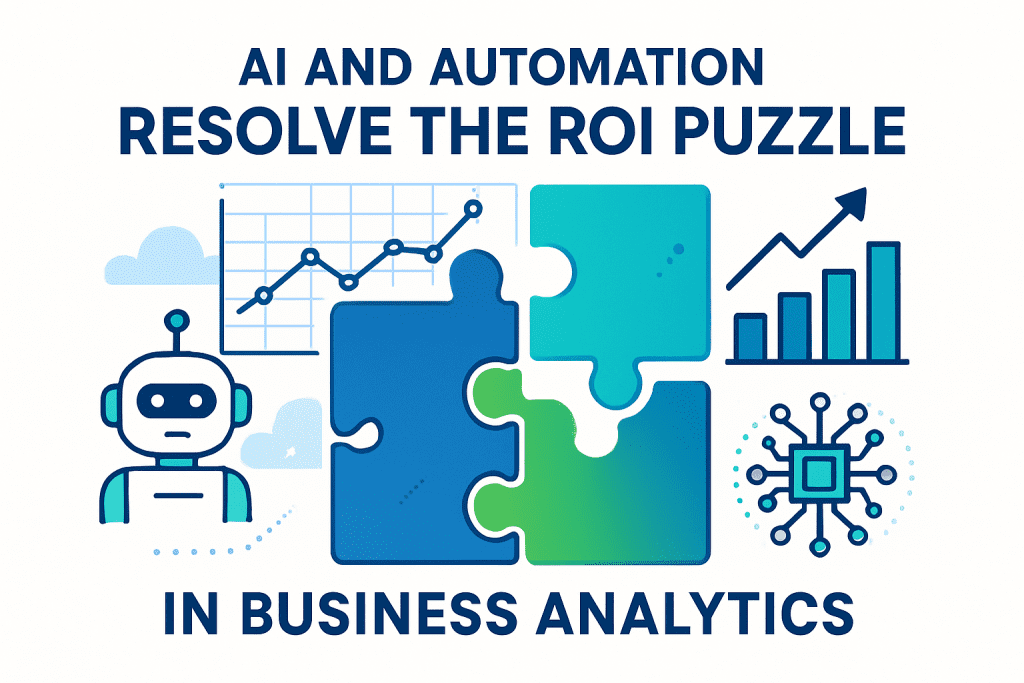
How AI & Automation Are Resolving the ROI Puzzle in Business Analytics

Introduction In today’s hyper-competitive business landscape, data has become the backbone of decision-making. But here’s the problem: while organizations collect tons of data daily, only a small fraction gets translated into measurable business value. The key challenge? ROI (Return on Investment) from analytics initiatives often remains unclear. This is where Artificial Intelligence (AI) and Automation step in. By accelerating data preparation, enhancing accuracy, and powering predictive insights, AI-driven automation is helping organizations connect the dots between analytics and real profit outcomes. This blog explores how AI and automation are revolutionizing business analytics ROI, along with use cases, benefits, challenges, trends, and frameworks to maximize returns. How AI and Automation Drive ROI in Business Analytics 1. Faster Data Processing and Insights Manual data cleaning and integration is time-consuming. Automation tools (ETL pipelines, Robotic Process Automation) cut data prep time by 60–80%. AI models instantly process structured + unstructured data, producing real-time insights. 2. Improved Accuracy and Reduced Errors Human-driven analytics can introduce bias or errors. Automated anomaly detection ensures clean, accurate datasets. AI reduces false positives in fraud detection or risk analysis. 3. Advanced Predictive Analytics AI models predict customer churn, sales demand, pricing trends, and risks. Predictive maintenance in manufacturing → reduces downtime & costs. Proactive strategies → higher ROI through smarter resource allocation. 4. Personalization and Customer Insights AI-powered segmentation → micro-level targeting (age, behavior, location). Sentiment analysis from social media & reviews. Personalized marketing → boosts conversions up to 20–25%. 5. Optimized Operational Efficiency Automated reporting = 70% less analyst time wasted on repetitive tasks. AI chatbots for analytics queries. Freeing analysts to focus on high-value decision-making. Key Benefits of AI & Automation for Business Leaders Benefit Business Impact Scalability Handles growing datasets without proportional cost increase Speed Real-time insights improve response to market changes Accuracy Reduces errors, ensuring reliable decision-making Efficiency Frees staff from repetitive tasks → focus on innovation ROI Tracking Easier attribution of revenue growth to data initiatives Continuous Learning ML models improve accuracy over time Use Cases Demonstrating ROI Success 1. E-commerce Growth AI-powered product recommendations increase AOV (Average Order Value). Real-time inventory analytics prevent stockouts. Example: Amazon’s recommendation engine generates 35% of total sales. 2. Risk Management in Finance AI fraud detection → monitors transactions in milliseconds. Predictive credit scoring → reduces loan default risk. Case: A global bank reduced fraud losses by 30% using AI automation. 3. Manufacturing Process Optimization Predictive maintenance reduces equipment downtime. AI-driven quality checks improve defect detection. Case: A leading automaker saved $50M annually using AI-enabled predictive analytics. 4. Healthcare & Life Sciences Automated diagnostics from medical images. Predictive patient care → reduced hospital readmission rates. AI-powered drug discovery accelerates R&D. Challenges in Measuring ROI from Business Analytics Data Silos: Scattered data across multiple systems. High Initial Costs: AI models, infrastructure, and skilled talent. Resistance to Change: Employees reluctant to adopt new workflows. Unclear Metrics: Organizations don’t define what ROI means for them (cost savings vs revenue growth). Skill Gaps: Need for data engineers, scientists, and AI experts. How to Measure ROI in Business Analytics ROI Metric Definition Example Cost Savings Reduction in manual effort, errors, or downtime 30% less time in report generation Revenue Growth Additional income from AI-driven strategies 20% higher sales via personalization Operational Efficiency Faster workflows, automation replacing manual work 70% less analyst effort in data cleaning Risk Reduction Lower financial & compliance risks 30% drop in fraud losses Customer Retention Enhanced loyalty via insights 25% higher retention with AI recommendations Future Trends in AI & Automation for Analytics   Natural Language Analytics (NLP) → Ask data questions in plain English. Generative AI in Analytics → AI-generated forecasts, insights, and reports. Cloud-based AI Platforms → Cost-effective, scalable solutions. Edge Analytics with AI → Real-time insights closer to data sources (IoT). Explainable AI (XAI) → Transparent decision-making for trust & compliance. Why Partner with Experts in AI & Automation? Implementing AI for analytics is not plug-and-play. It requires: Domain expertise. Integration with existing BI/BA tools. Continuous monitoring and model updates. 👉 Partnering with TechOTD Solutions ensures: Custom AI models tailored to your industry. Seamless integration with BI platforms. Scalable, cloud-ready architectures. 24/7 support for optimization. Conclusion AI and automation are no longer optional—they are essential to solving the ROI puzzle in business analytics. BI tells you what happened. BA tells you why it happened. AI + Automation tells you what will happen—and acts on it instantly. Organizations that embrace this shift will gain a sustainable competitive advantage in their industries. 👉 Call to Action: Ready to maximize ROI? Contact TechOTD today to explore customized AI and automation strategies tailored to your business.  FAQ Q1: How does AI improve business analytics ROI?AI speeds up analysis, predicts future outcomes, and eliminates costly errors. Q2: Can automation reduce analytics costs?Yes, automation minimizes manual work and errors, reducing long-term costs. Q3: What industries benefit most from AI analytics?E-commerce, finance, manufacturing, healthcare, logistics, and education. Q4: How do I measure ROI from AI projects?Track metrics like cost savings, revenue growth, efficiency gains, and retention. Q5: What’s the difference between AI-driven analytics and traditional BI?BI focuses on historical reporting, while AI-driven analytics predict and optimize future outcomes.

Business

Seamless Customer Journeys with AI

Introduction Delivering seamless customer experiences is now an industry-defining priority, with AI taking center stage in shaping the future of service excellence. As businesses evolve, artificial intelligence offers transformative enhancements—personalizing journeys, automating support, and anticipating customer needs. Here’s how AI is reimagining service for 2025 and beyond. Unlock your business’s future with TechOTD’s AI-powered solutions, expert partnerships, and custom development. How AI Transforms Customer Journeys 1. Personalization at Scale AI leverages customer data—from browsing behavior to purchase history—to craft individualized user journeys. Advanced algorithms anticipate customer intent, dynamically recommend products, personalize content, and tailor offers to unique preferences. This means every customer feels uniquely understood—boosting satisfaction and loyalty. 2. Instant and Smart Support AI chatbots and virtual assistants provide 24/7 support across websites, apps, and social channels. These systems offer quick resolutions to routine queries, freeing human agents to address complex issues. Natural Language Processing ensures interactions are context-aware and feel genuinely human—even as they automate recurring tasks. 3. Predictive Analytics AI analyzes vast datasets to forecast customer behavior, spot hidden trends, and suggest proactive solutions before problems occur. Businesses can anticipate what customers will want next, helping minimize friction and address pain points early. 4. Sentiment Analysis & Feedback Machine learning models track customer emotions and feedback in real time, surfacing dissatisfaction before it impacts loyalty. This empowers brands to adapt their strategies and communicate more empathetically across all touchpoints. 5. Omnichannel Consistency Integrating AI across channels—web, mobile, eCommerce, chat—ensures a unified, frictionless customer journey. No more repeating information or losing context between interactions; AI shares insights across platforms for a cohesive experience. Proven Benefits for Businesses Faster, Efficient Service: AI dramatically cuts resolution times, with chatbots handling up to 85% of routine inquiries and predictive systems improving “first-call” resolution rates. Cost Reduction: Automation and smarter workflows reduce operational costs and free up resources for innovation. Higher Customer Loyalty: 70% of consumers say personalized interaction boosts loyalty, and AI is the driving force behind this transformation. Scalable Excellence: AI-powered platforms grow with your business, adapting to new touchpoints and volumes without sacrificing service quality. Discover industry-specific innovations deployed by TechOTD in eCommerce, custom software, and more. AI-Powered Service Excellence with TechOTD TechOTD supports businesses at every step—from strategic planning to deployment—ensuring AI integration delivers measurable value. Partnering with TechOTD means you gain access to proven AI solutions, industry expertise, robust security, and continuous optimization. Explore client success and full-service offerings at TechOTD and learn more. How Machine Learning in Retail is Redefining the Sector FAQ 1. What is a seamless customer journey with AI? AI provides consistent, contextually aware experiences across all touchpoints—making navigation and support effortless for customers. 2. Can AI personalization be applied to any industry? Yes—AI adapts to retail, healthcare, finance, and even B2B sectors to personalize journeys at scale. 3. Is human empathy lost in AI-driven service? Not at all; AI frees agents from repetitive tasks, allowing more time for empathetic, high-value interactions. 4. How does AI ensure data privacy? TechOTD deploys solutions built on secure, compliant infrastructures, using the latest protocols for privacy. 5. What’s needed to adopt AI in customer journeys? Begin with strategic planning, solid data integration, and expert development. TechOTD provides end-to-end support.

How would you like me to respond?

Select a personality for your AI assistant

Normal
Happy
Sad
Angry

Your selection will affect how the AI assistant responds to your messages

Chat Assistant

Let's discuss your project!

Hear from our clients and why 3000+ businesses trust TechOTD

Tell us what you need, and we'll get back with a cost and timeline estimate

Scroll to Top