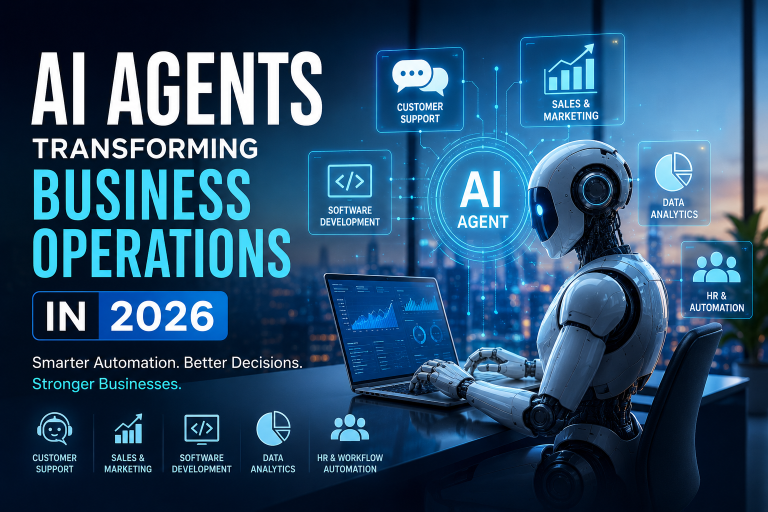
Artificial Intelligence has moved far beyond chatbots and simple automation. In 2026, businesses are increasingly adopting AI agents that can understand goals, make decisions, use digital tools, and complete multi-step tasks with minimal human intervention.
Unlike traditional software automation, which generally follows predefined rules, AI agents can analyze information, determine the next action, interact with different systems, and adapt their approach based on the situation.
From customer service and sales to software development, finance, human resources, and data analysis, AI agents are changing how organizations operate and make decisions.
For businesses looking to improve productivity, reduce operational costs, and deliver better customer experiences, AI agents are becoming an important part of the modern digital transformation strategy.
What Are AI Agents?
AI agents are intelligent software systems designed to achieve specific goals by combining artificial intelligence with reasoning, decision-making, and tool usage.
Traditional automation generally follows a fixed sequence:
Input → Rule → Action → Result
AI agents can operate more dynamically:
Goal → Analyze → Plan → Use Tools → Take Action → Evaluate → Adapt
For example, instead of simply responding to a customer’s question, an AI-powered customer service agent could:
- Understand the customer’s request.
- Retrieve relevant customer information.
- Check an order or account status.
- Determine the appropriate solution.
- Update the required system.
- Respond to the customer.
- Escalate the issue to a human when necessary.
This ability to perform multiple connected tasks makes AI agents particularly valuable for modern businesses.
Why AI Agents Matter for Businesses in 2026
Businesses generate enormous amounts of data and perform thousands of repetitive processes every day. Employees often spend valuable time searching for information, updating systems, preparing reports, responding to routine queries, and managing repetitive workflows.
AI agents can help automate many of these processes while allowing employees to focus on more strategic and creative work.
Some of the biggest advantages include:
- Higher productivity
- Faster business processes
- Reduced repetitive work
- 24/7 operational support
- Improved customer experiences
- Faster decision-making
- Better utilization of business data
- Scalable automation
The biggest shift is that businesses are moving from simply using AI as an assistant to using AI as an active participant in business workflows.
AI Agents in Customer Support
Customer support is one of the most practical applications of AI agents.
Traditional chatbots usually provide answers based on predefined flows or a limited knowledge base. Modern AI agents can understand context and interact with business systems to resolve more complex requests.
An AI customer service agent can:
- Answer product-related questions
- Track orders
- Check account information
- Handle appointment scheduling
- Create support tickets
- Recommend relevant solutions
- Escalate complex issues to human agents
This allows businesses to provide faster support without requiring employees to manually handle every routine request.
AI Agents for Sales and Marketing
Sales teams spend significant amounts of time researching prospects, updating CRM records, writing emails, and following up with leads.
AI agents can automate many of these activities.
A sales AI agent can help:
- Identify potential leads
- Analyze customer information
- Qualify prospects
- Generate personalized outreach
- Schedule meetings
- Update CRM systems
- Track follow-ups
- Analyze sales performance
Marketing teams can also use AI agents to analyze campaigns, generate content ideas, segment audiences, and identify trends.
Instead of replacing sales and marketing professionals, AI agents can act as intelligent assistants that reduce administrative work and allow teams to focus on relationships and strategy.
AI Agents in Software Development
Software development is another area experiencing rapid AI adoption.
AI coding assistants are already helping developers generate code, explain existing code, identify bugs, write tests, and improve documentation.
AI agents take this concept further by supporting multi-step development workflows.
For example, an AI development agent could:
- Analyze a development requirement.
- Create an implementation plan.
- Generate or modify code.
- Run tests.
- Identify errors.
- Suggest fixes.
- Update documentation.
This does not eliminate the need for developers. Instead, it allows development teams to spend more time on architecture, product decisions, security, and complex engineering problems.
AI Agents for Data Analysis and Business Intelligence
Modern businesses collect data from websites, applications, CRM platforms, financial systems, marketing platforms, and other sources.
The challenge is turning this data into actionable insights.
AI agents can help business teams interact with their data using natural language.
For example, a business manager could ask:
“Why did our sales decrease this month?”
An AI-powered system could analyze sales data, compare it with previous periods, identify unusual patterns, and present possible reasons.
AI agents can support:
- Automated reporting
- Data exploration
- Trend detection
- Forecasting
- KPI monitoring
- Anomaly detection
- Business recommendations
This can make data-driven decision-making more accessible to non-technical teams.
AI Agents in Human Resources
HR departments handle many repetitive processes, including employee queries, onboarding, documentation, scheduling, and internal requests.
AI agents can provide employees with instant access to company information and automate administrative workflows.
Common applications include:
- Employee onboarding
- Leave and policy queries
- Internal knowledge management
- Interview scheduling
- Candidate screening assistance
- HR document management
- Employee support
With appropriate security and human oversight, AI agents can help HR teams reduce administrative workloads while improving employee experiences.
AI Agents for Business Process Automation
One of the most important applications of AI agents is connecting different business systems.
A business may use separate platforms for CRM, accounting, email, customer support, project management, inventory, and analytics.
AI agents can potentially coordinate workflows across these systems.
For example, when a new customer signs up, an automated workflow could:
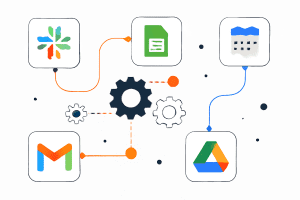
Create CRM record → Send welcome email → Create onboarding task → Notify sales team → Update analytics
This type of intelligent workflow automation can reduce manual data entry and improve operational efficiency.
AI Agents vs Traditional Automation
Traditional automation remains extremely useful, especially when processes are predictable and rules are clearly defined.
However, AI agents provide additional flexibility when workflows involve changing information or require reasoning.
| Traditional Automation | AI Agents |
|---|---|
| Rule-based | Goal-oriented |
| Fixed workflows | Dynamic workflows |
| Predictable inputs | Can handle variable inputs |
| Limited decision-making | AI-assisted reasoning |
| Usually predefined actions | Can select tools and actions |
| Best for repetitive rules | Best for complex workflows |
The two approaches are not competitors in every situation.
In many enterprise environments, the best solution will combine traditional automation + AI agents + human oversight.
Key Challenges of AI Agents
Despite their potential, businesses should not adopt AI agents without considering the risks.
Security and Privacy
AI agents may interact with sensitive business information. Strong access controls, authentication, encryption, monitoring, and data governance are essential.
Accuracy
AI systems can sometimes produce incorrect information or make inappropriate decisions. Critical workflows should include validation and human review.
Integration Complexity
Connecting AI agents with existing CRM, ERP, databases, APIs, and internal applications can require significant technical planning.
Cost Management
AI usage can become expensive at scale. Businesses need to monitor model usage, infrastructure costs, and workflow efficiency.
Human Oversight
Not every business decision should be fully automated. High-impact decisions should include appropriate human supervision.
How Businesses Can Prepare for an AI-Agent Future
Organizations should begin with practical use cases rather than trying to automate everything at once.
Step 1: Identify Repetitive Processes
Find workflows that consume significant employee time and have clear business value.
Step 2: Evaluate Data and Systems
Identify the data sources, APIs, applications, and permissions required for automation.
Step 3: Start With a Controlled Use Case
Choose one measurable workflow, such as customer support, reporting, lead qualification, or internal knowledge search.
Step 4: Establish Security Controls
Define authentication, authorization, data access, monitoring, and human approval requirements.
Step 5: Measure Results
Track metrics such as:
- Time saved
- Cost reduction
- Response time
- Customer satisfaction
- Employee productivity
- Error rates
Step 6: Scale Gradually
Once an AI workflow demonstrates measurable value, organizations can expand it to additional departments and processes.
The Future of AI Agents
The next phase of enterprise AI will likely involve organizations using multiple specialized AI agents working alongside employees and existing software systems.
Instead of a single AI tool performing one task, businesses can build interconnected systems where different agents handle different responsibilities.
For example:
Sales Agent → Customer Support Agent → Data Agent → Finance Agent → Management Dashboard
These systems could exchange information and coordinate workflows while humans remain responsible for important decisions and oversight.
The long-term opportunity is not simply to automate individual tasks. It is to create intelligent business processes that continuously analyze information, take appropriate actions, and improve operational efficiency.
Conclusion
AI agents are becoming an important part of the next generation of business automation.
Their ability to understand goals, analyze information, use tools, and perform multi-step workflows makes them significantly more flexible than traditional automation systems.
For businesses, the opportunity is clear: reduce repetitive work, improve productivity, accelerate decision-making, and create better customer experiences.
However, successful AI adoption requires more than simply implementing an AI model. Businesses need the right combination of technology, data, security, integration, governance, and human oversight.
Organizations that strategically adopt AI agents today can build a stronger foundation for the increasingly intelligent and automated business environment of the future.
Ready to Explore AI-Powered Business Solutions?
Businesses looking to adopt AI automation can start by identifying repetitive workflows and evaluating where intelligent automation can create measurable value.
TechOTD helps businesses leverage modern technologies to build scalable software solutions, AI-powered applications, automation workflows, and digital transformation strategies.
Explore AI & Technology Solutions with TechOTD → https://www.facebook.com/profile.php?id=61555452386126