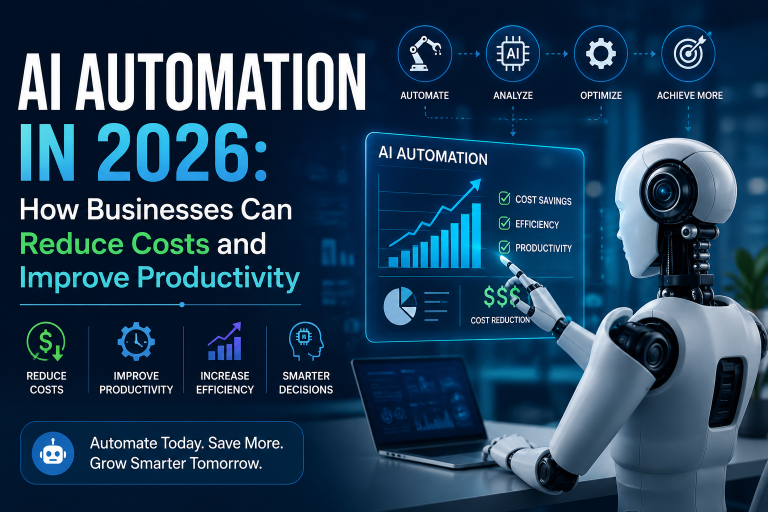
Artificial Intelligence is rapidly changing the way businesses operate. In 2026, AI automation is moving beyond simple chatbots and repetitive task automation. Businesses are increasingly using AI-powered systems to analyze information, automate workflows, assist employees, improve customer experiences, and make faster decisions.
For organizations dealing with increasing operational costs, large amounts of data, and repetitive processes, AI automation can provide a practical way to improve efficiency without continuously increasing manual workloads.
From customer support and sales to finance, human resources, software development, and business analytics, AI automation is becoming an important part of modern digital transformation.
What Is AI Automation?
AI automation combines artificial intelligence with automated workflows to perform tasks that traditionally require human intervention.
Traditional automation usually follows predefined rules:
Input → Rule → Action → Result
AI automation can work with more flexible processes:
Data → AI Analysis → Decision → Automated Action → Evaluation
This allows automated systems to handle information, identify patterns, make recommendations, and trigger appropriate actions based on changing situations.
For example, a traditional workflow might automatically send the same email to every new customer.
An AI-powered workflow could analyze customer information, identify their interests, personalize the message, update the CRM, and schedule a follow-up automatically.
This makes AI automation more adaptable to modern business processes.
Why AI Automation Matters in 2026
Businesses are under constant pressure to improve productivity while controlling operational costs.
Employees often spend significant amounts of time performing repetitive activities such as:
- Entering data
- Responding to routine emails
- Updating CRM systems
- Preparing reports
- Scheduling meetings
- Processing documents
- Answering common customer questions
- Monitoring business metrics
- Managing repetitive administrative workflows
AI automation can reduce the amount of manual work involved in these processes.
The goal is not simply to automate everything. Instead, businesses can use AI to automate suitable tasks while allowing employees to focus on activities that require creativity, strategic thinking, communication, and human judgment.
Some major benefits include:
- Reduced repetitive work
- Improved employee productivity
- Faster business processes
- Lower operational overhead
- Faster customer responses
- Better data utilization
- Improved decision-making
- Scalable workflows
- 24/7 automated operations
How AI Automation Helps Businesses Reduce Costs
Reducing costs does not always mean reducing employees. In many cases, businesses can reduce operational costs by improving how existing resources are used.
AI automation can help organizations achieve this in several ways.
1. Reduce Repetitive Manual Work
Employees can spend hours performing repetitive tasks that follow predictable patterns.
AI automation can handle many of these processes automatically.
For example:
Manual Process:
Employee receives request → Reads information → Updates system → Sends response → Creates follow-up task
Automated Process:
Request received → AI analyzes request → System updated → Personalized response sent → Follow-up created
This allows employees to spend more time on higher-value work.
2. Improve Operational Efficiency
Manual processes often involve multiple systems and departments.
For example, processing a new customer may require information to be entered into:
- CRM
- Email platform
- Accounting system
- Project management software
- Customer support platform
- Analytics system
AI automation can coordinate these systems and reduce unnecessary manual data entry.
3. Reduce Errors
Manual data entry and repetitive processing can result in mistakes.
AI-powered workflows can validate information, identify inconsistencies, and trigger alerts when something requires human attention.
This can help reduce the operational cost associated with avoidable errors and rework.
4. Improve Resource Utilization
Businesses can use automation to handle routine processes while employees focus on more complex responsibilities.
Instead of hiring additional resources for every increase in workload, organizations can automate suitable processes and scale operations more efficiently.
5. Provide 24/7 Support
AI-powered systems can operate outside normal business hours.
Customer questions, internal requests, monitoring activities, and other automated processes can continue even when employees are unavailable.
This can improve service availability without requiring a larger support team to work around the clock.
How AI Automation Improves Productivity
Cost reduction is only one side of AI automation.
The larger opportunity is improving productivity.
Faster Task Completion
AI systems can process large amounts of information quickly and automate workflows that previously required multiple manual steps.
Less Administrative Work
Employees can spend less time on repetitive activities such as documentation, scheduling, reporting, and data entry.
Better Access to Information
AI-powered systems can help employees search internal information and retrieve relevant data using natural language.
Faster Decision Support
AI automation can analyze business information and highlight trends, anomalies, and important changes.
This gives teams faster access to information needed for decision-making.
Improved Collaboration
Automated workflows can notify the right team members, create tasks, update systems, and share information automatically.
This reduces delays caused by manual communication between departments.
AI Automation in Customer Support
Customer support is one of the most practical areas for AI automation.
Businesses can use AI-powered systems to handle routine customer interactions and automate support workflows.
Common applications include:
- Answering frequently asked questions
- Tracking orders
- Checking account information
- Creating support tickets
- Categorizing customer requests
- Routing issues to the appropriate department
- Scheduling appointments
- Providing personalized responses
- Escalating complex issues to human agents
For example, when a customer submits a support request, an AI system can understand the request, retrieve relevant information, categorize the issue, and either provide an answer or route the request to a human support professional.
This can reduce response times while allowing support teams to focus on more complex customer problems.
AI Automation in Sales and Marketing
Sales and marketing teams manage large amounts of customer and prospect information.
AI automation can help reduce administrative workloads across the sales process.
A sales automation workflow can:
- Identify potential leads.
- Collect relevant customer information.
- Qualify prospects.
- Update CRM records.
- Generate personalized outreach.
- Schedule follow-ups.
- Notify sales representatives.
- Track engagement.
- Generate performance reports.
Marketing teams can also use AI automation for:
- Content planning
- Audience segmentation
- Campaign analysis
- Lead scoring
- Customer research
- Trend identification
- Personalized communication
- Performance reporting
The objective is not to remove human involvement from sales and marketing. Instead, automation can handle administrative tasks so professionals can focus on relationships, creativity, and strategy.
AI Automation in Finance and Accounting
Finance teams manage many structured and repetitive processes.
AI automation can support activities such as:
- Invoice processing
- Expense categorization
- Financial reporting
- Document processing
- Payment reminders
- Data reconciliation
- Transaction monitoring
- Financial data analysis
For example, an AI-powered workflow can extract information from an invoice, validate the data, categorize the expense, update the accounting system, and notify the appropriate employee if additional approval is required.
Human review can remain part of the process for sensitive financial decisions.
AI Automation in Human Resources
Human Resources departments also have many repetitive workflows.
AI automation can assist with:
- Employee onboarding
- Interview scheduling
- Employee questions
- Document management
- Internal knowledge search
- Leave and policy queries
- Candidate screening assistance
- HR reporting
For example, when a new employee joins the organization, an automated workflow can create onboarding tasks, send required documents, provide company information, notify relevant teams, and track completion.
This can reduce administrative work for HR professionals while creating a smoother employee experience.
AI Automation in Software Development
Software development is another area where AI automation can improve productivity.
Modern development workflows can use AI to support:
- Code generation
- Code analysis
- Bug identification
- Test generation
- Documentation
- Code review assistance
- Development task management
- Technical research
An AI-assisted development workflow could look like:
Requirement → Planning → Code Generation → Testing → Error Detection → Fix Suggestions → Documentation
Developers remain responsible for architecture, security, quality, technical decisions, and final approval.
AI automation can simply reduce the amount of repetitive work involved in the development lifecycle.
AI Automation for Data Analysis
Businesses generate data from many sources, including websites, applications, CRM platforms, financial systems, marketing platforms, and internal software.
The challenge is turning this information into useful insights.
AI automation can help organizations:
- Generate reports
- Monitor KPIs
- Detect anomalies
- Identify trends
- Compare business performance
- Analyze customer behavior
- Support forecasting
- Provide decision recommendations
For example, instead of manually reviewing several business reports, a manager could receive an automated summary highlighting significant changes, unusual activity, and important performance metrics.
This can make business intelligence faster and more accessible.
AI Automation for Business Process Management
One of the biggest opportunities for AI automation is connecting different business systems.
Consider a new customer registration process.
A traditional workflow may require multiple employees to perform different steps.
An AI-powered workflow could automatically:
New Customer → CRM Record → Welcome Email → Sales Notification → Onboarding Task → Analytics Update
This type of connected automation can reduce manual data entry and improve consistency across departments.
AI Automation vs Traditional Automation
Traditional automation remains valuable for processes that are predictable and rule-based.
AI automation becomes more useful when processes involve changing information, natural language, pattern recognition, or decision support.
| Traditional Automation | AI Automation |
|---|---|
| Rule-based | AI-assisted |
| Fixed workflows | More flexible workflows |
| Predictable inputs | Can handle variable information |
| Predefined actions | Can select appropriate actions |
| Limited decision support | Can analyze and recommend |
| Best for repetitive rules | Best for complex workflows |
In many businesses, the best approach is not choosing one over the other.
A combination of traditional automation + AI automation + human oversight can provide a more reliable business automation strategy.
Key Challenges of AI Automation
AI automation offers significant opportunities, but businesses should also understand its limitations.
Data Security and Privacy
AI systems may process sensitive customer, employee, financial, or business information.
Organizations need appropriate access controls, authentication, encryption, monitoring, and data governance.
Accuracy and Reliability
AI systems can sometimes produce incorrect information.
Critical business processes should include validation and human review where appropriate.
Integration Complexity
Connecting AI systems with existing CRM, ERP, databases, APIs, and internal applications can require careful technical planning.
Implementation Costs
Although automation can reduce costs over time, implementation may require investment in technology, infrastructure, integration, and employee training.
Employee Adoption
Employees need to understand how AI automation affects their workflows.
Proper training and communication can help organizations adopt automation more effectively.
Human Oversight
Not every process should be fully automated.
High-impact decisions should include appropriate human supervision and approval.
How Businesses Can Start With AI Automation
Businesses do not need to automate every process immediately.
A gradual approach is usually more practical.
Step 1: Identify Repetitive Processes
Start by identifying tasks that:
- Consume significant employee time
- Occur frequently
- Follow a relatively clear process
- Create measurable operational costs
Step 2: Identify the Business Objective
Define what the organization wants to achieve.
For example:
- Reduce processing time
- Improve response times
- Reduce manual errors
- Lower operational costs
- Improve employee productivity
- Improve customer experience
Step 3: Select a Practical Use Case
Start with one controlled workflow.
Potential starting points include:
- Customer support
- Lead qualification
- Reporting
- Document processing
- Internal knowledge search
- Employee onboarding
Step 4: Connect the Required Systems
Identify the applications and data sources required for the workflow.
This may include:
- CRM
- ERP
- Databases
- APIs
- Customer support platforms
- Analytics systems
Step 5: Establish Security Controls
Define:
- Authentication
- Authorization
- Data access
- Monitoring
- Approval requirements
- Audit processes
Step 6: Measure the Results
Track measurable business outcomes such as:
- Time saved
- Cost reduction
- Processing speed
- Error rate
- Employee productivity
- Customer satisfaction
Step 7: Scale Gradually
Once the initial automation demonstrates measurable value, businesses can expand automation to other departments and workflows.
Measuring the ROI of AI Automation
Businesses should evaluate automation using measurable results rather than simply counting how many AI tools they have implemented.
Important metrics include:
Cost Savings
Compare the operational cost before and after automation.
Time Savings
Measure how much employee time is saved through automated workflows.
Productivity
Track the amount of work teams can complete within the same period.
Error Reduction
Compare manual errors and automated process errors.
Customer Experience
Monitor response time, resolution time, satisfaction, and support quality.
Process Efficiency
Measure how long a workflow takes from beginning to completion.
A successful AI automation project should demonstrate measurable business value.
The Future of AI Automation
AI automation is likely to become increasingly integrated with everyday business software.
Instead of using AI as a separate tool, organizations can build AI capabilities directly into their workflows.
Multiple specialized AI systems may work together across departments.
For example:
Sales AI → Customer Support AI → Finance Automation → Data Analysis → Management Dashboard
These connected systems can exchange information and automate workflows while humans remain responsible for important decisions.
The future of business automation is therefore not simply about replacing individual manual tasks.
It is about creating intelligent business processes that can understand information, coordinate actions, identify problems, and continuously improve operational efficiency.
Conclusion
AI automation is becoming an important strategy for businesses looking to reduce operational costs and improve productivity in 2026.
By automating repetitive processes, connecting business systems, analyzing data, and supporting employees, organizations can create faster and more efficient workflows.
The biggest opportunity is not simply reducing the amount of manual work. It is allowing employees to spend more time on strategic, creative, and high-value activities.
However, successful AI automation requires more than implementing an AI model. Businesses need the right combination of technology, data, security, integration, governance, and human oversight.
Organizations that start with practical use cases, measure results, and scale gradually can build a strong foundation for a more intelligent and efficient future.
Ready to Automate Your Business?
Businesses looking to reduce repetitive work, improve productivity, and build intelligent workflows can start by identifying processes where AI automation can create measurable value.
TechOTD helps businesses build scalable software solutions, AI-powered applications, automation workflows, and digital transformation solutions designed around real business needs.
Explore AI & Automation Solutions with TechOTD →https://www.facebook.com/profile.php?id=61555452386126