July 2025

App Development

Mobile App Development Process: The Ultimate Build-to-Launch Guide

Introduction Every day, the number of apps released to the market grows. Plus, right now, there are more mobile devices in the world than there are people. No wonder that by 2026 mobile applications are projected to generate $233 billion in revenue.   With such promising forecasts, it’s easy to see why many companies are looking into mobile app development. Some businesses are interested in creating the next TikTok or Zoom. Thus, focusing on consumer-facing projects and the revenue they can generate. Others, want to optimize internal processes and choose to invest in enterprise solutions that can reduce expenses and improve efficiencies. Discover the Difference Between Consumer and Enterprise Mobile Apps Whether you’re building for end users or your workforce, understanding the distinctions between consumer and enterprise mobile solutions is crucial. Today, we’ll share an ultimate guide to the seven-step mobile app development process—complete with insider insights from TechOTD and strategic backlinks to our services. Let’s dive in! 7 Key Steps of the Mobile App Development Process Strategy Development Analysis & Planning UI/UX Design App Development Application Testing Deployment Support & Performance Monitoring Read on for detailed best practices, and learn how to leverage TechOTD’s expertise at each stage. Step 1: Strategy Development Begin by defining your app’s vision and business model. Identify Objectives: What problem does your app solve? Who are its target users? What results do you expect? Research Competitors: Analyze similar apps to identify gaps and differentiation opportunities. Select Platform: Decide between iOS, Android, or cross-platform based on your audience and budget. Choose Monetization (Consumer Apps): In-app purchases, subscriptions, ads, or paid downloads. Partner with TechOTD to refine your strategy and prioritize features through our comprehensive Web & App Development services. Step 2: Analysis & Planning Translate your vision into a detailed blueprint. Functional Requirements: List all user actions and features (e.g., account creation, payments, data sync). Non-Functional Requirements: Define performance, security, and scalability targets. Product Roadmap: Prioritize features for your MVP versus future releases. Technology Stack: Select frameworks, databases, cloud services, and DevOps tools. Gain clarity on project scope and risk management by partnering with TechOTD’s IT Consulting & Deployment team. Ste UI/UX Design Craft intuitive, engaging user experiences.   Information Architecture: Map out data structures and user workflows. Wireframes: Sketch layouts for each screen and user flow. Style Guides & Mockups: Standardize fonts, colors, and UI components for consistency. Interactive Prototypes: Simulate the app experience to gather early feedback. Elevate your design with insights from TechOTD’s eCommerce & Industry Solutions. Step 4: App Development Build the core functionality in iterative sprints. Backend: REST/GraphQL APIs, database schemas, authentication, and cloud hosting. Frontend: Native (Swift/Kotlin) or cross-platform (Flutter/React Native). CI/CD Pipelines: Automate builds, tests, and deployments for rapid iteration. Leverage AI-powered automation from TechOTD’s AI & Machine Learning services to accelerate development. Step 5: Application Testing Ensure quality, performance, and security. Functional Testing: Validate all features. Usability Testing: Gather real-user feedback. Performance Testing: Simulate peak loads. Security Testing: Penetration tests and compliance checks. Compatibility Testing: Test across devices and OS versions. Ensure robust QA by tapping into TechOTD’s Web & App Development expertise. Step 6: Deployment Launch your app to stores or enterprise environments. App Store Optimization: Keywords, icons, screenshots, and descriptions. Store Compliance: Follow Apple and Google’s guidelines. Private Distribution: Use enterprise programs for internal apps. Simplify deployment with TechOTD’s IT Consulting & Deployment services. Step 7: Support & Performance Monitoring Turn your launch into sustained success. Analytics & KPIs: Track downloads, active users, retention, and conversions. Crash & Error Monitoring: Quickly triage and resolve issues. Feature Updates: Roll out new functionality and security patches. User Engagement: Use push notifications and in-app messaging. For ongoing maintenance and scaling, rely on TechOTD’s full-cycle support detailed on our About Us page. Why Partner with TechOTD? TechOTD delivers end-to-end mobile development services, combining industry best practices, AI/ML expertise, and robust infrastructure support. Whether you’re launching a public consumer app or a secure enterprise solution, our team is ready to guide you through every step. Explore our homepage: https://www.techotd.com/ Discover AI & Machine Learning services: https://www.techotd.com/pages/ai-page.html Learn about TechOTD: https://www.techotd.com/pages/abouts/about.html See eCommerce solutions: https://www.techotd.com/pages/industries/eCommerce.html Join our partner program: https://www.techotd.com/pages/abouts/partner.html Access Web & App Development services: https://www.techotd.com/pages/services/web-development.html Embark on your mobile journey today—partner with TechOTD for innovative, scalable, and secure mobile solutions. conclusion Every great app starts with an idea and becomes reality through a disciplined, step-by-step approach. Planning, designing, developing, and optimizing your app paves the way for business growth and deep user engagement. Ready to turn your vision into a mobile reality? Start your roadmap today—and partner with experts for world-class results. FAQ 1. Which programming language should I use for mobile app development in 2025? Swift (iOS), Kotlin (Android), and Flutter or React Native for cross-platform solutions offer robust features and community support. 2. How long does it take to build a mobile app? Simple apps can take around 2–4 months, while complex or cross-platform apps may require 6+ months. 3. What’s the best way to optimize app store rankings? Master App Store Optimization (ASO) with relevant keywords, stunning visuals, clear descriptions, and frequent updates. 4. How important is app security? Extremely—user data protection, secure authentication, and regular updates keep your app reliable and safe. 5. Where can I find trustworthy tutorials and examples? Explore Techotd, GeeksforGeeks, official Android/iOS docs, plus the resource links above.  
Cloud

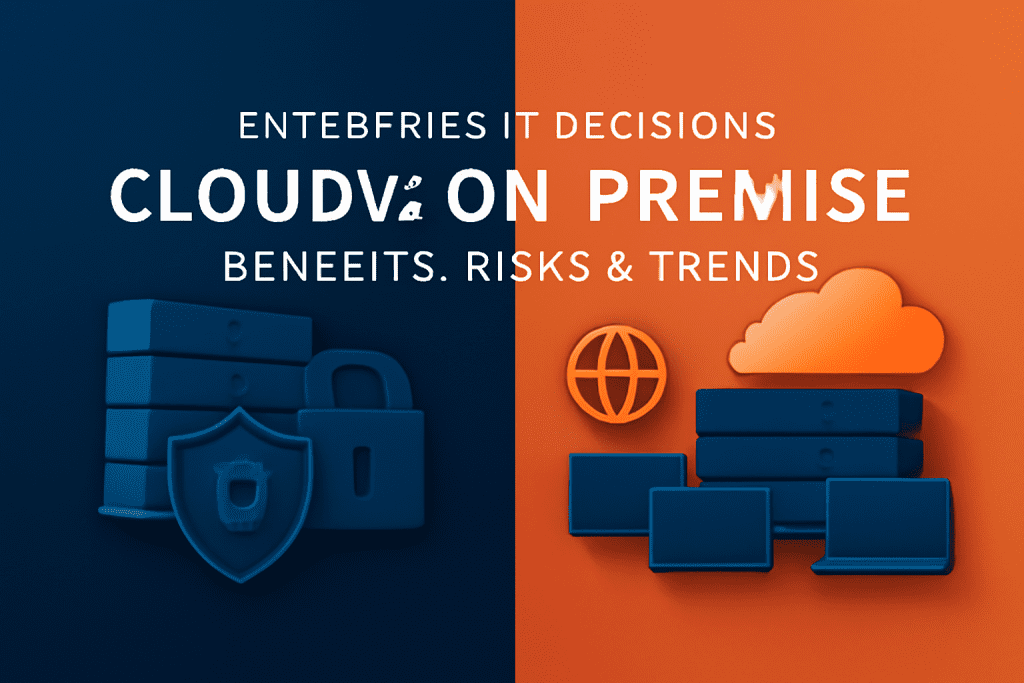
Enterprise IT Decisions: Comparing Cloud and On-Premise Benefits & Risks

Introduction In today’s era of digital acceleration, choosing the right IT infrastructure—cloud or on-premise—is a major strategic decision that can fuel your enterprise’s performance, security, and innovation. As market demands shift toward agility, scalability, and compliance, understanding the advantages, challenges, and modernization trends for each option is essential. This blog unpacks core differences, sector-specific examples, benefits, limitations, and real-world adoption trends—so you can make an informed, future-focused IT choice that propels your business forward. What Are Cloud and On-Premise IT Infrastructures? Cloud: IT services (servers, storage, databases, networking, analytics, and software) delivered over the internet by external providers. Explore Cloud Solutions On-Premise: Computing resources are installed and maintained on-site at your organization’s facility, with full direct control by your IT team. IT Consulting & On-Premises Solutions Key Differences: Cloud vs On-Premise Aspect Cloud On-Premise Deployment Off-site (third-party provider), accessed via internet. Cloud Services On-site (organization’s premises), your IT manages setup. IT Consulting Cost Low upfront investment (OpEx); subscription/pay-per-use billing. AI Solutions High upfront investment (CapEx); ongoing hardware/software costs. Scalability Elastic—scale up/down instantly. Data Analytics Scaling requires buying/installing new hardware—slower and costlier. Security & Control Provider-managed security and compliance certifications; some loss of direct control. Full direct data/control management; meets strict regulatory/industry needs. Accessibility Global access, ideal for hybrid/remote teams. Physical/campus access; remote requires extra configuration. Maintenance Provider manages updates, patches, disaster recovery. Your IT team maintains everything, from system updates to security. Vendor Lock-In Potential for dependency/migration challenges. No vendor lock, but older systems can be hard/expensive to integrate. Performance Flexible capacity, variable latency based on network quality. Direct control for ultra-low latency and critical workloads. Benefits & Risks: Cloud vs On-Premise Cloud Benefits Agility: Deploy new resources, apps, and sites quickly—supporting market expansion and innovation. Cost-Efficiency: Only pay for what you use; no expensive upfront hardware. Reduced IT Burden: Provider manages uptime, upgrades, and security. Business Continuity: Robust backup and disaster recovery. Remote-Ready: Enables global collaboration and hybrid teams. Cloud Risks Internet outages can cause downtime. Less direct control over sensitive data. Vendor lock-in risk if not planned for from the start. Ongoing operational costs. On-Premise Benefits Full Control: Customize security, compliance, hardware, and integrations for your needs. Regulatory Compliance: Simpler to meet industry/national data regulations (e.g., finance, healthcare). Performance: Low latency for mission-critical real-time operations. Customization: Tailor IT systems for unique or legacy workflows. On-Premise Risks Large upfront investment in hardware/facilities. All maintenance, upgrades, and support handled internally. Scaling and modernization can be slow and disruptive. Requires a larger, skilled IT team. Enterprise Use Cases & Industry Examples When Cloud Excels Retail: Instantly scale resources for sales peaks and geographic expansion. SaaS/Startups: Launch quickly, experiment safely, avoid infrastructure investment. Remote Collaboration: Enable global teams, file sharing, secure mobile and desktop access. Data Analytics/ML: Run big data or AI workloads dynamically. When On-Premise Is Ideal Banking/Finance: Regulatory oversight, data residency, high-frequency trading. Healthcare: HIPAA, medical record security, legacy system integration. Energy/Government: National security, control over access, strict privacy compliance. Modern Trends: Hybrid and Multi-Cloud Today’s enterprises often blend cloud and on-premise environments (“hybrid” or “multi-cloud”) to balance speed, compliance, and cost efficiency. Hybrid: Keep sensitive/regulated workloads on-premise and leverage cloud for agility, collaboration, and scale. Edge Computing: Combine on-premise/edge servers with cloud for ultra-fast operations (e.g., smart manufacturing, logistics). Stay ahead: Contact TechOTD’s experts for a custom roadmap Conclusion There’s no universal choice—your decision should reflect your unique business goals, industry requirements, and growth strategy. Choose cloud for agility, cost savings, and digital transformation. Choose on-premise for total control, compliance, and customized performance. For many, a hybrid strategy maximizes the advantages of both worlds. Ready to transform your IT? Visit TechOTD’s solutions hub or connect with our experts to shape the future of your enterprise IT. FAQ 1. Is cloud or on-premise more secure? Cloud vendors offer strong security, but on-premise gives you direct oversight. The safest path depends on compliance needs and your IT team’s expertise. 2. Which option costs less long-term? Cloud is cheaper up front and for dynamic workloads; on-premise may save money at scale, but needs careful management. 3. Can enterprises mix cloud with on-premise? Yes—the hybrid approach is powerful for balancing flexibility with control. 4. How do I avoid vendor lock-in with cloud? Choose platforms supporting open standards and plan migration strategies early. 5. Is on-premise IT outdated? No. It’s vital for compliance-heavy sectors and advanced when integrated with cloud or edge.

Software development

Custom Development vs White Label Solutions: Choosing What’s Best for Your Business

Introduction In today’s hyper-competitive digital world, selecting the right software strategy is crucial for business growth. Should your business invest in a bespoke solution tailored to your unique vision through custom development, or opt for a white label solution for fast, cost-effective deployment? This guide explores the key differences, benefits, and limitations of both approaches—empowering you to make an informed decision in line with your growth targets, market, and resources. Key Differences Between Custom Development and White Label Solutions Aspect Custom Development White Label Solutions Customization Built from scratch to fit your business’s requirements. Full control over features, branding, scalability, and security. Web & Software Development Pre-built, ready-to-deploy software. Customizable mainly for branding/interface. Explore Solutions Investment Higher upfront investment, potentially lower long-term cost (no ongoing vendor licenses). Your dedicated development partner: About Techotd Lower initial cost, but ongoing subscription/licensing fees may add up over time. Deployment Speed Requires skilled team and longer timelines—often months to years for complex projects. Rapid market entry—often deployable in weeks. eCommerce & More Support & Updates Managed by your in-house or dedicated team. Requires continuous investment in updates/security. Partner for Innovation Vendor provides technical support and product updates. Autonomy may be limited by provider’s roadmap. Scalability Infinite scalability and evolving features tailored to your growth. AI/ML Expertise Scalability is dependent on the vendor’s platform capabilities. Modifications are restricted. Use Cases Custom Development: Best for highly regulated industries (fintech, healthcare), unique SaaS, solutions demanding maximum compliance, complex workflows. See: Healthcare Solutions White Label Solutions: Ideal for startups, agencies, e-commerce businesses, and organizations needing fast, low-risk entry. See: eCommerce Platforms Weighing the Pros and Cons Advantages Custom Development Unique features and branding for a true competitive edge. Unlimited scalability and flexibility. Security tailored to compliance and industry specifics. May lower total cost of ownership in the long run. In-house or dedicated support ensures alignment and faster innovation. White Label Solutions Go live in weeks, not months. Low initial costs—make technology accessible for any size business. Pre-tested, vendor-maintained software means fewer technical hurdles. Focus on your core business; tech is managed by the solution provider. Limitations Custom Development High upfront investment and long project cycles. Ongoing expenses for maintenance, security, updates. Risk of delays or overruns if requirements change or expertise is lacking. White Label Solutions Limited ability to differentiate your brand. Customization confined mainly to aesthetics and minor features. Vendor lock-in risks and recurring costs. Scalability and compliance may be hindered by vendor limitations. Support and updates are dictated by the solution provider’s priorities. Conclusion Choosing between custom development and white label solutions depends on your organization’s vision, resource availability, and growth ambitions. If rapid launch and minimal investment are your priorities, a white label approach is practical. For businesses focused on unique positioning, advanced features, and long-term competitiveness, investing in custom development is a strategic move. Ready to elevate your business? Connect with TechOTD’s experts, assess your needs, and prepare for future-ready digital growth. FAQ 1. What is the biggest difference between custom development and white label solutions? Custom development is fully tailored, while white label is ready-made and limited to superficial customization. 2. Which approach is more cost-effective? White label is cheaper up front, but custom solutions may cost less long-term by avoiding subscription/vendor fees. 3. Does custom development guarantee faster business growth? It boosts long-term competitiveness via uniqueness and scalability, but doesn’t guarantee immediate gains. 4. Can white label solutions be customized for unique needs? Mostly limited to branding/interface tweaks—not deep feature or workflow changes. 5. When should I choose a white label solution? If you need to go to market quickly, have a limited budget, or don’t need complex integrations.

Data Privacy & Security

CTOs & Compliance: Simplifying US HealthTech Regulations for Innovation & Growth

Introduction Navigating the complex world of US Health Tech regulations is one of the biggest challenges facing today’s CTOs. The rapid pace of technological advancement, increased focus on data privacy, and evolving legislative frameworks have transformed compliance from a “checkbox” exercise into a critical pillar for innovation and growth. In this blog, we’ll break down what every CTO needs to know about simplifying and embracing Health Tech compliance—not just to stay legal, but to accelerate innovation, build market trust, and drive scalable success in the US Health Tech ecosystem. Understanding the Regulatory Terrain: What CTOs Must Know HIPAA & HITECH Foundation HIPAA (Health Insurance Portability and Accountability Act) is the cornerstone of US Health Tech regulation, requiring robust safeguards for Protected Health Information (PHI) including data encryption, access controls, audit logs, and disaster recovery. HITECH (Health Information Technology for Economic and Clinical Health Act) amplifies HIPAA: penalties for violations are tougher and requirements for breach transparency are stricter. Emerging Standards & Trends The FDA alignment with ISO 13485 for device quality management is raising the bar for digital health platforms and connected devices, especially by February 2026. Interoperability mandates driven by FHIR APIs and Electronic Health Record (EHR) standards mean CTOs must consider not only their own infrastructure but also integrations with external systems and partners. New regulatory scrutiny around AI in HealthTech, cybersecurity, and diagnostics introduces dedicated compliance frameworks and audit trails for advanced Health Tech products. Key Considerations for CTOs Compliance isn’t just a legal formality—it must influence technical architecture from the first line of code. Regular risk assessments, comprehensive documentation, and up-to-date staff training are essential for continuous compliance. Practical Steps to Streamline Compliance and Enable Innovation Make Compliance a Business Strategy Proactive Planning: Integrate regulatory considerations (HIPAA, HITECH, FDA/ISO, HITRUST) into early product roadmaps instead of post-development fixes. Cross-Functional Teams: Include legal, compliance, and security experts in all major tech decisions, particularly during MVP and scaling phases. Leverage Modern Compliance Tools Use digital compliance platforms to track regulations, manage documentation, and quickly adapt to new standards—reducing risk and operational costs. Choose cloud vendors and technology stacks with proven compliance certifications (e.g., HITRUST CSF), which streamline audits and boost partner trust. Continuous Monitoring & Documentation Conduct regular risk audits and vulnerability assessments. Maintain precise documentation of development and user feedback—improving both audit success rates and team accountability. Balance Innovation and Safety Pilot AI, IoT, and healthcare innovation within legal frameworks, using synthetic data or controlled environments to validate concepts before exposure to real patient data. Ensure any use of third-party APIs and integrations doesn’t introduce unexamined regulatory risks—every touchpoint matters in audits. Conclusion CTOs hold the keys to transforming Health Tech compliance from a barrier to an engine for growth and innovation. By architecting compliance into every aspect of product development and leveraging the right processes and tools, leaders can not only meet today’s regulatory requirements but confidently innovate for the future. Ready to future-proof your Health Tech innovation? Make compliance your launchpad—not your roadblock—grow boldly! FAQ Q1: What is the biggest compliance challenge for Health Tech CTOs today?Staying updated and building scalable systems as HIPAA, HITECH, and FDA/ISO evolve, especially with the rise of AI and interoperability mandates. Q2: Can compliance slow down Health Tech innovation?Not if approached proactively; integrating compliance early can actually accelerate product launches and unlock new partnerships by building stakeholder trust. Q3: How can startups streamline compliance efforts?Use digital compliance tools, choose compliant vendors, and integrate cross-functional teams from day one for a structured, scalable approach. Q4: What happens if Health Tech companies fail to comply?Financial penalties, delayed launches, reputational damage, and even loss of business opportunities—compliance is critical for sustainable growth. Q5: Are there frameworks that help simplify multi-standard compliance?Yes, frameworks like HITRUST CSF and automation-led compliance platforms help unify requirements for HIPAA, HITECH, and ISO, making multi-standard compliance more manageable.

Educational Technology

How AR/VR is Changing Education Forever

Introduction Augmented Reality (AR) and Virtual Reality (VR) are revolutionizing education, creating immersive, interactive environments that go far beyond traditional textbooks and lectures. From elementary schools introducing fun, 3D models in classrooms to universities using advanced VR simulations for medical training, AR/VR is making learning more engaging, effective, and accessible for all―forever transforming how students experience knowledge. What is AR and VR in Education?          .   Augmented Reality(AR): Integrates digital elements—like images, text, or 3D models—into the real world, viewed               through devices such as tablets, smartphones, or smart glasses. Virtual Reality (VR): Fully immerses users in a digital environment, typically via headsets, enabling “learning by doing,” simulation, and exploration far beyond the classroom’s physical walls. How AR/VR is Transforming Learning 1. Enhanced Engagement & Motivation Interactive AR/VR lessons make complex and abstract topics fun and tangible—students retain more information and develop a love for learning. Gamified elements and hands-on experiences break the monotony of rote learning. 2. Improved Understanding of Complex Concepts 3D models let students visualize everything from atoms to the solar system, and even human anatomy, enhancing their grasp of difficult subjects. Virtual field trips allow students to “visit” historical sites, disaster zones, or far-off planets—without leaving their school. 3. Safe, Experiential Learning VR simulations provide a risk-free way to practice real-world skills, such as surgery, engineering, or scientific experiments, improving practical skills with zero danger. 4. Personalized & Differentiated Learning Tailored AR/VR scenarios adapt to individual learning speeds and preferences, catering to diverse learning needs and styles. 5. Increased Collaboration and Social Skills Multi-user VR classrooms and AR projects encourage teamwork, communication, and collaborative problem-solving—even when students are remote. Real-World Examples Elementary Schools: AR sandboxes for geography; interactive 3D flashcards for biology; chemistry visualizations through AR cubes. Colleges/Universities: VR simulations for medical training; AR to study brain functions and psychological phenomena. Vocational Training: Virtual reality labs for mechanics, engineers, and healthcare professionals to practice skills before entering real workplaces. Distance/Online Learning: Students from around the world attend the same immersive VR classrooms, making quality education globally accessible. Benefits at a Glance Benefit AR Example VR Example Higher Student Engagement 3D interactive models in class Immersive field trips Improved Knowledge Retention AR flashcards, games Simulated hands-on lab work Accessibility Translation & instant guides Attend remote classrooms Collaboration & Social Learning Group AR projects Multi-user VR lessons Safe Practice for Risky Scenarios Step-by-step AR guides VR medical & engineering sims Personalized Learning Adaptive AR quizzes Branching VR scenarios How to Use AR/VR in Your Education Setting Start with available AR apps and tools—many offer free trials for classrooms (like Google Expeditions and ClassVR). Identify complex topics or skills in your curriculum where AR/VR can add value. Train teachers and students on using devices and software for maximum impact. Foster collaboration by creating group VR projects or AR-based treasure hunts/assignments. Regularly assess learning outcomes and adapt experiences for continued progress. Conclusion AR/VR is much more than a tech trend—it’s a paradigm shift in education. By merging virtual and real worlds, educators make learning vivid, memorable, and personalized for every student. As AR and VR tools become more accessible, their role in classrooms will only grow, ensuring that education everywhere is more engaging, relevant, and future-ready. FAQ Q1: What is the difference between AR and VR in education? A1: AR overlays digital information on the real world, enhancing what you see; VR immerses users in a completely virtual environment, allowing “hands-on” practice and exploration. Q2: Is AR/VR expensive for schools to implement? A2: Costs are dropping as technology evolves. Many AR apps work on smartphones/tablets. VR headsets are becoming more affordable, and many companies offer education discounts and ready-to-use lesson packages. Q3: How does AR/VR affect student learning outcomes? A3: Research shows AR/VR increases engagement, improves memory retention by nearly 9%, and supports diverse learners, especially those with special needs or remote access challenges. Q4: Can AR/VR be used for online or distance education? A4: Yes! VR classrooms enable students worldwide to learn together, while AR tools support remote, interactive, and collaborative activities. Q5: Will AR/VR replace teachers? A5: No. AR/VR is a tool to enhance teaching, not replace it. Human guidance, support, and expertise remain crucial for effective learning outcomes.

finance, Technology

Digital Currencies vs Traditional Banking: Who Will Win?

Introduction The world of money is at a pivotal crossroads: digital currencies are transforming how people move and store value, while traditional banking remains the cornerstone of global finance. With instantly accessible digital wallets and the rise of central bank digital currencies (CBDCs), the competition between digital and conventional banking is fierce. This blog unpacks what digital currency is, how it compares to traditional banking, and which model could shape the future of finance. What Is a Digital Currency? Digital currency is a form of money that exists only in electronic form There are no coins or notes. Other names include digital money, electronic money, e-currency, and cybercast. These currencies are accessible only via computers, smartphones, and online wallets, and they’re used to execute electronic transactions globally.   Key Take aways Digital currencies are purely electronic; there are no physical coins or notes. They typically allow faster, cheaper transactions by skipping intermediaries. All cryptocurrencies are digital currencies, but not all digital currencies are cryptocurrencies. Pros: Fast transfers, global accessibility, lower costs, enhanced privacy. Cons: Technical barriers, hacking risks, volatile prices, limited acceptance, irreversibility. Types of Digital Currencies Cryptocurrencies: Decentralized, secured using cryptography, e.g., Bitcoin, Ethereum. Virtual Currencies: Issued by private networks, often for gaming or social platforms. Central Bank Digital Currencies (CBDCs): Regulated, issued by governments (e.g., digital yuan), designed to supplement or replace traditional currency. Digital Currency vs Traditional Banking Feature Digital Currency Traditional Banking Form Purely electronic, no physical format Physical + digital (cash, cards, e-banking) Transaction Speed Instant, 24/7 global transfers Slower, especially cross-border, limited by business hours Accessibility Anyone with an internet connection; global reach Branch-based, dependent on banking infrastructure Cost Low transaction fees, no intermediaries Higher fees, multiple middlemen Regulation Varies: crypto unregulated, CBDCs highly regulated Highly regulated and insured Privacy High (in some types), can be anonymous Identity-linked, less private Security & Safety Prone to hacks and irreversibility of errors Strong consumer protection mechanisms Physical Presence Not required Branches for in-person help and complex services Stability & Trust Volatile (especially crypto); growing for CBDCs Stable, decades of public trust Use Cases Remittances, online payments, digital investments Deposits, loans, wealth management, daily banking Where Digital Currencies Shine Seamless online payments and transfers across borders, ideal for gig workers and global businesses. Financial inclusion where traditional banking infrastructure is weak. Programmable money in decentralized finance (Defib), reducing costs and enabling automation (e.g., smart contracts). Increased privacy and control for tech-savvy users. Where Traditional Banks Reign Widespread acceptability—banks are integrated into most economies. Personal service for complex needs like mortgages, investments, and financial advice. Stability during market upheavals due to regulatory protections. Deposit insurance and consumer protections. The Future: Competition or Collaboration? Most experts foresee coexistence: digital currencies will complement, not completely replace, traditional banking in the near term. CBDCs are helping banks modernize, allowing for direct, government-backed digital money. Banks are adopting blockchain and digital tech to offer faster payments and enhanced security. Conclusion No clear winner has emerged—yet. Digital currencies and traditional banking each serve different needs. Digital currencies are pushing boundaries, making transactions faster, cheaper, and potentially more private. Traditional banks still deliver trust, security, and broad financial services. The ultimate “winner” will likely be a hybrid system, combining digital innovation with the reassuring stability of traditional banks. Are you ready for the future of money? Explore how digital wallets, crypto, or CBDCs could enhance your financial life—and don’t ignore the staying power of your local bank branch. The choice is increasingly yours! FAQ Q1: Are all digital currencies cryptocurrencies? No, while all cryptocurrencies are digital currencies, not all digital currencies use blockchain or cryptography—CBDCs and virtual currencies are examples that may not. Q2: Do I need a bank account to use digital currency? Typically, no. Digital currencies can be accessed via digital wallets without a bank, though some platforms may require identity checks. Q3: Are digital currencies safer than traditional banking? Digital currencies offer privacy and fast transfers but carry hacking and volatility risks. Traditional banks provide regulated protection and insurance. Q4: Can digital currencies replace banks? Not entirely—banks offer a range of services, personal support, and stability. Digital currencies may complement, but not fully replace, traditional banking soon. Q5: What is a Central Bank Digital Currency (CBDC)? A CBDC is a state-issued, regulated digital currency designed to supplement (or eventually replace) physical money, with direct access from central authorities.

Technology

Green Energy Innovations That Will Save the Planet

Introduction As the climate crisis accelerates and the world races toward net-zero emissions, green energy innovations are at the heart of our hopes for a cleaner, more sustainable future. From breakthroughs in solar and wind power to revolutionary energy storage and green hydrogen, 2025 is witnessing extraordinary advances that promise to save the planet and transform industries, economies, and everyday lives. What Makes Green Energy So Important? Reduces Greenhouse Gas Emissions: Renewable sources like solar and wind emit little to no CO₂, critical for slowing climate change. Improves Air Quality: Shift to green energy lowers smog and airborne toxins, benefiting public health especially in cities. Drives Down Costs: As renewables become cheaper, they make electricity more affordable everywhere. Creates Jobs: Millions of new roles in technology, manufacturing, and installation are powered by the green shift. Boosts Energy Security: Reduces dependence on imported fossil fuels, strengthening national resilience. Top Green Energy Innovations in 2025 1. Perovskite & Tandem Solar Cells Perovskite cells are revolutionizing solar power with rapid efficiency gains—now topping 25%, rivaling and even surpassing traditional silicon panels. Tandem cells combine perovskite and silicon, pushing efficiencies above 30%. Bifacial panels capture sunlight from both sides for higher output, while thin-film and transparent solar panels can power windows, vehicles, or entire buildings. 2. Green Hydrogen Produced by splitting water with renewable electricity, green hydrogen is emerging as an emission-free fuel for heavy industry, shipping, steel production, and long-haul transport. Major increases in investment and tech breakthroughs in hydrogen storage and distribution make this a key player in decarbonizing sectors that electricity can’t reach. 3. Next-Gen Energy Storage (Solid-State & Iron-Air Batteries) Solid-state batteries offer higher density, faster charging, and better safety than classic lithium-ion, supporting grid stability and powering cleaner vehicles. Iron-air and lithium-glass batteries provide long-duration storage at lower costs, ensuring renewables can deliver 24/7—even when sun or wind is intermittent. 4. AI-Powered Smart Grids Smart grids use AI and IoT to dynamically balance supply and demand in real time—optimizing energy distribution, reducing blackouts, and integrating high shares of renewables. Automated maintenance and energy forecasting power a more stable, efficient, and resilient green grid. 5. Floating & Offshore Wind Farms Floating wind turbines open up deep-sea areas with persistent winds. Advances in turbine size, design, and modularity allow installations in new places, slashing both cost and environmental footprint. 6. Floating Solar Farms Installing solar panels on lakes and reservoirs saves land, keeps panels cool (boosting output), and protects water from evaporation—a win-win for crowded regions and climate resilience. 7. Tidal & Wave Energy Ocean energy taps the immense power of tides and waves using underwater turbines and oscillating columns—offering constant, predictable clean generation. 8. Carbon Capture & Storage (CCS) Breakthrough filters and membrane technologies now capture CO₂ at source—factories, power plants—and lock it underground or reuse it, tackling emissions that can’t be eliminated immediately. 9. Modular Residential Wind and Solar Smaller vertical wind turbines, “solar canopies,” and solar windows integrate renewable generation into homes, cities, and even moving vehicles. 10. Green Transportation Solutions Solar-powered trains, rechargeable tires, and green hydrogen fuel cell vehicles are being piloted around the world, drastically cutting transport emissions. How Regions Are Leading in 2025 Region Key Progress in 2025 China Wind and solar surpass coal in installed capacity. India Clean electricity up 26% over 2024. USA Renewables now generate more power than coal. Australia Rooftop solar surged, powering 16% of national demand. Europe Investment in offshore wind, but challenged by low wind in some quarters. Real-World Benefits Cheaper electricity bills in regions expanding green energy. Job creation: Manufacturing, installing, and maintaining renewables is booming. Healthier cities: Clear drops in smog and pollutants. Decentralized grids: Community-powered microgrids drive energy independence and resilience. Frequently Asked Questions (FAQ) Q1: What are the most promising green energy innovations for the near future? A: Perovskite solar cells, green hydrogen, next-gen batteries, floating/offshore wind, and AI-powered grids lead the field. Q2: Is green hydrogen really sustainable? A: Yes, when produced with renewables, green hydrogen offers emissions-free fuel for uses where electricity can’t practically replace fossil fuels. Q3: Can renewable energy supply power 24/7? A: With advancements in storage (solid-state, iron-air) and integration of AI-enabled smart grids, 24/7 green power is now increasingly reliable and affordable. Q4: How affordable is it to adopt green energy at home? A: Costs continue to fall for solar panels, home wind, and batteries thanks to rapid innovation and scaling. Q5: Which countries are leading in renewable adoption in 2025? A: China, India, USA, and Australia are making groundbreaking strides, with Europe investing heavily in offshore wind and smart grid upgrades. Conclusion The planet is at a turning point, and thanks to green energy innovations, a cleaner, healthier, and more prosperous future is within reach. From revolutionary solar cells to smart and resilient grids, and breakthrough storage systems, humanity’s ingenuity is powering the transition toward sustainability. These advances aren’t just technical marvels—they are tools of hope, resilience, and opportunity that put climate action in everyone’s hands.

Technology

Microlearning & AI Tutors: The Future of Upskilling

Introduction In today’s fast-changing work environment, traditional corporate training often struggles to keep pace with the need for continuous learning and rapid upskilling. Enter microlearning and AI tutors—two transformative forces that are redefining how employees, students, and professionals acquire skills. Microlearning breaks complex topics into short, focused modules that are easy to fit into even the busiest schedules. With the integration of AI tutors, training becomes personalized, adaptive, and remarkably efficient. This blog explores how combining these innovations is empowering learners to close skill gaps, improve retention, and future-proof their careers—why it matters for organizations and individuals aiming to remain competitive in a digital-first world. The Power of Microlearning in Upskilling Bite-Sized, Targeted Learning: Microlearning delivers content in short modules, making it highly accessible and easy to digest, minimizing disruptions to daily work. Enhanced Knowledge Retention: Studies show microlearning can boost long-term retention by up to 80% compared to traditional methods. Real-Time Application: Training can be directly related to current job tasks or upcoming projects, ensuring immediate applicability. Flexibility for Modern Learners: Employees and students can access training on-demand and at their own pace—whether at work, at home, or on the go. Cost and Time Efficiency: Organizations reduce classroom time, travel costs, and printed materials while maximizing engagement. Supports Continuous Upskilling: Microlearning fits seamlessly into daily routines, enabling ongoing skill development without overwhelming learners. Use Cases Onboarding new employees with short, interactive lessons. Continuous professional development and compliance training. Soft skill enhancement—leadership, time management, communication. Role-specific technical skills for rapid workplace adaptation. How AI Tutors Supercharge Microlearning Personalized Learning Paths: AI tutors analyze learner performance and preferences, adapting content recommendations in real time for optimal challenge and engagement. Instant, Intelligent Feedback: Learners get immediate answers, personalized tips, and reinforcement exactly when needed, increasing motivation and clarity. Scalable and Adaptive: AI systems can scale training across entire organizations while tailoring the experience for each individual—bridging skill gaps efficiently. Automated Content Creation: AI-driven tools can quickly turn documentation or new policies into microlearning modules, quizzes, or infographics—cutting development time drastically. Popular Examples: Platforms like Khanmigo (Khan Academy), Duolingo, Quizlet, and TutorMe are already enhancing learning through AI-driven adaptation and support. Impactful Results AI-driven training programs have been shown to boost learning efficiency by up to 57%. Real-world implementations report higher engagement, improved completion rates, and measurable skill improvements. In academic settings, microlearning combined with AI intervention has produced significant gains in soft skill development and job readiness, particularly in business and technical fields. Conclusion Microlearning and AI tutors are not just passing trends—they’re strategic assets for the workforce of the future. By combining short, focused learning moments with adaptive, AI-powered support, organizations and individuals can accelerate reskilling, boost engagement, and unlock ongoing career growth. If you’re ready to future-proof your learning strategy, it’s time to embrace microlearning and AI tutors. Call to Action: Share this article with your network, comment below with your upskilling experiences, or reach out to learn how microlearning and AI tutors can empower your organization. FAQ Section Q1: What is the primary benefit of microlearning for busy professionals? A1: Microlearning enables professionals to learn new skills in short, targeted bursts, fitting easily into their daily schedules and minimizing disruption to their workflow. Q2: How do AI tutors personalize the learning experience? A2: AI tutors track learner progress, analyze performance, and adapt the difficulty and content in real time, creating a custom learning path for each user. Q3: Can microlearning be used for soft skill development? A3: Yes. Microlearning is highly effective for developing soft skills like communication, leadership, and time management, especially when modules are scenario-based and interactive. Q4: Are there proven results from using AI-powered microlearning in the workplace? A4: Yes. Studies report boosts in learning efficiency, improved skill retention, and higher engagement rates when organizations deploy AI-powered microlearning solutions. Q5: What are some top platforms combining microlearning and AI tutors? A5: Popular platforms include Khanmigo (Khan Academy), Duolingo, Quizlet, TutorMe, and Elsa Speak, which offer adaptive, AI-driven learning experiences across various skills and subjects

Business Process

The Rise of Digital Twins: How Virtual Models Are Changing Industries

Introduction Digital twins—virtual replicas of physical objects, systems, or processes—are rapidly transforming the industrial landscape. By bridging the gap between the real and digital worlds, these sophisticated virtual models allow organizations to simulate, monitor, and optimize operations in real time. As businesses grapple with increasing complexity, talent shortages, and global competition, digital twins offer a pathway to smarter decision-making, reduced costs, and unprecedented efficiencies. Understanding how these technologies are revolutionizing industries is crucial for leaders aiming to remain competitive and future-ready. What Are Digital Twins and Why Are They Important? Digital twins are detailed digital replicas of physical assets, processes, or systems, continuously updated using real-world data from sensors, IoT devices, and analytics platforms. These models reflect the current state and behavior of their physical counterparts, allowing organizations to: Simulate “what-if” scenarios for operational planning. Predict issues and enable proactive maintenance. Monitor performance and health of assets in real time. Why are they important? Enable safer, faster, and more cost-effective testing without physical risks. Provide insights to improve design, manufacturing, and end-user experiences. Lead to significant cost savings, increased uptime, and higher customer satisfaction. Key Market Statistics The global digital twin market is projected to reach $27.53 billion in 2025, with forecasts exceeding $471 billion by 2034—a CAGR of over 37%. Adoption is accelerating across sectors, with manufacturing, healthcare, construction, smart cities, and aerospace leading the way. How Digital Twins Are Transforming Industries Manufacturing Real-time asset monitoring and predictive maintenance minimize downtime and lower repair costs. Digital twins facilitate optimized production lines, reduced waste, and improved product quality. Companies like Mars are leveraging digital twins to enhance capacity, reduce packaging errors, and maximize equipment uptime. Healthcare Virtual models of the human body allow for better diagnosis, treatment, and personalized care. Hospital operations and logistics are improved through simulation and predictive analytics. Architecture, Construction, and Smart Cities Digital twins model buildings and infrastructure for planning, safety analysis, and efficient resource management. Cities use digital twins for traffic and utility management, disaster response, and sustainability initiatives. Aerospace & Automotive Simulate and test aircraft and vehicle performance before physical prototypes are built. Predict maintenance needs, reducing unexpected failures and extending asset life. Energy and Utilities Power plants and grids use digital twins for real-time operation optimization and maintenance scheduling. Renewable energy assets (e.g., wind turbines) benefit from predictive analytics for improved efficiency. Conclusion Digital twins are much more than a technological trend; they are a transformative force reshaping how industries operate. By merging digital intelligence with physical systems, organizations unlock new value from their assets, making operations smarter, safer, and more sustainable. As adoption rises and AI-driven automation deepens, the only question is how fast businesses will implement these tools to gain and sustain competitive advantage. Ready to future-proof your operations? Now is the time to explore and invest in digital twin technologies for transformative results. FAQ 1. What is a digital twin? A digital twin is a virtual replica of a physical asset, process, or system, constantly updated with real-time data to simulate and optimize performance. 2. Which industries use digital twins the most? Manufacturing, healthcare, construction, smart cities, aerospace, and energy are leading adopters. 3. How do digital twins save costs? By predicting failures, optimizing operations, and enabling proactive maintenance, digital twins reduce downtime, resource waste, and maintenance expenses. 4. Are digital twins only for large businesses? While early adoption was led by large enterprises, advancements in IoT and cloud/edge computing are making digital twins accessible to mid-sized and even small companies. 5. What challenges are there in adopting digital twins? Key hurdles include integration with legacy systems, data privacy, high upfront costs, and ensuring data quality.

Lifestyle & Future Trends

From Digital Nomads to Meta-Workers: The Future of Work & Travel

Introduction The way we work and travel in 2025 is unlike anything seen before. Thanks to accelerated digital transformation and the rise of immersive technologies, the lines between career and lifestyle are rapidly blurring. Digital nomads, once a niche community of remote workers exploring the globe, now lead a revolution—ushering in the age of the “meta-worker.” Whether collaborating from tropical beaches or inside virtual office spaces, today’s professionals expect flexibility, inclusivity, and experience-driven work-life balance. This blog explores the evolution from digital nomadism to meta-working, key trends shaping the future of work and travel, and why this movement is reshaping how we live, connect, and achieve success. The Evolution: From Digital Nomads to Meta-Workers Digital Nomads in 2025: The digital nomad lifestyle has become “mainstream,” with over 40 million people worldwide identifying as nomads. Typical nomads are tech-literate, mid-career professionals, predominantly from the US, but with a rising share from the Global South and Gen Z. Many travel with partners or families, not just solo. Most digital nomads value flexibility, cultural immersion, and freedom, often changing locations every few weeks. Meta-Workers: The Next Frontier: Meta-workers use immersive technologies like VR and AR to engage in work from anywhere—physical or virtual. In the “metaverse,” workers design customizable avatars, participate in virtual offices, and join global teams in 3D environments. This move toward meta-working challenges traditional expectations around workplace identity, collaboration, and inclusion, offering new forms of expression and belonging. Key Points: High job satisfaction: Over 80% of digital nomads report satisfaction, noting improved quality of life and work independence. Major job types: Software development, digital marketing, UX/UI, product management, writing, and AI-powered freelancing are common. Annual income varies, but top earners (like developers and product managers) can make €58,000–€128,000/year. The Future of Work & Travel: Trends, Destinations, and Impacts Work Trends You Can’t Ignore Hybrid Work and “Bleisure” Travel: Hybrid models combining business and leisure travel are thriving. Professionals seek destinations with robust digital infrastructure, coworking spaces, and recreational opportunities. Meta-Workspaces: Firms are investing in VR/AR, with 60% of workers wanting VR headsets in the office and 70% expecting to work globally via immersive platforms. Flexibility & Inclusion: 67% of organizations say they’ll lose talent without flexible/remote options. Face-to-face meetings are shifting to virtual or augmented reality spaces, creating a new paradigm of global collaboration. Slow & Sustainable Travel: The “slow travel” and “regenerative travel” waves encourage longer stays and community impact, driven by remote professionals aiming for deeper cultural engagement and reduced environmental footprints. Popular Destinations & Legal Evolution Countries like Mexico, Georgia, Thailand, and Portugal remain top hotspots for digital nomads due to affordable cost of living, reliable internet, and supportive visa programs. The Global South is rising fast, with locations like Colombia, Kenya, and the Philippines gaining attention for flexibility and value-for-money. Governments are increasing compliance and creating digital nomad visas, making legal remote work more accessible worldwide. Technology, Wellbeing, and Lifestyle AI and automation tools make freelancing and entrepreneurship more efficient than ever. Community-led nomad villages and eco-friendly coworking hubs are flourishing worldwide. A strong emphasis on wellness, with professionals choosing destinations prioritizing health, nature, and work-life balance. Conclusion The convergence of digital nomadism and meta-working signals a radical shift in how we perceive, perform, and enjoy work and travel. As immersive tech, flexible policies, and global opportunities take center stage, more individuals are forging careers without borders—balancing freedom, innovation, and mindful living. Whether you’re a freelancer seeking new horizons or an exec rethinking virtual offices, now is the time to embrace the future of work and travel. Ready to become a meta-worker or take your digital nomad journey to the next level? The world—and the metaverse—are open. Start shaping your future, anywhere. FAQ 1. What is a meta-worker? A meta-worker is someone who works using immersive digital technologies (like AR and VR) in virtual spaces, often represented by avatars and collaborating transcending physical boundaries. 2. Are digital nomads still relevant in 2025? Absolutely! Digital nomad numbers are at an all-time high, with new types like “slowmads,” families, and hybrid-nomads gaining momentum. 3. Can I work legally while traveling abroad? Yes. Many countries now offer digital nomad visas, making it easier to live and work remotely around the world. 4. How do metaverse offices change collaboration? Virtual offices enable inclusivity, creative teamwork, and reduce the isolation of remote work by simulating real-world interaction in digital environments. 5. What jobs are best for digital nomads and meta-workers? Software development, digital marketing, design, virtual assistance, content creation, and AI-driven roles are especially well-suited for remote, globe-trotting professionals.

How would you like me to respond?

Select a personality for your AI assistant

Normal
Happy
Sad
Angry

Your selection will affect how the AI assistant responds to your messages

Chat Assistant

Let's discuss your project!

Hear from our clients and why 3000+ businesses trust TechOTD

Tell us what you need, and we'll get back with a cost and timeline estimate

Scroll to Top