

September 2026

AI scams in 2026 using deepfakes, voice cloning, phishing, and fake identities
Artificial Intelligence

AI Scams in 2026: How Technology Is Making Scams Harder to Detect

Artificial intelligence is changing the way we work, communicate, and do business. But the same technology is also giving scammers powerful new ways to deceive people. From AI-generated phishing messages and cloned voices to deepfake videos and highly personalized fraud, scams are becoming harder to recognize than ever. In 2026, AI scams are no longer limited to obvious fake messages. Attackers can use AI to imitate trusted people, create convincing websites, generate realistic audio and video, and personalize scams at scale. This makes traditional warning signs less reliable and increases the need for smarter prevention. The good news is that AI can also be used to fight back. AI-powered fraud detection, behavioral analysis, deepfake detection, and real-time scam monitoring can help individuals and businesses identify suspicious activity before it causes serious damage. In this article, we’ll explore how AI-powered scams work, why they are becoming harder to detect, and how technology and practical security habits can help prevent them. What Are AI-Powered Scams? AI-powered scams are fraudulent activities that use artificial intelligence to make scams more convincing, personalized, or difficult to detect. Instead of relying only on traditional scripts and fake messages, scammers can now use AI to generate realistic text, images, audio, video, and even fake identities. For example, a scammer can use AI to create a convincing phishing email that looks like it came from a bank, generate a voice that sounds like a family member, or create a deepfake video of a trusted person. These technologies allow criminals to make their attacks appear much more legitimate. The biggest change is the scale and speed of these attacks. AI allows scammers to create personalized content for thousands of targets with far less effort than before. This makes AI-powered fraud a growing challenge for individuals, businesses, financial institutions, and online platforms. How Scammers Are Using AI 1. AI-Generated Phishing Messages AI can generate highly convincing phishing emails, text messages, and social media messages within seconds. Scammers can customize these messages using information about a person’s job, interests, recent activities, or relationships, making fraudulent communication appear more legitimate. 2. Voice Cloning and Impersonation Voice cloning technology can reproduce a person’s voice from a relatively short audio sample. Scammers can use cloned voices to impersonate family members, company executives, customer support agents, or other trusted individuals and create urgent requests for money or sensitive information. 3. Deepfake Videos and Images AI-generated images and deepfake videos can make it appear as though a real person said or did something they never actually did. Scammers may use this technology to impersonate public figures, business leaders, or people known to the victim. 4. Fake Websites and AI-Generated Content Generative AI can help scammers create professional-looking websites, advertisements, product descriptions, and fake customer support conversations. When combined with stolen logos and copied branding, these websites can be difficult to distinguish from legitimate services. 5. Personalized Scams at Scale One of AI’s biggest advantages for scammers is automation. Instead of sending the same message to everyone, criminals can generate different messages for different targets. This makes scams more personalized while allowing attackers to reach a much larger number of people. Most Common AI Scams in 2026 AI-powered scams can take many forms, depending on the technology being used and the information available to the attacker. Some scams target individuals directly, while others are designed to manipulate employees, customers, or entire organizations. AI Voice Scams Scammers can use AI voice cloning to imitate someone the victim knows or trusts. A fake emergency call from a family member or an urgent payment request from a senior executive can create pressure to act without verification. Deepfake Investment Scams Deepfake videos and AI-generated content can be used to make fake investment opportunities appear credible. Scammers may impersonate business leaders, financial experts, or public figures to encourage victims to send money or share financial information. AI-Powered Phishing Scams AI makes it easier for scammers to create phishing messages that look professional and contain fewer obvious spelling or grammar mistakes. These messages may imitate banks, delivery companies, employers, government services, or popular online platforms. Fake Customer Support Scams Scammers can use AI-generated websites, chatbots, and social media profiles to imitate legitimate customer support services. Victims may be tricked into revealing passwords, verification codes, payment details, or other sensitive information. Romance and Social Engineering Scams AI can help scammers maintain convincing conversations for longer periods and personalize their communication based on information gathered from social media. This can make fake relationships, investment requests, or emotional manipulation much more difficult to recognize. Why AI Scams Are Harder to Detect Traditional scams often contain obvious warning signs such as poor grammar, generic messages, suspicious links, or unrealistic offers. AI can remove many of these clues by generating polished, natural-sounding, and highly targeted content. AI also makes impersonation more convincing. A cloned voice can sound like someone the victim knows, while a deepfake video can create the appearance of a real person speaking or appearing on camera. When a scam uses familiar identities and realistic communication, people may be more likely to trust it. Another challenge is speed. Scammers can use AI to create and modify fraudulent content quickly, test different approaches, and target large numbers of people. As AI-generated content becomes more realistic, relying only on visual or grammatical clues is no longer enough to identify every scam. How AI Can Help Prevent Scams While criminals are using AI to make scams more convincing, the same technology can also help detect and prevent fraud. AI systems can analyze large amounts of data, identify unusual patterns, and detect suspicious behavior much faster than traditional rule-based systems. Real-Time Scam Detection AI-powered security systems can analyze messages, websites, emails, and online interactions in real time. By identifying suspicious patterns and known indicators of fraud, these systems can warn users before they click a malicious link or share sensitive information. Behavioral Fraud Detection AI can learn normal user behavior and identify unusual activity. For example, an unexpected login, unusual transaction,
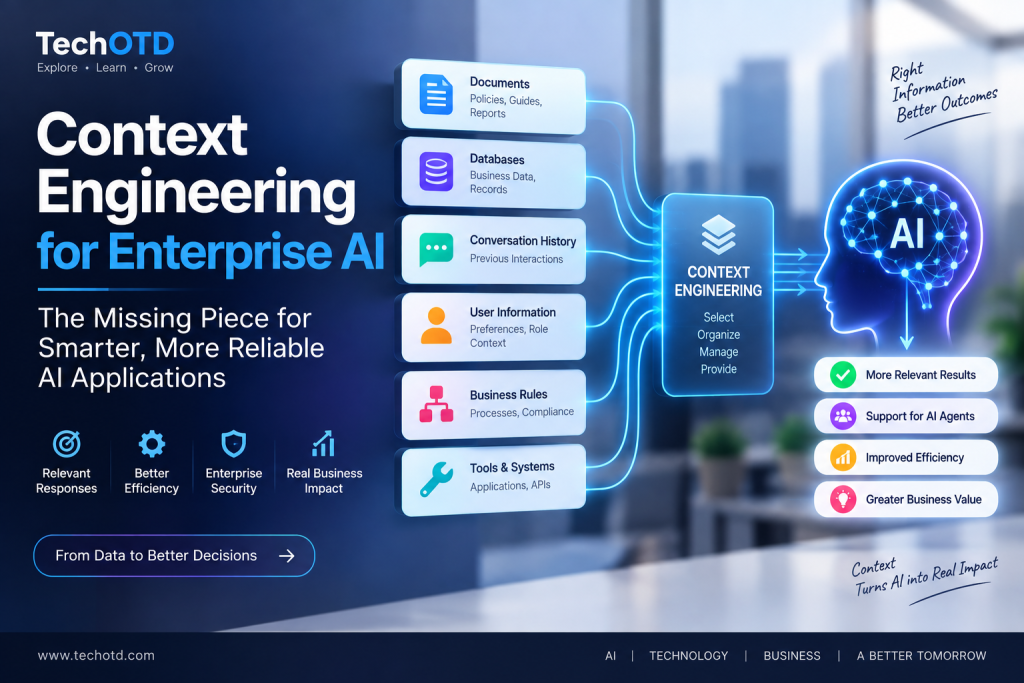
Context engineering for enterprise AI using business data and relevant information
Artificial Intelligence

Context Engineering: Why It Is Becoming Essential for Enterprise AI

Introduction As artificial intelligence becomes more deeply integrated into business applications, the quality of AI responses depends on more than the prompt alone. AI systems often need access to relevant information, instructions, user history, business data, and task-specific context to produce useful and reliable results. Prompt engineering focuses on designing effective instructions for AI models, but enterprise AI applications often require a broader approach. Businesses need to determine what information should be provided to an AI system, how that information should be structured, and when it should be included in the AI workflow. Context engineering is the process of designing and managing the information available to an AI system so it can better understand a task and generate more relevant responses. As organizations build AI agents and complex AI applications, effective context management is becoming increasingly important for performance, reliability, and scalability. What Is Context Engineering? Context engineering is the process of selecting, organizing, and providing the right information to an AI system so it can better understand a task and generate relevant, accurate, and useful responses. This information can include instructions, user preferences, conversation history, business data, documents, retrieved knowledge, and details about the current task. More Than Writing Better Prompts Prompt engineering focuses primarily on how instructions are written, while context engineering takes a broader approach. It considers everything the AI system needs to know before generating a response, including relevant background information, data, rules, and the current situation. Providing the Right Information at the Right Time An AI system does not always need access to every available piece of information. Context engineering helps determine which information is relevant to a specific task and when that information should be provided to the model. Managing Different Types of Context Enterprise AI applications may use multiple types of context, including system instructions, conversation history, customer information, company documents, database records, retrieved knowledge, and outputs from other AI tools or workflows. Why Context Quality Matters The quality and relevance of the information provided to an AI model can directly influence the usefulness of its output. Too little context may lead to incomplete responses, while irrelevant or excessive information can make it harder for the AI system to focus on the task. By carefully managing what information an AI system receives, businesses can build applications that produce more relevant and consistent results while using AI resources more efficiently. Context Engineering vs Prompt Engineering Context engineering and prompt engineering are closely related, but they focus on different parts of an AI interaction. Prompt engineering focuses on designing effective instructions, while context engineering focuses on managing the broader set of information that an AI system receives before generating a response. The Role of Prompt Engineering Prompt engineering focuses on how instructions are written and structured to guide an AI model toward a desired response. A well-designed prompt can clarify the task, define the expected output, and provide instructions about tone, format, or constraints. The Role of Context Engineering Context engineering considers the wider information environment around the prompt. This can include conversation history, user preferences, business rules, retrieved documents, database information, previous actions, and other task-specific data. Why Enterprise AI Needs Both Enterprise AI applications often require both effective prompts and well-managed context. Clear instructions help the AI understand what it should do, while relevant context helps the model understand the information and situation required to complete the task effectively. A Simple Example A customer support AI may receive an instruction to answer a customer’s question, but it may also need access to the customer’s recent interactions, product information, account details, company policies, and relevant support documents. Context engineering helps determine which of this information should be available for that specific request. Prompt engineering helps define the task, while context engineering helps provide the information needed to complete that task. Together, they can support more useful and reliable AI applications. Why Context Engineering Is Important for Enterprise AI Enterprise AI applications often operate in complex environments where a simple prompt is not enough to produce reliable results. AI systems may need access to business knowledge, user information, current data, previous interactions, and specific organizational rules to understand and complete a task effectively. Enterprise Information Is Often Distributed Business information may be stored across documents, databases, internal applications, knowledge bases, and communication systems. Context engineering helps determine how relevant information can be selected and provided to AI applications when it is needed. Better Context Can Improve AI Output Quality AI models can generate more useful responses when they receive relevant and accurate information about the task. Providing appropriate context can help reduce incomplete responses and improve the relevance of AI-generated outputs. Supporting AI Agents and Complex Workflows AI agents often perform tasks across multiple steps and may interact with different tools, systems, and sources of information. Context engineering can help ensure that an AI agent has access to the relevant information required at each stage of a workflow. Reducing Unnecessary Information Providing every available document or data source to an AI model can create unnecessary complexity and increase resource usage. Context engineering helps focus the AI system on information that is relevant to the current task. Supporting More Consistent AI Applications Enterprise AI applications may be used by many employees, customers, or automated systems. Well-managed context can help create more consistent behavior by ensuring that AI systems receive relevant instructions and information across different interactions. As enterprise AI systems become more connected to business data and workflows, context engineering can play an important role in improving AI performance, reliability, efficiency, and scalability. Key Components of Context Engineering Effective context engineering involves managing different types of information that can influence how an AI system understands and completes a task. Businesses need to decide what information should be included, how it should be organized, and when it should be provided to the AI model. System Instructions System instructions define the overall role, rules, priorities, and behavior expected from an AI system. They can provide consistent guidance

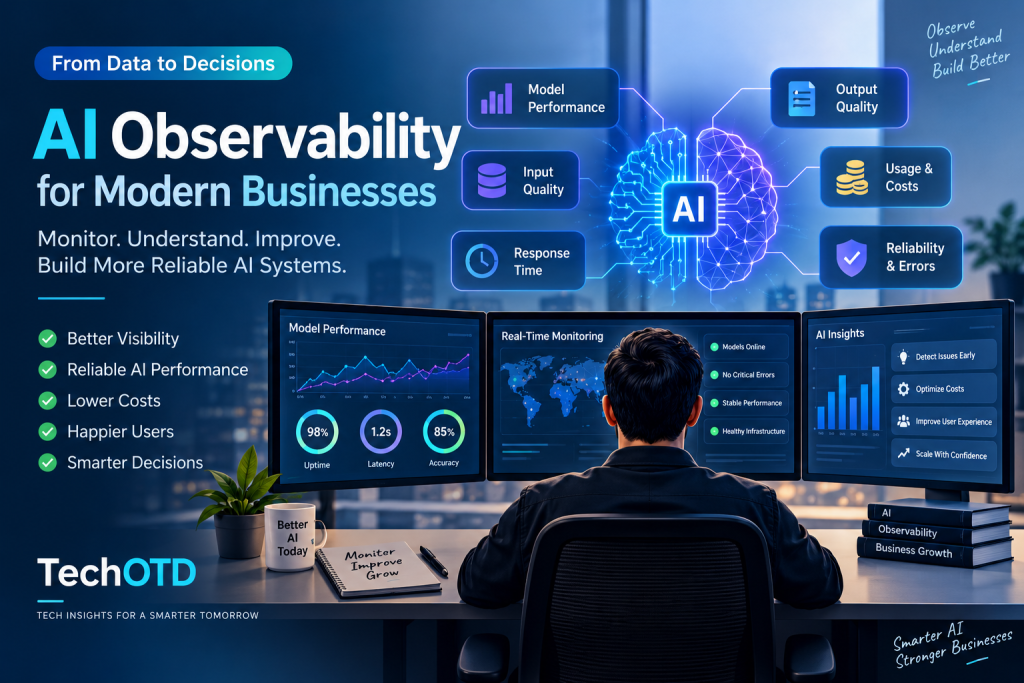
AI observability dashboard monitoring AI performance and system reliability
Artificial Intelligence

AI Observability: Why Businesses Need to Monitor AI Systems

Introduction Businesses are increasingly using artificial intelligence in customer support, software development, data analysis, automation, and decision-making. As AI systems become more important to daily business operations, organizations need better visibility into how these systems perform in real-world environments. Traditional monitoring tools can track infrastructure, applications, and system availability, but AI systems introduce additional challenges. AI outputs can vary, model performance can change over time, and factors such as data quality, response time, cost, and reliability can directly affect business outcomes. AI observability helps organizations understand what is happening inside their AI systems by monitoring model behavior, performance, inputs, outputs, and operational metrics. This visibility can help businesses identify problems, improve reliability, and manage AI systems more effectively as they scale. What Is AI Observability? AI observability is the ability to understand, monitor, and analyze how an AI system behaves in real-world operation. It provides visibility into factors such as model inputs, outputs, performance, response times, reliability, and resource usage. Beyond Traditional System Monitoring Traditional monitoring focuses primarily on infrastructure health, application availability, and technical metrics. AI observability goes further by helping organizations understand how AI models behave, whether their outputs remain useful and reliable, and how changes in data or usage affect overall performance. Understanding AI System Behavior AI systems can produce different outputs depending on the input, context, model configuration, and data available at the time of a request. AI observability helps businesses analyze these behaviors and identify unexpected patterns or performance issues. Monitoring Inputs and Outputs Monitoring AI inputs and outputs can help organizations understand how users and applications interact with AI systems. This visibility can support the detection of poor-quality inputs, unexpected responses, and patterns that may affect business performance. Supporting Reliable AI Operations As AI systems become part of important business workflows, reliability becomes increasingly important. AI observability can help teams identify potential issues earlier and maintain better visibility into how AI applications perform over time. By combining operational monitoring with visibility into model behavior, inputs, outputs, and performance, AI observability helps organizations manage increasingly complex AI systems more effectively. Why AI Observability Is Important for Businesses As businesses move AI systems from experimentation into real-world applications, understanding how those systems perform becomes increasingly important. Without clear visibility, organizations may struggle to identify why AI outputs change, performance declines, costs increase, or user experiences become inconsistent. AI Systems Can Change Over Time AI performance can change as user behavior, data patterns, workloads, and business requirements evolve. AI observability helps organizations identify these changes and understand whether they are affecting the quality or reliability of AI applications. AI Problems Are Not Always Infrastructure Problems An AI application can appear technically available while still producing poor or unreliable results. Infrastructure monitoring may show that servers and APIs are working correctly, but AI observability can provide additional visibility into model outputs and application behavior. Better Visibility for Business and Technical Teams AI systems often involve technical teams, business teams, and end users. AI observability can provide useful information that helps different stakeholders understand system performance and identify areas that may require improvement. Supporting AI at Scale As AI applications handle more users, requests, models, and workflows, identifying problems manually becomes increasingly difficult. AI observability can help organizations maintain visibility as their AI environments become larger and more complex. By providing a clearer view of how AI systems behave in production, AI observability can help businesses make more informed decisions about reliability, performance, cost, and future AI improvements. What Businesses Should Monitor in AI Systems AI observability involves monitoring more than whether an application is online or offline. Businesses need visibility into different aspects of AI system behavior to understand whether their models and AI-powered applications are delivering reliable and useful results. Model Performance Businesses should monitor whether AI models continue to perform effectively for their intended tasks. Changes in model behavior or output quality can affect the reliability and usefulness of AI applications. Input Quality and Data Patterns The quality and characteristics of inputs can significantly influence AI outputs. Monitoring data patterns can help organizations identify unusual inputs, changing user behavior, or data issues that may affect model performance. Output Quality AI-generated outputs should be monitored to determine whether they remain accurate, relevant, consistent, and useful for the intended business use case. Unexpected output patterns may indicate a need for further investigation or improvement. Response Time and Latency Response speed can directly affect the user experience of AI applications. Monitoring latency helps businesses identify whether delays are caused by models, APIs, infrastructure, or other parts of the AI workflow. AI Usage and Costs Businesses should monitor how AI resources are being used and how costs change as workloads grow. Tracking model usage, requests, and resource consumption can support better AI cost management and help identify unexpected spending. Errors and Reliability Monitoring errors, failures, and system reliability can help organizations identify technical issues that affect AI applications. Reliable AI operations require visibility into both traditional system health and AI-specific performance. By monitoring these areas together, businesses can develop a more complete understanding of how their AI systems perform and identify opportunities to improve reliability, efficiency, and business outcomes. AI Observability vs Traditional Monitoring Traditional monitoring and AI observability both help organizations understand how technology systems perform, but they focus on different types of information. Traditional monitoring primarily tracks infrastructure and application health, while AI observability provides additional visibility into model behavior, inputs, outputs, and AI-specific performance. Traditional Monitoring Traditional monitoring focuses on technical metrics such as server availability, CPU usage, memory consumption, application uptime, network performance, and error rates. These metrics help technical teams determine whether the underlying infrastructure and applications are operating correctly. AI Observability AI observability expands monitoring by examining how AI systems behave. It can provide visibility into model inputs, generated outputs, response quality, latency, usage patterns, and other factors that affect the performance of AI-powered applications. Why Businesses May Need Both An AI application depends on both reliable technical infrastructure and reliable AI behavior.

Scroll to Top