Technology & Innovation

Software development, Technology & Innovation

Beyond the Browser: Why WebAssembly (Wasm) is the Future of Web Development

Introduction:- Have you ever tried running a heavy piece of software—like a professional video editor, a massive multi-layered digital illustration tool, or a complex 3D physics engine—directly inside your web browser, only to watch your cursor freeze and your laptop fans spin up like a jet engine? For decades, we have accepted a fundamental, unwritten law of the internet: browsers are great for reading text, viewing images, filling out forms, and streaming media. But if you want to perform serious, heavy-duty computation, you have to download and install a native desktop application. JavaScript has done a heroic, borderline miraculous job of pushing the boundaries of what a webpage can do. Over the last twenty years, it evolved from a simple scripting tool designed to make image buttons animate into a language capable of powering massive single-page enterprise applications. Yet, despite just-in-time (JIT) compilation advancements, JavaScript eventually hits a rigid performance ceiling. Enter WebAssembly (Wasm). Far from being a niche tool just for browser-based video games, WebAssembly is quietly pulling off the tech world’s biggest architectural revolution. It isn’t just rewriting how we build websites; it is rewriting how we deploy cloud applications, package microservices, and run code at the edge. 1. Deconstructing the Performance Wall: Why JavaScript Isn’t Enough To understand why WebAssembly is a generational leap forward, we first have to appreciate the mechanics of how web browsers execute code, and why JavaScript can sometimes feel sluggish under heavy loads. The Lifecycle of JavaScript Execution When a browser downloads a JavaScript file, it receives a raw text file. The browser’s engine (like Google Chrome’s V8 or Mozilla’s SpiderMonkey) has to ingest this text and perform several complex steps before a single operation runs on your CPU: Parsing: The engine reads the source code and turns it into a structured tree format called an Abstract Syntax Tree (AST). Compilation: A baseline compiler transforms that AST into intermediate bytecode. Execution & JIT Optimization: An interpreter begins running the bytecode. As the code runs, a profiler watches for “hot spots”—blocks of code that run repeatedly. A Just-In-Time (JIT) compiler takes those hot spots and compiles them down to highly optimized machine code. This process is incredibly sophisticated, but it has a massive Achilles’ heel: unpredictability. Because JavaScript is a dynamically typed language, variables can change types on the fly. A function that handles integers for ten loops might suddenly receive a string on the eleventh loop. When that happens, the JIT compiler has to throw away its optimized machine code and fall back to the slow interpreted bytecode. This process of dynamic deoptimization introduces micro-stutters and performance spikes. The Sandbox and Garbage Collection Overhead JavaScript relies heavily on automatic memory management, known as Garbage Collection (GC). The browser periodically pauses your code execution to scan memory, find objects that are no longer being used, and clean them up. While modern garbage collectors are incredibly fast, these “stop-the-world” pauses are inherently unpredictable. For an enterprise dashboard, a 20ms pause is unnoticeable. For a real-time audio processing tool, a 60-FPS video editor, or an interactive CAD program, a 20ms pause means dropped frames, audio pops, and broken user experiences. 2. What is WebAssembly, Anyway? (Without the Hargon) Let’s bust the most common myth right out of the gate: WebAssembly is neither a programming language nor is it exclusively for the web. At its core, WebAssembly is a low-level binary code format and a virtual machine specification. Think of it as a universal compile target. Instead of writing Wasm code line-by-line, developers write software in highly performant, type-safe, system-level languages like Rust, C++, Go, Zig, or AssemblyScript. Once the source code is written, it is passed through a compiler toolchain (like LLVM) that translates it directly into a compact, pre-optimized binary file (.wasm). [ Your Source Code ] —> [ Compiler (LLVM / emscripten) ] —> [ .wasm Binary File ] (Rust, C++, Go, etc.) When a web browser downloads a .wasm file, it skips the slow text-parsing, AST generation, and unpredictable JIT profiling phases entirely. The binary format is structured in a way that allows the browser to compile it down to local machine code almost instantly—often at the same time the file is still streaming over the network. The Math Translator vs. The High-Speed Calculator To put this into a human perspective, imagine your web application is a highly complex architectural project. JavaScript is like a brilliantly versatile, multilingual translator on the job site. It can talk to the user, handle form layouts, change UI colors, adjust text styling, and navigate browser APIs perfectly. But if you hand the translator a massive blueprint and demand millions of high-precision trigonometry calculations to determine structural integrity in milliseconds, the translator gets bogged down. WebAssembly is like wheeling a dedicated, high-speed military-grade supercomputer onto the construction site. It doesn’t know how to talk to clients, and it doesn’t care about UI layouts. It takes the raw, massive math problems, crunches them at near-native hardware speed, and hands the clean numbers back to the translator instantly. By offloading the heavy computational lifting to WebAssembly, JavaScript is freed up to do what it does best: manage the user interface and coordinate application flow. 3. The Core Architecture of WebAssembly To truly leverage Wasm in a professional capacity, an engineer must understand its fundamental architectural constraints and design choices. Wasm operates on a remarkably elegant architecture based on a few core pillars: A Stack-Based Virtual Machine Wasm is designed as a structured, stack-based virtual machine. Most modern physical CPUs use registers to hold data during calculations. A stack machine, by contrast, evaluates instructions by pushing and popping values onto an implicit data stack. This design was chosen because it makes the binary file format highly compact, vastly simplifying verification and compilation by the underlying host system. The Linear Memory Model One of WebAssembly’s most disruptive features is its memory isolation. A Wasm module operates entirely within a single, contiguous array of raw bytes known as Linear Memory. +————————————————————-+

Artificial Intelligence, Cloud Computing and Technology, Software development, Technology & Innovation

Beyond the Hype: The Pragmatic Architect’s Guide to Microservices, Serverless, and Edge AI in 2026

Introduction: The Great Architectural Rebalancing of 2026 For nearly a decade, the tech industry operated under a collective delusion: that scalability was a problem everyone had, and that copying the infrastructure charts of Netflix or Google was the only path to engineering salvation. We sliced simple web apps into dozens of distributed microservices, built complex asynchronous event pipelines for low-traffic CRUD applications, and treated physical or local compute resources as relic storage spaces from a bygone era. Fast forward to 2026, and the architectural pendulum has swung decisively back toward pragmatism. The landscape we navigate today is defined not by framework dogmatism, but by rigid constraints. Cloud costs have escalated to the point where “FinOps” is no longer just a buzzword but a core engineering requirement. Regulatory frameworks like the EU AI Act and global data protection laws have made blind data ingestion a massive liability. Meanwhile, the absolute explosion of artificial intelligence has introduced a computing paradigm that traditional centralized cloud infrastructures simply cannot sustain economically or logistically. [ Centralized Cloud ] <— High Latency & Escalating Costs | v +—————————+ | MODERN ARCHITECTURE | —> [ Modular Monolith ] (Core Business Logic) | BALANCING | —> [ Serverless FaaS ] (Ephemeral / Event Workloads) +—————————+ | v [ Localized Edge AI ] <— Low Latency, High Privacy (NPUs / SLMs) Modern architecture is no longer about choosing a single deployment style and making it your entire engineering personality. Instead, it is an exercise in intelligent division: keeping core, transactional business logic tight and low-overhead; offloading ephemeral, event-driven tasks to serverless runtimes; and pushing heavy machine learning inference straight to the edge where data originates. This comprehensive guide is designed to help you navigate this decentralized reality. We will dissect the technical mechanics, the financial trade-offs, and the practical implementation patterns of the three pillars defining systems design today: the resurrected Modular Monolith, constrained Serverless, and Edge AI. Section 1: The Resurgence of the Modular Monolith If you told a room full of enterprise architects in 2018 that the hottest architectural trend in 2026 would be the monolith, you would have been laughed out of the room. Yet, here we are. The industry-wide migration back to single-deployable units is not a regression—it is an evolution driven by an understanding of coordination overhead. The Hidden Tax of Microservices Microservices promised autonomous teams, isolated deployments, and independent scaling. What they delivered for many mid-sized organizations was a sprawling web of network latencies, distributed tracing nightmares, and an organizational tax paid in continuous integration bottlenecks. When a single conceptual feature change requires coordinated pull requests across five different repositories, managed by three different teams, you haven’t decoupled your architecture; you have merely decoupled your text files while keeping your deployment dependencies tightly bound by an unstable network layer. Every network boundary introduced between components forces engineers to solve complex distributed systems problems: Implementing two-phase commits or Saga patterns for distributed transactions. Navigating data consistency models (eventual vs. strong consistency). Paying the performance penalty of serialization, network transit, and deserialization over HTTP/REST or even gRPC. Managing independent database instances that prevent simple SQL JOIN operations, leading to inefficient application-level data stitching. The Anatomy of a Modular Monolith The modular monolith solves the organizational and structural problems of large codebases without introducing network-induced failure modes. It is defined as a single deployable artifact containing highly isolated, independent modules with strictly enforced internal logical boundaries. +———————————————————————–+ | MODULAR MONOLITH | | | | +——————-+ In-Memory +——————-+ | | | Order Module | —————–> | Inventory Module | | | | (Private Domain) | (Public Interface) | (Private Domain) | | | +——————-+ +——————-+ | | | | | | v v | | +—————————————————————–+ | | | Isolated Schema Database Engine | | | | [Order Tables] [Inventory Tables] | | | +—————————————————————–+ | +———————————————————————–+ In a well-architected modular monolith, modules communicate using in-memory function calls or language-level interfaces, not network hops. However, they strictly respect domain separation: Database Schema Isolation: Modules do not cross-query tables belonging to other modules. If the OrderModule needs data from the InventoryModule, it must request it via the InventoryModule‘s public code interface. At the database layer, this can be enforced using separate database schemas or logical prefixes within a shared database instance. Strict Public Interfaces: Internal module implementation details are hidden behind explicit entry points (facades or public API contracts). Languages with robust module systems (such as Java’s module system, Go’s workspace layouts, or Rust’s visibility modifiers) are leveraged to block unauthorized cross-module imports at compile-time. Independent Data Models: Even if an object like a “User” is used across the system, the BillingModule and the SupportModule maintain their own distinct code definitions of a user, containing only the fields relevant to their domain. Implementing Hard Boundaries: Code Example Consider a typical backend layout structured using modern architectural patterns where boundaries are checked by automated linting or compilation rules: Go // package inventory/public_api.go package inventory type ProductAvailability struct { ProductID string IsAvailable bool StockCount int } // Only this interface and its types are accessible to external modules type Service interface { CheckStock(productID string) (ProductAvailability, error) } // package order/processor.go package order import “myproject/inventory” type OrderProcessor struct { inventoryService inventory.Service // Injected via constructor } func (op *OrderProcessor) Process(order Order) error { // Communication happens via direct, lightning-fast in-memory call avail, err := op.inventoryService.CheckStock(order.ProductID) if err != nil || !avail.IsAvailable { return ErrStockUnavailable } // Proceed with processing… return nil } By ensuring that dependencies point strictly to interfaces rather than raw database access or concrete structural implementations, teams can split a modular monolith into separate microservices in a matter of days if a specific component truly develops unique scaling demands. It acts as the ultimate pragmatic starting point. Section 2: Serverless Under Constraint – Overcoming Cold Starts and Vendor Lock-in Serverless computing (Functions-as-a-Service, or FaaS) has undergone a dramatic transformation. The early days of serverless were marked by naive enthusiasm: write a function, dump it on AWS Lambda

Artificial Intelligence, Technology & Innovation

Architects of Autonomy: The Complete Guide to Deploying Agentic AI in Enterprise Infrastructure

Introduction:- The landscape of artificial intelligence has shifted dramatically. For the past few years, organizations focused heavily on Generative AI—using Large Language Models (LLMs) primarily as sophisticated chatbots, creative writing assistants, or static data summarizers. While these applications delivered clear productivity gains, they remained fundamentally reactive. A human had to prompt the system, evaluate the output, copy-paste the result into another tool, and decide on the next course of action. The AI was a tool, not a teammate. Today, we are witnessing the dawn of the Agentic AI era. This paradigm shift moves us away from passive text generation and toward autonomous execution. Agentic AI refers to systems powered by advanced foundation models that can perceive their environment, reason through complex objectives, formulate multi-step plans, utilize external tools, collaborate with other digital entities, and execute actions to achieve specific business goals with minimal human intervention. For enterprise leaders and technology architects, this transition represents both an unprecedented opportunity and a massive infrastructure challenge. Transitioning from a single prompt-and-response model to a continuously running ecosystem of autonomous agents requires a fundamental rethinking of data pipelines, compute allocation, security frameworks, and software architecture. This guide provides a definitive roadmap for understanding, designing, and deploying enterprise-grade Agentic AI within modern technical ecosystems. Understanding the Anatomy of an AI Agent To build an effective agentic architecture, we must first break down what an AI agent actually is. Unlike a standard software program that follows rigid if/then logic, or a baseline LLM that predicts the next token in a vacuum, an autonomous agent functions as a dynamic loop of perception, reasoning, and action. An enterprise-grade agent consists of four core pillars. The Reasoning Core (The Brain) At the center of every agent is a foundation model, typically an LLM or a multimodal model. The core model acts as the central processing unit. It accepts a high-level goal from a user—such as “Audit our quarterly cloud expenditure and automatically resolve any misallocated billing codes”—and breaks it down into a logical sequence of sub-tasks. The reasoning engine utilizes sophisticated cognitive frameworks like Chain-of-Thought (CoT) or ReAct (Reason and Act) to evaluate its own progress, spot mistakes in its thinking, and pivot its approach when encountering obstacles. Memory Systems (The Context Engine) An agent cannot function effectively if it forgets what it did two minutes ago or lacks historical context about the enterprise. Agent architectures employ two primary types of memory: Short-Term Memory: This captures the immediate, in-flight context of the current task. It tracks what sub-tasks have been completed, what data has been gathered, and what the immediate next step is within a single session. Long-Term Memory: Powered by vector databases and semantic indexing, long-term memory allows an agent to retain knowledge across weeks, months, or thousands of distinct interactions. It stores user preferences, historical corporate data, past mistakes, and successful resolution patterns, allowing the agent to get smarter over time. Tool Integration (The Extremities) An LLM trapped in a sandbox can only talk. To turn talk into action, agents must be equipped with tools. Tools are APIs, database connectors, software development kits (SDKs), web scrapers, or even legacy terminal interfaces that allow the agent to interact with the external digital world. Through a process called function calling, the reasoning core determines when it needs external data or actions, selects the appropriate tool, formats the payload correctly, executes the call, and consumes the resulting data back into its reasoning loop. The Execution and Planning Layer (The Controller) This layer acts as the orchestrator that manages the state machine of the agent. It enforces constraints, manages token budgets, sets timeouts, and dictates how the agent should handle errors. If an API call fails, the planning layer prompts the reasoning core to find an alternative route rather than letting the system crash or enter an infinite loop. Infrastructure Requirements for Enterprise Agentic AI Deploying an application that hits an OpenAI or Anthropic API occasionally is relatively straightforward. Deploying thousands of autonomous agents that run continuously, polling systems, analyzing data streams, and modifying databases requires a robust, scalable, and highly resilient underlying infrastructure. Organizations looking to adopt agentic workflows must invest heavily in three distinct areas of their tech stack. Compute Optimization and Inference Scalability Agentic workflows are compute-intensive. A single user request to an agent might trigger twenty sequential calls to an LLM as the agent reasons, checks a database, refines its query, calls an API, validates the output, and finalizes the result. This creates a massive compounding effect on inference costs and latency. To mitigate this, enterprises are moving away from relying solely on commercial, one-size-fits-all API endpoints. Instead, they are adopting hybrid architectures. High-level planning and critical decision-making are routed to frontier models. Meanwhile, specialized, smaller open-source models (such as Llama-3 or Mistral variants fine-tuned for specific tasks like SQL generation or API interaction) are hosted locally on private cloud infrastructure. Utilizing advanced inference frameworks like vLLM or TensorRT-LLM, combined with dynamic batching, allows enterprises to maintain low latencies and manage predictable compute expenditures. High-Velocity and Graph-Based Data Pipelines Traditional Retrieval-Augmented Generation (RAG) relies on chunking documents and turning them into flat vector embeddings. While this works well for basic question-answering, it falls short for agentic workflows that require understanding complex corporate hierarchies, relational dependencies, and fast-changing operational data. Next-generation agent infrastructure requires a shift toward Knowledge Graphs integrated with vector spaces (GraphRAG). By representing corporate data as nodes (e.g., projects, employees, servers, clients) and edges (e.g., owns, reports to, depends on), agents can perform vastly superior semantic reasoning. If an agent is tasked with diagnosing a system outage, a knowledge graph allows it to instantly trace how a failure in a specific microservice impacts a downstream billing database, giving it the holistic perspective needed to take accurate corrective action. LLM Orchestration and Agent Frameworks Building an agent from scratch using raw API calls is akin to writing a web application in assembly language. Development teams require structured frameworks to manage agent lifecycles, states, and communications.

Artificial Intelligence, cybersecurity, Technology, Technology & Innovation

The New Cybersecurity Frontier: Defending Against AI-Driven Exploits and Autonomous Threats

The New Cybersecurity Frontier: Defending Against AI-Driven Exploits and Autonomous Threats The battleground of digital security has shifted from static defenses to dynamic, algorithmic warfare. For decades, the foundational rules of cybersecurity revolved around predictable patterns. A human attacker wrote malicious code, a security researcher analyzed its signature, and an enterprise deployed a patch or an antivirus definition to block it. This cat-and-mouse game was bounded by the limits of human speed, requiring human hours to discover vulnerabilities, write exploits, and configure defenses. That era has officially drawn to a close. The consumerization and rapid maturation of advanced artificial intelligence frameworks have handed both adversaries and defenders a radically new toolset. Today, security professionals are no longer just fighting human threat actors; they are confronting autonomous, self-learning software agents capable of executing multi-stage attacks at network speeds. When machine learning models can instantly scan millions of lines of code for zero-day vulnerabilities, dynamically mutate payload signatures to evade behavioral detection, and generate hyper-personalized social engineering campaigns at an industrial scale, traditional defensive measures collapse. The infrastructure of tomorrow cannot be protected by the manual workflows of yesterday. Understanding this new paradigm requires looking deep into how weaponized artificial intelligence operates, where it breaches existing defenses, and how enterprises must adapt to survive. The Anatomy of an AI-Driven Cyberattack To defend against an automated adversary, engineering teams must dissect how machine learning alters the traditional cyberkill chain. In a conventional attack blueprint, an offensive operation requires weeks of manual reconnaissance. Attackers trace network perimeters, map out employee organizational charts on professional networks, and carefully audit public-facing infrastructure for unpatched software versions. Artificial intelligence compresses this reconnaissance phase from weeks to seconds. Large language models and specialized code-analysis patterns can ingest massive swaths of public and private data, mapping out corporate attack surfaces with terrifying precision. An automated scanning agent can systematically probe an enterprise’s entire cloud footprint, identifying subtle logic flaws or forgotten API endpoints that a human analyst might overlook during a routine security audit. Once a vulnerability is identified, the weaponization phase begins. Historically, modifying an exploit to bypass a specific endpoint detection and response system required deep assembly-level knowledge and hours of trial and error. Weaponized AI models automate this entirely through a process known as polymorphic code mutation. The malicious agent evaluates the target environment’s defenses and dynamically alters its own structure—changing variable names, modifying execution flows, and encrypting payloads uniquely for that specific machine—ensuring that signature-based antivirus tools remain completely blind to the threat. The execution phase introduces the concept of autonomous decision-making in the wild. Traditional malware relies on a continuous back-and-forth connection with an external command-and-control server to receive instructions from a human operator. This network traffic is highly visible and often triggers behavioral alarms within modern network monitoring suites. An AI-driven malicious agent, however, carries its neural net logic directly within its payload. It can make independent, real-time decisions inside a compromised network—such as choosing when to lie dormant to avoid detection, which high-value databases to target for lateral movement, and how to quietly exfiltrate data without triggering data loss prevention systems. The Weaponization of Large Language Models and Deepfakes Beyond pure code execution, the intersection of generative artificial intelligence and social engineering represents one of the most immediate financial hazards to modern enterprises. Social engineering has always relied on human psychology, but it was historically limited by language barriers, stylistic inconsistencies, and the sheer time required to engage with targets. Generative text models have completely democratized the production of flawless phishing campaigns. Phishing emails used to be easy to spot, often plagued by broken grammar, generic greetings, and suspicious formatting. Today, specialized malicious LLMs can generate perfectly written, context-aware correspondence tailored to a specific target’s industry jargon, corporate hierarchy, and historical writing style. By scraping an executive’s public presentations, blog posts, and social media presence, an automated agent can construct emails that are virtually indistinguishable from legitimate corporate communications, drastically increasing the success rate of business email compromise attacks. Simultaneously, the maturation of synthetic audio and video generation—commonly referred to as deepfakes—has added an entirely new dimension to identity theft and corporate fraud. Threat actors no longer rely solely on written words to trick financial departments into executing fraudulent wire transfers. They deploy real-time voice cloning tools during active phone calls, mimicking the exact cadence, tone, and vocal characteristics of a company’s Chief Financial Officer or Chief Executive Officer. In advanced scenarios, attackers execute highly coordinated multi-media deceptions. They schedule video conference calls where an AI-generated avatar of a trusted corporate leader directs a mid-level manager to bypass standard verification protocols for an urgent, confidential corporate acquisition. The psychological impact of seeing a familiar face and hearing a familiar voice completely bypasses the traditional skepticism employees have been trained to maintain, revealing that the human element remains the most vulnerable interface in the corporate security stack. Vulnerabilities Inherent in the AI Lifecycle As companies rush to integrate artificial intelligence into their own products and internal workflows, they inadvertently introduce an entirely new category of software vulnerabilities. These are not standard software bugs like buffer overflows or SQL injections; they are flaws native to the data structures, training pipelines, and architectural design of machine learning systems. The first major vulnerability is data poisoning. Machine learning models are entirely products of the data they consume during training. If a threat actor managed to subtly corrupt the training dataset of an enterprise model—for instance, by injecting malicious code samples labeled as benign into an automated code-review model—the resulting neural network would inherently inherit that blind spot. The model would systematically approve malicious patterns in production, creating an architectural vulnerability that is incredibly difficult to detect through standard source-code analysis. The second critical risk vector is prompt injection, which specifically targets applications built on top of large language models. Because these systems process user inputs and system instructions within the same linguistic context window, an attacker can craft input strings that overwrite the model’s core

Cloud Computing and Technology, Digital Transformation, Technology, Technology & Innovation

The Future of Web Architecture: Why Edge Computing and Backendless Frameworks Are Redefining Scalability

The Future of Web Architecture: Why Edge Computing and Backendless Frameworks Are Redefining Scalability The internet is undergoing a quiet but radical structural transformation. For decades, the standard blueprint for building a web application followed a predictable, centralized path. A user in Tokyo would open a browser, click a button, and send a request across continents to a massive data center located in Northern Virginia or Ireland. The server would process the request, query a central database, format the data, and send it all the way back. While fiber-optic cables and content delivery networks optimized this journey, the fundamental limitation remained: physical distance equals latency. In a digital economy where a 100-millisecond delay can slash conversion rates by double digits, relying entirely on centralized cloud warehouses is no longer a viable strategy for hyper-scale applications. At the same time, the operational overhead of managing backend infrastructure has become an unnecessary burden for modern development teams. The traditional duties of provision, scaling, patching, and maintaining database connections are increasingly viewed as friction. To solve these compounding challenges, two architectural paradigms have converged to create a new blueprint for the web: Edge Computing and Backendless Frameworks. Together, they are shifting the center of gravity of the internet away from centralized mega-data centers and placing it directly at the perimeter of the network, mere miles—or sometimes millimeters—away from the end user. This is not just an incremental upgrade to server infrastructure; it is a fundamental re-engineering of how data is processed, stored, and delivered across the globe. The Limits of Centralized Cloud Infrastructure To understand where web architecture is going, we must first analyze the breaking points of where it has been. The rise of cloud computing giants in the late 2000s revolutionized the tech industry by turning hardware into software. Instead of buying physical racks, companies rented virtual machines. This centralized model brought unprecedented convenience, but it introduced structural inefficiencies that are now catching up to modern engineering demands. The first issue is the speed of light. Data cannot travel faster than the laws of physics allow. When an application requires complex server-side rendering or dynamic database lookups, a round-trip journey to a central cloud region introduces an unavoidable floor of latency. As applications become more interactive, relying on real-time data streaming, collaborative interfaces, and instant feedback loops, this regional latency becomes a jarring user experience bottleneck. The second bottleneck is data egress and bandwidth congestion. Centralized architectures require that every single interaction, no matter how trivial, be pushed to the core network. As billions of internet-of-things devices, smartphones, and smart appliances flood the internet with telemetry and media data, backhauling this raw information to central data centers creates immense network strain and skyrocketing cloud bills. Finally, centralized systems present a concentrated blast radius for failures. When a primary cloud region experiences a routing misconfiguration or power outage, thousands of dependent services across the globe go dark simultaneously. The internet becomes brittle when its intelligence is concentrated in only a handful of geographic zones. Demystifying Edge Computing Edge computing flips the centralized model on its head by moving compute and storage capabilities out of distant data centers and into localized nodes positioned directly at the network’s perimeter. These nodes are embedded within cellular towers, regional internet service providers, and content delivery network points of presence. Instead of acting as passive pipes that merely cache static images and style sheets, modern edge networks operate as distributed mini-computers capable of executing complex code on the fly. When a user interacts with an edge-native application, their request is intercepted by the physically closest node. If code execution is required, it happens right there. By processing data at the edge, the round-trip time across the backbone of the internet is completely eliminated. Latency drops from hundreds of milliseconds to single digits. Crucially, edge computing changes how we handle data security and compliance. Instead of transmitting sensitive user information across sovereign borders to a centralized server, data can be sanitized, filtered, and anonymized locally at the edge. If local regulations require that citizen data remain within specific geographic boundaries, edge nodes can enforce these compliance rules dynamically, ensuring data sovereignty without sacrificing application performance. The Rise of Backendless and Serverless Frameworks Simultaneously, the development philosophy of “Backendless” architecture has matured from a niche experimental approach into an enterprise-grade standard. To clear up a common misconception: backendless does not mean there is no backend. It means that developers no longer build, manage, or maintain custom backend infrastructure or dedicated server instances. In a traditional setup, an engineering team spends significant time writing boilerplate code for authentication, session management, database scaling, file uploads, and API routing. They must configure load balancers to handle traffic spikes and set up monitoring tools to catch server crashes. Backendless frameworks abstract this entire layer away. Instead of writing a continuous monolithic server application, developers leverage managed, highly specialized micro-utilities and BaaS (Backend-as-a-Service) ecosystems. Authentication is handled by fully managed identity providers; file storage is offloaded to intelligent object storage systems; and custom business logic is broken down into modular, event-driven functions that execute only when explicitly triggered. This shift radically alters the economics of software development. Traditional servers run continuously, charging businesses for idle CPU cycles even when no users are online. Backendless architectures operate on a strict pay-as-you-go model. If an application receives zero traffic overnight, the infrastructure costs zero. When a massive spike of a million concurrent users hits the application, the underlying platform automatically provisions the necessary micro-resources instantly, scaling down just as quickly when the surge subsides. Developers are freed from the anxieties of infrastructure management, allowing them to focus exclusively on refining user experiences and frontend product value. The Convergence: Computational Edge Meets Managed Backends The true magic happens where edge computing and backendless frameworks intersect. For a long time, serverless functions suffered from a major flaw known as “cold starts.” Because cloud providers had to dynamically spin up a virtual container or runtime environment when a

Artificial Intelligence, Software development, Technology & Innovation

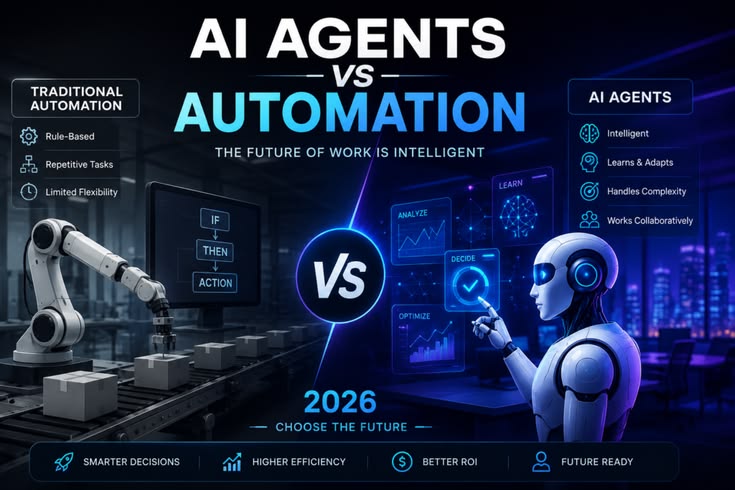
AI Agents vs. Traditional Automation: What’s Changing in 2026?

Introduction: The Evolution from Rules to Reasoning For decades, digital transformation was defined by a single, unwavering engineering paradigm: determinism. If you wanted a machine to execute a task, you had to explicitly map out every single variable, branch, and conditional statement beforehand. If an input deviated by even a single character from the expected schema, the automation would crash. This rigid framework birthed the massive market for Robotic Process Automation (RPA) and standard backend API integrations. By 2026, this deterministic wall has completely crumbled. We are currently witnessing a massive architectural migration from standard rule-based workflows to autonomous AI Agents. Unlike traditional software that simply accelerates data transmission across static structures, AI agents possess a cognitive layer. They don’t just execute instructions; they reason, interpret intent, adapt to unpredictable runtime changes, and dynamically formulate their own execution paths. This guide explores the deep technical divides between these two methodologies, maps out the core mechanics of agentic systems, and provides an enterprise blueprint for managing this massive shift. Section 1: Defining the Technical Boundary To understand this architectural evolution, we must establish clear technical boundaries between traditional automation and an actual AI agent. Traditional Automation: Rule-Based Systems Traditional automation operates entirely on if-this-then-that (IFTTT) execution graphs. A software engineer constructs a explicit pipeline using tools like Selenium, UiPath, or custom cron jobs. The software intercepts an input, references a hardcoded template or static database schema, maps fields explicitly, and routes the data to a destination API. The software has zero contextual understanding of the data it manipulates. If a vendor changes a button’s CSS selector on a billing portal, or if an invoice shifts a line item by five pixels, the script breaks. It cannot problem-solve because its world consists exclusively of binary conditions and explicitly coded paths. AI Agents: Goal-Oriented Systems An AI Agent is a software entity that leverages a Large Language Model (LLM) or Large Multimodal Model (LMM) as its central processing unit, running inside a continuous, stateful loop. Instead of receiving a step-by-step instruction set, an agent is given an objective, a set of constraints, and access to an array of external tools. The agent evaluates the current state of its environment, breaks down the main objective into an ordered series of sub-tasks, selects the appropriate tool for the immediate sub-task, analyzes the output of that tool, and continuously modifies its strategy based on real-time feedback. It handles unstructured data natively because it interprets semantic meaning rather than just looking for exact string matches. Section 2: Architectural Comparison: Static Pipelines vs. Cognitive Loops The foundational code paths of these two systems look fundamentally different under the hood. The Linear Pipeline Structure Traditional automation relies on linear or predictable branching logic. The execution flow looks like this: [Inbound Webhook] —> [Parse Exact JSON Schema] —> [Conditional Branching] —> [Write to Destination API] If any link in this chain encounters an anomaly, the execution thread fails, records an error log, and requires human intervention to patch the underlying code. The Agentic Cognitive Loop An autonomous AI agent runs within a non-linear, dynamic cognitive loop, often structured around the OODA Loop (Observe, Orient, Decide, Act) framework: +—————————————+ | Goal Formulation | +—————————————+ | v +———————————————+ —–> | Perception & Observation (Ingest Context) | | +———————————————+ | | | v | +———————————————+ | | Reasoning & Planning (LLM Evaluation) | | +———————————————+ | | | v | +———————————————+ | | Tool Selection & Execution (Take Action) | | +———————————————+ | | +—————————–+ The Core Pillars of Agent Architecture 1. The Planning Core The planning engine decomposes the primary target into manageable milestones. Modern agents utilize advanced prompt-engineering frameworks like Chain-of-Thought (CoT) or Tree-of-Thoughts (ToT) to explore multiple reasoning paths simultaneously, evaluating the probability of success for each direction before executing code. 2. Contextual Memory Systems Agents rely on two distinct memory tiers to maintain consistency over long-running operations: Short-Term Memory: Managed directly via the model’s active context window, keeping track of immediate conversational turns, tool outputs, and local state variables. Long-Term Memory: Powered by an external vector database or graph database. The agent saves past executions, successful problem-solving strategies, and corporate guidelines, retrieving them via semantic search whenever a similar task boundary arises. 3. Tool Utilization (Function Calling) Tools are the hands of the agent. A tool can be a database connection, an internal API, a web scraper, or a command-line terminal. The agent reads the documentation of these tools (written in clear, natural language schemas), determines which tool matches the current sub-task, formats the payload dynamically, executes the call, and parses the returned data to determine the next course of action. Section 3: In-Depth Comparison Matrix Technical Capability Traditional Automation (RPA/APIs) Autonomous AI Agents (2026 Paradigm) Input Type Access Strictly Structured (JSON, XML, CSV) Fully Unstructured (Audio, Video, PDFs, Free Text) Execution Paths Static, Pre-compiled, Deterministic Dynamic, Emergent, Goal-Oriented Error Handling Hardcoded try/catch blocks; immediate crash Autonomous Self-Healing and Error Correction Maintenance Profile High overhead; breaks on UI/API changes Self-adapting; updates strategies based on UI shifts Data Processing Exact string matching and regex parsers Semantic interpretation and conceptual mapping Compute Overhead Negligible; ultra-lightweight execution Substantial; high dependency on token throughput and inference speeds Section 4: Deep Dive into Multi-Agent Orchestration Systems As enterprise environments scale up, relying on a single, massive monolithic agent becomes inefficient. The complexity of managing massive context windows and disparate tool sets introduces latency and hallucinations. The industry has shifted heavily toward Multi-Agent Systems (MAS). In a multi-agent framework, complex corporate operations are divided among specialized, narrow AI agents that communicate with each other over structured protocol buses. +———————————–+ | Enterprise Controller | | (Manager/Router Agent) | +———————————–+ | +———————–+———————–+ | | v v +———————–+ +———————–+ | Security Audit Agent | | Data Extraction Agent | | – Validates Code | <== (Internal Bus) => | – Parses Documents | | – Monitors Regs | | – Cleans Inbound APIs| +———————–+ +———————–+ The Hierarchical Topology In this architecture, a Manager Agent intercepts user intents

Software development, Technology, Technology & Innovation

The Future of Wearable Technology: Beyond Smartwatches

The Future of Wearable Technology: Beyond Smartwatches Wearable technology has become a major part of modern life. Just a decade ago, wearable devices were mostly limited to fitness bands that counted steps and tracked basic activity. Today, smartwatches can monitor heart rates, detect falls, measure blood oxygen levels, and even perform electrocardiograms. However, the wearable technology industry is rapidly moving beyond smartwatches. In 2026, the next generation of wearable devices is transforming how people interact with technology, manage their health, communicate, and experience the digital world. From smart glasses and AI-powered assistants to smart clothing and health-monitoring patches, wearable technology is becoming more intelligent, less intrusive, and more integrated into everyday life. As advancements in artificial intelligence, sensors, connectivity, and materials science continue to accelerate, the future of wearable technology promises experiences that were once considered science fiction. The Evolution of Wearable Technology The journey of wearable technology began with simple devices designed to track physical activity. Over time, improvements in miniaturization, battery efficiency, and wireless communication allowed manufacturers to create more sophisticated products. The first wave of wearables focused on fitness tracking. The second wave introduced smartwatches capable of delivering notifications, supporting mobile payments, and monitoring health metrics. Today, the industry is entering its third wave, where wearable devices are becoming proactive companions rather than passive tools. Modern wearables are increasingly capable of understanding user behavior, predicting needs, and providing personalized recommendations through artificial intelligence. Instead of simply collecting data, future wearables will help users make informed decisions about their health, productivity, and daily routines. Why the Smartwatch Is No Longer the Center of Innovation Although smartwatches remain popular, they face several limitations. Small screens restrict user interactions, battery life remains a challenge, and constant notifications can contribute to digital fatigue. Technology companies are now exploring alternative wearable formats that provide richer experiences while reducing dependence on smartphones and traditional screen-based interfaces. The goal is not to replace smartwatches entirely but to create an ecosystem of specialized wearable devices that work together seamlessly. Smart Glasses: The Next Major Computing Platform One of the most promising developments in wearable technology is the rise of smart glasses. Unlike traditional screens that require users to look down at a phone or smartwatch, smart glasses place information directly within the user’s field of vision. This creates a more natural and immersive way of interacting with digital content. Future smart glasses are expected to offer: Real-time navigation overlays Instant language translation Hands-free communication AI-powered personal assistance Enhanced workplace productivity Augmented reality experiences Advancements in display technology are making smart glasses lighter, more stylish, and more practical for everyday use. As battery performance improves and artificial intelligence becomes more capable, smart glasses could eventually become the primary interface for digital interactions. AI-Powered Wearables Are Becoming Personal Assistants Artificial intelligence is rapidly becoming the driving force behind wearable innovation. Future wearable devices will do far more than collect information. They will analyze behavior patterns, understand user preferences, and proactively offer assistance. Imagine a wearable device that: Detects signs of stress before you notice them Suggests breaks during long work sessions Provides personalized fitness coaching Recommends dietary adjustments Schedules meetings based on energy levels Offers contextual information during conversations These capabilities are becoming possible through advanced machine learning models that process data directly on devices or through secure cloud platforms. AI-powered wearables are transforming technology from a reactive tool into a proactive companion. The Rise of Smart Clothing Smart clothing is emerging as one of the most exciting areas of wearable technology. Instead of wearing separate devices, users may soon wear garments embedded with intelligent sensors. These textiles can continuously monitor various physiological and environmental conditions without requiring additional accessories. Potential applications include: Heart rate monitoring Respiratory tracking Muscle activity analysis Posture correction Temperature regulation Athletic performance optimization For athletes, smart clothing can provide detailed performance insights. For healthcare providers, it can enable continuous patient monitoring. For everyday users, it can offer health tracking without the inconvenience of multiple devices. As flexible electronics become more affordable, smart clothing could become a mainstream technology over the next decade. Wearable Health Technology Is Revolutionizing Healthcare Healthcare remains one of the most impactful applications of wearable technology. Current wearable devices already track: Heart rate Sleep quality Blood oxygen levels Physical activity Stress indicators Future generations of wearables are expected to monitor even more advanced health metrics, including: Continuous blood pressure tracking Non-invasive glucose monitoring Hydration levels Early disease detection Respiratory health indicators Mental wellness metrics Continuous monitoring allows healthcare professionals to identify health risks before symptoms become severe. This shift from reactive healthcare to preventive healthcare has the potential to improve outcomes while reducing medical costs. Wearable health technology could become a critical component of personalized medicine in the coming years. Smart Rings Are Gaining Popularity Smart rings represent another growing category within wearable technology. These compact devices provide many of the same benefits as smartwatches while offering a more discreet form factor. Modern smart rings can track: Sleep patterns Activity levels Heart rate variability Stress levels Recovery metrics Because they are lightweight and comfortable, smart rings appeal to users who prefer minimalistic technology. As sensor technology continues to improve, smart rings may become powerful health-monitoring tools capable of delivering highly accurate biometric data. Brain-Computer Interfaces and Neural Wearables Perhaps the most futuristic area of wearable technology involves brain-computer interfaces (BCIs). These systems allow direct communication between the human brain and digital devices. Although still in the early stages of development, neural wearables could eventually enable: Hands-free device control Enhanced accessibility for people with disabilities Faster communication Advanced gaming experiences Cognitive monitoring Personalized learning systems Researchers and technology companies are investing heavily in this field because of its potential to redefine human-computer interaction. While widespread adoption may still be years away, neural wearables represent one of the most transformative possibilities for the future. Wearable Technology in the Workplace Businesses are increasingly adopting wearable technology to improve productivity, safety, and efficiency. Industrial wearables can help workers by: Providing real-time instructions

Artificial Intelligence, Software development, Technology & Innovation

Green AI: Making Artificial Intelligence More Sustainable

Green AI: Making Artificial Intelligence More Sustainable Artificial Intelligence (AI) has become one of the most transformative technologies of the modern era. From powering virtual assistants and recommendation systems to driving autonomous vehicles and advanced medical diagnostics, AI is changing the way individuals, businesses, and governments operate. However, as AI systems become more powerful and widespread, concerns about their environmental impact are growing. Training and operating large AI models require significant computing power, which in turn consumes vast amounts of electricity. Data centers housing AI infrastructure operate around the clock, contributing to energy consumption and carbon emissions. As organizations increasingly adopt AI solutions, the need for sustainable practices has become more important than ever. This is where Green AI comes into the picture. Green AI focuses on developing, deploying, and maintaining artificial intelligence systems in ways that minimize environmental impact while maximizing efficiency. It represents a growing movement within the technology industry aimed at balancing innovation with sustainability. What Is Green AI? Green AI refers to the practice of designing artificial intelligence systems that prioritize energy efficiency, resource optimization, and environmental sustainability. Unlike traditional AI development, which often focuses solely on achieving higher performance and accuracy, Green AI also considers the environmental costs associated with training and running AI models. The concept encourages researchers and organizations to measure not only the effectiveness of AI systems but also the resources required to build and operate them. This includes factors such as electricity consumption, carbon emissions, hardware utilization, and computational efficiency. Green AI promotes the idea that technological progress should not come at the expense of the environment. Instead, innovation should be aligned with sustainable development goals. Why Sustainability Matters in AI Artificial intelligence models are becoming increasingly complex. Modern generative AI systems often require enormous datasets and thousands of powerful processors to train effectively. Training a single large-scale AI model can consume as much electricity as hundreds of households use over several months. As AI adoption accelerates across industries, energy demand is expected to rise significantly. Without sustainable practices, the environmental footprint of AI could become a major concern. Several factors highlight the importance of sustainability in AI: Rising Energy Consumption AI workloads demand substantial computing resources. Large language models, image generation systems, and deep learning networks require extensive processing power that translates directly into increased energy usage. Growing Data Center Footprint Data centers serve as the backbone of AI infrastructure. These facilities consume massive amounts of electricity for both computing and cooling systems. As AI applications expand, data center energy requirements continue to increase. Carbon Emissions In regions where electricity is generated from fossil fuels, AI operations contribute to greenhouse gas emissions. Reducing these emissions is critical to achieving global climate goals. Resource Utilization Manufacturing AI hardware such as GPUs and specialized chips requires valuable natural resources. Sustainable AI practices help maximize the lifespan and efficiency of these technologies. The Evolution of Green AI The discussion around Green AI gained momentum as researchers began examining the environmental costs of training increasingly large machine learning models. While advancements in AI delivered impressive results, many experts questioned whether the pursuit of marginal performance improvements justified the significant increase in computational requirements. As awareness grew, researchers started advocating for greater transparency regarding the energy consumption and carbon footprint of AI systems. This shift encouraged organizations to consider efficiency as a key performance metric alongside accuracy. Today, Green AI has evolved into a broader movement that includes sustainable infrastructure, energy-efficient algorithms, responsible hardware design, and environmentally conscious deployment strategies. Key Principles of Green AI Energy Efficiency One of the primary goals of Green AI is reducing the amount of energy required to train and operate AI models. Developers achieve this through optimized algorithms, efficient architectures, and improved hardware utilization. Resource Optimization Green AI encourages maximizing the use of existing computational resources. Instead of constantly scaling infrastructure, organizations focus on improving efficiency and eliminating waste. Transparency Researchers are increasingly reporting computational costs alongside model performance metrics. This transparency helps stakeholders make informed decisions about AI development practices. Sustainable Infrastructure Green AI supports the use of renewable energy sources, efficient cooling systems, and environmentally friendly data center designs. Long-Term Environmental Responsibility The movement promotes balancing technological innovation with ecological responsibility, ensuring that future AI advancements remain sustainable. How Green AI Reduces Environmental Impact Efficient Model Design Developers are creating AI architectures that achieve comparable results with fewer parameters and lower computational requirements. Smaller and more efficient models consume less energy during both training and inference. Model Compression Techniques Techniques such as pruning, quantization, and knowledge distillation help reduce model size while maintaining performance. These methods decrease computational demands and energy consumption. Transfer Learning Rather than training models from scratch, transfer learning allows developers to build upon existing pre-trained models. This significantly reduces training time and resource requirements. Optimized Training Processes Advanced training strategies improve efficiency by reducing unnecessary computations. Better scheduling and workload management contribute to lower energy usage. Edge Computing Running AI applications closer to users through edge devices reduces the need for constant communication with centralized data centers. This can lower network energy consumption and improve efficiency. The Role of Renewable Energy in Green AI Renewable energy plays a crucial role in making AI more sustainable. Many technology companies are investing heavily in solar, wind, and hydroelectric power to support their AI operations. By powering data centers with renewable energy, organizations can significantly reduce the carbon footprint associated with AI workloads. Some companies are even designing data centers in locations where renewable energy resources are abundant. The integration of clean energy sources allows AI innovation to continue while minimizing environmental impact. Green Data Centers: The Foundation of Sustainable AI Data centers are at the heart of modern AI systems. Making these facilities more sustainable is essential for achieving Green AI objectives. Energy-Efficient Cooling Cooling systems often account for a significant portion of data center energy consumption. Modern facilities use advanced cooling technologies, including liquid cooling and intelligent climate control systems. Smart Energy Management

Digital Transformation, Technology & Innovation, telecom

The Business Impact of 5G and the Road to 6G Connectivity

The Business Impact of 5G and the Road to 6G Connectivity The world is becoming increasingly connected, and the technologies that power this connectivity are evolving at an unprecedented pace. Over the past few years, 5G has emerged as one of the most transformative technological advancements, promising faster speeds, lower latency, and the ability to connect billions of devices simultaneously. While many businesses are still exploring the full potential of 5G, discussions about 6G are already gaining momentum. Connectivity has become the foundation of modern business operations. From cloud computing and remote work to artificial intelligence and the Internet of Things (IoT), organizations depend on reliable, high-speed networks to remain competitive. As industries continue their digital transformation journeys, both 5G and the future transition to 6G are expected to redefine how businesses operate, innovate, and serve customers. Understanding the impact of these technologies is essential for organizations that want to stay ahead in a rapidly evolving digital landscape. Understanding 5G Technology 5G, or fifth-generation wireless technology, represents a significant upgrade from previous mobile network generations. Unlike 4G, which primarily focused on improving mobile internet speeds, 5G is designed to support a wide range of advanced applications and connected ecosystems. One of the most notable features of 5G is its ability to deliver extremely high data transfer speeds. Businesses can transmit large volumes of information in real time, enabling smoother communication, faster cloud access, and improved operational efficiency. Another critical advantage is ultra-low latency, which reduces the delay between sending and receiving information. This capability is particularly important for applications that require real-time responsiveness, such as autonomous vehicles, remote surgery, and industrial automation. Additionally, 5G can support a significantly larger number of connected devices compared to previous generations. This makes it ideal for environments where thousands or even millions of sensors, machines, and smart devices need to communicate simultaneously. How 5G Is Transforming Businesses The impact of 5G extends far beyond faster smartphone internet. Businesses across various sectors are leveraging this technology to create new opportunities and improve existing operations. Enhanced Remote Work and Collaboration The shift toward hybrid and remote work has increased the demand for reliable connectivity. 5G enables seamless video conferencing, faster file sharing, and real-time collaboration regardless of location. Employees can access cloud-based applications more efficiently, reducing delays and improving productivity. As organizations continue to embrace flexible work models, 5G provides the infrastructure needed to support distributed teams and digital workplaces. Accelerating the Internet of Things (IoT) The Internet of Things is one of the biggest beneficiaries of 5G technology. Smart devices generate enormous amounts of data, and 5G networks provide the bandwidth and reliability required to manage these connections effectively. Businesses can deploy large-scale IoT ecosystems for applications such as: Smart manufacturing Asset tracking Supply chain monitoring Smart agriculture Energy management Connected healthcare devices The ability to process and transmit data in real time enables organizations to make faster and more informed decisions. Revolutionizing Manufacturing Manufacturing is undergoing a major transformation through Industry 4.0 initiatives, and 5G plays a central role in this evolution. Factories equipped with connected sensors, autonomous robots, and intelligent monitoring systems can achieve greater efficiency and productivity. Real-time communication between machines allows manufacturers to optimize production processes, reduce downtime, and improve quality control. Predictive maintenance powered by IoT sensors helps identify potential equipment failures before they occur, minimizing disruptions and reducing maintenance costs. Improving Customer Experiences Customer expectations continue to rise, and businesses are seeking innovative ways to deliver personalized and engaging experiences. Retailers can use 5G-powered technologies such as augmented reality (AR) and virtual reality (VR) to create immersive shopping experiences. Customers can virtually try products, explore digital showrooms, and receive personalized recommendations in real time. Similarly, entertainment companies can deliver high-quality streaming services with minimal buffering, enhancing user satisfaction and engagement. Driving Innovation in Healthcare Healthcare organizations are leveraging 5G to improve patient care and operational efficiency. Real-time data sharing enables healthcare providers to access patient information instantly, facilitating faster diagnosis and treatment decisions. Telemedicine services become more reliable and effective, allowing doctors to consult with patients remotely without connectivity limitations. Advanced applications such as remote robotic surgery and AI-assisted diagnostics also benefit from the low latency and high reliability offered by 5G networks. Supporting Smart Cities Cities around the world are investing in smart infrastructure to improve transportation, energy management, public safety, and environmental monitoring. 5G provides the connectivity foundation for smart city initiatives by enabling real-time communication between sensors, cameras, vehicles, and public services. This results in more efficient resource utilization and improved quality of life for residents. Economic Benefits of 5G Adoption The adoption of 5G is generating significant economic opportunities for businesses and governments alike. Organizations that invest in 5G-enabled solutions can experience: Increased operational efficiency Reduced infrastructure costs Faster innovation cycles Enhanced customer engagement Improved workforce productivity New revenue streams Many businesses are also developing entirely new products and services that were not feasible under previous network limitations. As 5G ecosystems continue to mature, the economic impact is expected to expand across virtually every industry. Challenges in 5G Implementation Despite its advantages, implementing 5G is not without challenges. One of the primary concerns is infrastructure investment. Deploying 5G networks requires significant upgrades to existing telecommunications infrastructure, including additional base stations and advanced networking equipment. Cybersecurity is another important consideration. As more devices become connected, the potential attack surface for cyber threats increases. Businesses must implement robust security measures to protect sensitive data and critical systems. There are also concerns related to spectrum availability, regulatory compliance, and interoperability between different technologies and vendors. Organizations must carefully plan their adoption strategies to maximize benefits while managing risks. Looking Beyond 5G: The Emergence of 6G While 5G is still being rolled out globally, researchers and technology companies are already exploring the possibilities of 6G. 6G is expected to represent the next major leap in wireless communication. Although commercial deployment may still be years away, early research suggests that 6G could deliver speeds up to 100 times faster

Business, Business Analytics, Technology, Technology & Innovation

Hyperautomation in 2026: Beyond Traditional Process Automation

Hyperautomation in 2026: Beyond Traditional Process Automation Businesses have spent years automating repetitive tasks to improve efficiency and reduce operational costs. Traditional automation solutions, particularly Robotic Process Automation (RPA), have helped organizations streamline rule-based processes such as data entry, invoice processing, customer onboarding, and report generation. While these technologies have delivered significant value, the business landscape of 2026 demands much more than simple task automation. Organizations are now dealing with massive volumes of data, increasingly complex workflows, evolving customer expectations, and growing pressure to make faster decisions. As a result, companies are moving beyond basic automation and embracing hyperautomation—a more advanced approach that combines multiple technologies to automate entire business processes from start to finish. Hyperautomation is no longer a futuristic concept. It has become a strategic priority for organizations seeking greater agility, productivity, and innovation. By integrating artificial intelligence, machine learning, process mining, low-code platforms, intelligent document processing, and robotic process automation, businesses can create intelligent systems capable of learning, adapting, and making decisions with minimal human intervention. Understanding Hyperautomation Hyperautomation refers to the coordinated use of multiple advanced technologies to identify, automate, optimize, and continuously improve business processes. Unlike traditional automation, which focuses on individual tasks, hyperautomation aims to automate complete workflows across departments and systems. Think of traditional automation as teaching a machine to perform one repetitive task. Hyperautomation, on the other hand, creates an ecosystem where different technologies work together to handle complex business operations autonomously. For example, when a customer submits a loan application, a hyperautomation system can automatically collect documents, verify information, assess risk using AI models, perform compliance checks, communicate with the customer, and generate approval decisions. What once required multiple employees and several days can now be completed within minutes. The goal is not simply to replace manual work but to create intelligent business operations that continuously learn and improve. Why Hyperautomation Is Gaining Momentum in 2026 Several factors are driving the rapid adoption of hyperautomation across industries. The first is the explosion of enterprise data. Organizations generate vast amounts of structured and unstructured information every day. Processing this data manually is increasingly impractical. Hyperautomation enables businesses to extract insights, make decisions, and execute actions automatically. Another major driver is the growing demand for operational efficiency. Economic uncertainty and competitive markets are forcing organizations to do more with fewer resources. Hyperautomation helps reduce costs while improving speed and accuracy. Customer expectations have also evolved significantly. Modern consumers expect instant responses, personalized experiences, and seamless service. Businesses that rely solely on manual processes struggle to meet these expectations consistently. Additionally, advances in artificial intelligence have made intelligent automation more accessible than ever before. AI models can now understand language, analyze documents, recognize patterns, and generate recommendations with remarkable accuracy. Together, these factors are pushing businesses toward a new era of automation where machines not only execute tasks but also support decision-making and continuous optimization. Key Technologies Powering Hyperautomation Hyperautomation is not a single technology. It is a combination of several powerful tools working together. Artificial Intelligence and Machine Learning AI and machine learning provide the intelligence behind hyperautomation. These technologies allow systems to analyze data, identify patterns, make predictions, and improve performance over time. In customer service, AI can classify support requests, suggest responses, and route inquiries to the appropriate departments. In finance, machine learning algorithms can detect fraud and assess risk in real time. As AI capabilities continue to evolve, businesses are automating increasingly sophisticated decision-making processes. Robotic Process Automation (RPA) RPA remains a foundational component of hyperautomation. Software bots can perform repetitive tasks such as copying data, updating records, generating reports, and interacting with multiple applications. While traditional RPA focuses on rule-based activities, its integration with AI allows bots to handle more dynamic and complex scenarios. Intelligent Document Processing Businesses process enormous volumes of documents, including invoices, contracts, applications, and compliance records. Intelligent Document Processing uses AI, optical character recognition, and natural language processing to extract, classify, and validate information automatically. This significantly reduces manual document handling while improving speed and accuracy. Process Mining One of the biggest challenges in automation is identifying which processes should be automated. Process mining tools analyze system logs and workflow data to uncover inefficiencies and bottlenecks. Organizations can gain a clear understanding of how work is performed and identify opportunities for automation and optimization. Low-Code and No-Code Platforms Low-code and no-code platforms allow employees with limited programming knowledge to create automation workflows quickly. These platforms accelerate digital transformation by reducing dependency on specialized development teams while encouraging innovation across departments. Conversational AI Chatbots and virtual assistants have evolved dramatically in recent years. Modern conversational AI systems can understand context, provide personalized responses, and complete transactions. Businesses are increasingly using conversational AI to automate customer interactions, employee support services, and internal workflows. How Hyperautomation Differs from Traditional Automation Traditional automation typically focuses on isolated tasks. For example, a software bot might transfer data from one system to another. Hyperautomation takes a broader approach. It connects multiple technologies to automate entire processes from beginning to end. Traditional automation follows predefined rules and struggles when exceptions occur. Hyperautomation incorporates AI-driven decision-making, allowing systems to adapt to changing circumstances and handle more complex scenarios. Another key difference is continuous improvement. Hyperautomation systems monitor performance, identify inefficiencies, and recommend optimizations automatically. This creates a cycle of ongoing enhancement that traditional automation cannot achieve. Real-World Applications Across Industries The impact of hyperautomation extends across virtually every sector. Healthcare Healthcare organizations are using hyperautomation to streamline patient registration, appointment scheduling, insurance verification, medical coding, and claims processing. AI-powered systems can analyze patient records, assist with diagnosis support, and improve administrative efficiency, allowing healthcare professionals to focus more on patient care. Banking and Financial Services Financial institutions face increasing pressure to deliver faster services while maintaining compliance and security. Hyperautomation helps automate loan approvals, fraud detection, customer onboarding, compliance monitoring, and transaction processing. These capabilities reduce operational costs while improving customer experiences. Manufacturing Manufacturers are combining automation, AI, and Internet of Things

How would you like me to respond?

Select a personality for your AI assistant

Normal
Happy
Sad
Angry

Your selection will affect how the AI assistant responds to your messages

Chat Assistant

Let's discuss your project!

Hear from our clients and why 3000+ businesses trust TechOTD

Tell us what you need, and we'll get back with a cost and timeline estimate

Scroll to Top