Data Analytics

Artificial Intelligence, Business Intelligence, Data Analytics

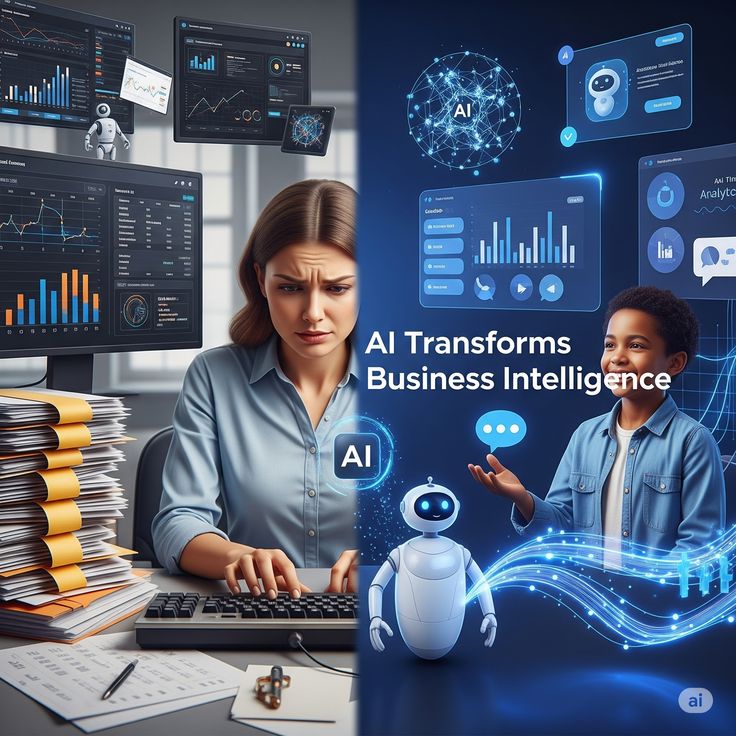
How AI Is Revolutionizing Business Intelligence and Analytics

Introduction In today’s digital economy, businesses generate massive amounts of data every second. From customer interactions and sales transactions to website activity and operational metrics, organizations have access to more information than ever before. However, collecting data alone is not enough. The real challenge lies in transforming that data into actionable insights that drive better business decisions. This is where Artificial Intelligence (AI) is changing the landscape of Business Intelligence (BI) and analytics. Traditional BI systems helped organizations analyze historical data and create reports. AI-powered BI takes this a step further by uncovering hidden patterns, predicting future outcomes, automating analysis, and providing real-time recommendations. As companies strive to remain competitive in rapidly changing markets, AI-driven business intelligence is becoming a critical tool for growth, efficiency, and innovation. What Is Business Intelligence? Business Intelligence refers to the technologies, processes, and strategies used to collect, analyze, and visualize business data. The primary goal of BI is to help organizations make informed decisions based on accurate information. Traditional BI solutions typically focus on: Data collection and storage Reporting and dashboards Performance monitoring Historical data analysis Trend identification While these capabilities remain valuable, modern businesses require deeper insights and faster decision-making. AI addresses these needs by enhancing the capabilities of conventional BI platforms. The Growing Role of AI in Business Intelligence Artificial Intelligence enables machines to analyze data, learn from patterns, and make predictions with minimal human intervention. When integrated with business intelligence systems, AI helps organizations move from descriptive analytics to predictive and prescriptive analytics. Instead of simply answering questions like: “What happened?” AI-powered systems can answer: “Why did it happen?” “What is likely to happen next?” “What actions should we take?” This shift allows businesses to become more proactive rather than reactive. Automated Data Analysis One of the biggest advantages of AI in business intelligence is automation. Traditional data analysis often requires teams of analysts to collect data, clean datasets, create reports, and identify trends manually. This process can take hours or even days. AI-powered analytics platforms can automate many of these tasks by: Cleaning and organizing data Detecting anomalies Identifying trends Generating reports Highlighting important insights Automation reduces human error and enables organizations to analyze larger volumes of data much faster. For example, a retail company can automatically monitor thousands of products and instantly identify unusual changes in sales patterns without requiring manual investigation. Predictive Analytics: Looking Into the Future Predictive analytics is one of the most impactful applications of AI in business intelligence. Using historical data and machine learning algorithms, AI can forecast future outcomes with impressive accuracy. Businesses use predictive analytics to: Forecast sales demand Predict customer behavior Estimate inventory requirements Identify market trends Reduce operational risks For instance, an e-commerce company can predict which products will experience increased demand during upcoming seasons and adjust inventory levels accordingly. This proactive approach helps organizations improve efficiency and reduce costs. Real-Time Decision Making Modern businesses operate in fast-moving environments where decisions often need to be made instantly. Traditional BI systems typically rely on periodic reports, which may already be outdated by the time they are reviewed. AI-driven analytics platforms continuously process incoming data and provide real-time insights. Benefits include: Faster response to market changes Improved customer service Immediate detection of operational issues Better financial monitoring Enhanced risk management For example, financial institutions can detect suspicious transactions in real time and prevent fraudulent activities before significant damage occurs. Enhanced Data Visualization Data visualization is a core component of business intelligence. AI is making dashboards smarter and easier to understand by automatically identifying key insights and presenting them in visually meaningful ways. Advanced BI tools can: Highlight critical trends automatically Generate dynamic charts and graphs Explain data patterns in plain language Customize dashboards for different users Instead of manually searching through hundreds of charts, decision-makers receive instant summaries of the most important business developments. This significantly improves productivity and decision quality. Natural Language Queries One of the most user-friendly innovations in AI-powered business intelligence is Natural Language Processing (NLP). NLP allows users to interact with BI systems using everyday language. Rather than writing complex database queries, users can simply ask questions such as: “What were our top-selling products last month?” “Why did sales decline in the northern region?” “Which customer segment generated the highest revenue?” The system then analyzes data and provides answers instantly. This capability makes data analysis accessible to employees without technical expertise, promoting a stronger data-driven culture throughout the organization. Improving Customer Insights Understanding customer behavior is essential for business success. AI-powered analytics helps organizations gain deeper insights into customer preferences, buying patterns, and engagement trends. Businesses can analyze: Purchase history Website interactions Social media activity Customer feedback Support requests By combining these data sources, AI creates a comprehensive customer profile that enables personalized experiences. Organizations can use these insights to: Improve marketing campaigns Increase customer retention Enhance product recommendations Deliver personalized services As a result, businesses can strengthen customer relationships and drive higher revenue. Fraud Detection and Risk Management Many industries face increasing challenges related to fraud and risk. AI significantly improves risk management by continuously monitoring transactions and identifying suspicious behavior. Machine learning algorithms can detect unusual patterns that may indicate: Financial fraud Cybersecurity threats Compliance violations Operational risks Unlike traditional rule-based systems, AI continuously learns and adapts to emerging threats. This capability helps organizations reduce financial losses and improve security. Supply Chain Optimization Supply chain management generates enormous amounts of operational data. AI-powered business intelligence solutions help companies optimize supply chains through advanced analytics and forecasting. Key benefits include: Demand prediction Inventory optimization Supplier performance monitoring Logistics planning Cost reduction For example, manufacturers can predict supply shortages before they occur and take preventive action to avoid production delays. This leads to greater efficiency and improved customer satisfaction. Personalized Business Strategies Every business operates under unique conditions and objectives. AI enables organizations to develop personalized strategies based on their specific data and performance metrics. Instead of relying solely on industry averages, companies can make decisions based on:
Business Analytics, Business Intelligence, Data Analytics, Digital Transformation

The Role of Data Analytics in Business Growth and Decision-Making

The Role of Data Analytics in Business Growth and Decision-Making For generation after generation, the ultimate business icon was the “gut-instinct executive.” We’ve all seen this character celebrated in business memoirs and biographies—the visionary leader who walks into a high-stakes boardroom, ignores the paperwork, listens to their inner voice, and makes a massive, multi-million-dollar gamble that somehow pays off perfectly. It was a romantic, thrilling way to think about entrepreneurship. But if you peel back the curtain on the businesses that are consistently dominating their industries today, you’ll find that the era of relying entirely on blind gut feelings is officially over. Running a business in 2026 without data analytics is the equivalent of flying a commercial airliner in a dense storm with the windshield blacked out and the dashboard instruments turned off. You might feel like you’re moving in the right direction, but you are structurally blind to the terrain around you. Data analytics isn’t about burying your company under cold, intimidating mountains of mathematical equations or sterile code blocks. At its heart, data analytics is a deeply human pursuit: it is the act of turning raw, chaotic digital footprints into clear, actionable stories. It is the compass that takes the terrifying guesswork out of scaling a business. Let’s dive deep into the real-world role of data analytics, how it reshapes corporate decision-making, and how your enterprise can leverage it to fuel sustainable growth. 1. The Maturity Curve: Moving Beyond the Rearview Mirror Many organizations believe they are practicing data analytics simply because they review a monthly financial statement or track basic website traffic hits. But data analytics isn’t a single, static task; it is a progressive maturity curve. To truly unlock business growth, an organization must transition from looking backward to looking forward. ┌─────────────────────────────────────────┐ │ THE DATA ANALYTICS CONTINUUM │ └────────────────────┬────────────────────┘ │ ┌───────────────────┬─────────────┴─────────────┬───────────────────┐ ▼ ▼ ▼ ▼ ┌─────────────────┐ ┌─────────────────┐ ┌─────────────────┐ ┌─────────────────┐ │ Descriptive │ │ Diagnostic │ │ Predictive │ │ Prescriptive │ │ Analytics │ │ Analytics │ │ Analytics │ │ Analytics │ ├─────────────────┤ ├─────────────────┤ ├─────────────────┤ ├─────────────────┤ │ “What happened?”│ │ “Why did it │ │ “What is likely │ │ “How can we │ │ (The Past) │ │ happen?” │ │ to happen?” │ │ make it happen?”│ └─────────────────┘ └─────────────────┘ └─────────────────┘ └─────────────────┘ Phase 1: Descriptive Analytics (“What happened?”) This is the foundational baseline. It compiles historical data to show you the past. It looks like your basic QuickBooks reports, monthly sales totals, or social media engagement tallies. It tells you the state of the union, but it doesn’t explain the underlying mechanics. Phase 2: Diagnostic Analytics (“Why did it happen?”) This phase digs below the surface to uncover anomalies and correlations. If your sales suddenly dropped by 15% in May, diagnostic analytics isolates the variables: it cross-references the drop with a simultaneous technical glitch on your checkout page or a aggressive ad campaign launched by a direct competitor. Phase 3: Predictive Analytics (“What is likely to happen?”) This is where data begins to actively drive growth. By feeding historic patterns and current market variables into statistical models, businesses can forecast future consumer trends, seasonal demand spikes, and inventory constraints with incredible precision. Phase 4: Prescriptive Analytics (“How can we make it happen?”) The absolute peak of the curve. Prescriptive analytics doesn’t just predict a future scenario; it acts as an automated strategic advisor, testing thousands of simulations to recommend the exact business moves, pricing adjustments, or supply chain changes required to optimize your profit margin. 2. Transforming the Boardroom: From Loudest Opinion to Hard Truths We’ve all sat in business meetings that quickly devolved into an exhausting shouting match. The marketing director is convinced the company needs to spend more money on video ads because of a trend they saw online. The sales director insists that discounting the product tier is the only way to hit quarterly targets. Traditionally, the tie-breaking vote went to the HIPPO—the Highest Paid Person’s Opinion. Data analytics completely re-engineers this toxic cultural dynamic. When an organization embraces data fluency, decisions are democratized and stripped of personal ego. Instead of debating unverified assertions, team members bring clean, cross-verified data dashboards to the table. You no longer argue about whether a marketing campaign is “good” or “bad” based on subjective aesthetics. Instead, you look directly at your Customer Acquisition Cost (CAC), Lifetime Value (LTV) ratios, and drop-off points in the sales funnel. Data shifts the corporate focus away from who is right, and centers it squarely on what is right for the customer and the bottom line. 3. The Core Engines of Growth Driven by Analytics When deployed intentionally, data analytics operates as a high-powered engine that accelerates growth across three foundational pillars of your enterprise: Pillar 1: Radical Customer Closeness and Personalization In modern commerce, consumers leave a rich trail of digital breadcrumbs wherever they go. Analytics aggregates these touchpoints—what time they open your emails, how long they hover over a pricing tier, what questions they type into your support chat—to build highly accurate behavioral archetypes. Instead of treating your audience as a single, generic demographic block, you can dynamically tailor your web copy, product bundles, and outreach timing to match an individual’s exact position in the buying journey. This hyper-personalization builds deep customer loyalty and drastically drives up retention rates. Pillar 2: Identifying Hidden Operational Leaks Growth isn’t just about bringing more revenue in through the front door; it’s about stopping capital from quietly leaking out the back door. Operational data analytics continuously audits your internal workflows. It flags delivery trucks that are wasting fuel on inefficient routes, spots manufacturing machinery that is showing signs of mechanical wear before it suffers a costly breakdown, and highlights customer service issues that take up disproportionate team time. Cleaning up these quiet internal inefficiencies instantly maximizes your net margins. Pillar 3: Risk Mitigation and Market Navigation Expanding into a new market, launching a new product line, or altering your pricing strategy is inherently risky. Data analytics functions as a low-cost testing

Automobile, Data Analytics, Real-Time Visibility, Technology & Innovation

How Fleet Management Software Slashes Operational Costs

Driving Down the Bottom Line: How Fleet Management Software Slashes Operational Costs Managing a fleet is often described as trying to plug leaks in a sinking ship. Between fluctuating fuel prices, unexpected engine failures, and the rising cost of insurance, fleet managers are under constant pressure to do more with less. The introduction of Fleet Management Software (FMS) hasn’t just added a map to the dashboard; it has provided a financial scalpel. By turning raw data into actionable insights, FMS allows businesses to cut costs with surgical precision. 1. The Fuel Factor: Cutting Your Largest Expense Fuel usually accounts for nearly 30% of total fleet operating costs. FMS reduces this burden in three distinct ways: Eliminating Idling Did you know that a heavy-duty truck can burn roughly one gallon of fuel for every hour it idles? FMS tracks “dead time” and alerts managers when a driver leaves the engine running unnecessarily. By humanizing this data—explaining to drivers why idling matters—companies often see a 5–10% drop in fuel spend within the first month. Route Optimization It’s not just about getting from point A to point B; it’s about avoiding the traffic at point C. Innovative routing algorithms analyze historical traffic patterns and real-time accidents to ensure drivers take the most fuel-efficient path, reducing total mileage and wear on the tires. 2. Predictive Maintenance: Stopping the “Small” Problems A $50 sensor check is always cheaper than a $5,000 engine overhaul. FMS connects directly to the vehicle’s diagnostic port (OBD-II), allowing for Predictive Maintenance. Real-time Alerts: The software notifies the shop the moment a “Check Engine” light flickers, often before the driver even notices a change in performance. Scheduled Servicing: Instead of guessing when to change the oil based on a calendar, FMS uses actual mileage and engine hours to schedule service exactly when it’s needed—neither too early (wasting money) nor too late (risking damage). 3. The Humanized Side: Improving Driver Behavior We often forget that the most expensive part of a vehicle is the person behind the wheel. Aggressive driving—speeding, harsh braking, and rapid acceleration—can lower fuel economy by up to 33% at highway speeds. Gamification and Coaching Modern FMS provides “Driver Scorecards.” Instead of “spying” on drivers, managers can use this data to reward the safest, most efficient operators. This humanized approach reduces turnover and slashes the costs associated with accidents and insurance premiums. When drivers know their safety is being monitored for reward rather than punishment, the culture of the fleet shifts toward efficiency. 4. Total Cost of Ownership (TCO) and Lifecycle Management Every vehicle has a “sweet spot”—a point where it is most profitable before maintenance costs begin to outweigh its value. FMS tracks the lifecycle of every asset. It tells you exactly when to sell a van before it becomes a “money pit,” ensuring you always have the most cost-effective fleet on the road. 5. Reducing Administrative “Paper” Costs The hidden cost of fleet management is the hours spent on paperwork—IFTA fuel tax reporting, ELD compliance, and maintenance logs. FMS digitizes this entire process. Compliance: Automatically generating HOS (Hours of Service) reports prevents heavy fines. Labor Savings: By automating reports that used to take a manager 10 hours a week, you effectively “buy back” a quarter of their salary to focus on growth. Conclusion: Data as Your Most Valuable Asset Fleet management software isn’t just about “tracking trucks”; it’s about visibility. When you can see every drop of fuel, every minute of idling, and every harsh brake, you gain the power to control your destiny. In 2026, the most successful fleets aren’t the ones with the newest trucks; they are the ones with the best data.How to Develop an Innovative Social Commerce App: A Blueprint for Success

Big Data, Data Analytics, Digital Transformation, Technology & Innovation

More Than Just Numbers: Constructing the Human Importance of Big Data

More Than Just Numbers: Constructing the Human Importance of Big Data In the early days of the digital revolution, we viewed data as a byproduct—digital exhaust that was left behind as we browsed the web or swiped our cards. Fast forward to today, and that “exhaust” has become the fuel for the modern world. However, when we talk about the Importance of Big Data, we often get bogged down in the “Big” (the zettabytes, the speed, the variety) and forget about the “Data” (the stories, the people, and the solutions). Constructing the importance of Big Data isn’t just a technical exercise; it’s a human one. It’s about how we use information to understand our world better and make life just a little bit easier for everyone. The Three Pillars of Big Data Significance To understand why Big Data matters, we have to look past the servers and into three specific areas of impact: Empowerment, Prediction, and Personalization. 1. Empowerment: Giving a Voice to the Silent Big Data allows us to see patterns that were previously invisible. For a small business owner, it means having the same level of market insight that was once reserved for billion-dollar corporations. By analyzing localized trends, they can compete on a global scale. This “democratization of information” is perhaps the most humanized aspect of the data revolution. 2. Prediction: Moving from Hindsight to Foresight The true value of data lies not in telling us what happened, but in suggesting what will happen. Public Safety: Cities use data to predict traffic congestion before it happens, reducing commute times and lowering stress for millions. Crisis Management: By tracking environmental data, we can predict natural disasters with higher accuracy, saving lives through early evacuation. 3. Personalization: The End of “One Size Fits All” We live in a world of infinite choice. Big Data acts as a filter, helping us find what we actually need. Whether it’s a medical treatment tailored to your specific genetic makeup or a streaming service recommending a movie that perfectly matches your mood, data makes the world feel smaller and more attentive to our individual needs. The “Human” V’s of Big Data In academic circles, Big Data is defined by the “V’s” (Volume, Velocity, Variety). But to truly construct its importance, we need to add a few more human-centric V’s: Value (The “So What?” Factor) Data is worthless if it doesn’t solve a problem. The importance of Big Data is constructed when it creates value—like reducing food waste in supply chains or helping a student find a learning path that fits their unique pace. Veracity (The Trust Factor) In an era of deepfakes and misinformation, the veracity (truthfulness) of data is our most important shield. Constructing a reliable data infrastructure is about building a foundation of trust between technology and the people who use it. Vulnerability (The Protection Factor) We cannot discuss the importance of data without discussing its defense. Data Privacy & Security is the silent partner of Big Data. As we collect more information, the responsibility to protect the “human” behind that data grows exponentially. Big Data in Action: Solving Global Challenges To reach a deeper understanding of this topic, we must look at how Big Data tackles the “unsolvable” problems of our time. Fighting Climate Change with Precision We are currently using Big Data to build a “Digital Twin” of the Earth. By feeding billions of sensor readings into massive models, scientists can simulate the impact of policy changes in real-time. This allows us to move away from “guessing” at environmental solutions and toward data-backed strategies that actually work. The Healthcare Renaissance In Healthcare & Fitness, Big Data is the difference between a generic prescription and a cure. By analyzing the health data of millions, researchers can identify rare side effects or discover new uses for existing medications in days rather than decades. The Future: From Big Data to “Smart” Data As we move further into 2026, the focus is shifting. We no longer care just about having more data; we care about having better data. The next phase of Big Data importance will be defined by Context. AI is helping us move beyond raw numbers to understand the “Why” behind the “What.” When data starts to understand human emotion, culture, and intent, we will see a new level of innovation in Artificial Intelligence that feels less like a machine and more like a partner. Conclusion: Constructing a Better World The importance of Big Data is not found in the size of the hard drive, but in the breadth of the impact. It is a tool for empathy, a weapon against inefficiency, and a roadmap for the future. As digital farmers, home automation enthusiasts, and healthcare innovators, we are all part of the construction crew. By focusing on the humanized application of these technologies, we ensure that the “Big Data” of tomorrow leads to a “Better World” today. Beyond the Chart: How Innovative Technologies are Empowering Population Health Management

Artificial Intelligence, Data Analytics, Digital Transformation, Healthcare & Fitness

Beyond the Chart: How Innovative Technologies are Empowering Population Health Management

Beyond the Chart: How Innovative Technologies are Empowering Population Health Management For decades, the healthcare system has been largely “reactive.” You get sick, you visit a doctor, and you receive a treatment. However, the tide is shifting toward a more holistic, proactive approach known as Population Health Management (PHM). At its core, PHM is about keeping people healthy before they ever need an ER visit. But managing the health of thousands—or millions—of individuals is a gargantuan task. This is where Innovative Technology steps in. We aren’t just talking about digital filing cabinets; we’re talking about an intelligent ecosystem that empowers providers to see the “whole person” behind the data point. The Human Face of Population Health When we discuss “population health,” it’s easy to get lost in spreadsheets and percentages. But population health is actually about the grandmother who avoids a hospital stay because a sensor caught her rising blood pressure early. It’s about the neighborhood with high asthma rates finally getting the air quality sensors and mobile clinics they need. Technology is the “bridge” that allows doctors to extend their reach beyond the four walls of the clinic. It humanizes medicine by allowing for personalization at scale. 1. Predictive Analytics: Seeing the Future Today The most powerful tool in the PHM arsenal is Predictive Analytics. By leveraging Machine Learning, healthcare systems can analyze historical data to identify which patients are at the highest risk for chronic diseases. Identifying the “Rising Risk” In a traditional model, resources are often focused on the “high-cost” patients who are already very ill. Predictive technology allows us to find the “Rising Risk” group—individuals who are currently stable but whose data signatures (missed appointments, fluctuating glucose, or even socio-economic factors) suggest they are headed for a crisis. Proactive Intervention: Instead of a surgery, the patient gets a call from a health coach. Resource Allocation: Hospitals can predict “surge” times for respiratory illnesses based on weather and pollution data. 2. The Internet of Medical Things (IoMT) and RPM Remote Patient Monitoring (RPM) has completely redefined the patient-provider relationship. Handheld devices and wearables have turned the home into a continuous stream of health insights. Continuous Care, Not Episodic Care With IoMT, a doctor doesn’t have to wait for a 6-month checkup to know how a patient is doing. Smart Scales: For heart failure patients, a sudden weight gain (fluid retention) can trigger an immediate medication adjustment. Wearable ECGs: Detecting arrhythmias in real-time while the patient goes about their daily life. Handheld Integration: Patients can sync their devices to their smartphones, giving them a sense of agency and “ownership” over their own health journey. 3. Artificial Intelligence and Social Determinants of Health (SDOH) We now know that clinical care only accounts for about 20% of a person’s health outcomes. The other 80% is determined by where they live, what they eat, and their access to transportation—the Social Determinants of Health. AI as a Social Advocate Innovative AI platforms are now being used to scan non-clinical data to help providers understand these barriers. Zip Code Analysis: AI can flag that a patient lives in a “food desert,” prompting the healthcare team to connect them with local food security programs. Natural Language Processing (NLP): AI can “read” a doctor’s typed notes to pick up on social cues—like a patient mentioning they can’t afford their bus pass—and automatically trigger a referral to a social worker. 4. Telehealth and the End of Geographic Barriers Technology & Innovation in telecommunications has made “distance” irrelevant. In population health, this is critical for reaching rural or underserved communities. Virtual Care Teams Telehealth isn’t just a video call; it’s a collaborative platform. A primary care doctor in a small town can instantly share data and video with a specialist in a major city. This ensures that the “population” being managed isn’t limited by their proximity to a skyscraper hospital. The Challenge: Data Silos and Privacy While the potential is infinite, the biggest hurdle is the Silo. Patient data is often trapped in different systems that don’t talk to each other. Interoperability: The future of PHM relies on Blockchain & Technology and unified API standards (like FHIR) to ensure that a patient’s data follows them wherever they go. Trust: To humanize this tech, we must ensure absolute Data Privacy & Security. Patients must feel that their data is being used to help them, not just track them. Conclusion: Empowering the Healers Ultimately, leveraging technology in population health management isn’t about replacing doctors with algorithms. It’s about removing the administrative noise so that healers can focus on healing. When we empower population health with data, we move from a world of “fixing what’s broken” to a world of “nurturing what’s whole.” That is the true promise of digital health transformation. The Command Center in Your Pocket: Mastering Home Automation and Security via Handheld Devices

Artificial Intelligence, Data Analytics, data science, Digital Transformation, Gaming, Graphic Designing

What is Agentforce? Unveiling Salesforce’s Game-Changing AI Platform

What is Agentforce? Unveiling Salesforce’s Game-Changing AI Platform The End of the “Copilot” Era For the last two years, the tech world has been obsessed with “assistants.” We’ve all used them: the little chat bubbles that help us summarize a long email or draft a polite rejection note. But in 2026, the novelty of the assistant is wearing off. Business leaders are no longer asking for a tool that tells them what to do; they are demanding a platform that simply does it. Salesforce’s answer to this demand is Agentforce. If the previous generation of AI (Einstein Copilot) was a co-pilot sitting in the passenger seat giving directions, Agentforce is the autonomous vehicle that drives the route itself. It represents a fundamental shift from “Predictive AI” and “Generative AI” to “Agentic AI.” This platform allows organizations to build, customize, and deploy autonomous agents that handle tasks end-to-end, across every department from Sales and Service to Marketing and Commerce. 1. The Secret Sauce: The Atlas Reasoning Engine The most frequent question technical teams ask is: “How does it actually make decisions?” The answer lies in the Atlas Reasoning Engine. Unlike standard LLMs that simply predict the next word in a sentence, Atlas is designed to reason through complex business logic. It operates on a continuous loop of: Evaluation: Analyzing the user’s intent and the current state of the CRM data. Refinement: Breaking down a vague request (e.g., “Fix this shipping delay”) into granular steps. Execution: Selecting the right “tools”—whether that’s a Salesforce Flow, an Apex class, or a MuleSoft API call—to resolve the issue. This reasoning engine ensures the agent doesn’t just “hallucinate” a solution; it follows the strict business processes already defined in your Salesforce environment. 2. Data Cloud: The Nervous System of the Agent An agent is only as smart as the data it can access. This is why Agentforce is inextricably linked to Salesforce Data Cloud. In many organizations, customer data is “trapped” in silos—emails, PDFs, legacy databases, and call transcripts. Data Cloud acts as the nervous system, harmonizing this unstructured data and feeding it to the agent in real-time. This allows an Agentforce service agent to know that a customer just complained on Twitter, opened a high-priority ticket ten minutes ago, and has a contract expiring next month—all before the conversation even begins. 3. Building Without Code: The Agent Builder Salesforce has always championed the “low-code” revolution, and Agentforce continues that legacy. Through the Agent Builder, admins can create a digital worker as easily as they would create a custom object. The builder focuses on four key pillars: Role: Defining exactly what the agent does (e.g., “Tier 1 Support Concierge”). Knowledge: Pointing the agent to the right documentation and data sources. Actions: Giving the agent “hands” to perform tasks like processing refunds or scheduling meetings. Guardrails: Setting the ethical and operational boundaries the agent must never cross. 4. Real-World Impact: Beyond the Hype The true value of Agentforce isn’t in its code, but in the hours it returns to human employees. Consider these 2026 benchmarks: Customer Service: Early adopters are seeing agents resolve up to 75% of common inquiries autonomously, from password resets to complex troubleshooting. Sales Qualification: AI agents are now performing 100% of initial lead follow-ups within minutes, ensuring that human sales reps only step in when a deal is “warm.” Operational Efficiency: In manufacturing, agents are being used to detect anomalies in field service data and automatically trigger repair workflows before a machine even fails. 5. The “Human-in-the-Loop” Security Model Autonomy often triggers anxiety about security. Salesforce addresses this through the Einstein Trust Layer. This security framework ensures that sensitive customer data (like PII) is stripped away before being processed by an LLM and that every autonomous action leaves a clear audit trail. Furthermore, Agentforce is built with a “Handoff Logic.” If the agent detects frustration in a customer’s tone or encounters a problem it isn’t authorized to solve, it seamlessly transfers the case to a human, providing a full summary of the interaction so the customer never has to repeat themselves. 6. Pricing and The “Consumption” Revolution Moving into mid-2026, Salesforce has shifted its pricing model to match the agentic era. Instead of just paying “per seat,” many organizations are moving toward a consumption-based model. * Flex Credits: Enterprises can purchase credits that are consumed as agents perform specific actions. Conversation-Based Pricing: For customer-facing bots, a flat rate (typically around $2 per conversation) allows for predictable scaling without adding headcount. Conclusion: Writing the Next Chapter of CRM Salesforce Agentforce is more than just a new feature; it is the blueprint for the future of work. By moving from “assistants” to “agents,” Salesforce is allowing businesses to scale their operations at a rate previously thought impossible. The companies that will win in the coming years are those that view AI not as a threat to their workforce, but as an expansion of it. Agentforce provides the platform to make that expansion safe, data-driven, and—most importantly—deeply human. We are no longer just managing relationships; we are orchestrating a symbiotic team of humans and agents, working together to drive success. The Digital Colleague: How Agentic AI Will Work as a Coworker Alongside Your Team

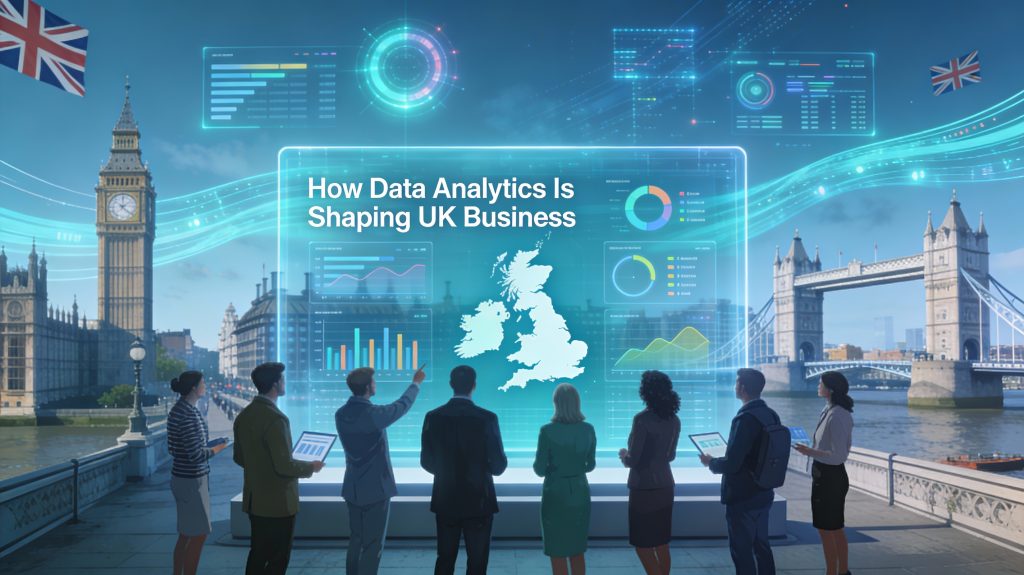
How Data Analytics Is Shaping UK Business
Data Analytics

Data Analytics in UK SMEs and Startups

Introduction Across the UK, data analytics has shifted from back-office reporting to a strategic capability that determines which businesses grow, adapt, and outperform competitors. The UK data analytics market was valued at roughly USD 3.5–4.7 billion in 2024 and is expected to grow to around USD 17–25 billion by 2030–2033, reflecting rapid adoption across industries. This blog explores how data analytics is transforming key UK sectors, the benefits for organisations of all sizes, and where the next wave of innovation is heading.​ How to Build Demand Forecasting Software Why Data Analytics Matters to UK Businesses UK companies increasingly see data as a core asset that underpins competitiveness, resilience, and innovation.​ Around three-quarters of UK businesses now prioritise data to drive performance, highlighting a shift from intuition-led to insight-led decisions.​ Analytics helps organisations anticipate market shifts, simulate scenarios, and respond faster to changing customer needs and economic pressures.​ For SMEs, data analytics supports improved decision making, better understanding of customers, and more efficient operations, narrowing the gap with larger competitors.​ Key benefits frequently cited by UK businesses include:​ Faster, evidence-based decisions instead of guesswork. Reduced costs through process optimisation and elimination of bottlenecks. Stronger customer relationships through targeted, personalised engagement. Sector-by-Sector Impact Across the UK Data analytics is shaping the future differently in each sector, but with a common thread: more precise, proactive decision-making.​ Retail and eCommerce UK retailers use predictive analytics to personalise offers, optimise pricing, and forecast demand, improving conversion and margins.​ Analytics also supports inventory optimisation and omnichannel experiences, reducing stockouts and enhancing customer satisfaction.​ Financial services Finance and insurance are among the top sectors for advanced analytics and AI adoption in the UK, with adoption rates above 60% in some surveys.​ Banks and fintechs use analytics for fraud detection, credit scoring, risk modelling, and personalised financial products.​ Healthcare and life sciences Providers use analytics to improve diagnostic accuracy, optimise treatment pathways, and allocate resources more efficiently.​ Population-level data supports better planning, while predictive models help identify at-risk patients earlier.​ Manufacturing, logistics, and energy Manufacturers and logistics firms deploy data analytics for predictive maintenance, supply chain optimisation, and demand planning.​ In energy, analytics supports load forecasting, grid optimisation, and integration of renewables, boosting reliability and sustainability.​ Public sector and local government UK public bodies increasingly use analytics for service planning, resource allocation, and measuring policy impact.​ Data-driven insights help improve citizen services and identify where interventions deliver the greatest value.​ How Data Analytics Empowers UK SMEs For UK SMEs, data analytics has become a practical way to compete with larger players by using insight rather than scale.​ Operational efficiency SMEs analysing operational data can identify inefficiencies, reduce waste, and improve productivity, directly impacting profitability.​ Tools like dashboards and business intelligence platforms make it easier to monitor KPIs in real time.​ Targeted marketing and customer insight Analytics enables small firms to segment customers, tailor messaging, and focus spend on high-value segments, improving ROI.​ Behaviour and purchase data help SMEs refine offerings and build long-term customer loyalty.​ Competitive advantage and innovation UK SMEs using analytics gain better visibility into market trends and competitor activity, helping them spot opportunities earlier.​ Even simple analytics (sales trends, channel performance, campaign analysis) can drive more confident, growth-oriented decisions.​ Future Trends: Where Data Analytics Is Taking UK Business Emerging trends in analytics are set to deepen its impact across UK sectors in the coming years.​ AI and machine learning embedded everywhere AI-driven analytics, including predictive and prescriptive models, is moving from specialised teams into everyday business processes.​ This shift enables automated decision support, from dynamic pricing to smart routing and personalised recommendations.​ Augmented analytics and self-service BI Augmented analytics tools help non-technical staff interact with data using natural language queries and guided insights.​ This broadens analytics adoption beyond data teams, making insight generation a normal part of daily work.​ Higher adoption, but also new challenges UK surveys show high adoption of advanced digital technologies like AI, big data, and cloud, but also highlight gaps in skills and technology diffusion, especially for smaller firms.​ Data privacy, governance, and talent shortages remain key challenges, pushing organisations to invest in training and robust data strategies.​ Conclusion Data analytics is reshaping the future of UK businesses by turning raw data into a strategic resource that drives growth, resilience, and innovation across sectors. From retail personalisation and financial risk management to SME efficiency and public-sector optimisation, analytics is now embedded in how organisations plan, decide, and compete. To stay ahead, UK businesses should invest in clear data strategies, accessible analytics tools, and upskilling teams so insight becomes a daily habit rather than an occasional project.​ A strong call-to-action: Audit how your organisation currently uses data, identify two or three high-impact decisions that could be improved with analytics, and pilot a focused data project that delivers measurable value within 90 days.​ FAQ 1. Which UK sectors are leading in data analytics adoption? Finance and insurance, retail, healthcare, manufacturing, energy, and parts of the public sector are among the leading adopters of data analytics in the UK.​ 2. How does data analytics help UK SMEs? It helps SMEs make better decisions, improve operational efficiency, understand customers more deeply, and gain competitive advantage despite limited resources.​ 3. What are the main challenges with data analytics in the UK? Common challenges include data quality, privacy and compliance, skills shortages, and difficulty integrating analytics into day-to-day decision-making.​ 4. Is data analytics only for large enterprises? No. Affordable cloud tools, self-service dashboards, and packaged BI solutions now make analytics accessible to even very small UK firms.​ 5. What future trends should UK businesses watch? Key trends include deeper integration of AI and machine learning, growth of augmented analytics, and broader sector-wide adoption supported by cloud and data infrastructure investments.​

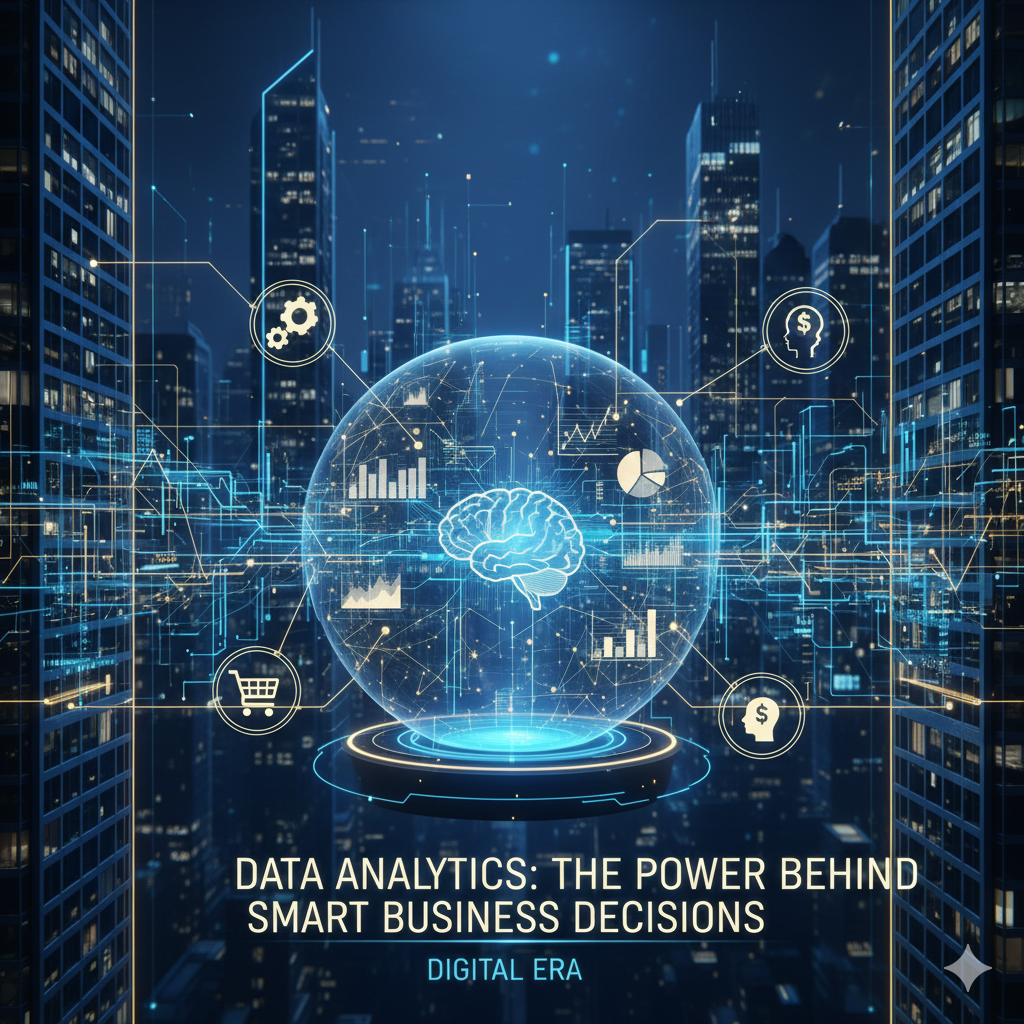
Futuristic digital city with glowing data analytics icons and brain hologram symbolizing smart business intelligence
Data Analytics

The Power Behind Smart Business Decisions in the Digital Era

Introduction In today’s digital-first world, data has become one of the most valuable resources for organizations. From e-commerce and healthcare to banking and education, every industry relies on data to make smarter, evidence-based decisions. Data Analytics bridges the gap between raw information and meaningful insights, empowering businesses to innovate, optimize operations, and predict future trends. What is Data Analytics? Data Analytics is the process of examining raw data to discover patterns, trends, and insights that can help make informed decisions. It involves collecting, cleaning, processing, and interpreting data using statistical and computational methods. Simply put, it helps answer questions like: What happened? Why did it happen? What will happen next? What should we do about it? Why Data Analytics Matters Organizations generate massive amounts of data every day — from customer interactions to online transactions. Data analytics helps transform this chaos into clarity. It enables companies to: Understand customer behavior Optimize marketing strategies Reduce operational costs Improve product quality Predict future market trends Businesses using data analytics are more agile, customer-centric, and profitable compared to those relying solely on intuition. Types of Data Analytics There are four main types of data analytics, each serving a unique purpose: Descriptive Analytics – Answers “What happened?” by summarizing past data. Diagnostic Analytics – Answers “Why did it happen?” by identifying causes and relationships. Predictive Analytics – Answers “What might happen?” using statistical models and machine learning. Prescriptive Analytics – Answers “What should we do?” by suggesting data-driven actions. Key Components of Data Analytics Data Collection: Gathering data from various sources like databases, APIs, and IoT devices. Data Cleaning: Removing inconsistencies, duplicates, and errors to ensure accuracy. Data Processing: Structuring data for analysis using tools and programming languages. Data Analysis: Applying algorithms, visualization, and statistical techniques. Data Interpretation: Turning results into actionable business strategies. Data Analytics Tools and Technologies Some popular tools and technologies include: Excel – Basic analytics and visualization. Python and R – For advanced statistical and machine learning models. Tableau and Power BI – For creating interactive dashboards. Apache Hadoop and Spark – For handling large-scale data. SQL – For querying structured databases. Google Analytics – For web and marketing analytics. Real-World Applications of Data Analytics Retail: Personalized recommendations and inventory optimization. Healthcare: Predicting disease outbreaks and improving patient care. Finance: Fraud detection and credit risk assessment. Manufacturing: Quality control and predictive maintenance. Education: Tracking student performance and customizing learning plans. Sports: Enhancing team performance using real-time stats. Benefits of Implementing Data Analytics Improved decision-making Enhanced customer experience Reduced costs and inefficiencies Increased innovation and competitiveness Real-time monitoring and performance evaluation Challenges in Data Analytics Despite its advantages, data analytics faces several challenges: Data privacy and security concerns Shortage of skilled professionals Integrating data from multiple sources Managing data quality and governance High implementation costs for small businesses Future Trends in Data Analytics Artificial Intelligence (AI) Integration: AI-driven analytics will automate insights. Edge Analytics: Real-time analysis on devices close to data sources. Augmented Analytics: Natural language processing (NLP) for easier data interaction. Cloud-Based Analytics: Scalable and cost-effective solutions for businesses of all sizes. Data Democratization: Empowering non-technical users to make data-driven decisions. Conclusion Data Analytics is no longer a luxury — it’s a necessity for organizations aiming to stay competitive in the digital age. From improving customer engagement to predicting market behavior, it helps businesses make informed, timely, and impactful decisions. As technology evolves, the role of analytics will continue to expand, unlocking even more opportunities for innovation and growth. Top Mobile App Development Frameworks in 2025 FAQs Q1. What is data analytics in simple terms?It is the process of analyzing raw data to find useful information for decision-making. Q2. How is data analytics different from data science?Data science focuses on developing algorithms and models, while analytics focuses on applying those models for business insights. Q3. Which industries use data analytics the most?Finance, healthcare, retail, e-commerce, and manufacturing industries rely heavily on analytics. Q4. What skills are needed for a career in data analytics?Statistical knowledge, Python/R programming, SQL, data visualization, and critical thinking. Q5. Is data analytics a good career option?Yes! It’s one of the most in-demand and high-paying career paths in the tech industry. Q6. What are some free tools to start learning data analytics?Google Analytics, Tableau Public, Power BI (free version), and Excel.

How would you like me to respond?

Select a personality for your AI assistant

Normal
Happy
Sad
Angry

Your selection will affect how the AI assistant responds to your messages

Chat Assistant

Let's discuss your project!

Hear from our clients and why 3000+ businesses trust TechOTD

Tell us what you need, and we'll get back with a cost and timeline estimate

Scroll to Top