Artificial Intelligence

Artificial Intelligence

Creating Hyper-Personalized Banking with AI: Cost, ROI, and Use Cases

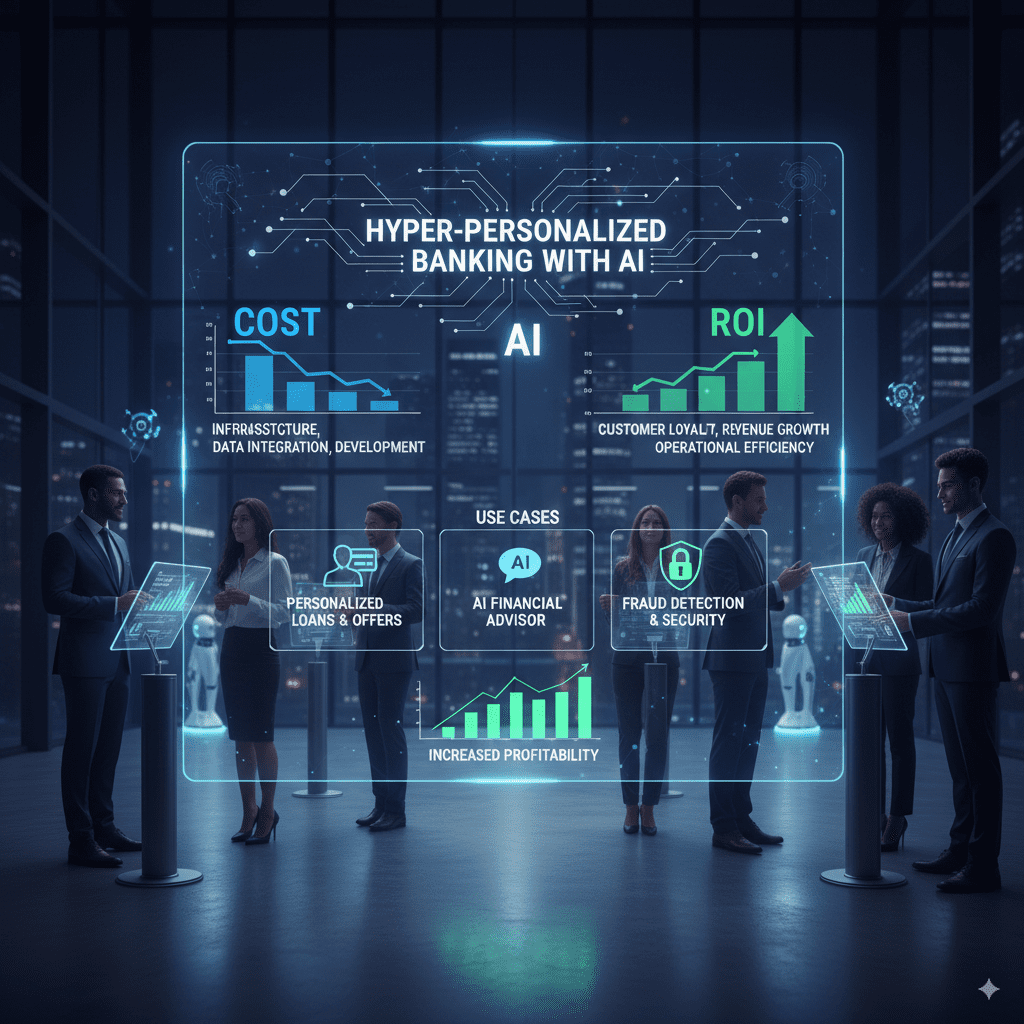
 Introduction The banking industry is witnessing one of the most profound technological revolutions in its history. Artificial Intelligence (AI) is at the core of this transformation, enabling hyper-personalized banking experiences that go far beyond simple customer greetings. In 2025, AI personalization allows banks to predict customer needs, recommend relevant products in real-time, and create seamless customer journeys that boost loyalty and profitability. This blog will explore the cost structures, ROI, benefits, and real-world use cases of AI-driven hyper-personalization in banking, while also examining challenges and the future of this trend. (Internal backlink: How Blockchain Integration is Optimizing Business Processes in Dubai) Discover how hyper-personalized banking with AI transforms customer experiences in 2025. Learn about cost, ROI, benefits, and top AI banking use cases The Imperative for Hyper-Personalization in Banking Modern customers no longer compare banks with other banks—they compare them with Netflix, Amazon, and Spotify. They expect the same level of personalization in financial services as they do in e-commerce and entertainment. Banks that fail to deliver risk losing relevance. Key Drivers: Customer Expectations: 75% of customers prefer financial institutions that provide personalized services. Competitive Edge: McKinsey reports banks leveraging AI personalization see up to 40% more revenue than peers. Efficiency & Loyalty: AI reduces friction, improves experience, and decreases churn. (Internal backlink: Seamless Customer Journeys with AI – The Future of Service Excellence) The Role of AI in Hyper-Personalized Banking AI enables banks to process vast datasets and uncover patterns that traditional analytics miss. Here are the core AI technologies powering hyper-personalization: Machine Learning (ML): Predicts customer behavior from transaction and interaction data. Natural Language Processing (NLP): Enables AI chatbots and assistants for conversational support. Predictive Analytics: Anticipates customer needs such as loan or credit offers. Robo-Advisors: Delivers personalized investment advice at scale. Generative AI: Creates contextual responses for customer service and marketing. (Internal backlink: Large Language Models in Finance – Benefits, Applications, and Real Examples) Cost of Implementing AI-Powered Personalization The cost of AI adoption in banking depends on scale, integration, and compliance requirements. Here’s a breakdown: Project Level Features Estimated Cost (USD) Timeline Basic / MVP Chatbots, rule-based recommendations $40,000 – $100,000 4–6 months Mid-Range NLP, predictive analytics, CRM integration $100,000 – $200,000 6–8 months Advanced End-to-end personalization, fraud AI $200,000 – $400,000 8–12 months Enterprise Full-stack, multi-system deployment $400,000 – $600,000+ 12–18 months Cost Factors: Legacy system integration. Cloud vs. on-premises deployment. AI model customization. Security & compliance (GDPR, RBI, etc.). (Internal backlink: Predictive Analytics Software Development: Features, Benefits, Use Cases, Process, and Cost) ROI of AI Hyper-Personalization Banks usually achieve ROI in 12–24 months, driven by: Revenue Uplift: 15–30% growth via cross-selling and upselling. Customer Retention: Reduced churn due to personalized experiences. Operational Efficiency: Automation in support, onboarding, and loan approvals reduces manual costs. Fraud Prevention: AI anomaly detection reduces fraud losses. Example Case: A global bank that deployed AI personalization in loans and onboarding saw: 27% increase in cross-sell revenue. 20% drop in customer attrition. ROI realized in 14 months. (Internal backlink: Technology Impact on Education – An Ultimate Guide for CEOs) Popular AI Use Cases in Banking Personalization Use Case AI Features Benefits Personal Finance Management (PFM) Smart budgeting, alerts Improved financial wellness Product Recommendations Predictive analytics Higher conversions Customer Service NLP chatbots 24/7 personalized support Fraud Detection Real-time anomaly detection Lower fraud losses Credit Scoring Alternative data models Inclusive lending Investment Advice Robo-advisors Personalized portfolios Transaction Categorization Auto-tagging with ML Better insights Marketing & Communication Personalized campaigns Stronger engagement (Internal backlink: Best Gadgets for Programmers in 2025) Real-World Example: AI-Powered Micro-Personalization A leading Asian bank adopted AI micro-personalization strategies: Customer nudges increased engagement by 34%. Loan acceptance rates rose by 19%. Non-performing assets decreased by 11%. This proves how AI-driven strategies shift banking from transactional to relationship-based engagement. (Internal backlink: React Native vs Swift – Choosing the Right Mobile App Framework) Meta Title: Creating Hyper-Personalized Banking with AI in 2025 – Cost, ROI & Use Cases Benefits of Hyper-Personalization with AI For Customers Tailored experiences aligned with lifestyle & financial goals. Proactive alerts for savings, credit, and investment. Enhanced financial literacy via AI-guided advice. For Banks Higher loyalty and lower churn. Revenue diversification via upsell & cross-sell. Improved fraud detection and compliance monitoring. (Internal backlink: Mobile App Development Services) Key Implementation Challenges Data Privacy & Trust: Compliance with GDPR, RBI, and local frameworks. Legacy Systems: Integration hurdles with outdated infrastructure. Talent Gap: Need for skilled AI engineers and data scientists. Change Management: Bank-wide adoption requires cultural and operational shifts. (Internal backlink: How We Work – TechOTD) Looking Ahead: The Future of AI-Powered Personalization By 2030, AI banking will evolve into anticipatory financial ecosystems. Key advancements include: Voice-enabled AI banking assistants. Generative AI-driven financial coaching. Predictive life-event-based recommendations. Unified financial ecosystems integrating health, travel, and lifestyle. The shift will be from responsive banking to proactive, predictive, and journey-based financial guidance. AI banking, hyper-personalization banking, personalized banking 2025, AI ROI banking, AI transformation cost, digital banking, predictive analytics, robo-advisors, AI banking use cases, customer engagement banking, fintech trends 2025 Conclusion AI-driven hyper-personalization in banking is no longer optional—it is the foundation for growth, customer trust, and long-term relevance. While implementation costs range from $40,000 to $600,000+, the ROI within 12–24 months makes it one of the most impactful investments banks can make in 2025. Institutions must adopt AI responsibly, ensuring compliance, transparency, and ethical use of customer data. FAQs Q1: How much does AI personalization cost for banks? Between $40,000 and $600,000+, depending on scope and integration. Q2: How quickly can ROI be achieved? Typically within 12–24 months. Q3: What is the top AI use case in 2025? Personal financial management (PFM), followed by personalized lending and investments. Q4: Is data privacy a concern? Yes, compliance with regulations like GDPR and RBI guidelines is crucial. Q5: Can small banks implement AI personalization? Yes, modular and cloud-based AI solutions make it accessible even for regional banks. Backlinks TechOTD Blog How Blockchain Integration is Optimizing Business Processes in Dubai Large Language Models in Finance Seamless

Artificial Intelligence

Creating Hyper-Personalized Banking with AI: Cost, ROI, and Use Cases

Introduction Artificial Intelligence (AI) is revolutionizing the banking industry by enabling hyper-personalized customer experiences that were previously unimaginable. Banks can now leverage AI-driven data analytics, machine learning models, and natural language processing to tailor services, products, and interactions uniquely to each customer’s preferences and behaviors. This shift enhances customer satisfaction, loyalty, and operational efficiency, making AI-powered personalization a powerful competitive differentiator. This blog explores how banks can create hyper-personalized experiences using AI, including typical costs involved, potential Return on Investment (ROI), and compelling use cases transforming the sector. For insights on AI in finance and predictive analytics, explore TechOTD’s AI services and their technology blog. What is Hyper-Personalized Banking? Hyper-personalization uses AI to analyze vast datasets encompassing transactional history, demographics, social media, and behavioral signals, delivering real-time, individualized banking experiences. This goes beyond segment-based marketing to dynamic, one-to-one customer engagement. Key Use Cases of AI-Driven Hyper-Personalization 1. Personalized Financial Product Recommendations AI models analyze spending patterns, credit scores, and life events to suggest tailored loans, credit cards, or investment products. 2. Intelligent Virtual Assistants and Chatbots AI-powered chatbots offer 24/7 personalized customer support, resolve queries, and proactively alert customers about offers or account anomalies. 3. Customized Credit Risk Assessment Machine learning algorithms refine credit scoring individually based on expanded datasets, enabling more accurate risk evaluation and inclusive lending. 4. Dynamic Pricing and Offers Banks can customize interest rates, fees, and promotions in real time based on customer behavior and market conditions. 5. Fraud Detection and Prevention AI analyzes transaction patterns to identify unusual activities, instantly protecting customers from fraud and identity theft. Costs of Implementing AI for Hyper-Personalization Technology Investment: Procuring AI platforms, cloud infrastructure, and data storage solutions. Data Management: Cleaning, integrating, and maintaining quality datasets. Talent Acquisition: Hiring data scientists, AI engineers, and financial analysts. Development and Integration: Building, testing, and deploying AI models with existing banking systems. Compliance and Security: Ensuring data privacy and meeting regulatory standards (GDPR, PCI-DSS). Typical budgets vary based on scope: Small-scale pilots: $100,000 – $250,000 Mid-size implementations: $250,000 – $1 million Large enterprise-wide AI initiatives: $1 million+ Return on Investment (ROI) from AI-Powered Personalization Increased Customer Retention: Personalized services improve satisfaction and reduce churn by up to 30%. Boosted Revenue: Targeted product recommendations and dynamic pricing can increase sales by 10-20%. Cost Savings: AI automation reduces customer service costs and fraud losses significantly. Faster Decision-Making: Accelerated loan approvals with AI-driven credit assessment improve conversion rates. A well-executed AI personalization project typically sees ROI within 12-24 months. How to Get Started with AI-Powered Personalization Assess Data Readiness: Evaluate data quality and integration capabilities. Identify Use Cases: Prioritize high-impact personalization areas aligned with business goals. Choose AI Partners: Collaborate with AI vendors or development experts like TechOTD for custom solutions. Pilot and Scale: Implement pilot projects, analyze results, and expand capabilities iteratively. Ensure Compliance: Embed privacy and governance frameworks. Explore how TechOTD supports AI-enabled banking innovations: TechOTD AI Banking Solutions. Conclusion AI-driven hyper-personalization is transforming banking by creating seamless, tailored customer journeys that drive business growth and operational excellence. While initial investments can be substantial, the long-term ROI through enhanced loyalty, revenue, and efficiency justifies the commitment. With expert partners and a clear strategy, banks can harness AI to redefine customer relationships and competitive positioning in the digital age. Stay updated on AI and banking innovations through TechOTD Blog. FAQs Q1: What distinguishes hyper-personalization from traditional personalization? It uses real-time AI-driven insights for individual customer experiences versus broad segmentation. Q2: How much does AI personalization cost for banks? Costs range from $100,000 for pilots to over $1 million for enterprise projects. Q3: What are the biggest ROI drivers? Customer retention, revenue growth from targeted offers, fraud reduction, and operational efficiency. Q4: How quickly can banks implement AI personalization? Pilots can launch within 3-6 months, with scaling taking 1-2 years. Q5: Is data privacy a concern with AI in banking? Yes, compliance with regulations like GDPR is critical when handling sensitive financial data.

Artificial Intelligence

How Much Does It Cost to Build AI Software in the UK?

Introduction Artificial Intelligence (AI) is reshaping industries across the UK, powering innovation, efficiency, and new business models. However, one of the most common questions businesses ask before embarking on AI projects is: How much does it cost to build AI software in the UK? This blog dives deep into AI development costs in the UK, breaking down the key factors that influence pricing, typical budget ranges, and tips to optimize investment. It also links to expert insights and AI-driven innovation services from TechOTD AI Services and valuable content on the TechOTD Blog. Factors Influencing AI Software Development Costs in the UK 1. Project Complexity and Scope AI projects range from simple chatbots to complex predictive analytics and computer vision platforms. The wider and deeper the AI capabilities, the higher the cost. Basic AI: Chatbots, simple machine learning models (£15,000–£40,000) Intermediate AI: NLP assistants, recommendation engines (£40,000–£120,000) Advanced AI: Deep learning, generative AI, computer vision systems (£120,000–£500,000+) 2. Data Acquisition and Preparation Good AI depends on quality data. Acquiring, cleaning, labeling, and preparing datasets can be resource-intensive, driving up costs. 3. Technology Stack and Infrastructure Open-source frameworks like TensorFlow and PyTorch reduce licensing fees, but cloud hosting, GPUs, APIs, and proprietary tools impact budgets significantly. 4. UI/UX Design Custom, interactive, and responsive designs require more skilled effort than basic UI, influencing development cost. 5. Development Team and Location UK-based developers’ higher salaries increase prices, but bring advantages in compliance and project management. Outsourcing may reduce costs but can introduce coordination complexities. Typical Price Ranges for AI Software Development in the UK Project Type Description Estimated Cost (GBP) MVP / Prototype Basic AI features, client testing £15,000 – £40,000 SME Custom AI Solution Moderate AI features, limited integrations £40,000 – £120,000 Enterprise-Grade AI System Scalable, full-stack AI platforms £120,000 – £500,000+ London tends to be at the higher end due to talent demand. How to Optimize AI Development Costs Start with a Minimum Viable Product (MVP) to validate concepts cheaply. Prioritize essential features offering the most value. Leverage open-source libraries and cloud AI platforms. Outsource cost-heavy tasks strategically. Invest in continuous data quality management to avoid costly rework. Why Partner with AI Experts Like TechOTD Companies like TechOTD AI Services specialize in tailored AI development, blending cost optimization with compliance and high-quality outcomes. Their expert teams help businesses unlock AI’s value efficiently while mitigating risks. Learn how to future-proof your AI solutions with insights from the TechOTD Blog. Conclusion Building AI software in the UK involves diverse cost factors, from project complexity to data needs and team composition. While budgets can range widely, starting with a clear plan, leveraging expert help, and focusing on core value ensures successful, cost-effective AI projects.

Artificial Intelligence

How Much Does It Cost to Build an AI Product?

Introduction Artificial Intelligence (AI) has transitioned from a futuristic concept to a critical driver of innovation across industries. From personalized customer experiences to intelligent automation and predictive analytics, AI products are transforming how businesses operate. However, one of the first questions enterprises and startups face when embarking on AI product development is: How much will it cost? This comprehensive blog explores the various factors influencing the cost of building an AI product, breaking down key components, typical budgeting ranges, cost drivers, and strategies to optimize investment while maximizing returns. Insights from leading AI service providers and current market trends, including those shared by TechOTD AI Services, complement the discussion. Factors Influencing AI Product Development Cost 1. Complexity and Scope of the AI Solution Simple AI features like chatbots or recommendation engines cost less compared to advanced solutions such as autonomous systems or deep learning models. The breadth of functionalities—e.g., real-time processing, multi-language support, or integration with IoT devices—increases costs. 2. Data Requirements and Preparation Quantity, quality, and variety of data needed affect cost. Data collection, cleaning, labeling, and preprocessing demand significant time and resources. Specialized datasets might incur acquisition or licensing fees. 3. Model Development and Testing Developing ML models involves algorithm selection, training, testing, tuning, and validation. Complex models (e.g., deep neural networks) require higher computational resources, adding to cost. Iterative experimentation typically extends timelines and budgets. 4. Infrastructure and Tools Cloud computing resources or on-premise hardware. AI development frameworks, APIs, and third-party integrations. Costs vary based on usage volume, storage, and scalability needs. 5. Team Composition and Expertise AI engineers, data scientists, software developers, UX designers, and domain experts. Senior talent and specialists command higher rates. Project management and collaboration tools also add to overhead. 6. Deployment and Maintenance Integrating AI into production environments. Post-launch maintenance including model retraining, monitoring, and updates. Support and compliance with data security and privacy regulations. Typical Cost Ranges for AI Product Development Small-scale AI projects: $30,000 to $100,000 Suitable for PoCs, chatbots, or basic automation. Mid-sized AI applications: $100,000 to $500,000 Includes integrated features, moderate data handling, and real-time components. Enterprise-level AI systems: $500,000 and above Large-scale solutions involving complex AI models, extensive data ecosystems, and global deployment. Note: Actual costs vary widely by geography, project specifics, and vendor pricing. Cost Optimization Strategies Start with a clear use case and minimum viable product (MVP) to validate assumptions. Leverage pre-built AI platforms and cloud services to reduce infrastructure expenses. Use open-source tools and frameworks where feasible. Outsource specialized tasks to expert partners with proven track records. Establish continuous data governance and model improvement processes to avoid costly failures. Value and ROI of AI Investment While initial costs are tangible, the long-term value of AI comes from enhanced decision-making, operational efficiency, customer satisfaction, and new revenue streams. Measuring ROI through KPIs aligned with business goals ensures sustained AI success. Learn about deploying AI for business impact through expert consulting at TechOTD AI Services. Conclusion Building an AI product is a significant investment influenced by many variables. Understanding cost drivers and deploying pragmatic development strategies helps organizations align AI initiatives with budgets and deliver measurable business outcomes.  

Artificial Intelligence

APIs 2.0: The Backbone of Digital Products and Platforms

Introduction In today’s fast-evolving digital economy, Application Programming Interfaces (APIs) have become far more than integration points—they are the nervous system of modern digital products and platforms. The next wave, APIs 2.0, moves beyond simple data fluency to offer intelligence, real-time interaction, robust security, and lifecycle governance across AI, blockchain, IoT, and cloud ecosystems. For businesses committed to agility, scalability, and innovation, APIs 2.0 are no longer optional—they’re foundational. This comprehensive guide explores what powers APIs 2.0, how they empower industries, and best practices to successfully harness their transformative potential. Table of Contents What Defines APIs 2.0 Core Features of APIs 2.0 Why APIs 2.0 Matter for Digital Platforms Key Industry Use Cases Challenges and Strategic Solutions Best Practices for Adopting APIs 2.0 Future Trends: What Lies Ahead Key Points Summary Table FAQ Section Conclusion 1. What Defines APIs 2.0 APIs 2.0 represent a new generation of interfaces — smarter, more interactive, and secure. They go beyond REST or SOAP, incorporating: Intelligent Capabilities: AI/ML-powered responses, adaptive routing, and predictive insights (TechOTD AI page) Event-Driven Architecture: Real-time, asynchronous communication via streams or WebSockets, powered by standards like AsyncAPI asyncapi.comThe New Stack GraphQL & Async APIs: Precision querying, minimal data tunneling, and asynchronous updates for efficiency API7 Advanced Security: Zero Trust, OAuth, blockchain-based authentication for trusted operations API Mesh & Management: Unified orchestration, lifecycle control, governance, and observability across distributed systems DZoneNordic APIs Together, these capabilities transform APIs into dynamic, intelligent workflows rather than static connectors. 2. Core Features of APIs 2.0 Intelligent Routing & API Mesh API Mesh extends beyond gateways and service meshes, creating a unified orchestration layer across all API environments. It helps with dynamic routing, scalability, and lifecycle management DZone. Event-Driven & Real-Time Interaction Using AsyncAPI standards enables seamless handling of message-driven architectures with tooling and governance in place MuleSoftPatryk Bandurski. Protocol Flexibility: GraphQL, gRPC, WebSockets APIs 2.0 embrace multiple protocols—REST, GraphQL for custom data requests, gRPC for high-performance inter-service communication, and WebSockets/Kafka for real-time streaming API7. Unified Governance & Observability Modern API management integrates policy enforcement, observability, and governance across cloud, microservices, and multi-environment systems Nordic APIsMedium. Enhanced Security & Zero Trust These APIs incorporate multi-layered authentication, rate limiting, encryption, and threat monitoring to protect data and operations. 3. Why APIs 2.0 Matter for Digital Platforms Scalability & Microservices APIs 2.0 are ideal for scaling microservices, serverless functions, and containerized deployments. They align with modern DevOps pipelines and continuous delivery strategies (How We Work). Immersive & Real-Time Experience Event-driven APIs power use cases like live dashboards, push notifications, and dynamic personalization (Seamless customer journeys with AI). Ecosystem Expansion Open APIs and marketplaces foster developer communities, allowing third-party integrations and monetization models (Mobile Apps Services). AI & Blockchain Integration Advanced APIs connect enterprise systems to AI engines and blockchain smart contracts for autonomous workflows and secured transactions (Large Language Models in Finance; Blockchain Integration in Dubai). Real-Time Analytics & Decisioning Tight integration with predictive analytics and data pipelines enables real-time insights and automated decision-making (Predictive Analytics Software Guide). 4. Key Industry Use Cases Finance and FinTech Open banking, fraud monitoring, AI-powered insights — APIs 2.0 enable secure, intelligent financial services. Healthcare Real-time EHR exchange, diagnostics, and telehealth APIs improve patient care and compliance. Telecommunications Seamless IoT provisioning, dynamic network orchestration, and subscriber management rely on robust, lightweight APIs. Retail & E-Commerce Dynamic pricing, inventory sync, omnichannel cart updates, and personalization all hinge on modern API interfaces. EdTech & Hybrid Learning APIs 2.0 drive content delivery, student analytics, and virtual classroom integration (Technology Impact on Education). 5. Challenges and Strategic Solutions Challenge API 2.0 Solution Security & Exposure Implement zero-trust, OAuth, encryption, regular audits (How We Work) API Governance Complexity Use management platforms for versioning, developer portals, lifecycle control Performance & Scalability Enable caching, load balancing, autoscaling microservices Developer Friction Provide documentation, SDKs, and sandbox onboarding (Best Gadgets for Programmers) 6. Best Practices for Adopting APIs 2.0 Begin with an API-First Design mindset. Utilize an API Mesh for distributed governance (DZone API Mesh) DZone. Embrace AsyncAPI specifications for event-driven implementations MuleSoftPatryk Bandurski. Support multiple protocols—REST, GraphQL, gRPC, WebSockets—for varied performance needs API7. Deploy unified API Management—for observability, monetization, and lifecycle control Nordic APIs. Apply rigorous security practices, including zero-trust and encryption. Equip developers with documentation, SDKs, and sandbox environments. 7. Future Trends: What Lies Ahead AI-Powered APIs: Self-optimizing endpoints that predict traffic patterns and auto-adjust routing. Decentralized APIs: Blockchain-backed authentication for trusted peer-to-peer services. API Marketplaces: Platforms where APIs are packaged, monetized, and consumed like products. Edge Computing Integration: APIs powered at the edge to reduce latency and boost responsiveness. Unified API Management Suites: End-to-end governance across cloud, on-prem, and distributed systems. 8. Key Points Topic Insight Definition APIs 2.0 are intelligent, real-time, secure, and flexible interfaces. Role Backbone of scalable platforms and seamless omnichannel experiences. Leading Industries Finance, healthcare, telecom, retail, education. Challenges Security, governance, performance, developer experience. Best Practices API-first, mesh architecture, security-by-design, developer enablement. 9. FAQs Q1: How do APIs 2.0 differ from traditional APIs?APIs 2.0 include AI logic, event-driven capabilities, multiple protocols, and robust governance versus simple REST calls. Q2: Do I need an API Mesh for APIs 2.0?Yes—API Mesh enables unified routing, lifecycle, and governance—especially in complex architectures (DZone API Mesh) DZone. Q3: When should I use GraphQL vs gRPC vs WebSockets? GraphQL lets clients fetch curated data in a single query. gRPC is ideal for internal microservice calls with low latency. WebSockets/Kafka suit real-time streaming needs API7. Q4: What’s the role of AsyncAPI?AsyncAPI defines standards for event-driven APIs, improving documentation, governance, and team collaboration MuleSoftPatryk Bandurski. Q5: How do I secure APIs 2.0 effectively?Use zero-trust security, OAuth, gateways, encryption, threat monitoring, and regular audits. Image Alt Text “Visual illustration of modern APIs 2.0 connecting cloud, AI, IoT and blockchain in a digital infrastructure.” Conclusion APIs 2.0 are redefining what it means to build digital products and platforms, evolving from static interfaces to dynamic, intelligent systems that power scalability, security, and innovation. By embracing API-first design, multiple protocols, real-time architectures, robust governance, and

Artificial Intelligence

10 Use Cases, Benefits, and Examples of How cobots are Transforming the Manufacturing Industry

Introduction The manufacturing industry has always been at the forefront of adopting new technologies. From the industrial revolution to automation and now artificial intelligence (AI), innovation is continuously shaping how goods are produced. One of the most revolutionary advancements of the 21st century is the rise of collaborative robots (cobots). Unlike traditional industrial robots that work in isolation, cobots are designed to work alongside humans, augmenting their skills and enhancing efficiency. In this comprehensive blog, we’ll explore 10 real-world use cases of cobots in manufacturing, the key benefits they offer, and practical examples of their adoption worldwide. (For more AI-driven business insights, explore AI solutions and check out our latest blogs on transformative technologies.) What Are Cobots? Cobots, or collaborative robots, are advanced robotic systems designed to share workspace with humans. Unlike traditional robots that require safety cages, cobots integrate safety features such as force sensors, vision systems, and smart programming, making them safe to work alongside people. They are cost-effective, flexible, and highly scalable, making them ideal for small and medium-sized enterprises (SMEs) that previously could not afford robotics. 10 Use Cases of Cobots in Manufacturing 1. Assembly Line Automation Cobots can handle repetitive tasks such as screwing, fitting, and component assembly. Benefit: Reduces human error and increases consistency. Example: BMW uses cobots on their assembly line to assist workers in fitting car doors, ensuring accuracy without replacing human jobs. 2. Quality Inspection & Testing Cobots equipped with vision systems can inspect products for defects with high accuracy. Benefit: Improves product quality and reduces wastage. Example: A food packaging plant in Japan uses cobots to scan for damaged packaging before distribution. 3. Machine Tending Cobots can load and unload CNC machines, injection molding machines, or 3D printers. Benefit: Increases machine uptime and reduces operator fatigue. Example: A US-based plastics manufacturer deployed cobots for injection molding machine tending, boosting output by 25%. 4. Material Handling & Logistics Cobots move raw materials, tools, and products across the factory floor. Benefit: Enhances worker safety by reducing manual lifting. Example: DHL uses cobots in warehouses for picking and transporting items alongside human workers. 5. Packaging & Palletizing Cobots are ideal for repetitive tasks like placing items into boxes or stacking pallets. Benefit: Reduces packaging time and increases efficiency. Example: Universal Robots’ cobots are widely used in FMCG companies for automated palletizing. 6. Welding & Soldering Cobots can perform precision welding tasks with minimal supervision. Benefit: Improves welding quality while protecting humans from hazardous fumes. Example: Ford Motor Company uses cobots for welding, reducing error rates in vehicle production. 7. Painting & Coating Cobots apply paint or coatings with high precision and uniformity. Benefit: Reduces wastage of materials and ensures consistent surface finish. Example: A furniture manufacturer in Italy uses cobots for automated spray painting, cutting down coating costs by 30%. 8. Electronics Manufacturing Cobots handle delicate components like circuit boards and microchips. Benefit: Increases accuracy and reduces product defects. Example: Samsung uses cobots in semiconductor manufacturing for handling fragile wafers. 9. Healthcare & Pharmaceutical Manufacturing Cobots assist in pill packaging, sterile lab work, and chemical handling. Benefit: Reduces contamination risk and ensures compliance with safety standards. Example: A pharma lab in Germany deployed cobots for filling vials during the COVID-19 vaccine production process. 10. 3D Printing & Additive Manufacturing Cobots assist in preparing materials, cleaning, and post-processing printed items. Benefit: Streamlines the additive manufacturing workflow. Example: Aerospace manufacturers use cobots to handle large-scale printed parts requiring precision finishing. Key Benefits of Cobots in Manufacturing Enhanced Productivity – Cobots reduce downtime and keep machines running longer. Improved Worker Safety – Cobots take on hazardous and physically demanding tasks. Flexibility & Scalability – Easily programmable for different processes. Cost-Effectiveness – Lower investment compared to traditional industrial robots. Higher Quality Products – Consistency in repetitive processes ensures fewer defects. Faster ROI – Most cobot investments pay for themselves within 12-18 months. Seamless Human-Robot Collaboration – Workers focus on creative/problem-solving tasks. Future-Readiness – Prepares factories for Industry 4.0 and smart manufacturing. (To learn more about tech-driven efficiency, check our guide on predictive analytics software. Real-World Examples of Cobots in Action   Automotive: BMW & Ford use cobots for assembly and welding. Electronics: Samsung & Sony deploy cobots for micro-component handling. Food & Beverages: Nestlé uses cobots for packaging chocolates. Pharmaceuticals: Pfizer and Moderna deployed cobots during COVID-19 vaccine production. SMEs: Thousands of small businesses now integrate cobots to remain competitive. The Future of Cobots in Manufacturing With the rise of AI, IoT, and machine learning, cobots will become smarter, more autonomous, and capable of predictive maintenance. Future cobots will not just assist but learn and optimize processes on their own. (For more insights, see how AI is shaping customer service). Final Thoughts Cobots are no longer a futuristic concept—they are already reshaping manufacturing by enabling smarter, safer, and more efficient factories. Businesses that embrace cobots today will gain a competitive edge in productivity, cost savings, and innovation. Whether you are a small manufacturer or a global enterprise, cobots represent the future of human-machine collaboration.

Artificial Intelligence

How to Choose the Best AI Agent Development Company for Businesses

Introduction Artificial Intelligence (AI) has moved far beyond being a buzzword – it is now one of the most crucial technologies shaping the future of business. From automating workflows to delivering personalized customer experiences and enabling predictive decision-making, AI agents are transforming industries across the globe. Businesses looking to stay competitive are increasingly turning to AI agent development companies for customized solutions. However, choosing the right AI agent development company can be overwhelming, especially with the rapid growth of the AI service provider ecosystem. This blog serves as a comprehensive 5000-word guide to help businesses identify, evaluate, and partner with the best AI agent development companies. It will also reference relevant resources from TechOTD and related blogs to provide deeper insights into AI, blockchain, predictive analytics, and other cutting-edge technologies. Table of Contents Introduction to AI Agent Development for Businesses Why AI Agents Are Critical for Modern Enterprises Key Services Provided by AI Agent Development Companies Factors to Consider Before Choosing an AI Partner Evaluating Company Expertise and Technical Proficiency Industry-Specific Experience: Why It Matters Comparing Global vs. Local AI Development Companies Assessing Scalability and Long-Term Value Questions to Ask a Potential AI Agent Development Partner Red Flags to Avoid When Hiring AI Development Firms Case Studies: AI Success Stories in Businesses How TechOTD and Similar Firms are Leading AI Innovation Future Trends in AI Agent Development Final Checklist for Selecting the Best AI Development Company Conclusion 1. Introduction to AI Agent Development for Businesses AI agents are intelligent systems capable of perceiving their environment, making decisions, and taking actions to achieve specific goals. These agents are widely used in: Customer service automation (chatbots, voice assistants) Predictive analytics and business intelligence Fraud detection in finance Personalized marketing campaigns Workflow automation With demand skyrocketing, organizations need expert AI development companies that understand their industry, challenges, and goals. For a more detailed introduction to AI applications in modern business, visit TechOTD AI Page. 2. Why AI Agents Are Critical for Modern Enterprises Businesses today are data-driven. AI agents provide: 24/7 customer engagement (chatbots and virtual assistants) Cost reduction through automation Revenue growth by enabling hyper-personalization Improved decision-making with predictive insights Relevant read: Seamless Customer Journeys with AI – The Future of Service Excellence. 3. Key Services Provided by AI Agent Development Companies Custom AI Agent Development Tailor-made AI chatbots, virtual assistants, and workflow bots. Integration Services Connecting AI agents with CRM, ERP, or third-party systems. Data Analytics and Machine Learning Predictive modeling, data processing, and insights. Read: Predictive Analytics in Software Development. Natural Language Processing (NLP) Enabling agents to understand and respond in human-like language. AI in Finance Fraud detection, investment advisory, and compliance automation. Resource: Large Language Models in Finance. 4. Factors to Consider Before Choosing an AI Partner Business Needs Alignment – Does the company understand your domain? Technology Stack – Do they specialize in NLP, ML, computer vision, or multi-agent systems? Proven Track Record – Verified success stories and references. Security Standards – Ensuring compliance with data privacy laws. Cost & ROI – Transparent pricing with long-term value. Related resource: Blockchain Integration in Business Processes. 5. Evaluating Company Expertise and Technical Proficiency A good AI development company must: Employ certified AI/ML engineers. Have experience with frameworks such as TensorFlow, PyTorch, Rasa. Demonstrate expertise in cloud platforms like AWS, Azure, GCP. Show past projects in similar industries. Check How We Work – TechOTD Process to understand the structured approach followed by leading firms. 6. Industry-Specific Experience: Why It Matters AI applications vary across industries: Healthcare – Diagnostics, patient engagement. Retail & E-commerce – Product recommendations. Finance – Fraud detection. Education – Adaptive learning platforms. Further insights: Technology Impact on Education. 7. Comparing Global vs. Local AI Development Companies Global Firms – Offer broader experience, advanced capabilities, and scalability. Local Firms – Provide personalized support, cultural context, and faster communication. Your choice depends on your project scope and long-term expansion plans. 8. Assessing Scalability and Long-Term Value The right AI development company should: Offer flexible solutions that grow with your business. Provide ongoing maintenance and optimization. Stay updated with emerging AI trends. Relevant guide: React Native vs. Swift – Choosing the Right Development Framework. 9. Questions to Ask a Potential AI Agent Development Partner What industries have you delivered AI solutions for? What is your process for AI project implementation? How do you ensure data security and compliance? Can you provide real case studies? What post-deployment support do you offer? 10. Red Flags to Avoid When Hiring AI Development Firms Lack of clear methodology. Overpromising unrealistic outcomes. No portfolio of successful AI projects. Poor communication and transparency. Weak data security measures. 11. Case Studies: AI Success Stories in Businesses   E-commerce: Personalized shopping experiences increased sales by 25%. Finance: Fraud detection reduced transaction losses by 40%. Healthcare: AI chatbots reduced patient query response times by 60%. 12. How TechOTD and Similar Firms are Leading AI Innovation TechOTD has been consistently delivering advanced AI and digital transformation services. Explore: AI Services Mobile App Development Services Best Gadgets for Programmers in 2025 for insights on emerging tech. 13. Future Trends in AI Agent Development Autonomous multi-agent systems AI-driven hyper-automation Voice-first AI assistants Generative AI for business operations AI in sustainable and green technologies 14. Final Checklist for Selecting the Best AI Development Company ✅ Define your AI goals clearly. ✅ Evaluate company expertise & industry experience. ✅ Check client testimonials and case studies. ✅ Ensure security and compliance. ✅ Discuss long-term scalability and support. 15. Conclusion Choosing the best AI agent development company is not just about technical capabilities – it’s about finding a partner who understands your business needs, industry challenges, and long-term vision. Companies like TechOTD are leading the way in delivering customized AI solutions that empower businesses to innovate, optimize processes, and stay competitive. For more AI-related insights and services, explore: AI Services by TechOTD TechOTD Blog How We Work

Artificial Intelligence

Physical AI in 2025: 10 Innovative Use Cases Reshaping Our World

Introduction As artificial intelligence continues its rapid evolution, Physical AI emerges as the transformative force that bridges the digital and physical worlds. Unlike traditional AI, which processes data and makes decisions in virtual environments, Physical AI endows robots, smart machines, and autonomous systems with the ability to perceive, learn, and act in the real world. Powered by breakthroughs in machine learning, computer vision, and sensor technology, Physical AI is reshaping industries and daily life in profound ways. This blog explores 10 innovative use cases of Physical AI in 2025 that are revolutionizing sectors such as healthcare, manufacturing, logistics, agriculture, and more. It also highlights how TechOTD’s AI-driven solutions enable businesses to leverage these advancements for operational excellence (AI services). What Is Physical AI? Physical AI integrates intelligent algorithms with robotic hardware and sensory systems to create autonomous agents capable of real-world interaction. These systems combine perception, cognition, and action capabilities, enabling machines to navigate complex environments, adapt to changing conditions, and perform tasks with minimal human intervention. Physical AI’s core advantage lies in embodied intelligence—where AI is not confined to digital computations but woven into the physical fabric of machinery and devices. This intelligence fuels autonomous vehicles, robotic surgery systems, drones, automated warehouses, and more. Top 10 Game-Changing Use Cases of Physical AI in 2025 1. Autonomous Delivery and Logistics Robots Physical AI enables autonomous robots to handle last-mile deliveries, warehouse sorting, and inventory management. These robots navigate congested urban environments and complex warehouses efficiently, reducing human labor costs and improving delivery speed. Amazon’s Scout or Starship Technologies’ delivery bots illustrate how this technology revolutionizes logistics, supporting e-commerce growth and sustainability (Mobile apps services). 2. Robotic Surgical Systems Advanced robotic surgery platforms powered by Physical AI provide remarkable precision and control, minimizing invasiveness and improving patient outcomes. Robots assist in complex procedures such as neurosurgery, cardiology, and orthopedics, supporting surgeons in delivering high-precision care (Medical AI use cases). 3. Intelligent Manufacturing Automation Physical AI drives smart factories where robotic arms adapt to variable parts, perform quality inspections using AI vision, and optimize assembly lines autonomously. This flexibility boosts productivity, reduces errors, and shortens product cycles (How We Work). 4. Autonomous Vehicles and Fleet Robotics Self-driving cars, trucks, and delivery vans utilize Physical AI to navigate, avoid obstacles, and manage dynamic road scenarios. Logistics companies optimize fuel usage and route planning while enhancing safety, aided by AI-driven predictive maintenance systems (Blockchain in business). 5. Drones for Environmental and Infrastructure Monitoring AI-enabled drones conduct wildlife tracking, crop analysis, and inspecting infrastructure like power lines or pipelines. Their ability to gather high-resolution sensor data digitally transforms environmental monitoring and maintenance tasks (Predictive analytics). 6. Autonomous Agricultural Equipment From planting to harvesting, smart agricultural machines use sensor data and AI to optimize crop yields, efficient water use, and reduce labor dependency. Physical AI enables real-time decision-making for sustainable farming practices (Agricultural AI use). 7. Smart Warehouse Robotics Physical AI-powered robots automate picking, packing, and inventory control, seamlessly collaborating with human workers. These systems improve accuracy, speed, and scalability in supply chain operations, vital for modern retail (E-commerce AI). 8. Construction and Heavy Machinery Automation AI-augmented construction vehicles and equipment analyze terrain, optimize loads, and work autonomously in hazardous or complex environments. This innovation boosts safety and project efficiency (Best gadgets for programmers). 9. Physical AI in Smart Cities Integrating Physical AI with urban infrastructure enables adaptive traffic control, enhanced public safety through AI surveillance, and energy efficiency in building management. These applications support smarter, safer, and more sustainable cities globally (Seamless AI customer journeys). 10. Physical AI-Powered Exoskeletons and Prosthetics AI-driven exoskeletons assist mobility-impaired individuals, rehabilitation patients, and industrial workers to augment strength and endurance. Incorporating Physical AI ensures adaptive support tailored to individual movements and needs (AI-powered innovations). The Role of TechOTD in Physical AI Innovation As industries adopt Physical AI, partnering with technology experts is paramount. TechOTD specializes in building AI-driven solutions from custom model development to system integration. By combining AI, machine learning, and sensor fusion technologies, TechOTD enables businesses to deploy scalable and secure Physical AI applications, unlocking new value and operational agility (How We Work). TechOTD’s expertise extends to blockchain integration (Blockchain in business) and AI-powered analytics (Predictive analytics), enabling comprehensive digital transformations across sectors. Frequently Asked Questions (FAQ) Q1: What distinguishes Physical AI from traditional AI? Physical AI couples intelligent algorithms with real-world sensing and actuation, enabling machines to autonomously interact with and adapt to their physical environments. Q2: How will Physical AI impact jobs? While Physical AI automates repetitive or dangerous tasks, it also creates opportunities in AI system development, maintenance, and supervision, augmenting human capabilities. Q3: What industries benefit most from Physical AI? Healthcare, manufacturing, logistics, agriculture, construction, and smart city infrastructure are key sectors driving Physical AI adoption. Q4: Can small enterprises leverage Physical AI? Yes, cloud-based AI tools and scalable robotic platforms make adoption feasible for businesses of various sizes. Q5: How does TechOTD support Physical AI projects? TechOTD offers end-to-end AI consulting, model development, integration, and ongoing support to tailor Physical AI solutions for business needs (TechOTD AI services). Conclusion Physical AI represents the next wave of AI evolution, blending intelligent computation with physical autonomy to solve complex challenges across multiple industries. By 2025, its applications—from autonomous robots to smart urban systems—are set to redefine efficiency, safety, and human-machine collaboration. Forward-thinking enterprises must embrace Physical AI technologies integrated with AI-driven analytic platforms. With partners like TechOTD, businesses can confidently navigate this revolution to unlock innovation, resilience, and competitive advantage.

Artificial Intelligence

From Robots to Smart Machines: 10 Game-Changing Use Cases of Physical AI

Introduction Artificial Intelligence (AI) has transformed the digital realm with advanced data analytics, natural language processing, and automation. Yet, the next frontier is the realm of Physical AI—where smart machines and autonomous robots interact with the physical world intelligently, dynamically adapting to their environments and tasks. Physical AI combines sensing, computation, and actuation to power smart robotics, autonomous vehicles, intelligent drones, and other machines able to think and act autonomously in real space. This blog reveals 10 game-changing use cases of Physical AI fundamentally reshaping industries and everyday life. It also explores how innovations fueled by AI-driven tools from companies like TechOTD drive this transformation further (TechOTD AI services). What Is Physical AI? Physical AI integrates algorithms with sensors and actuators to enable machines to perceive, understand, and perform complex physical actions autonomously. Unlike software-only AI focused on data or decision-making in virtual spaces, Physical AI endows machines with physical autonomy—allowing them to sense their environment, learn continuously, and dynamically act without human intervention. This technology underpins autonomous vehicles, robotic arms in manufacturing, surgical robots, and smart drones, blending AI models with real-time feedback control systems. Such machines optimize efficiency, safety, and productivity by reacting adaptively to unpredictable real-world scenarios. 1. Autonomous Delivery Robots Autonomous delivery robots have transformed last-mile logistics by navigating urban and suburban environments to deliver parcels efficiently. These robots avoid obstacles, handle diverse weather conditions, and solve traditional delivery challenges such as parking limit and package theft. For example, Amazon Scout, deployed in select neighborhoods, reliably carries packages up to 30 pounds and operates seamlessly in pedestrian zones. This represents a major cost-effective disruption in delivery services—reducing dependency on human drivers and enabling 24/7 delivery capabilities. 2. Surgical Robots in Healthcare Physical AI-powered surgical systems enhance procedural precision and reduce patient recovery times. These robots stabilize surgical implements eliminating hand tremors and allow minimally invasive procedures through keyhole-sized openings. Johnson & Johnson’s Ottava system, for instance, enables complex operations with accelerated recovery and reduced hospital stays. Such AI-driven robotic surgery revolutionizes healthcare delivery, improving outcomes in specialties like urology, gynecology, and cardiothoracic surgery (Learn more about AI in healthcare). 3. Intelligent Robotic Assembly in Manufacturing Factories benefit immensely from Physical AI through intelligent robotic assembly lines. Robots equipped with AI learn continuously to adjust to variations in parts and production specifications, optimizing efficiency and minimizing human error. This flexibility means factories rapidly adapt product designs or volumes without expensive retooling, exemplifying the future of smart manufacturing and digital twins—where virtual models simulate and optimize physical processes (How We Work at TechOTD). 4. Autonomous Vehicles and Fleet Management From self-driving cars to autonomous trucks, Physical AI drives the future of transportation. Autonomous vehicles use extensive sensor arrays combined with AI to perceive surroundings, make split-second navigation decisions, and control driving actions. Fleet operators leverage these technologies to reduce accidents, optimize fuel consumption, and enable predictive maintenance. This paradigm shift in logistics helps streamline supply chains and decrease operational costs while reducing carbon footprints (Blockchain integration in business). 5. Smart Agricultural Equipment AI-powered farming machinery deploys drones, robotic harvesters, and smart irrigation systems to maximize crop yield and resource use. These machines analyze soil quality, monitor crop health with imaging sensors, and perform precision planting and harvesting autonomously. Physical AI in agriculture reduces labor demands, minimizes waste, and helps meet growing food production needs sustainably. This transformation supports efficient food supply chains crucial for global populations (Predictive analytics software). 6. Autonomous Cleaning and Maintenance Robots Commercial cleaning and maintenance robots maintain hospital hygiene, airport sanitation, and office cleanliness with minimal human supervision. They map facilities, optimize their cleaning paths, and adjust intensity based on usage patterns. These robots help reduce hospital-acquired infections and maintain consistent standards across large, complex environments—ultimately improving safety and operational efficiency. 7. Intelligent Security and Surveillance Robots Physical AI-driven surveillance robots continuously patrol facilities, using facial recognition and behavioral analysis to detect potential threats proactively. These machines operate in risky or inaccessible areas, coordinating with human security teams for comprehensive coverage. Organizations deploying these robotic guards benefit from extended coverage, faster threat identification, and reduced manpower fatigue (Seamless customer journeys with AI). 8. Autonomous Drones for Wildlife and Environmental Monitoring Mounted with non-invasive sensors, AI drones monitor wildlife movement, habitat health, and environmental changes without disturbing natural ecosystems. They collect data critical for conservation efforts, resource management, and climate science. This use case highlights Physical AI’s capacity to merge humanitarian and environmental benefits with advanced technology (Technology impact on education). 9. Smart Warehouse Robots and Inventory Management Robotic systems in warehouses automate picking, packing, and sorting—ensuring faster fulfillment cycles and higher accuracy. Physical AI enables these robots to navigate cluttered spaces, collaborate with human workers, and adapt to changing inventory needs. This technology enhances eCommerce capabilities and supports scalable, efficient supply chains (Mobile app services). 10. AI-Enabled Construction Equipment Heavy machinery empowered by Physical AI analyzes terrain in real-time and optimizes operations autonomously. Smart bulldozers, cranes, and excavators reduce fuel consumption and improve safety through predictive obstacle detection and automated project coordination. Companies like Caterpillar are leaders in smart construction tech, boosting productivity on large-scale infrastructure projects (Best gadgets for programmers). Conclusion: Embracing the Physical AI Revolution Physical AI is redefining how industries operate—enabling machines to perform with autonomy, intelligence, and adaptability never seen before. From healthcare to logistics to agriculture, these smart machines transform operations, reduce costs, and improve safety and quality. Businesses seeking to future-proof their operations must explore innovative Physical AI applications integrated with AI-driven analytics and automation solutions. TechOTD offers cutting-edge AI services to help organizations harness these powerful technologies and achieve new levels of operational excellence (Explore TechOTD AI solutions). FAQs Q1: How is Physical AI different from traditional robotics? Traditional robots operate on pre-defined rules and programming. Physical AI robots continuously learn and adapt from sensor inputs and environments, enabling greater autonomy and flexibility. Q2: What industries benefit most from Physical AI? Healthcare, manufacturing, logistics, agriculture, construction, retail, and security are rapidly adopting Physical AI to optimize processes

Artificial Intelligence

Best Gadgets for Programmers in 2025

Introduction Choosing the right tech can transform productivity, focus, and enjoyment for developers at every stage. The world of coding gadgets is evolving faster than ever—with AI-powered tools, ergonomic setups, and next-gen accessories topping the list. If you’re looking to supercharge your workspace, here’s the ultimate guide to the best gadgets for programmers in 2025. Explore more productivity technologies and advanced IT solutions with TechOTD and AI-powered innovation. 1. AI Coding Assistants & Smart IDEs Tools like GitHub Copilot and Cursor IDE offer real-time AI code suggestions, bug finding, and natural language prompts—speeding up problem-solving and code completion dramatically. Why you need it: Boosts code accuracy, automates repetitive tasks, and learns your coding style for consistent improvement. 2. Ergonomic Mechanical Keyboards Programmers spend hours typing—a high-quality keyboard is a worthwhile investment. Models like the Keychron K8 Pro and Logitech MX Mechanical provide tactile feedback, customizable layouts, and reduced wrist fatigue. 3. Noise-Cancelling Headphones   Distractions kill productivity. The latest headphones—Sony WH-1000XM5, Apple AirPods Max—deliver active noise cancellation and superior sound quality. Perfect for home offices, co-working spaces, or focus zones. 4. Standing Desks & Ergonomic Chairs   Height-adjustable desks and ergonomic seating (e.g., Herman Miller Aeron, FlexiSpot EC1) foster healthy posture and reduce fatigue during coding marathons. 5. High-Resolution Monitors Extra screen real estate enhances multitasking, debugging, and code review. Ultra-wide and 4K monitors (Dell UltraSharp, LG UltraWide) provide vibrant clarity and advanced display features. 6. Smart Mugs & Temperature Control Devices   Gadgets like the Ember Smart Mug keep your coffee or tea at the perfect temperature—ideal for long coding stretches. 7. Wireless Charging Hubs & USB-C Docking Stations   Consolidate charging for all devices—phone, smartwatch, earbuds—keeping your workspace tidy and efficient. 8. Portable SSDs & Cloud Backups Speedy storage and secure backup solutions like Samsung T7 or cloud integrations ensure you never lose essential code or project assets. 9. Smart Lighting Programmable, eye-friendly desktop lighting (Philips Hue, BenQ e-Reading Lamp) creates an ideal coding environment day or night. 10. Security Gadgets Two-factor authentication keys (YubiKey) and dedicated VPN routers protect your code, accounts, and online identity—crucial for devs handling sensitive projects. For advanced AI-driven security, visit TechOTD’s AI solutions page. Why These Matter for Programmers Modern developer gadgets eliminate friction, minimize distractions, and support healthy work habits. Investing in productivity-boosting hardware and AI-powered tools translates directly into better code, faster releases, and a happier, healthier workflow. Find custom web and software solutions at TechOTD, and see how our partners and eCommerce clients leverage technology for growth. FAQ 1. Are AI-powered coding assistants safe for confidential projects? Yes, provided you use reputable, privacy-focused platforms. For advanced AI integration with custom security, see TechOTD AI services. 2. What’s the best investment for programmer ergonomics? A combination of an adjustable standing desk, an ergonomic chair, and a mechanical keyboard offers the most comfort and long-term health benefits. 3. Why use external monitors with laptops? Larger, high-res screens make it easier to multitask, debug, and review code—improving software quality and reducing eye strain. 4. Which gadgets support remote software teams? AI-powered collaboration tools, wireless charging hubs, and secure conferencing setups streamline teamwork across locations. 5. How do I choose tech accessories for my stack? Prioritize tools that automate, organize, or secure your workflow. Reference TechOTD consulting for tailored recommendations.

Scroll to Top