The Role of Artificial Intelligence in Modern Education
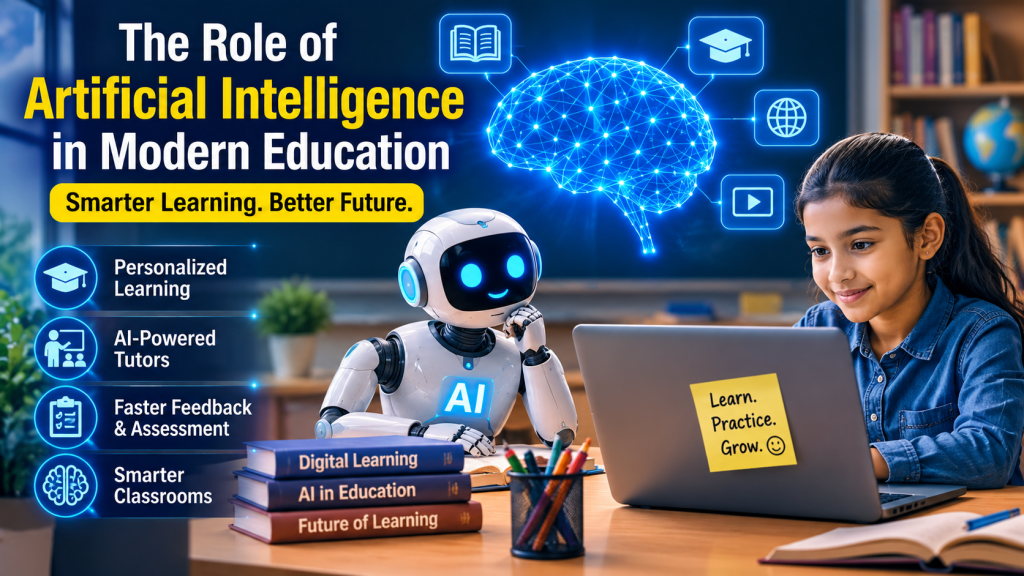
Introduction Artificial intelligence is becoming an important part of modern education. From personalized learning platforms to AI-powered educational tools, artificial intelligence is changing how students learn and how teachers plan, deliver, and support education. In 2026, AI is moving beyond simple automation. Educational institutions are exploring AI to provide more personalized learning experiences, support teachers, improve accessibility, and help students develop skills for a rapidly changing digital world. However, successful AI adoption requires responsible use, human oversight, and a clear focus on educational outcomes. What Is AI in Education? AI in education refers to the use of artificial intelligence technologies to support teaching and learning. These technologies can analyze information, recognize patterns, generate content, provide recommendations, and assist users with educational tasks. AI can be integrated into learning platforms, educational applications, assessment systems, virtual tutors, and other digital tools. Unlike traditional digital tools that mainly provide fixed content, AI-powered systems can adapt their responses based on user interactions and available data. This makes AI useful for creating more responsive and personalized learning experiences. How AI Is Transforming Education AI is transforming education by helping students learn more effectively and giving teachers new ways to support their learners. From personalized learning and AI tutoring to automated assessment and content creation, AI can support different stages of the educational process. 1. Personalized Learning Students have different learning styles, abilities, and levels of understanding. AI-powered learning platforms can analyze student performance and recommend appropriate content, exercises, and learning activities. This can help students receive support based on their individual learning needs and progress at their own pace. 2. AI-Powered Virtual Tutors AI-powered virtual tutors can provide students with explanations, examples, practice questions, and instant feedback. These tools can be available at any time, allowing students to review concepts and ask questions outside traditional classroom hours. 3. AI Is Supporting Teachers AI can also support teachers by helping with lesson planning, creating learning materials, generating practice questions, and organizing educational content. By reducing time spent on repetitive tasks, AI can allow teachers to focus more on classroom interaction, mentoring, and supporting individual students. 4. Faster Feedback and Assessment AI-powered assessment tools can help analyze student responses and provide faster feedback. Teachers can use these insights to identify areas where students may need additional support and adjust their teaching strategies accordingly. 5. Improved Accessibility AI can help make education more accessible by supporting tools such as speech recognition, text-to-speech, translation, and adaptive learning systems. These technologies can help learners with different abilities and language needs access educational content more effectively. Benefits of AI in Education When used responsibly and with clear educational goals, artificial intelligence can provide several benefits for students, teachers, and educational institutions. AI can make learning more personalized, efficient, accessible, and interactive. Personalized Learning Experiences AI can analyze learning patterns and recommend content based on individual student needs. This can help learners focus on areas where they need additional practice and progress at a suitable pace. Time-Saving for Teachers AI can assist teachers with repetitive tasks such as preparing learning materials, generating practice questions, and organizing information. This can give educators more time to focus on teaching and student interaction. Instant Support and Feedback AI-powered educational tools can provide students with immediate responses, explanations, and feedback. This can help learners identify mistakes and understand concepts without always having to wait for a formal classroom session. Better Accessibility AI-based tools can support translation, speech recognition, text-to-speech, and other accessibility features. These capabilities can make educational content easier to access for learners with different needs. Data-Driven Insights AI can help educational platforms analyze learning data and identify patterns in student performance. Teachers and institutions can use these insights to understand learning gaps and make more informed educational decisions. Challenges and Risks of AI in Education Although AI offers significant opportunities in education, its use also comes with challenges. Educational institutions need to consider privacy, accuracy, bias, academic integrity, digital access, and the importance of maintaining human involvement in the learning process. Data Privacy and Security AI-powered educational systems may process student information and learning data. Schools and technology providers need appropriate security and privacy practices to protect sensitive information and use data responsibly. Accuracy and Reliability AI systems can sometimes generate incorrect, incomplete, or misleading information. Students and teachers should verify important information and use human judgment rather than relying on AI responses without evaluation. Academic Integrity Easy access to AI tools can create challenges related to plagiarism, cheating, and excessive dependence on generated content. Educational institutions need clear guidelines that encourage students to use AI as a learning aid while continuing to develop their own knowledge and critical thinking. Digital Inequality Not every student or institution has equal access to AI-powered tools, reliable internet, or suitable devices. Unequal access can create differences in learning opportunities and needs to be considered when introducing AI into education. Human Oversight AI should support teachers rather than replace human judgment. Teachers play an important role in understanding students, providing guidance, encouraging creativity, and creating meaningful learning environments. The Future of AI in Education The role of artificial intelligence in education is expected to grow as AI technologies become more capable and accessible. Future learning environments may include AI-powered tutors, adaptive learning systems, intelligent assessment tools, and personalized educational platforms that respond to individual student needs. However, the future of AI in education should focus on collaboration between technology and people rather than replacing teachers. Effective use of AI will require responsible implementation, teacher training, strong data protection, clear policies, and continued emphasis on creativity, critical thinking, and human interaction. AI and the Changing Role of Teachers As AI takes on more repetitive and administrative tasks, teachers may have more opportunities to focus on mentoring, discussion, creativity, problem-solving, and personalized support. The teacher’s role can evolve from simply delivering information to guiding students in how to understand, evaluate, and apply knowledge. Conclusion Artificial intelligence is changing modern education by creating new ways for students to learn and