
app budget planning

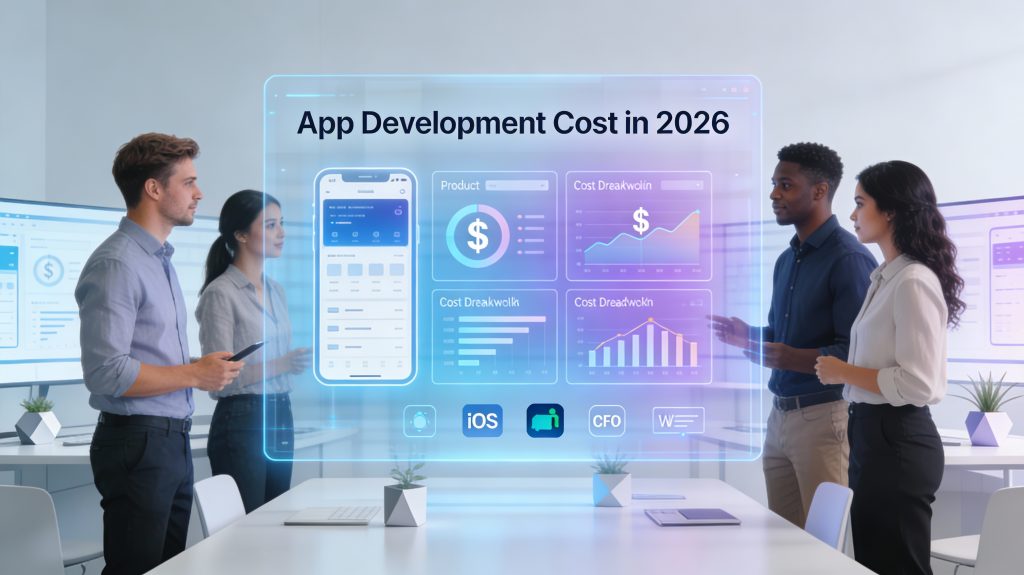
Futuristic 16:9 business illustration showing a diverse professional team in a modern digital workspace, reviewing mobile app wireframes and cost breakdown charts on large transparent screens, with iOS, Android, and web icons, cool blue and purple gradients, and the title “App Development Cost in 2026” displayed prominently.
App Development

How Much Does it cost to Develop an App in 2026?

Introduction Launching an app in 2026 is less about “Can it be built?” and more about “What will it take to build it right?” A clear understanding of app development costs helps you avoid budget overruns, choose the right tech stack, and prioritize features that actually move the needle. Industry data from 2024–2025 suggests that app budgets continue to rise with expectations around UX, security, and AI-driven features. This guide breaks down realistic app cost ranges, the factors that influence them, and how to estimate your own budget so you can plan with confidence.​ How to Build Demand Forecasting Software Typical App Cost Ranges in 2026 Most cost ranges for 2026 can be extrapolated from up-to-date 2024–2025 benchmarks, adjusted for modest inflation and complexity trends.​ Simple apps (few screens, basic CRUD, no complex backend): $20,000 – $60,000.​ Medium-complexity apps (auth, APIs, payments, dashboards): $60,000 – $150,000.​ Complex apps (real-time features, AI/ML, AR/VR, heavy integrations): $150,000 – $350,000+.​ Key global benchmarks you can expect to still hold in 2026:​ Many full projects land in the $80,000 – $250,000 range for a high-quality product. Building in regions with higher hourly rates (e.g., North America) tends to push you toward the upper end of these ranges.​ What Actually Drives App Cost? Several core factors decide where your app sits in those ranges.​ App complexity & features Basic apps (e.g., content display, simple forms) require fewer development hours and cheaper infrastructure.​ Advanced features like AR, AI recommendations, real-time chat, or IoT integrations add specialist skills and more development time, increasing cost significantly.​ Platform choice (iOS, Android, web, cross-platform) Native apps (separate iOS and Android codebases) can run $90,000 – $330,000+ depending on complexity.​ Cross-platform solutions (e.g., Flutter, Kotlin Multiplatform) often reduce cost, with many projects between $60,000 – $230,000+ while still offering near-native performance.​ Location and rates of the development team Typical hourly ranges: North America $100–$250/hour, Western Europe $80–$200/hour, Eastern Europe $30–$70/hour, India $20–$50/hour.​ The standard formula still applies in 2026: App cost = Development hours × hourly rate.​ Design depth and UX/UI Basic UI may add tens of thousands; advanced motion design and custom interactions can push design alone into the $20,000–$50,000+ range for complex products.​ Strong UX can reduce rework and support, making it a strategic investment, not just an aesthetic choice.​ Backend, integrations, and infrastructure Apps needing complex backends, microservices, or multiple third-party integrations (payments, CRM, analytics, logistics) cost more than standalone or offline-first apps.​ Advanced apps may require scalable cloud infrastructure, which influences both build and ongoing costs.​ Cost Breakdown by Phase and Platform You can break down an app budget into phases and platforms to see where your money goes.​ Typical Phase-Wise Budget Split While exact numbers vary, many 2025 guides outline a similar structure that remains relevant going into 2026.​ Strategy & discovery: 5–10% of total budget (market research, requirements, product workshops).​ UX/UI design: 10–20% (wireframes, prototypes, visual design).​ Development (frontend + backend): 50–60% (core build work).​ QA & testing: 10–20% (manual + automated tests, performance checks).​ Project management & overhead: 5–10% (coordination, sprint planning, reporting).​ Maintenance alone is often estimated at about 15–25% of the initial app cost per year, covering bug fixes, OS updates, and minor improvements.​ Platform & Tech-Stack Cost Snapshot Recent industry breakdowns give realistic benchmarks by platform and approach that still guide 2026 planning.​ Native mobile (iOS + Android): often $90,000 – $330,000+ for full-featured apps.​ Cross-platform (Flutter, Kotlin Multiplatform): roughly $60,000 – $230,000+, especially attractive if you need both platforms quickly.​ Web or PWA versions: commonly $15,000 – $60,000 for robust products, depending on complexity.​ How to Estimate Your Own App Budget for 2026 Using current data, you can create a practical, reader-focused estimate for your own 2026 app project.​ Define your app’s complexity List features as “must-have”, “nice-to-have”, and “future”. Map yourself to a band: simple, medium, or complex as described earlier.​ Choose approach and region Decide between native vs. cross-platform and where your team will be based (e.g., Eastern Europe vs. US).​ Use realistic hourly rates from those regions, such as $20–$50/hour in India vs. $100–$250/hour in North America.​ Estimate hours and multiply Simple MVPs often take 2–3 months, while complex builds can exceed 4 months.​ After you receive rough hour ranges from vendors, apply the formula: hours × hourly rate to get your baseline.​ Add buffer and maintenance Add 10–20% contingency for scope changes or unknowns.​ Plan 15–25% of initial cost annually for maintenance, marketing integrations, and updates so the app remains competitive.​ Conclusion Developing an app in 2026 will usually require a budget between $20,000 and $300,000+, with most serious business apps landing in the $80,000–$250,000 bracket once design, engineering, QA, and launch are accounted for. Your exact cost depends on complexity, feature set, platform strategy, and the location and experience level of your development team, but structured estimation and clear priorities keep you in control of the numbers. To move forward, define your must-have features, choose a tech approach (native vs. cross-platform), then request detailed estimates from 2–3 vendors so you can compare scope, timelines, and total cost before committing.​ A strong call-to-action: Document your app idea clearly, shortlist potential partners, and request a line-item quote that separates design, development, QA, and maintenance—this single step will dramatically improve your chances of delivering on time and on budget.​ FAQ 1. What is the minimum cost to build an app in 2026? For a very simple MVP with limited screens and basic backend, many teams can still deliver something usable starting around $20,000–$30,000, especially with cross-platform frameworks or lower-rate regions.​ 2. Why do some apps cost over $300,000? Apps that cross the $300,000 mark typically include complex architectures, AI/ML, AR/VR, real-time features at scale, and multiple third-party integrations, all of which require larger teams and longer timelines.​ 3. How much should I budget yearly for maintenance? A common rule of thumb is 15–25% of your initial development cost per year to cover bug fixes, performance tuning, OS updates, and incremental improvements.​ 4. Is cross-platform cheaper than native development? In many cases yes, because one codebase covers both iOS and Android, with example cost ranges such as $60,000 – $230,000+ versus $90,000 – $330,000+ for separate native builds of similar complexity.​ 5. How do developer locations affect app cost? Hourly rates vary significantly: North America tends to charge $100–$250/hour, Western Europe $80–$200/hour, Eastern Europe $30–$70/hour,
App Development

How Much Does It Cost to Develop an App in 2025?

Introduction Budgeting for app development is one of the most critical decisions a business leader will make in 2025. With digital transformation reshaping every industry, a well-planned mobile or web app is a gateway to new customers and better efficiency—but how much does it really cost to turn your idea into a fully functioning app? Costs depend on app complexity, required features, choice of tech, and team expertise. Understanding these factors will help every founder, manager, or enterprise leader plan smarter and build with confidence. In this detailed guide, we’ll break down app development costs phase-by-phase, compare budgets for different industries, highlight influencing factors, and show how leveraging AI and modern tech (like TechOTD’s solutions) can optimize investments. Explore TechOTD’s AI services, how we work, and mobile app solutions as you plan your journey. Phases of App Development and Associated Costs Building an app involves several distinct steps, each with budget requirements. Let’s break down each stage, using recent industry cost data: 1. Strategy & Planning ($4,000–$10,000) Business analysis, market research, competitor benchmarking. Defining user personas, app objectives, and feature lists. See TechOTD strategy examples. 2. Design (UX/UI) ($6,000–$30,000) Wireframing, prototyping, visual branding, user journey mapping. Interactive mockups and usability testing. Learn more about UX/UI trends. 3. Core Development ($25,000–$75,000+) Frontend and backend coding (iOS, Android, web, cross-platform). Third-party integrations (payment, GPS, social login). Custom features: e.g., predictive analytics, chatbots, real-time feeds. Framework insights: React Native vs Swift. 4. Third-Party Integrations ($5,000–$15,000) APIs for CRM, analytics, cloud storage, payment gateways. Blockchain or AI integrations for security and personalization. More on blockchain-powered apps. 5. Quality Assurance & Testing ($8,000–$18,000) Device, OS, and usability tests, bug fixing, security audits. Compliance with GDPR, PCI DSS, and industry standards. Predictive analytics in QA. 6. Deployment & Launch ($2,000–$7,000) App store submission (Apple, Google Play), launch marketing. Backend optimization, analytics setup. See TechOTD’s launch support. 7. Maintenance & Support (15–20% per year) Updates, bug fixes, feature enhancements, security patches. Hosting and server monitoring. Typical App Development Budgets by Complexity App Type Budget Range Examples Timeline Simple/MVP $20,000–$60,000 To-do, news, calculators 2–4 months Medium $60,000–$120,000 Loyalty, booking, fintech 4–7 months Complex $120,000–$250,000+ E-commerce, social media, healthcare, AR/AI 6–12 months Explore detailed cost analysis for loyalty apps: How much does it cost to build a customer loyalty app? Key Factors Influencing App Development Cost 1. App Complexity Number of user roles, features (e.g., chat, push notifications, payment). Custom UI, animation, and security. Advanced integrations (AI, ML, blockchain). TechOTD leverages latest innovations. 2. Platform Choice Native (Swift/Java/Kotlin) costs more than cross-platform (Flutter, React Native). Multi-platform apps increase cost by 30–40%. Cross-platform vs native advice. 3. Design and Branding High-fidelity UI/UX, custom illustrations, AR/VR increase cost. TechOTD’s design approach. 4. Data Security & Compliance Apps in finance, healthcare, and education need strict compliance (HIPAA, GDPR, PCI DSS). Cost increases for advanced encryption and regulatory audits. TechOTD’s security-first methodology. 5. AI, Analytics, and Next-Gen Technology Adding AI/ML for personalization, recommendation engines increases budget. Predictive analytics, chatbots, speech/image processing. AI-powered app solutions. 6. Team Location & Experience US/Europe rates: $60–$200/hr; Asia/Eastern Europe: $20–$60/hr. Experienced agencies deliver better quality and ongoing support. See TechOTD’s multi-regional expertise. Cost Examples by Industry Industry Typical Budget Unique Features Explore Fintech $80,000–$200,000+ Secure payments, AI analytics, blockchain LLMs in Finance Education $50,000–$150,000 LMS, AR/VR, remote learning, analytics Tech & Education E-Commerce $100,000–$250,000 Product catalog, cart, payment, push notifications Industry Blogs Loyalty/App $60,000–$120,000 CRM, rewards, gamification, partner systems Customer Loyalty App Guide On-Demand $75,000–$180,000 Real-time tracking, chat, payments, reviews Explore TechOTD’s solutions How TechOTD Optimizes Costs with Emerging Technologies AI & Machine Learning: Saves time, automates personalization, improves retention. Cloud & Edge Computing: Scalable infrastructure and performance. Blockchain Integration: High security and transparency for finance and supply chain apps. Agile & DevOps: Quicker cycles, better quality, ongoing support. Learn more from TechOTD’s blog and how we work. Tips to Budget Effectively for App Development Start with an MVP and validate user needs. Choose cross-platform tools if budget is limited. Use proven frameworks for speed and reliability. Invest in robust QA and post-launch support. Allocate budget for ongoing marketing and analytics. Partner with experienced agencies (like TechOTD) for guidance and best practices. Conclusion The cost to develop an app in 2025 depends on its complexity, features, chosen technology, and vendor expertise. Typical budgets range from $20,000 for a simple app to $250,000+ for enterprise-level solutions, with maintenance usually about 15–20% of initial yearly cost. Careful planning, partner selection, and leveraging advanced tech are key to maximizing ROI. Take the next step: Book a free consultation with TechOTD Explore best practices on TechOTD’s blog Discover AI-driven solutions FAQ Q1: What is the lowest possible budget for a simple app in 2025? A: MVPs with minimal features start at $20,000–$40,000 in most regions. Q2: Why do maintenance costs matter? A: Post-launch updates, bug fixes, and performance improvements are critical; expect 15–20% of original build cost per year. Q3: Can I reduce expenses by using cross-platform tools? A: Yes, React Native and Flutter typically lower costs by up to 30% compared to fully native solutions. Q4: Is security a major cost factor? A: Apps in finance or healthcare need greater compliance and security testing, which increases costs but protects your business. Q5: What kind of costs do loyalty and e-commerce apps involve? A: Loyalty apps range $60,000–$120,000 and e-commerce apps from $100,000–$250,000+, depending on features and integrations.

How would you like me to respond?

Select a personality for your AI assistant

Normal
Happy
Sad
Angry

Your selection will affect how the AI assistant responds to your messages

Chat Assistant

Let's discuss your project!

Hear from our clients and why 3000+ businesses trust TechOTD

Tell us what you need, and we'll get back with a cost and timeline estimate

Scroll to Top