AI

Digital Transformation, Technology & Innovation, telecom

The Business Impact of 5G and the Road to 6G Connectivity

The Business Impact of 5G and the Road to 6G Connectivity The world is becoming increasingly connected, and the technologies that power this connectivity are evolving at an unprecedented pace. Over the past few years, 5G has emerged as one of the most transformative technological advancements, promising faster speeds, lower latency, and the ability to connect billions of devices simultaneously. While many businesses are still exploring the full potential of 5G, discussions about 6G are already gaining momentum. Connectivity has become the foundation of modern business operations. From cloud computing and remote work to artificial intelligence and the Internet of Things (IoT), organizations depend on reliable, high-speed networks to remain competitive. As industries continue their digital transformation journeys, both 5G and the future transition to 6G are expected to redefine how businesses operate, innovate, and serve customers. Understanding the impact of these technologies is essential for organizations that want to stay ahead in a rapidly evolving digital landscape. Understanding 5G Technology 5G, or fifth-generation wireless technology, represents a significant upgrade from previous mobile network generations. Unlike 4G, which primarily focused on improving mobile internet speeds, 5G is designed to support a wide range of advanced applications and connected ecosystems. One of the most notable features of 5G is its ability to deliver extremely high data transfer speeds. Businesses can transmit large volumes of information in real time, enabling smoother communication, faster cloud access, and improved operational efficiency. Another critical advantage is ultra-low latency, which reduces the delay between sending and receiving information. This capability is particularly important for applications that require real-time responsiveness, such as autonomous vehicles, remote surgery, and industrial automation. Additionally, 5G can support a significantly larger number of connected devices compared to previous generations. This makes it ideal for environments where thousands or even millions of sensors, machines, and smart devices need to communicate simultaneously. How 5G Is Transforming Businesses The impact of 5G extends far beyond faster smartphone internet. Businesses across various sectors are leveraging this technology to create new opportunities and improve existing operations. Enhanced Remote Work and Collaboration The shift toward hybrid and remote work has increased the demand for reliable connectivity. 5G enables seamless video conferencing, faster file sharing, and real-time collaboration regardless of location. Employees can access cloud-based applications more efficiently, reducing delays and improving productivity. As organizations continue to embrace flexible work models, 5G provides the infrastructure needed to support distributed teams and digital workplaces. Accelerating the Internet of Things (IoT) The Internet of Things is one of the biggest beneficiaries of 5G technology. Smart devices generate enormous amounts of data, and 5G networks provide the bandwidth and reliability required to manage these connections effectively. Businesses can deploy large-scale IoT ecosystems for applications such as: Smart manufacturing Asset tracking Supply chain monitoring Smart agriculture Energy management Connected healthcare devices The ability to process and transmit data in real time enables organizations to make faster and more informed decisions. Revolutionizing Manufacturing Manufacturing is undergoing a major transformation through Industry 4.0 initiatives, and 5G plays a central role in this evolution. Factories equipped with connected sensors, autonomous robots, and intelligent monitoring systems can achieve greater efficiency and productivity. Real-time communication between machines allows manufacturers to optimize production processes, reduce downtime, and improve quality control. Predictive maintenance powered by IoT sensors helps identify potential equipment failures before they occur, minimizing disruptions and reducing maintenance costs. Improving Customer Experiences Customer expectations continue to rise, and businesses are seeking innovative ways to deliver personalized and engaging experiences. Retailers can use 5G-powered technologies such as augmented reality (AR) and virtual reality (VR) to create immersive shopping experiences. Customers can virtually try products, explore digital showrooms, and receive personalized recommendations in real time. Similarly, entertainment companies can deliver high-quality streaming services with minimal buffering, enhancing user satisfaction and engagement. Driving Innovation in Healthcare Healthcare organizations are leveraging 5G to improve patient care and operational efficiency. Real-time data sharing enables healthcare providers to access patient information instantly, facilitating faster diagnosis and treatment decisions. Telemedicine services become more reliable and effective, allowing doctors to consult with patients remotely without connectivity limitations. Advanced applications such as remote robotic surgery and AI-assisted diagnostics also benefit from the low latency and high reliability offered by 5G networks. Supporting Smart Cities Cities around the world are investing in smart infrastructure to improve transportation, energy management, public safety, and environmental monitoring. 5G provides the connectivity foundation for smart city initiatives by enabling real-time communication between sensors, cameras, vehicles, and public services. This results in more efficient resource utilization and improved quality of life for residents. Economic Benefits of 5G Adoption The adoption of 5G is generating significant economic opportunities for businesses and governments alike. Organizations that invest in 5G-enabled solutions can experience: Increased operational efficiency Reduced infrastructure costs Faster innovation cycles Enhanced customer engagement Improved workforce productivity New revenue streams Many businesses are also developing entirely new products and services that were not feasible under previous network limitations. As 5G ecosystems continue to mature, the economic impact is expected to expand across virtually every industry. Challenges in 5G Implementation Despite its advantages, implementing 5G is not without challenges. One of the primary concerns is infrastructure investment. Deploying 5G networks requires significant upgrades to existing telecommunications infrastructure, including additional base stations and advanced networking equipment. Cybersecurity is another important consideration. As more devices become connected, the potential attack surface for cyber threats increases. Businesses must implement robust security measures to protect sensitive data and critical systems. There are also concerns related to spectrum availability, regulatory compliance, and interoperability between different technologies and vendors. Organizations must carefully plan their adoption strategies to maximize benefits while managing risks. Looking Beyond 5G: The Emergence of 6G While 5G is still being rolled out globally, researchers and technology companies are already exploring the possibilities of 6G. 6G is expected to represent the next major leap in wireless communication. Although commercial deployment may still be years away, early research suggests that 6G could deliver speeds up to 100 times faster

Artificial Intelligence, Digital Transformation, Technology

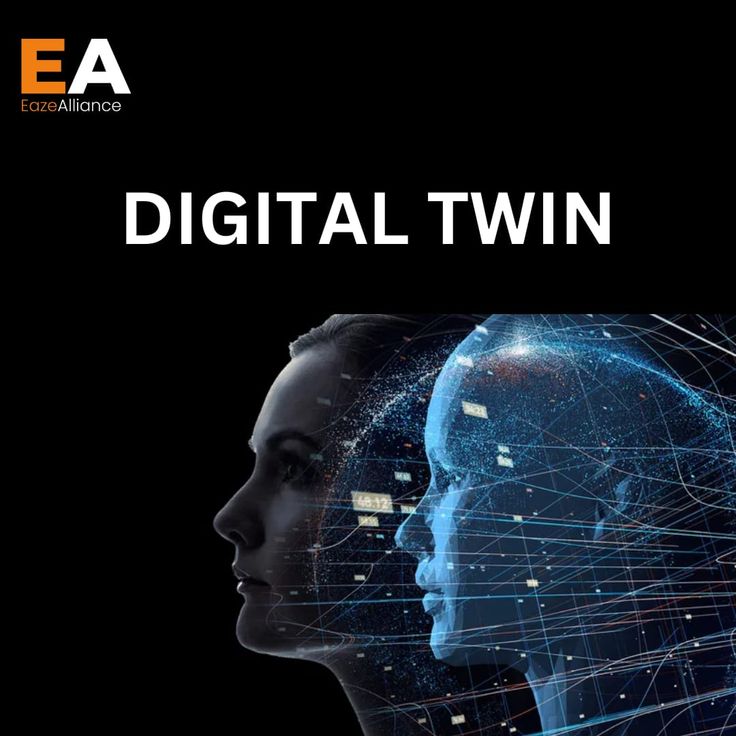
How Digital Twins Are Transforming Manufacturing and Smart Cities

How Digital Twins Are Transforming Manufacturing and Smart Cities Imagine being able to create an exact digital replica of a factory, a production line, a power grid, or even an entire city. Now imagine that this digital replica updates itself continuously using real-time data from sensors, machines, cameras, and connected devices. Engineers can test changes before implementing them, city planners can predict traffic congestion before it occurs, and manufacturers can identify equipment failures before they happen. This is the power of digital twin technology. Over the past few years, digital twins have evolved from an experimental concept into one of the most impactful technologies driving digital transformation. Organizations across industries are leveraging digital twins to improve efficiency, reduce costs, optimize operations, and make better decisions based on real-world data. As manufacturing facilities become smarter and cities become increasingly connected, digital twins are emerging as a critical technology that bridges the gap between the physical and digital worlds. Understanding how digital twins work and why they matter is essential for businesses, city planners, and technology leaders looking to stay competitive in an increasingly data-driven future. What Is a Digital Twin? A digital twin is a virtual representation of a physical object, process, system, or environment that continuously receives data from its real-world counterpart. Unlike traditional simulations that rely on static information, digital twins are dynamic. They constantly collect and analyze real-time data through sensors, Internet of Things (IoT) devices, software systems, and connected networks. The digital model mirrors the current condition of the physical asset and can predict future behavior based on historical and live data. For example, in a manufacturing plant, a digital twin of a machine can monitor temperature, vibration levels, energy consumption, and production output. If the system detects unusual behavior, it can alert operators before a costly breakdown occurs. Similarly, a digital twin of a city can monitor traffic flow, public transportation, energy consumption, water distribution, weather patterns, and infrastructure performance to help authorities make smarter decisions. The combination of IoT, artificial intelligence, cloud computing, big data analytics, and advanced visualization technologies has accelerated the adoption of digital twins across multiple sectors. Why Digital Twins Matter More Than Ever Today’s organizations face increasing pressure to improve operational efficiency while reducing costs and minimizing risks. Manufacturers must manage complex supply chains, maintain equipment reliability, and meet customer demands for faster production. City governments must address challenges such as population growth, traffic congestion, energy management, sustainability, and public safety. Traditional monitoring systems often provide limited visibility into operations. Digital twins offer a more comprehensive approach by providing a complete digital view of physical systems. This enables organizations to move from reactive decision-making to predictive and proactive management. Instead of fixing problems after they occur, organizations can anticipate issues and take action before disruptions happen. This shift is creating significant value across industries and transforming how physical assets are designed, managed, and optimized. The Role of Digital Twins in Modern Manufacturing Manufacturing is one of the industries experiencing the greatest impact from digital twin technology. Modern factories generate enormous amounts of operational data every day. Machines, robots, conveyors, sensors, and production systems continuously produce information that can be used to improve efficiency and productivity. Digital twins bring all this information together into a single intelligent model. Manufacturers can visualize operations in real time, identify inefficiencies, and test improvements without disrupting production. One of the most valuable applications is predictive maintenance. Equipment failures can cause expensive downtime and production delays. Traditional maintenance schedules often rely on fixed intervals, which may result in unnecessary servicing or unexpected breakdowns. Digital twins continuously monitor machine health and identify early warning signs of potential failures. This allows maintenance teams to perform repairs at the optimal time, reducing downtime and extending equipment lifespan. Production optimization is another major benefit. Manufacturers can simulate different production scenarios and evaluate their impact before implementing changes. Whether adjusting workflows, introducing new machinery, or redesigning assembly lines, digital twins help organizations make informed decisions with minimal risk. Quality control also improves significantly. By monitoring production processes in real time, digital twins can identify deviations that may affect product quality. This enables faster corrective actions and helps maintain consistent manufacturing standards. As competition increases and margins become tighter, these improvements can deliver substantial financial benefits. Enhancing Product Development and Innovation Digital twins are not only transforming factory operations but also revolutionizing product development. Traditionally, creating and testing physical prototypes requires significant time and resources. Digital twins enable engineers to evaluate product designs in virtual environments before building physical versions. Manufacturers can test performance, durability, safety, and functionality under various conditions using advanced simulations. This approach reduces development costs, accelerates innovation, and shortens time-to-market. For industries such as automotive, aerospace, electronics, and industrial equipment, digital twins provide a powerful way to improve product quality while reducing design risks. Companies can identify potential issues earlier in the development process and make adjustments before production begins. This creates a more efficient and cost-effective innovation cycle. Supply Chain Visibility and Optimization Global supply chains have become increasingly complex and vulnerable to disruptions. Manufacturers need better visibility into every stage of the supply chain to ensure smooth operations. Digital twins can create virtual models of supply chain networks, allowing organizations to track inventory, shipments, supplier performance, and logistics operations in real time. By analyzing supply chain data, businesses can identify bottlenecks, predict delays, and optimize inventory management. This improved visibility helps organizations respond more effectively to market fluctuations and unexpected disruptions. The ability to simulate different scenarios also supports strategic planning and risk management. As supply chain resilience becomes a top priority for businesses worldwide, digital twins are becoming an essential tool for operational success. How Digital Twins Are Powering Smart Cities The same technology that improves manufacturing efficiency is also helping cities become smarter, safer, and more sustainable. Urban populations continue to grow rapidly, creating increasing demands on infrastructure and public services. City planners face challenges related to transportation, energy consumption, environmental sustainability, housing, waste

Digital Transformation, Frontend Developer, startup, Technology & Business

The “Solo-Studio” Era: How AI Made the Full-Stack Dev a One-Person Agency

Introduction For years, the dream of the “solopreneur” usually came with a massive asterisk. You could have a great idea, but unless you were a coding prodigy, a UI/UX expert, a DevOps wizard, and a marketing specialist all rolled into one, you eventually hit a wall. You needed a team. You needed capital. You needed time. Fast forward to 2026, and that wall hasn’t just been lowered—it’s been demolished. We’ve entered the era of the Solo-Studio. Today, a single developer with a clear vision can outpace a mid-sized software house from five years ago. This isn’t just about “coding faster”; it’s about a fundamental shift in what it means to be a creator in the digital age. From “Syntax Writer” to “Product Architect” The old way of web development was heavy on syntax. We spent 40% of our time fighting CSS alignment, 30% writing boilerplate API calls, and maybe 30% actually solving the user’s problem. In the Solo-Studio era, AI handles the syntax. Tools like Cursor and GitHub Copilot have evolved from simple autocomplete to full-blown pair programmers that understand your entire codebase. You no longer ask “how do I write a map function?”; you tell the AI, “Build a secure checkout flow that integrates with Stripe and updates my Supabase database,” and it generates the architecture. This shifts the developer’s value. Your worth is no longer measured by how many languages you know, but by your ability to architect a product that solves a real-world problem. The Rise of the “One-Person Agency” Why do we call it a “Solo-Studio”? Because the modern full-stack dev is no longer just handling the backend and frontend. With AI-assisted design tools like v0.dev or Figma’s AI features, developers are now producing high-fidelity UI/UX that looks like it came from a dedicated design team. Furthermore, DevOps—once the scariest part of a launch—has been abstracted away. With the “Backendless” and “Edge” technologies we’ve discussed previously, a solo dev can deploy a globally distributed app in minutes. You aren’t just a coder; you are the CTO, the Lead Designer, and the Head of Infrastructure, all powered by a single keyboard. The Human Element: Why Vision Still Wins There is a common fear that AI will make developers obsolete. In reality, AI is making the uninspired obsolete. AI can write a function, but it can’t tell you why a user feels frustrated with your onboarding flow. It can’t spot a gap in the market for a specific niche tool. The “Solo-Studio” thrives because the human at the center provides the empathy, the taste, and the strategic direction. The AI is simply the most powerful intern in human history. The Tech Stack of the Solo-Studio If you’re looking to transition into this one-person agency model, your 2026 stack likely looks like this: Editor: Cursor or VS Code with heavy AI integration. Frontend: Next.js or Astro for speed and SEO. Backend/Database: Supabase for instant Auth and DB. Design: v0.dev for generating React components from plain English. Deployment: Vercel or Netlify for zero-config scaling. Conclusion: It’s Time to Build We are living through a “Renaissance” of individual creativity. The barriers to entry have vanished. The cost of failure is lower than ever, and the speed of execution is at an all-time high. The “Solo-Studio” isn’t just a trend; it’s the future of how software is built. You don’t need a boardroom full of people to change an industry anymore. You just need a laptop, a few AI agents, and the courage to hit npm run dev. How to Study Smarter, Not Harder, Using Online Education Apps

Future trends shaping the software development industry
Software development

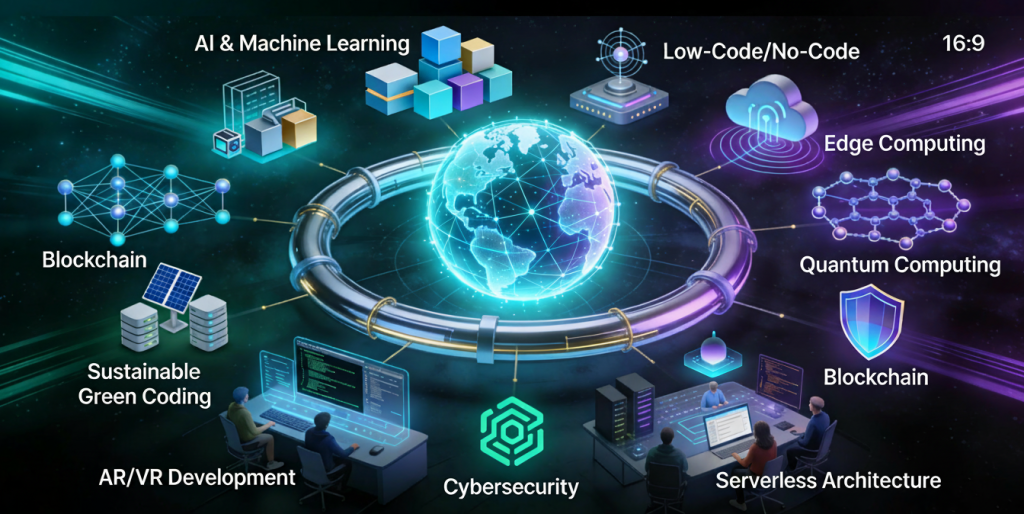
Future Trends in Software Development: What to Expect in the Coming Years

Introduction Software development is evolving at an unprecedented pace. Rapid advancements in artificial intelligence, cloud computing, automation, and development tools are reshaping how applications are built, deployed, and maintained. Organizations that fail to adapt risk falling behind in an increasingly competitive digital world. Understanding future trends in software development helps developers, businesses, and technology leaders prepare for upcoming challenges and opportunities. In this blog, we explore key trends that will define the future of software development and how they will impact the industry. Artificial Intelligence in Software Development AI is transforming every stage of the software development lifecycle. Key Applications AI-powered code generation Intelligent debugging Automated testing AI tools improve productivity and reduce human error. Low-Code and No-Code Development Low-code and no-code platforms enable faster application development with minimal coding. Benefits Faster time to market Reduced development costs Empowered non-technical users These platforms are ideal for rapid prototyping and internal tools. Cloud-Native Development Cloud-native applications are designed specifically for cloud environments. Key Technologies Containers Microservices Serverless computing Cloud-native development improves scalability and resilience. DevOps and Automation Automation continues to play a vital role in software development. Trends AI-driven CI/CD pipelines Automated infrastructure Continuous monitoring Automation enhances efficiency and reliability. Cybersecurity-First Development Security is becoming a core development priority. Emerging Practices Zero trust architecture DevSecOps Continuous security testing Security-first development protects applications from evolving threats. Microservices Architecture Microservices allow applications to be built as independent, scalable services. Advantages Better scalability Faster updates Improved fault isolation Microservices support modern, distributed systems. Edge Computing Edge computing processes data closer to the source. Use Cases IoT devices Real-time analytics Autonomous systems Edge computing reduces latency and improves performance. Remote and Distributed Development Teams Remote work is becoming the norm in software development. Benefits Access to global talent Improved flexibility Reduced operational costs Collaboration tools enable seamless teamwork. Sustainable Software Development Green software engineering focuses on energy-efficient applications. Key Goals Reduced carbon footprint Efficient resource usage Sustainability is becoming a strategic priority. Continuous Learning and Skill Evolution Developers must continuously update their skills to remain competitive. In-Demand Skills Cloud platforms AI and ML Cybersecurity Lifelong learning is essential in modern software development. Conclusion The future of software development is shaped by innovation, automation, and continuous improvement. AI, cloud-native technologies, security-first practices, and sustainability will define the next generation of applications. By embracing these trends, organizations and developers can stay competitive and build software that meets future demands. Frequently Asked Questions (FAQs) 1. What is the biggest trend in software development? AI and automation are the most impactful trends. 2. Will low-code platforms replace developers? No, they will complement developers by improving productivity. 3. Is cloud-native development the future? Yes, cloud-native approaches are becoming the industry standard. 4. How important is cybersecurity in future development? Cybersecurity is critical and must be integrated from the start. 5. Will DevOps continue to grow? Yes, DevOps will remain essential for modern software delivery. 6. How can developers prepare for the future? By continuously learning new technologies and adapting to change. Connect With Us:https://www.facebook.com/profile.php?id=61555452386126

A robotic human face representing artificial intelligence technology.
Artificial Intelligence

Artificial Intelligence in Everyday Life

Introduction Artificial Intelligence (AI) is no longer just a futuristic idea — it’s already a part of our everyday lives. Whether it’s voice assistants like Alexa, smart recommendations on Netflix, or self-driving cars, AI quietly powers many aspects of our daily routines. But how exactly does it work, and where do we experience it the most? What is Artificial Intelligence? Artificial Intelligence is the simulation of human intelligence in machines. These systems are designed to learn, reason, and make decisions — often faster and more accurately than humans. The main goal of AI is to make systems capable of performing tasks that normally require human intelligence, such as understanding language, recognizing images, or solving problems. AI in Our Daily Lives a. Smart Assistants Devices like Amazon Alexa, Google Assistant, and Siri help us with daily tasks such as setting reminders, playing music, or checking the weather — all powered by natural language processing (NLP). b. Personalized Recommendations When Netflix suggests a movie or Amazon recommends a product, it’s using machine learning algorithms to analyze your preferences and predict what you’ll like next. c. AI in Healthcare AI helps doctors detect diseases early, analyze X-rays, and predict health risks. For example, AI models can detect diabetic retinopathy from eye scans with remarkable accuracy. d. Smart Homes and Devices From thermostats that adjust to your temperature preference to fridges that track food freshness — AI makes our homes smarter and energy-efficient. e. AI in Education Personalized learning platforms powered by AI assess student performance and adapt lessons accordingly, improving learning outcomes. Benefits of AI in Everyday Life Convenience: Simplifies daily tasks. Efficiency: Automates repetitive work. Accuracy: Reduces human error. Personalization: Offers custom experiences.  Challenges of AI Privacy Concerns: Data collected by AI devices can be misused. Job Automation: Some jobs are being replaced by AI systems. Bias: AI systems can inherit biases from training data. Conclusion Artificial Intelligence is shaping a smarter, more connected world. As it evolves, it promises to make our lives easier — but also challenges us to use it responsibly. The future of AI lies in finding the right balance between innovation and ethics. FAQs Q1: What is an example of AI in daily life?AI examples include voice assistants, facial recognition on smartphones, and personalized online recommendations. Q2: How does AI make life easier?AI automates tasks, provides personalized suggestions, and improves decision-making in daily routines. Q3: What are the risks of AI?Major risks include privacy issues, unemployment due to automation, and biased algorithms.

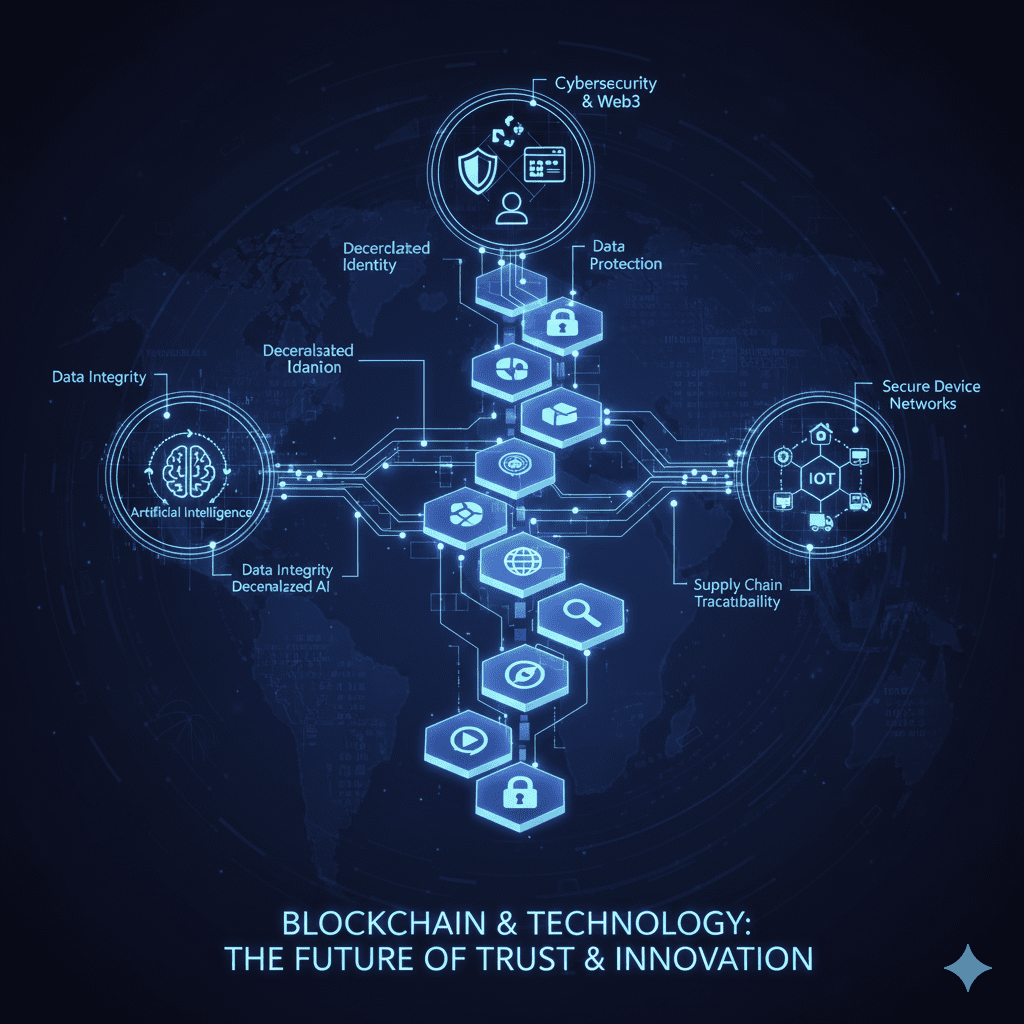
A futuristic infographic titled 'BLOCKCHAIN & TECHNOLOGY,' showing a central blockchain icon connected to other technologies like AI, IoT, Cybersecurity, DeFi, NFTs, and Web3.
Blockchain & Technology

Blockchain’s Role in Building Tomorrow’s Tech

Introduction What do AI, cybersecurity, and the future of the internet (Web3) have in common? They all have critical problems with trust, security, and centralization. Blockchain technology is emerging as the key solution to all three. It’s the invisible architecture that provides the security for our data, the transparency for our transactions, and the ownership of our digital assets. Let’s dive into the technology ecosystem that blockchain is building right now. What is Blockchain? At its simplest, a blockchain is a secure, digital ledger that is shared among many computers in a network. Once a piece of information (a “block”) is added to the ledger, it is linked to the previous block using cryptography, creating a “chain.” This structure makes it immutable, meaning once data is recorded, it is extremely difficult to change or remove. Core Components Decentralization: Instead of one person or company controlling the ledger (like a single bank), the ledger is copied and spread across many computers. This means no single entity has control, and there is no single point of failure. Cryptography: Every transaction is secured and verified using advanced math. This ensures that only the rightful owner can access their assets and that all records are authentic. Blocks: These are the “pages” of the ledger. Each block contains a batch of recent, verified transactions. Consensus Mechanism: This is the “rulebook” that the network follows to agree on which transactions are valid and can be added to the chain (e.g., Proof-of-Work or Proof-of-Stake). The Big Trends: Web3, DeFi, and NFTs Blockchain is the foundational technology for several major trends: Web3: This is the idea of a new, decentralized internet. Web1 was the “read-only” internet (static websites). Web2 is the “read-write” internet we use today (social media, user-generated content), but it’s controlled by large tech companies. Web3 aims to be a “read-write-own” internet, where users control their own data and identity using blockchain. DeFi (Decentralized Finance): This is an entire ecosystem of financial applications built on blockchain. It aims to recreate traditional financial systems (like lending, borrowing, and trading) without the need for intermediaries like banks. Users interact directly with smart contracts. NFTs (Non-Fungible Tokens): An NFT is a unique digital certificate of ownership for an asset (like a piece of digital art, a collectible, or even a real-world item). “Non-fungible” means it’s one-of-a-kind and cannot be replaced by another, unlike a dollar bill, which is fungible. This ownership is recorded and verifiable on the blockchain. Blockchain’s Integration with Other Technologies Blockchain doesn’t exist in a bubble. Its real power is unlocked when combined with other technologies. 1. Artificial Intelligence (AI) Data Integrity: AI models are only as good as the data they’re trained on. Blockchain can provide an immutable, verifiable audit trail for AI training data, ensuring it hasn’t been tampered with and proving its origin. Decentralized AI: It enables “Federated Learning,” where an AI model can be trained across multiple devices without the users’ private data ever leaving their device. The blockchain is used to log and verify the model’s updates, protecting user privacy. 2. Internet of Things (IoT) Security: IoT networks often have thousands of simple devices (like sensors) that are vulnerable to hacking. Blockchain can create a secure, decentralized network for these devices to communicate directly and verifiably, preventing a central server from being hacked. Traceability: For supply chains, an IoT sensor can log a package’s temperature and location to a blockchain at every step. This creates a tamper-proof record that all parties (the producer, the shipper, the customer) can trust. 3. Cybersecurity Decentralized Identity: Instead of relying on Google or Facebook to log in to websites, blockchain allows for Self-Sovereign Identity (SSI). You would control your own digital identity, stored securely, and grant specific, temporary access to services that need to verify it. Mitigating Attacks: By decentralizing data storage, blockchain can help prevent large-scale data breaches. It also makes systems more resilient to Distributed Denial of Service (DDoS) attacks, as there is no single central server to overwhelm Conclusion In conclusion, blockchain has evolved far beyond its origins in cryptocurrency. It is now the essential “trust layer” for the next generation of technology. By providing a decentralized, immutable, and transparent ledger, it solves the critical vulnerabilities in our current systems. It’s the thread that securely connects AI models to verifiable data, enables IoT devices to communicate without a central point of failure, and provides the very foundation for a user-owned internet in Web3, DeFi, and NFTs. As we move forward, it’s clear that blockchain isn’t just another technology in the stack; it’s the fundamental architecture the future is being built on. FAQ Q1: What is blockchain in the simplest terms? Blockchain is a digital ledger, like a shared notebook, that is duplicated and spread across many computers. Once a transaction (a “block”) is added to this notebook, it’s cryptographically linked to the one before it, creating a “chain.” This structure makes the data immutable, meaning it’s nearly impossible to change or tamper with. Q2: Isn’t blockchain just for Bitcoin and cryptocurrency? No. While Bitcoin was the first major application, it’s just one use case. Blockchain is the underlying technology that enables cryptocurrencies, but its core value is in providing a secure and decentralized way to record any kind of data. It’s now being used in supply chains, healthcare, voting systems, cybersecurity, and more. Q3: What’s the difference between Blockchain and Web3? Think of blockchain as the tool and Web3 as the movement. Blockchain is the specific technology (a decentralized ledger). Web3 is the broader vision for a new, decentralized internet built using tools like blockchain, crypto, and decentralized networks. Web3’s goal is to shift control from large tech companies to individual users. Q4: How does blockchain work with Artificial Intelligence (AI)? Blockchain can be seen as the “source of truth” for AI. Data Integrity: It provides a tamper-proof log of the data used to train an AI model, so you can verify its origin and quality. Privacy: It enables federated learning,

Lifestyle & Future Trends

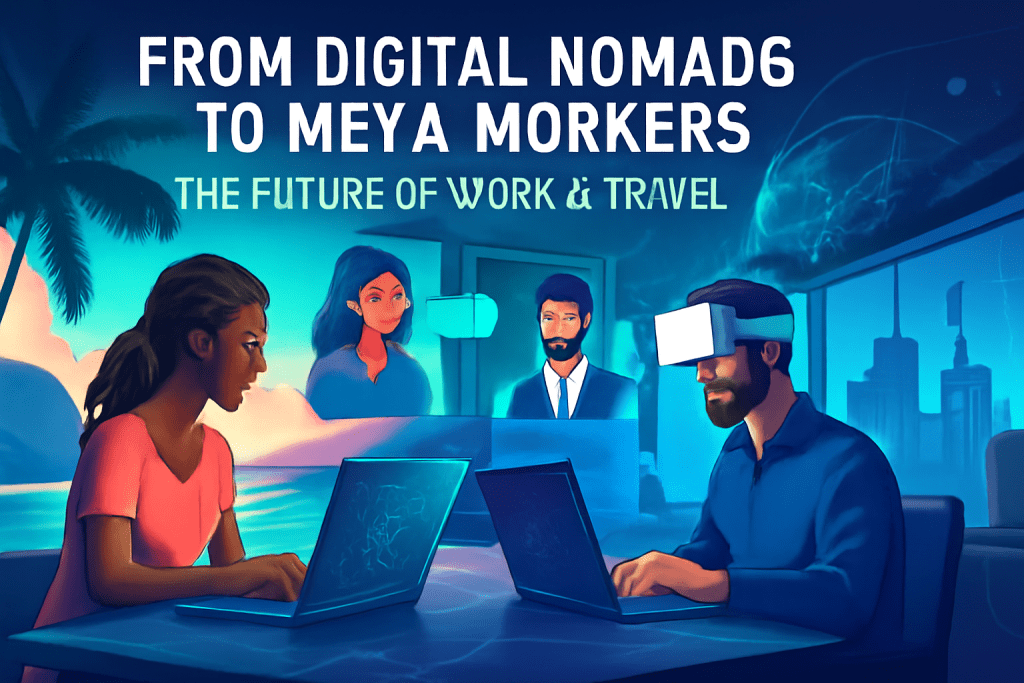
From Digital Nomads to Meta-Workers: The Future of Work & Travel

Introduction The way we work and travel in 2025 is unlike anything seen before. Thanks to accelerated digital transformation and the rise of immersive technologies, the lines between career and lifestyle are rapidly blurring. Digital nomads, once a niche community of remote workers exploring the globe, now lead a revolution—ushering in the age of the “meta-worker.” Whether collaborating from tropical beaches or inside virtual office spaces, today’s professionals expect flexibility, inclusivity, and experience-driven work-life balance. This blog explores the evolution from digital nomadism to meta-working, key trends shaping the future of work and travel, and why this movement is reshaping how we live, connect, and achieve success. The Evolution: From Digital Nomads to Meta-Workers Digital Nomads in 2025: The digital nomad lifestyle has become “mainstream,” with over 40 million people worldwide identifying as nomads. Typical nomads are tech-literate, mid-career professionals, predominantly from the US, but with a rising share from the Global South and Gen Z. Many travel with partners or families, not just solo. Most digital nomads value flexibility, cultural immersion, and freedom, often changing locations every few weeks. Meta-Workers: The Next Frontier: Meta-workers use immersive technologies like VR and AR to engage in work from anywhere—physical or virtual. In the “metaverse,” workers design customizable avatars, participate in virtual offices, and join global teams in 3D environments. This move toward meta-working challenges traditional expectations around workplace identity, collaboration, and inclusion, offering new forms of expression and belonging. Key Points: High job satisfaction: Over 80% of digital nomads report satisfaction, noting improved quality of life and work independence. Major job types: Software development, digital marketing, UX/UI, product management, writing, and AI-powered freelancing are common. Annual income varies, but top earners (like developers and product managers) can make €58,000–€128,000/year. The Future of Work & Travel: Trends, Destinations, and Impacts Work Trends You Can’t Ignore Hybrid Work and “Bleisure” Travel: Hybrid models combining business and leisure travel are thriving. Professionals seek destinations with robust digital infrastructure, coworking spaces, and recreational opportunities. Meta-Workspaces: Firms are investing in VR/AR, with 60% of workers wanting VR headsets in the office and 70% expecting to work globally via immersive platforms. Flexibility & Inclusion: 67% of organizations say they’ll lose talent without flexible/remote options. Face-to-face meetings are shifting to virtual or augmented reality spaces, creating a new paradigm of global collaboration. Slow & Sustainable Travel: The “slow travel” and “regenerative travel” waves encourage longer stays and community impact, driven by remote professionals aiming for deeper cultural engagement and reduced environmental footprints. Popular Destinations & Legal Evolution Countries like Mexico, Georgia, Thailand, and Portugal remain top hotspots for digital nomads due to affordable cost of living, reliable internet, and supportive visa programs. The Global South is rising fast, with locations like Colombia, Kenya, and the Philippines gaining attention for flexibility and value-for-money. Governments are increasing compliance and creating digital nomad visas, making legal remote work more accessible worldwide. Technology, Wellbeing, and Lifestyle AI and automation tools make freelancing and entrepreneurship more efficient than ever. Community-led nomad villages and eco-friendly coworking hubs are flourishing worldwide. A strong emphasis on wellness, with professionals choosing destinations prioritizing health, nature, and work-life balance. Conclusion The convergence of digital nomadism and meta-working signals a radical shift in how we perceive, perform, and enjoy work and travel. As immersive tech, flexible policies, and global opportunities take center stage, more individuals are forging careers without borders—balancing freedom, innovation, and mindful living. Whether you’re a freelancer seeking new horizons or an exec rethinking virtual offices, now is the time to embrace the future of work and travel. Ready to become a meta-worker or take your digital nomad journey to the next level? The world—and the metaverse—are open. Start shaping your future, anywhere. FAQ 1. What is a meta-worker? A meta-worker is someone who works using immersive digital technologies (like AR and VR) in virtual spaces, often represented by avatars and collaborating transcending physical boundaries. 2. Are digital nomads still relevant in 2025? Absolutely! Digital nomad numbers are at an all-time high, with new types like “slowmads,” families, and hybrid-nomads gaining momentum. 3. Can I work legally while traveling abroad? Yes. Many countries now offer digital nomad visas, making it easier to live and work remotely around the world. 4. How do metaverse offices change collaboration? Virtual offices enable inclusivity, creative teamwork, and reduce the isolation of remote work by simulating real-world interaction in digital environments. 5. What jobs are best for digital nomads and meta-workers? Software development, digital marketing, design, virtual assistance, content creation, and AI-driven roles are especially well-suited for remote, globe-trotting professionals.

Scroll to Top