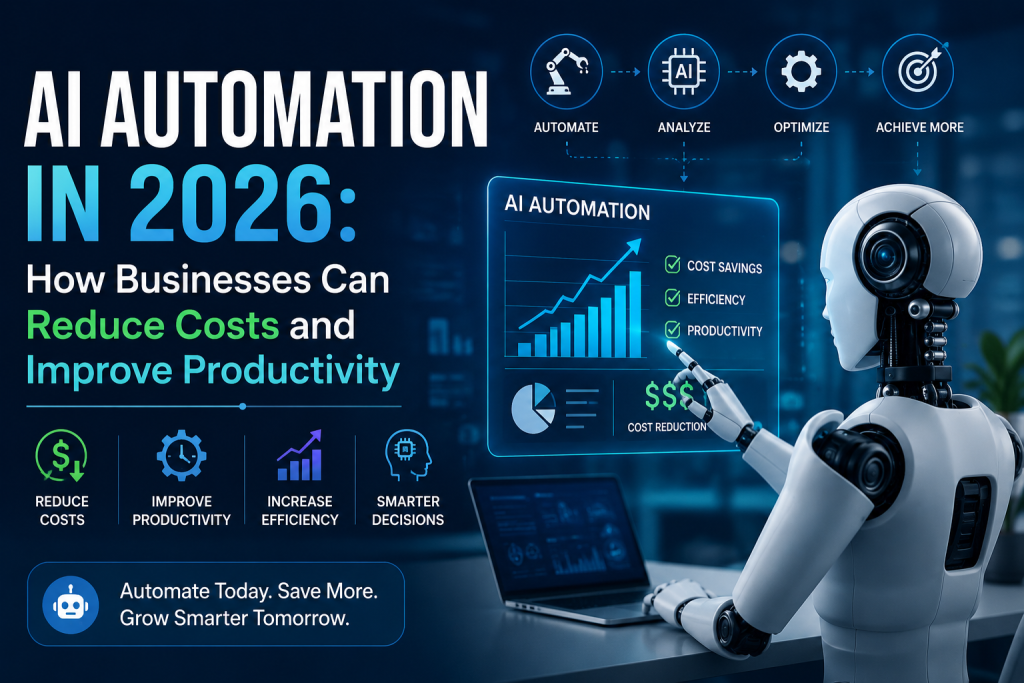
AI Automation in 2026: How Businesses Can Reduce Costs and Improve Productivity
Artificial Intelligence is rapidly changing the way businesses operate. In 2026, AI automation is moving beyond simple chatbots and repetitive task automation. Businesses are increasingly using AI-powered systems to analyze information, automate workflows, assist employees, improve customer experiences, and make faster decisions. For organizations dealing with increasing operational costs, large amounts of data, and repetitive processes, AI automation can provide a practical way to improve efficiency without continuously increasing manual workloads. From customer support and sales to finance, human resources, software development, and business analytics, AI automation is becoming an important part of modern digital transformation. What Is AI Automation? AI automation combines artificial intelligence with automated workflows to perform tasks that traditionally require human intervention. Traditional automation usually follows predefined rules: Input → Rule → Action → Result AI automation can work with more flexible processes: Data → AI Analysis → Decision → Automated Action → Evaluation This allows automated systems to handle information, identify patterns, make recommendations, and trigger appropriate actions based on changing situations. For example, a traditional workflow might automatically send the same email to every new customer. An AI-powered workflow could analyze customer information, identify their interests, personalize the message, update the CRM, and schedule a follow-up automatically. This makes AI automation more adaptable to modern business processes. Why AI Automation Matters in 2026 Businesses are under constant pressure to improve productivity while controlling operational costs. Employees often spend significant amounts of time performing repetitive activities such as: Entering data Responding to routine emails Updating CRM systems Preparing reports Scheduling meetings Processing documents Answering common customer questions Monitoring business metrics Managing repetitive administrative workflows AI automation can reduce the amount of manual work involved in these processes. The goal is not simply to automate everything. Instead, businesses can use AI to automate suitable tasks while allowing employees to focus on activities that require creativity, strategic thinking, communication, and human judgment. Some major benefits include: Reduced repetitive work Improved employee productivity Faster business processes Lower operational overhead Faster customer responses Better data utilization Improved decision-making Scalable workflows 24/7 automated operations How AI Automation Helps Businesses Reduce Costs Reducing costs does not always mean reducing employees. In many cases, businesses can reduce operational costs by improving how existing resources are used. AI automation can help organizations achieve this in several ways. 1. Reduce Repetitive Manual Work Employees can spend hours performing repetitive tasks that follow predictable patterns. AI automation can handle many of these processes automatically. For example: Manual Process: Employee receives request → Reads information → Updates system → Sends response → Creates follow-up task Automated Process: Request received → AI analyzes request → System updated → Personalized response sent → Follow-up created This allows employees to spend more time on higher-value work. 2. Improve Operational Efficiency Manual processes often involve multiple systems and departments. For example, processing a new customer may require information to be entered into: CRM Email platform Accounting system Project management software Customer support platform Analytics system AI automation can coordinate these systems and reduce unnecessary manual data entry. 3. Reduce Errors Manual data entry and repetitive processing can result in mistakes. AI-powered workflows can validate information, identify inconsistencies, and trigger alerts when something requires human attention. This can help reduce the operational cost associated with avoidable errors and rework. 4. Improve Resource Utilization Businesses can use automation to handle routine processes while employees focus on more complex responsibilities. Instead of hiring additional resources for every increase in workload, organizations can automate suitable processes and scale operations more efficiently. 5. Provide 24/7 Support AI-powered systems can operate outside normal business hours. Customer questions, internal requests, monitoring activities, and other automated processes can continue even when employees are unavailable. This can improve service availability without requiring a larger support team to work around the clock. How AI Automation Improves Productivity Cost reduction is only one side of AI automation. The larger opportunity is improving productivity. Faster Task Completion AI systems can process large amounts of information quickly and automate workflows that previously required multiple manual steps. Less Administrative Work Employees can spend less time on repetitive activities such as documentation, scheduling, reporting, and data entry. Better Access to Information AI-powered systems can help employees search internal information and retrieve relevant data using natural language. Faster Decision Support AI automation can analyze business information and highlight trends, anomalies, and important changes. This gives teams faster access to information needed for decision-making. Improved Collaboration Automated workflows can notify the right team members, create tasks, update systems, and share information automatically. This reduces delays caused by manual communication between departments. AI Automation in Customer Support Customer support is one of the most practical areas for AI automation. Businesses can use AI-powered systems to handle routine customer interactions and automate support workflows. Common applications include: Answering frequently asked questions Tracking orders Checking account information Creating support tickets Categorizing customer requests Routing issues to the appropriate department Scheduling appointments Providing personalized responses Escalating complex issues to human agents For example, when a customer submits a support request, an AI system can understand the request, retrieve relevant information, categorize the issue, and either provide an answer or route the request to a human support professional. This can reduce response times while allowing support teams to focus on more complex customer problems. AI Automation in Sales and Marketing Sales and marketing teams manage large amounts of customer and prospect information. AI automation can help reduce administrative workloads across the sales process. A sales automation workflow can: Identify potential leads. Collect relevant customer information. Qualify prospects. Update CRM records. Generate personalized outreach. Schedule follow-ups. Notify sales representatives. Track engagement. Generate performance reports. Marketing teams can also use AI automation for: Content planning Audience segmentation Campaign analysis Lead scoring Customer research Trend identification Personalized communication Performance reporting The objective is not to remove human involvement from sales and marketing. Instead, automation can handle administrative tasks so professionals can focus on relationships, creativity, and strategy. AI Automation in Finance and Accounting Finance