
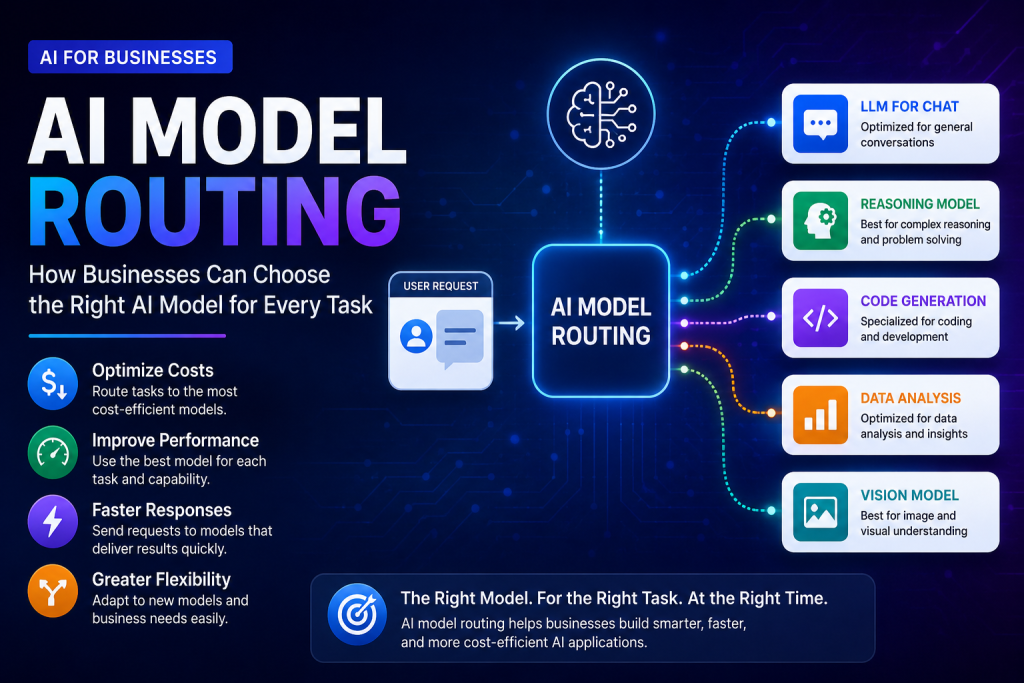
AI Model Routing: How Businesses Can Choose the Right AI Model for Every Task
Introduction Businesses are increasingly using artificial intelligence for customer support, content creation, data analysis, software development, and decision-making. However, not every AI task requires the same type of model. Different AI models can vary in capability, speed, cost, and specialization. Using a single AI model for every task can increase costs and may not always provide the best balance between performance and efficiency. As organizations adopt multiple AI models, they need a smarter way to decide which model should handle each request. AI model routing helps businesses direct AI tasks to the most suitable model based on factors such as complexity, cost, speed, capability, and business requirements. This approach can help organizations improve performance while using AI resources more efficiently. What Is AI Model Routing? AI model routing is the process of directing an AI request to the most suitable model based on the requirements of a specific task. Instead of sending every request to the same model, an AI system can evaluate factors such as task complexity, required accuracy, response speed, cost, and model capabilities. Why One AI Model Is Not Always Enough AI models are designed with different strengths. Some models may be better for complex reasoning, while others may provide faster responses, lower costs, coding capabilities, or multimodal features. Using one model for every situation can therefore be inefficient. How AI Model Routing Works An AI model routing system analyzes the requirements of an incoming request and selects an appropriate model. Simple tasks may be directed to efficient models, while more complex tasks can be routed to advanced models with stronger reasoning or specialized capabilities. Key Factors Used in Model Selection AI model routing can consider factors such as task type, complexity, expected output quality, response time, cost, available models, and specific business requirements. These factors help determine which model is the most suitable for a particular request. By matching AI workloads with appropriate models, businesses can create more flexible AI systems that balance performance, speed, and cost. Why AI Model Routing Is Becoming Important for Businesses As businesses adopt more AI tools and models, managing which model is used for each task is becoming increasingly important. Organizations may use different models for language processing, reasoning, coding, data analysis, and multimodal applications, creating a need for more efficient AI model management. Growing Number of Available AI Models Businesses now have access to a growing range of AI models with different capabilities, performance levels, and pricing structures. Choosing the same model for every workload can limit flexibility and increase unnecessary costs. Balancing Performance and Cost More advanced AI models can provide stronger capabilities for complex tasks, but they may also require more computing resources or have higher usage costs. AI model routing can help businesses balance performance requirements with the cost of AI operations. Improving Response Speed Some AI applications require fast responses, such as customer support systems and real-time business tools. Routing suitable requests to faster models can help improve responsiveness while reserving more powerful models for tasks that require advanced capabilities. Supporting Multiple AI Use Cases A single organization may use AI for many different purposes, including content processing, software development, analytics, customer service, and internal automation. AI model routing can help manage these diverse workloads more effectively. How AI Model Routing Works in Practice In practice, AI model routing works by evaluating an incoming request and determining which available model is most suitable for handling it. The routing decision can be based on predefined rules, performance requirements, cost limits, or automated evaluation systems. Step 1: Understanding the Request The AI system first analyzes the incoming request to understand its type and requirements. For example, a request may involve summarization, reasoning, coding, data analysis, image understanding, or another specialized task. Step 2: Evaluating Task Requirements The routing system can evaluate factors such as task complexity, required response speed, expected accuracy, available budget, and security or privacy requirements. These factors help determine the level of AI capability needed. Step 3: Selecting the Appropriate Model Based on the evaluation, the system selects a suitable AI model. Simple or repetitive tasks may be handled by smaller and more efficient models, while complex reasoning or specialized tasks may be directed to more advanced models. Step 4: Processing the Request The selected AI model processes the request and generates a response. The result can then be returned directly to the user or passed to another application, workflow, or business system. Step 5: Monitoring Results and Performance Businesses can monitor response quality, processing time, model usage, and cost after requests are completed. This information can help organizations improve routing decisions and optimize their AI systems over time. By continuously evaluating AI workloads and model performance, businesses can make AI model routing more accurate, efficient, and aligned with changing business requirements. Key Benefits of AI Model Routing for Businesses AI model routing can help businesses build more flexible and efficient AI systems. By selecting models based on the requirements of each task, organizations can improve how they use AI resources while maintaining the level of performance required for different business applications. 1. Better Cost Optimization Not every request requires the most advanced or expensive AI model. AI model routing can direct simpler tasks to efficient models and reserve more powerful models for complex workloads, helping businesses reduce unnecessary AI spending. 2. Improved Performance Different AI models have different strengths. Routing tasks to models that are better suited for specific capabilities, such as reasoning, coding, language processing, or multimodal analysis, can help improve overall application performance. 3. Faster Response Times Businesses can route time-sensitive requests to models that provide faster responses. This can improve the user experience for applications such as customer support, internal tools, and real-time AI services. 4. Greater Flexibility A multi-model approach allows organizations to adapt as AI technologies change. Businesses can add, replace, or evaluate models without redesigning their entire AI strategy around a single provider or model. 5. Better AI Resource Management AI model routing provides greater control