
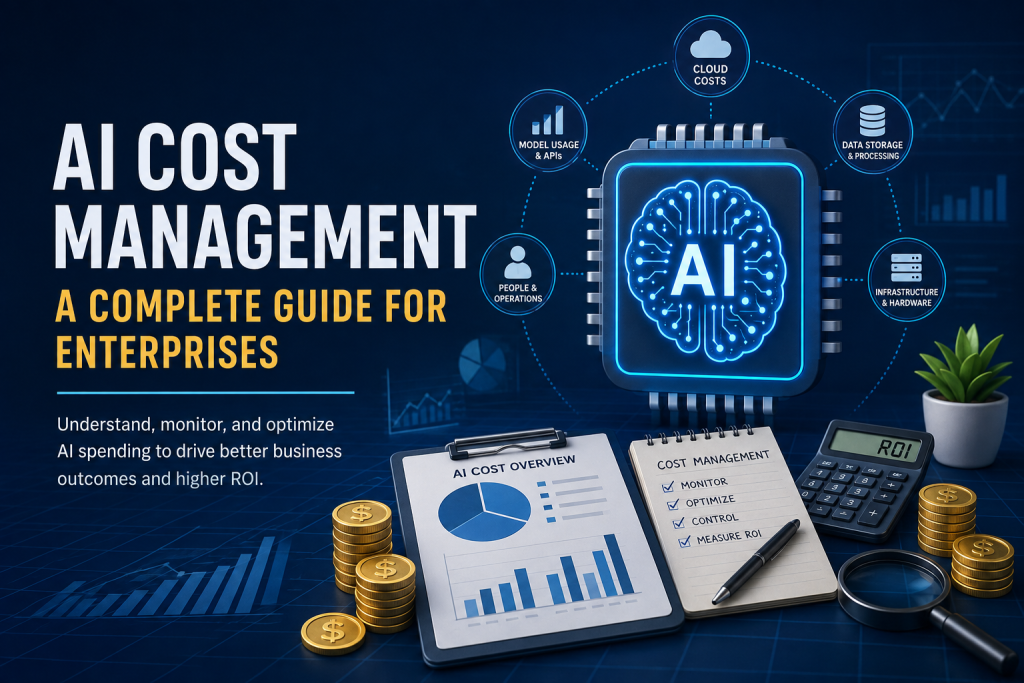
The Hidden Cost of AI: How Businesses Can Control AI Spending in 2026
Introduction Artificial intelligence is becoming an increasingly important part of modern business operations. Companies are using AI for automation, data analysis, customer support, software development, content creation, and decision-making. However, as AI adoption grows, so does the cost of running and scaling AI systems. The cost of AI is not always limited to purchasing a software subscription. Businesses may also need to consider AI model usage, token consumption, API requests, inference infrastructure, data processing, specialized hardware, and the cost of managing AI systems at scale. AI cost management helps organizations understand where their AI spending is coming from and how efficiently their resources are being used. By monitoring costs, optimizing AI workloads, and connecting spending with business outcomes, companies can work toward improving the return on their AI investments. What Is AI Cost Management? AI cost management is the process of tracking, understanding, and controlling the expenses associated with developing, deploying, and using artificial intelligence systems. It helps businesses identify where AI spending occurs and make informed decisions about how AI resources are used. Understanding AI Spending AI spending can come from several sources, including AI software subscriptions, API usage, model inference, data storage, cloud infrastructure, specialized hardware, and the people required to manage AI systems. As usage increases, these costs can become more difficult to monitor. Why Traditional Cost Management Is Not Enough Traditional IT and cloud cost management focuses mainly on infrastructure and software resources. AI systems can introduce additional cost factors because usage may depend on model complexity, the amount of data processed, the number of requests, and how frequently AI services are used. The Role of AI FinOps AI FinOps applies financial management principles to AI operations. It encourages teams to monitor AI spending, improve visibility, optimize resource usage, and connect technology costs with measurable business value. By understanding how and where AI resources are consumed, businesses can build a more effective AI cost management strategy and reduce unnecessary spending as their AI adoption grows. The Hidden Costs of Enterprise AI The cost of enterprise AI can increase in ways that are not always visible at the beginning of an AI project. A company may start with a small number of users or limited workloads, but expenses can grow as more employees, applications, data, and AI models are added. 1. AI Model and API Costs Many businesses access AI capabilities through APIs or hosted AI platforms. Costs can depend on the number of requests, the amount of information processed, and the type of AI model being used. High-volume workloads can therefore create significant expenses over time. 2. AI Inference Costs Every time an AI model processes a request and generates an output, computing resources are required. As AI applications scale, inference can become a major operational expense, particularly for systems that require frequent or real-time responses. 3. Data Processing and Storage AI systems often require large amounts of data for training, testing, retrieval, and ongoing operations. Collecting, processing, storing, and transferring data can add additional costs that may not be obvious when an AI project first begins. 4. Infrastructure and Hardware Organizations that run AI workloads on dedicated infrastructure may need specialized computing resources. Cloud computing charges, GPUs, AI accelerators, networking, and supporting infrastructure can all contribute to the total cost of AI operations. 5. Integration and Maintenance AI systems also require integration with existing business applications, regular monitoring, updates, testing, security controls, and ongoing maintenance. These operational requirements can create costs beyond the initial implementation of an AI solution. Why AI Spending Can Grow So Quickly AI spending can grow rapidly because the cost of an AI system often increases with usage. A small pilot project may appear affordable, but expenses can rise as more users, applications, requests, and workloads are added across the organization. Increasing AI Usage As employees begin using AI tools more frequently, the number of requests and the amount of data processed can increase significantly. Without clear visibility into usage patterns, businesses may not immediately notice how quickly these costs are growing. Using More Expensive Models Than Necessary Not every AI task requires the most advanced or expensive model. Using high-cost models for simple tasks can increase AI spending without providing a proportional improvement in business results. Uncontrolled AI Experiments Different teams may independently test AI tools, models, and platforms. While experimentation can encourage innovation, uncoordinated usage can create duplicate subscriptions, overlapping tools, and unnecessary spending. Rapid Growth in AI Applications Organizations may gradually add AI capabilities to customer support, internal operations, software development, analytics, marketing, and other business functions. Each new application can introduce additional infrastructure, integration, and operational costs. Lack of Cost Visibility AI costs can be spread across cloud services, APIs, software platforms, infrastructure, and different business teams. Without centralized visibility, it can be difficult to understand the total cost of AI and identify opportunities for optimization. How Businesses Can Control AI Spending Controlling AI spending does not necessarily mean reducing AI adoption. The goal of AI cost management is to help businesses use artificial intelligence efficiently while ensuring that technology investments continue to support meaningful business outcomes. 1. Monitor AI Usage and Costs Businesses should track how AI tools, models, APIs, and infrastructure are being used. Monitoring usage patterns can help organizations identify unexpected increases in spending and understand which workloads are generating the highest costs. 2. Choose the Right AI Model for Each Task Different AI models have different capabilities and costs. Organizations can evaluate whether a task requires an advanced model or whether a smaller and more efficient model can provide an acceptable result at a lower cost. 3. Set Budgets and Usage Limits Setting budgets, spending alerts, and usage limits can help prevent unexpected AI expenses. Teams can define appropriate limits for specific projects and review spending regularly as AI workloads grow. 4. Reduce Unnecessary AI Requests Optimizing how applications interact with AI systems can reduce unnecessary requests and repeated processing. Techniques such as improving workflows, reusing appropriate results, and avoiding duplicate requests