
April 2026

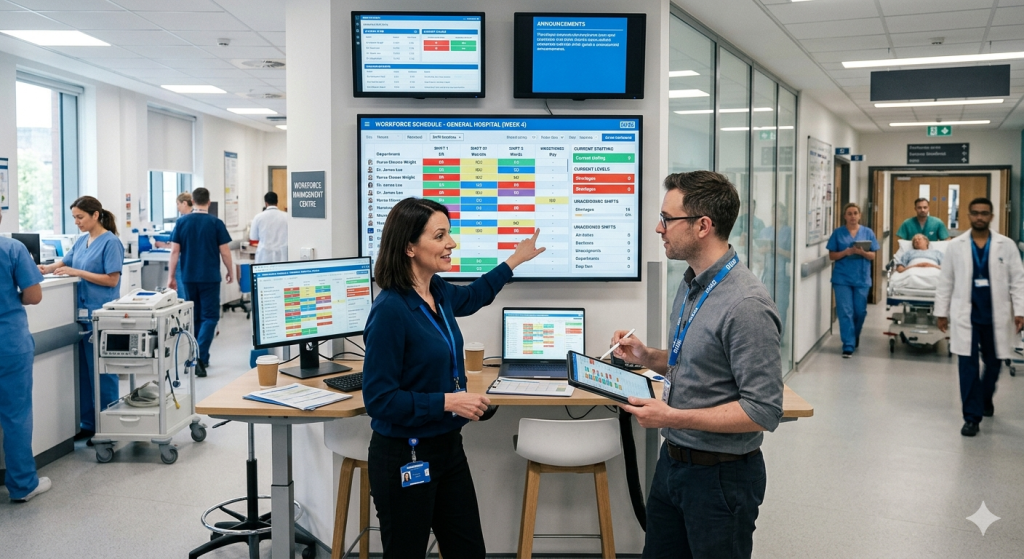
Illustration of healthcare workforce management showing a diverse hospital team with digital dashboards for scheduling, shift planning, and staff performance tracking in a modern control center.
Healthcare & Fitness

Healthcare Workforce Management

Introduction In 2026, hospitals face their toughest staffing crisis yet—nurse shortages up 17%, burnout rates at 62%, and compliance violations costing millions annually. Enter healthcare workforce management software: the AI-powered solution transforming chaos into precision. Hospitals lose $8.4 billion yearly to inefficient scheduling and staffing gaps, while 70% of healthcare leaders report manual processes as their #1 operational bottleneck. This comprehensive guide reveals how healthcare workforce management software leverages AI scheduling, predictive analytics, and HIPAA-compliant automation to: Reduce labor costs 30% through optimized shift planning Cut overtime 45% with demand forecasting Boost staff retention 28% via fatigue monitoring Ensure 100% compliance across 50+ state regulations From real-time nurse scheduling to integrated credential tracking, discover the top 8 features, 5 must-have integrations, and 3 implementation pitfalls every hospital administrator needs to master in 2026. Ready to transform your workforce management? This 2026 definitive guide delivers proven strategies, real-world examples, and ROI calculations to help healthcare leaders achieve operational excellence while prioritizing patient care and staff wellbeing. Healthcare workforce management software revolutionizes hospital operations by automating scheduling reducing overtime costs by 30%, and ensuring compliance across 24/7 shifts. Facing 20% global nurse shortages and $7.5B annual overtime expenses, hospitals need AI-driven tools to match staff skills with patient demand in real-time. This software integrates EHR systems, tracks credentials, and forecasts census with 95% accuracy—preventing fines from understaffing while eliminating budget waste from overstaffing. From ER surges to surgical backlogs, healthcare workforce management software delivers 98% schedule adherence, 25% faster onboarding, and 40% agency spend reduction. Essential for CNOs and HR directors, these platforms boost HCAHPS scores through consistent care teams and HIPAA-compliant automation. Professional team of diverse doctors and nurses representing seamless healthcare workforce management software optimization. Key Features Modern healthcare workforce management software handles complex regulations and 50+ roles: AI-powered demand forecasting (7-30 days ahead) Drag-and-drop scheduling with fatigue/skill matching Automated credentialing alerts (90-day warnings) Geofenced time tracking + payroll integration JCAHO-compliant reporting for ratios/labor laws Top Solutions Overview symplr Workforce excels in labor cost control for large systems ($250K+/year). ADP WorkForce Suite offers payroll integration ($120K/year). UKG Healthcare provides analytics for enterprises ($400K+). Workforce.com suits clinics at $15/staff/month. Legion specializes in real-time ER adjustments ($80K/year). Proven ROI Metrics Overtime savings: 25-35% ($2M+ annually) Agency usage: 40% → 12% No-shows: 18% reduction Payroll accuracy: 99.2% 300-500% Year 1 ROI for 500+ bed facilities. 2026 Implementation Steps Data migration + training (Month 1) Unit pilot (ER/ICU – Month 2) System-wide rollout (Month 3) Continuous AI optimization Conclusion Healthcare workforce management software eliminates staffing chaos, cuts costs 30%, and elevates patient care. Prioritize AI forecasting, EHR integration, and HIPAA compliance for maximum ROI. Schedule demos with symplr or UKG today to transform your operations. FAQ https://images.unsplash.com/photo-1576091160399-1d65cdaa8782?w=1200 Q1: What is healthcare workforce management software? A: Cloud-based platforms automating hospital scheduling, credentialing, time tracking, and AI demand forecasting while ensuring HIPAA/JCAHO compliance across 24/7 operations. Q2: How much does it cost for a 500-bed hospital? A: $120K-$400K/year depending on features; smaller clinics start at $15/staff/month. ROI hits 300% in Year 1 via overtime/agency savings. Q3: Does it integrate with Epic or Cerner EHR? A: Yes—95% of enterprise solutions (symplr, UKG, ADP) offer native APIs for seamless patient census syncing. Q4: What’s the typical implementation timeline? A: 60-90 days: Month 1 (migration/training), Month 2 (pilot), Month 3 (full rollout). Q5: Can it reduce nurse agency spend? A: Absolutely—40% to 12% fill rates typical, saving $1M+ annually for mid-size systems.


A futuristic book cover titled “Software Development: An Ultimate Guide for 2026.” It shows two developers working at multiple computer screens in a high-tech environment. Surrounding them are glowing digital elements, including an AI cube, holographic interfaces, and lines of code. In the background, a robotic arm, a rocket launching into the sky, and a modern cityscape emphasize innovation and progress. Bright neon colors (blue, orange, and yellow) create a dynamic, tech-driven atmosphere. Text highlights include “Latest Trends & Technologies,” “AI & Machine Learning,” “Cloud & DevOps,” and “Cybersecurity Strategies.”
Artificial Intelligence

Software Development An Ultimate Guide for 2026

Introduction Software development in 2026 has evolved beyond traditional coding into AI-augmented, security-first engineering that powers intelligent systems across industries. With AI coding assistants handling 40-60% of boilerplate code, developers now focus on architecture, integration, and business outcomes rather than syntax. This guide covers modern SDLC processes, essential tech stacks, team structures, costs, trends, and proven strategies for building scalable, resilient applications that deliver measurable ROI. Modern Software Development Lifecycle 2026 follows hybrid Agile-DevOps pipelines with AI acceleration at every stage. Core Phases Discovery & AI Requirements: AI analyzes user data, support tickets, and market trends to generate precise user stories and prioritize features. Architecture Planning: Microservices with event-driven design dominate; quantum-safe encryption becomes standard.   Development: AI tools (GitHub Copilot v3+, Tabnine Enterprise) auto-generate 50%+ of code; humans focus on complex logic and integrations. CI/CD Automation: Full pipeline automation with GitHub Actions, GitLab CI, or Harness deploys to production multiple times daily. Security & Compliance: Shift-left security scans code in real-time; zero-trust architecture required for enterprise. Key Metric: Teams now deliver production-ready features in 1-2 weeks vs. 3-6 months in traditional models. Essential Tech Stacks for 2026 Choose stacks based on scale, performance, and ecosystem maturity. Use Case Frontend Backend Database Deployment Web Apps Next.js 16+, SvelteKit Node.js 22+, Go 1.23 PostgreSQL 17, PlanetScale Vercel, Netlify Mobile React Native 0.76+, Flutter 4.0 Supabase, Firebase Firestore, SQLite Expo, Appflow Enterprise Angular 19+, Vue 4 Java Spring Boot 3.4, .NET 10 CockroachDB, Yugabyte Kubernetes, EKS AI/ML Streamlit, Gradio FastAPI 0.115+, LangChain 0.3 Pinecone, Weaviate SageMaker, RunPod Pro Tip: Use TypeScript universally (95% adoption); Rust for performance-critical components. Team Structure & Roles Modern teams blend specialized engineers with AI orchestration experts. Product Owner (1): Defines vision, prioritizes features Tech Lead/Architect (1): Designs scalable systems Full-Stack Engineers (3-5): End-to-end feature delivery DevOps/SRE (1-2): Infrastructure automation QA Automation (1): AI-driven testing Security Champion (1): Zero-trust implementation Remote-First Reality: 85% of dev teams operate distributed across 3+ timezones using Linear, Slack huddles, and async standups. Cost Breakdown & Budgeting Realistic 2026 pricing for quality delivery: Project Size Team Size Duration Cost Range MVP 4-6 3 months $80K-$150K Mid-Size 6-10 6 months $200K-$400K Enterprise 12-20 12 months $800K-$2M+ Hourly Rates: North America: $120-$250/hr Western Europe: $90-$180/hr Eastern Europe: $50-$90/hr India/SE Asia: $35-$70/hr Hidden Costs: Add 20% for cloud ($2K-$20K/month), tools ($500-$2K/month), and compliance audits. Critical Best Practices Implement these to avoid 90% of common failures: AI-First Development: Use Copilot, Cursor, or Aider for 3x productivity gains GitOps Everywhere: Infrastructure as code with Terraform + ArgoCD Observability Native: OpenTelemetry + Grafana for full-stack monitoring Zero-Trust Security: mTLS, service meshes (Istio), WAF from day one Event-Driven Architecture: Kafka, NATS for resilient, scalable systems 2026 Mega-Trends AI Agent Swarms: Autonomous agents handle testing, deployment, and monitoring Platform Engineering: Internal developer platforms reduce cognitive load 70% Quantum-Resistant Crypto: NIST standards mandatory for enterprise Edge Computing: 5G + WebAssembly runs AI models client-side Conclusion Software development in 2026 rewards teams that master AI augmentation, zero-trust security, and platform engineering. Success requires hybrid Agile-DevOps processes, modern tech stacks (Next.js + Go + PostgreSQL), and distributed teams leveraging global talent. Budget realistically, prioritize observability and security from day zero, and embrace AI as a force multiplier. Next Step: Define your MVP features, select 2-3 vendors for discovery workshops, and target first production release within 90 days. FAQ 1. How long does MVP development take in 2026? 3 months with experienced teams using AI tools and modern stacks. 2. What’s the most important 2026 tech skill? Platform engineering + AI orchestration over pure coding. 3. Should I build native mobile or cross-platform? React Native or Flutter covers 95% of use cases faster and cheaper. 4. How much should I budget for cloud? 10-20% of dev budget monthly; optimize with serverless and spot instances. 5. Is offshore development still viable? Yes, Eastern Europe/India deliver enterprise quality at 40-60% lower cost.

Futuristic 16:9 illustration of a secure digital vault with data streams flowing to backup servers, IT professionals monitoring recovery dashboards on screens with cloud icons and locks, blue-green gradients, charts, subtle cyber threats in background, titled "Data Backup Recovery 2026 Guide".
Cloud Computing and Technology

Data Backup Recovery: The Ultimate 2026 Guide

Introduction Data loss strikes businesses of all sizes, with 67.7% of organisations reporting significant incidents in recent surveys, often leading to prolonged downtime and massive recovery costs. The stakes are high: prolonged data loss (over 10 days) causes 93% of affected companies to go bankrupt within a year, while even short outages cost small businesses an average of $1,410 per minute. This guide covers why data backup and recovery matter, best practices for 2026, cost considerations, and how to build a strategy that safeguards your operations and ensures fast recovery. Why Data Backup and Recovery Are Non-Negotiable Data loss comes from multiple sources—human error, hardware failure, ransomware, natural disasters—and the consequences are devastating. Financial impact: Recovery costs range from $100–$500 for simple cases to $1,500–$5,000+ for physical damage or enterprise systems, not including downtime losses. Operational disruption: 25.9% of recovery efforts consume significant staff resources, halting productivity and revenue. Regulatory and reputational risks: Fines for compliance failures (e.g., GDPR) and loss of customer trust compound the damage. Proactive backup strategies turn potential disasters into manageable events, enabling rapid restoration and business continuity. Key Data Backup Strategies for 2026 Modern backup strategies prioritise the 3-2-1 rule: three copies of data on two different media, with one offsite. Backup types Full backups: Complete data copies, reliable but storage-intensive. Incremental: Only changed data since last backup, efficient for frequent use. Differential: Changes since last full backup, balancing speed and recovery ease. Frequency and automation Aim for higher frequency (daily or real-time for critical data) aligned with recovery time objectives (RTO). Automate to eliminate human error and ensure consistency. Cloud and hybrid approaches Use cloud for offsite copies, encryption (AES-256), and immutability against ransomware. Hybrid setups combine on-premises speed with cloud scalability. Regular testing of restores is crucial—untested backups fail 30–50% of the time in real scenarios. Effective Data Recovery Best Practices Recovery success depends on preparation, with cleanroom labs achieving 60–80% success for physical damage at $2,000–$4,000 average cost. Recovery Scenario Typical Cost (USD) Key Best Practices Logical (deletion, corruption) $100–$600 Stop using affected drive; use software first. Physical damage (water, drops) $1,500–$5,000+ Professional cleanroom service; avoid DIY. RAID/NAS/Enterprise $1,000–$10,000+ Specialised tools; plan for extended timelines. Encrypted/Military-grade $1,000–$6,000+ Expert forensics; ensure key backups. Prioritise RTO/RPO: Match recovery speed to business needs (e.g., 15–30 minutes for critical apps). Use replication for mission-critical data beyond backups. Conduct drills: Simulate failures quarterly to validate processes. Costs of Data Backup vs. Recovery Investing in backup prevents exponentially higher recovery expenses. Backup solutions: Software starts at $50–$100; enterprise cloud services scale with data volume (e.g., $99–$149 for 100GB transfers). Recovery pricing by region: North America/Europe highest ($1,500–$10,000); Asia-Pacific 30–60% cheaper with comparable tech. ROI example: A $1,410/minute downtime for SMEs makes even premium backups cost-effective. Budget 10–20% of IT spend on backup/recovery to mitigate 93% bankruptcy risk from prolonged loss. Emerging Trends in 2026 2026 sees AI-enhanced backups and ransomware-proof features becoming standard. Immutable backups prevent alteration by attackers. In-flight masking secures data during restores. AI for anomaly detection and automated recovery orchestration. Multi-factor authentication (MFA) and regular audits are now table stakes for compliance. Conclusion Data backup and recovery form the backbone of business resilience, protecting against losses that could cost thousands per minute or even bankrupt your organisation. By following the 3-2-1 rule, automating processes, testing regularly, and embracing cloud/hybrid strategies, you can achieve fast, reliable restores at a fraction of disaster costs. In 2026, staying ahead means immutable, AI-augmented solutions tailored to your RTO needs. Start today: Audit your current backups, implement the 3-2-1 rule if missing, schedule a recovery test this quarter, and explore immutable cloud options to ransomware-proof your data. FAQ 1. What is the 3-2-1 backup rule? Keep three copies of data on two different media types, with one stored offsite for maximum protection. 2. How much does data recovery typically cost? Logical recovery: $100–$600; physical/enterprise: $1,500–$10,000+, varying by damage and region. 3. What causes most data loss? Human error, hardware failure, ransomware, and cyber attacks top the list. 4. How often should I test backups? Quarterly full recovery drills, plus monthly partial tests for critical systems. 5. Are cloud backups enough? No—combine with on-premises for hybrid resilience, plus encryption and immutability.

How would you like me to respond?

Select a personality for your AI assistant

Normal
Happy
Sad
Angry

Your selection will affect how the AI assistant responds to your messages

Chat Assistant

Let's discuss your project!

Hear from our clients and why 3000+ businesses trust TechOTD

Tell us what you need, and we'll get back with a cost and timeline estimate

Scroll to Top