Machine Learning

Artificial intelligence network scanning for cyber threats and data protection.
Artificial Intelligence, cybersecurity

The Role of Artificial Intelligence in Cybersecurity

Introduction In a world where cyberattacks are growing more sophisticated by the day, traditional defense systems are no longer enough. Businesses, governments, and individuals face threats ranging from phishing scams to ransomware and identity theft. To combat this, Artificial Intelligence (AI) has emerged as a game-changing weapon in the field of cybersecurity. By combining machine learning (ML), predictive analytics, and automation, AI helps security teams identify, prevent, and respond to attacks — often before they occur. As per IBM’s Cost of a Data Breach Report 2025, organizations using AI-driven cybersecurity tools save an average of $3 million per breach compared to those without it. Clearly, the future of cybersecurity is AI-powered. What Is AI in Cybersecurity? Artificial Intelligence in Cybersecurity involves using algorithms and machine learning models to analyze data, detect anomalies, and automatically respond to threats. Unlike traditional security systems that rely on pre-defined rules, AI systems learn and adapt to new threats dynamically — making them ideal for handling today’s complex digital environments.     Core Functions: Real-time threat detection Automated response and mitigation Behavioral analysis Network monitoring Predictive analytics Why AI Is Essential in Cybersecurity Traditional cybersecurity relies on human experts and static rule-based systems. However, with billions of daily data points and evolving attack patterns, humans alone can’t keep up. AI brings: Speed: Instantly processes large datasets to identify threats. Accuracy: Reduces false positives compared to manual analysis. Scalability: Monitors thousands of endpoints simultaneously. Adaptability: Learns from new data and evolving attacks. AI acts as a force multiplier — enhancing human intelligence rather than replacing it. Key Applications of AI in Cybersecurity 1. Threat Detection and Prediction AI systems analyze historical attack data to predict potential threats. By learning patterns, AI can detect zero-day vulnerabilities that traditional systems might miss. Example: Darktrace uses AI to continuously learn an organization’s network behavior and identify anomalies in real-time. 2. Behavioral Analytics AI monitors user and system behavior to detect suspicious activities such as unauthorized access or data transfers. Example: If an employee’s account suddenly downloads huge amounts of data at odd hours, AI can flag and isolate that activity. 3. Automated Incident Response AI can automate the initial response to threats — such as isolating infected devices or blocking suspicious IP addresses — reducing the time between detection and action. Example: SOAR (Security Orchestration, Automation, and Response) platforms use AI to streamline security workflows. 4. Phishing and Email Security Machine learning models analyze email content, sender patterns, and URLs to detect phishing attacks before they reach users’ inboxes. Example: Google’s Gmail AI blocks over 100 million phishing emails daily using ML filters. 5. Malware Detection AI-powered systems can detect new malware strains by studying code structure and execution patterns — even if the malware hasn’t been seen before. Example: Cylance uses AI models trained on millions of malicious files to predict threats in real-time. 6. Network Security and Monitoring AI helps track massive network traffic volumes, identifying abnormalities that might signal cyberattacks like DDoS (Distributed Denial of Service). Example: AI tools detect unusual spikes in network activity and alert administrators instantly. 7. Fraud Detection Banks and e-commerce companies use AI to analyze user transactions and detect fraudulent behavior. Example: Mastercard’s Decision Intelligence uses AI to evaluate transaction risks within milliseconds.  Advantages of Using AI in Cybersecurity Advantage Impact Speed & Efficiency Real-time threat detection and mitigation Improved Accuracy Fewer false alarms and better prioritization Cost Reduction Reduced operational costs and data breach impact Predictive Capabilities Prevents attacks before they occur 24/7 Monitoring Continuous protection without downtime Adaptive Learning Evolves with emerging cyber threats Challenges and Limitations While AI offers immense potential, it’s not without challenges. 1. Adversarial AI Attacks Hackers use AI to create smarter malware or bypass security systems by mimicking legitimate behavior. 2. High Implementation Costs Building and training AI models require significant investment in infrastructure and expertise. 3. False Positives Poorly trained AI systems may still misclassify safe activities as threats, leading to unnecessary alerts. 4. Data Privacy Concerns AI models need large datasets to train — which sometimes include sensitive user data. 5. Skill Gap The shortage of AI and cybersecurity professionals makes it difficult for many organizations to deploy AI effectively. The Future of AI in Cybersecurity The next era of cybersecurity will be autonomous, predictive, and intelligent. Key Trends to Watch: AI + Blockchain Integration: For tamper-proof data verification. Quantum AI Security: Defending against quantum computing-based attacks. Self-Healing Systems: Networks that can automatically detect, isolate, and repair vulnerabilities. Edge AI: Real-time protection for IoT and edge devices. AI-driven Cyber Threat Intelligence (CTI): Collaborative global databases for predictive defense. By 2030, AI will be the central pillar of all major cybersecurity infrastructures — empowering organizations to respond to threats faster than hackers can act. Real-World Case Studies IBM Watson for Cybersecurity Uses natural language processing and machine learning to analyze millions of security reports, helping security teams make faster decisions. Capital One Implements AI to monitor billions of transactions in real time, protecting customers from credit card fraud and identity theft. Healthcare Networks Hospitals use AI-based security tools to protect sensitive patient records and detect ransomware attacks. Conclusion The rise of Artificial Intelligence has redefined the battle against cybercrime. From predictive threat detection to automated defense mechanisms, AI enables businesses to stay one step ahead of hackers. As digital transformation accelerates, the fusion of AI and cybersecurity will become the cornerstone of trust and resilience in the online world. However, with great power comes responsibility — ensuring AI is used ethically, transparently, and securely will be crucial for a safer digital future. In short, AI is not just defending the digital world — it’s redefining it. FAQs 1. How is AI used in cybersecurity?AI analyzes patterns, detects anomalies, and automates responses to identify and mitigate cyber threats in real time. 2. Can AI prevent cyberattacks completely?AI reduces risks and improves detection, but human oversight remains essential for complex decision-making. 3. What are the main benefits of AI in cybersecurity?Faster detection, improved accuracy,

Data analytics dashboard displaying visual graphs and metrics for business performance.
Big Data

Big Data Analytics: Powering Smarter Decisions in the Digital Age

Introduction In the modern world, data is often referred to as the “new oil” — a resource that drives innovation, business growth, and strategic decision-making. However, unlike oil, data’s value depends on how effectively it is analyzed and interpreted. This is where Big Data Analytics comes into play. From personalized recommendations on Netflix to predictive maintenance in manufacturing, Big Data has transformed the way organizations operate. By turning massive volumes of raw data into actionable insights, companies can make faster, smarter, and more confident decisions. In this blog, we’ll explore what Big Data Analytics is, its key components, real-world applications, benefits, challenges, and the future trends shaping this powerful field. What is Big Data Analytics? Big Data Analytics is the process of examining large and complex data sets — often too vast for traditional processing systems — to uncover hidden patterns, correlations, trends, and insights. It involves using advanced technologies like machine learning, artificial intelligence (AI), cloud computing, and data visualization to make sense of massive data generated every second. The 5Vs of Big Data: Volume: The huge amount of data generated from sources like social media, IoT devices, and transactions. Velocity: The speed at which new data is created and needs to be processed. Variety: The different formats of data — structured, semi-structured, and unstructured. Veracity: The reliability and accuracy of data. Value: The insights and business impact derived from analyzing the data. Types of Big Data Analytics Descriptive Analytics: Answers “What happened?” by summarizing historical data (e.g., monthly sales reports). Diagnostic Analytics: Answers “Why did it happen?” by identifying causes and relationships. Predictive Analytics: Answers “What might happen?” using statistical models and forecasting. Prescriptive Analytics: Answers “What should we do next?” by recommending actions based on predictive insights. Together, these analytics types empower organizations to move from hindsight to foresight, enabling smarter business strategies. How Big Data Analytics Works The process involves several key steps: Data Collection: Gathering data from sources such as IoT devices, social media, transactions, and sensors. Data Storage: Using platforms like Hadoop, Apache Spark, or cloud databases to store massive datasets. Data Processing: Cleaning and transforming raw data into usable formats. Data Analysis: Applying algorithms and tools like Python, R, or Power BI to extract insights. Visualization: Presenting data through dashboards and reports to support decision-making. Real-World Applications of Big Data Analytics 1. Healthcare Hospitals and research institutions use Big Data to predict disease outbreaks, personalize treatment plans, and improve patient care.Example: Analyzing patient histories and genetics helps doctors prescribe customized medicines for better outcomes. 2. Retail Retail giants like Amazon and Walmart use analytics to track customer preferences, optimize inventory, and personalize shopping experiences.Example: Big Data predicts buying behavior, allowing targeted ads and product recommendations. 3. Finance Banks and financial institutions use Big Data to detect fraud, assess credit risk, and enhance customer engagement.Example: Real-time fraud detection systems analyze thousands of transactions per second to flag anomalies. 4. Manufacturing Predictive analytics helps manufacturers forecast equipment failures and perform maintenance before breakdowns occur.Example: GE uses Big Data in its “Industrial Internet” to monitor and optimize production equipment globally. 5. Transportation Public and private transport companies analyze data from GPS, sensors, and ticketing systems to improve route efficiency and reduce congestion.Example: Uber uses real-time analytics to match drivers with passengers and set dynamic pricing. 6. Education Educational institutions use data analytics to track student performance, improve learning outcomes, and design adaptive learning programs. Benefits of Big Data Analytics Better Decision-Making: Real-time insights support quick and accurate strategic choices. Operational Efficiency: Identifies inefficiencies and optimizes workflows. Enhanced Customer Experience: Personalizes services based on data-driven behavior analysis. Fraud Detection: Monitors unusual activities and reduces financial risks. Innovation and Competitive Edge: Uncovers new opportunities and emerging market trends. Challenges in Big Data Analytics Data Privacy and Security: Managing sensitive information securely is a major concern. Data Quality Issues: Incomplete or inaccurate data leads to misleading insights. Integration Difficulties: Combining data from multiple systems and formats can be complex. Skill Gaps: There’s a shortage of skilled data analysts and data scientists. Infrastructure Costs: Building and maintaining large-scale data systems can be expensive. Emerging Technologies Shaping the Future of Big Data 1. Artificial Intelligence (AI) and Machine Learning AI automates data processing and enables predictive modeling with higher accuracy. 2. Edge Computing Brings data processing closer to the data source, reducing latency and bandwidth usage. 3. Cloud Analytics Cloud-based solutions make Big Data Analytics more scalable and accessible for businesses of all sizes. 4. Real-Time Analytics Organizations can now act instantly on insights — from fraud detection to dynamic pricing. 5. Data Fabric and Integration Platforms These unify disparate data sources, enabling seamless data sharing across departments. Big Data and Ethics As organizations handle massive amounts of user data, ethical considerations become essential. Businesses must ensure transparency, consent, and fairness in how they collect and analyze data. Implementing strong data governance frameworks and adhering to privacy laws like GDPR and CCPA are vital to maintaining public trust. Conclusion Big Data Analytics is revolutionizing industries, empowering organizations to make data-driven decisions that lead to innovation, efficiency, and growth. As AI, machine learning, and cloud technologies evolve, data analytics will become even more intelligent and accessible. However, success lies in balancing technology with ethical responsibility, ensuring that the power of data serves humanity positively. In the coming years, companies that embrace Big Data Analytics will not just predict the future — they’ll help create it. FAQs 1. What is Big Data Analytics used for? It’s used to analyze large datasets to uncover insights, trends, and patterns that help organizations make better decisions. 2. Which industries use Big Data Analytics the most? Healthcare, finance, retail, manufacturing, and transportation are leading sectors using Big Data for innovation and optimization. 3. How does Big Data improve business performance? It helps companies understand customer behavior, reduce costs, detect fraud, and predict future trends for better strategic planning. 4. What are the main tools for Big Data Analytics? Popular tools include Apache Hadoop, Spark, Tableau, Power

A robotic human face representing artificial intelligence technology.
Artificial Intelligence

Artificial Intelligence in Everyday Life

Introduction Artificial Intelligence (AI) is no longer just a futuristic idea — it’s already a part of our everyday lives. Whether it’s voice assistants like Alexa, smart recommendations on Netflix, or self-driving cars, AI quietly powers many aspects of our daily routines. But how exactly does it work, and where do we experience it the most? What is Artificial Intelligence? Artificial Intelligence is the simulation of human intelligence in machines. These systems are designed to learn, reason, and make decisions — often faster and more accurately than humans. The main goal of AI is to make systems capable of performing tasks that normally require human intelligence, such as understanding language, recognizing images, or solving problems. AI in Our Daily Lives a. Smart Assistants Devices like Amazon Alexa, Google Assistant, and Siri help us with daily tasks such as setting reminders, playing music, or checking the weather — all powered by natural language processing (NLP). b. Personalized Recommendations When Netflix suggests a movie or Amazon recommends a product, it’s using machine learning algorithms to analyze your preferences and predict what you’ll like next. c. AI in Healthcare AI helps doctors detect diseases early, analyze X-rays, and predict health risks. For example, AI models can detect diabetic retinopathy from eye scans with remarkable accuracy. d. Smart Homes and Devices From thermostats that adjust to your temperature preference to fridges that track food freshness — AI makes our homes smarter and energy-efficient. e. AI in Education Personalized learning platforms powered by AI assess student performance and adapt lessons accordingly, improving learning outcomes. Benefits of AI in Everyday Life Convenience: Simplifies daily tasks. Efficiency: Automates repetitive work. Accuracy: Reduces human error. Personalization: Offers custom experiences.  Challenges of AI Privacy Concerns: Data collected by AI devices can be misused. Job Automation: Some jobs are being replaced by AI systems. Bias: AI systems can inherit biases from training data. Conclusion Artificial Intelligence is shaping a smarter, more connected world. As it evolves, it promises to make our lives easier — but also challenges us to use it responsibly. The future of AI lies in finding the right balance between innovation and ethics. FAQs Q1: What is an example of AI in daily life?AI examples include voice assistants, facial recognition on smartphones, and personalized online recommendations. Q2: How does AI make life easier?AI automates tasks, provides personalized suggestions, and improves decision-making in daily routines. Q3: What are the risks of AI?Major risks include privacy issues, unemployment due to automation, and biased algorithms.

Business professionals collaborating with digital technology, holographic displays, and innovative workspace
Technology & Innovation

The Future of Technology & Innovation: Transforming Tomorrow’s World

Introduction Technology and innovation have become the twin engines driving humanity forward in the 21st century. As we navigate through 2025, the pace of technological advancement shows no signs of slowing down. From artificial intelligence reshaping how we work to quantum computing promising to solve previously unsolvable problems, innovation continues to redefine what’s possible. In this comprehensive guide, we’ll explore the most significant technology trends, understand how innovation is transforming industries, and look ahead at what the future holds for our increasingly digital world. Artificial Intelligence: Beyond the Hype Artificial intelligence has evolved from a buzzword to an essential business tool. In 2025, AI is no longer just about automation—it’s about augmentation, enabling humans to make better decisions and achieve outcomes that were previously impossible. Generative AI’s Maturation Generative AI has moved beyond novelty to become a productivity powerhouse. Organizations are integrating AI assistants into workflows, automating complex tasks, and creating personalized customer experiences at scale. The technology has matured to handle multimodal inputs—text, images, audio, and video—opening new creative and analytical possibilities. AI in Healthcare Medical diagnostics powered by AI are detecting diseases earlier and more accurately than ever before. Machine learning algorithms analyze medical imaging, predict patient outcomes, and even assist in drug discovery, potentially saving millions of lives and billions in healthcare costs. Quantum Computing: The Next Frontier Quantum computing is transitioning from theoretical promise to practical application. While still in its early stages, quantum computers are beginning to tackle problems in cryptography, materials science, and complex optimization that would take classical computers millennia to solve. Major tech companies and research institutions are racing to achieve “quantum advantage”—the point where quantum computers can solve real-world problems faster than traditional computers. This breakthrough could revolutionize fields from climate modeling to financial forecasting. Sustainable Technology: Innovation with Purpose Climate change has made sustainable technology not just desirable but essential. Innovation is increasingly focused on reducing environmental impact while maintaining or improving functionality. Green Energy Solutions Solar and wind technology continues to become more efficient and affordable. Battery storage solutions are solving the intermittency problem, making renewable energy viable for baseload power. Innovations in hydrogen fuel cells and carbon capture technology are addressing hard-to-decarbonize sectors. Circular Economy Tech Technology is enabling circular economy models where waste becomes a resource. IoT sensors track product lifecycles, AI optimizes recycling processes, and blockchain ensures transparency in supply chains, all working together to minimize environmental impact. The Internet of Things (IoT) and Edge Computing The IoT ecosystem has exploded, with billions of connected devices generating unprecedented amounts of data. Edge computing processes this data closer to its source, reducing latency and enabling real-time responses crucial for applications like autonomous vehicles and smart cities. Smart homes, wearable health monitors, industrial sensors, and connected infrastructure are creating a world where physical and digital realms seamlessly integrate. This connectivity is optimizing everything from energy consumption to traffic flow. Blockchain Beyond Cryptocurrency While cryptocurrencies grabbed headlines, blockchain’s real innovation lies in its ability to create trust in trustless environments. In 2025, blockchain is being applied to supply chain transparency, digital identity verification, smart contracts, and decentralized finance (DeFi). Organizations are using blockchain to ensure product authenticity, streamline cross-border transactions, and create tamper-proof records for everything from medical histories to property deeds. Augmented and Virtual Reality: Merging Worlds AR and VR technologies have matured beyond gaming into practical applications across industries. Virtual training environments allow professionals to practice high-risk procedures safely. AR assists technicians with complex repairs by overlaying digital instructions onto physical equipment. The metaverse concept continues evolving, with virtual spaces hosting business meetings, educational experiences, and social interactions that feel increasingly natural and immersive. Biotechnology and Human Enhancement The convergence of technology and biology is opening extraordinary possibilities. CRISPR gene editing, brain-computer interfaces, and personalized medicine are moving from research labs to real-world applications. Wearable technology monitors health metrics in real-time, while implantable devices can restore sight, hearing, and mobility. The ethical implications are profound, but the potential to eliminate diseases and extend healthy lifespans is transforming healthcare. The Innovation Ecosystem True innovation rarely happens in isolation. It emerges from ecosystems where startups, established companies, research institutions, and governments collaborate. Open-source communities, accelerator programs, and venture capital all play crucial roles in bringing innovative ideas to market. The Role of Startups Startups continue to be innovation catalysts, unburdened by legacy systems and willing to take risks. They’re disrupting established industries and creating entirely new markets, from fintech to foodtech. Corporate Innovation Labs Large corporations are establishing innovation labs and partnering with startups to stay competitive. This collaboration combines startup agility with corporate resources and market access, accelerating technology adoption. Challenges and Considerations Innovation brings challenges alongside opportunities. Cybersecurity threats evolve as quickly as the technologies they target. Privacy concerns grow as data collection becomes ubiquitous. The digital divide risks leaving behind those without access to technology or digital literacy. Ethical considerations around AI bias, autonomous weapons, and genetic modification require thoughtful regulation and public discourse. Society must balance innovation’s benefits against potential risks and unintended consequences. Preparing for the Future Organizations and individuals must embrace continuous learning to thrive in this rapidly evolving landscape. Technical skills remain important, but creativity, critical thinking, and adaptability are equally crucial. Investing in STEM education, supporting diverse voices in technology, and fostering cultures of experimentation will determine who leads and who follows in the innovation race. Conclusion Technology and innovation are reshaping every aspect of human existence. From how we work and communicate to how we address global challenges like climate change and healthcare, technological advancement offers unprecedented opportunities. The future belongs to those who embrace change, think creatively, and use technology purposefully. As we stand at the intersection of multiple technological revolutions, the question isn’t whether innovation will transform our world—it’s how we’ll shape that transformation to benefit all of humanity. The most exciting innovations may not yet be invented. The next breakthrough could come from a garage startup, a university lab, or a global corporation. What’s certain is

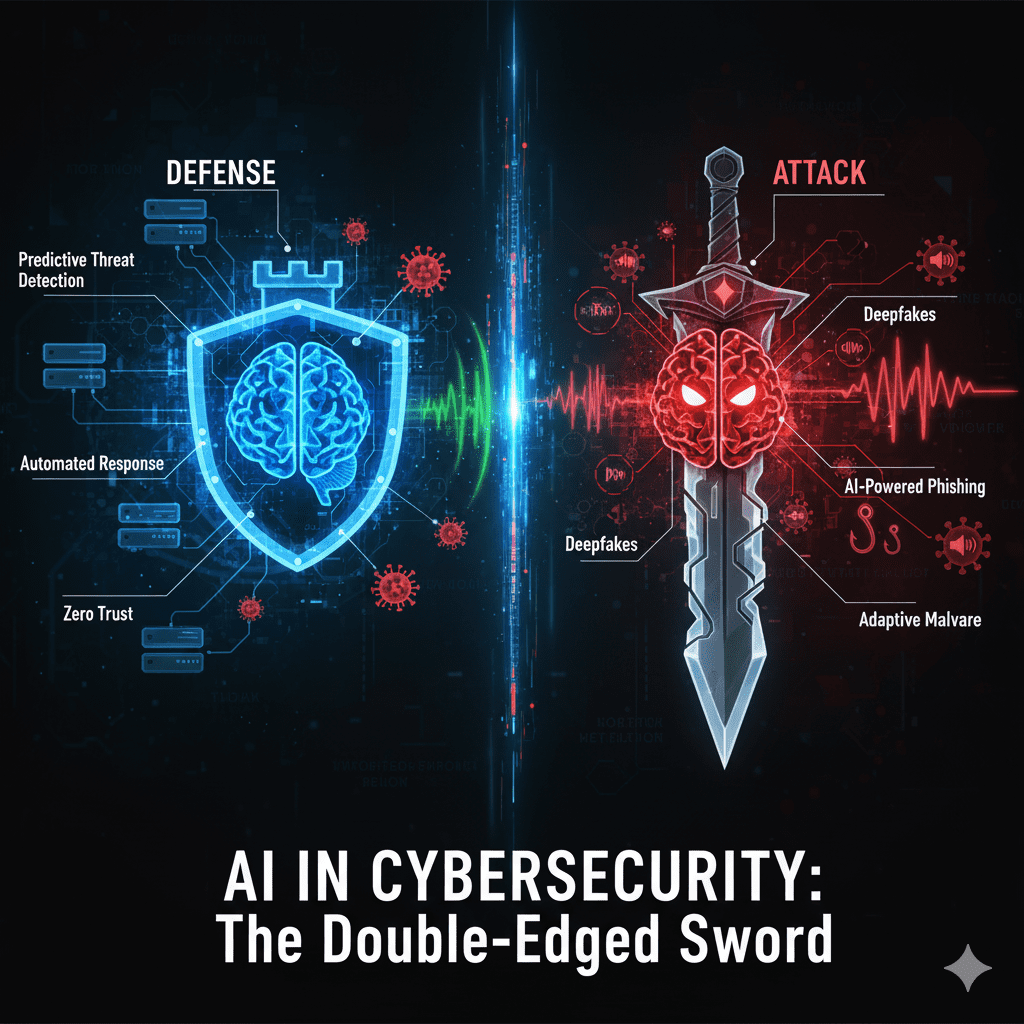
PREDICTIVE THREAT DETECTION and AUTOMATED RESPONSE
cybersecurity

Digital Armor: Defending Against Cyber Threats

Introduction For decades, the world of cybersecurity has been a high-stakes cat-and-mouse game. Security professionals build a wall, and hackers find a way over it. But today, this game is being fundamentally transformed by a powerful new player: Artificial Intelligence. AI is not just another tool; it’s a revolutionary force acting as both the strongest shield and the most dangerous new weapon. This article explores the dual role of AI in Cybersecurity, breaking down how it’s creating unprecedented defenses while simultaneously arming attackers with terrifying new capabilities The New Shield: AI as a Defensive Powerhouse The primary advantage of AI in a defensive role is its ability to process and analyze data at a scale and speed no human team could ever hope to match. While a human analyst sleeps, an AI security model is monitoring billions of events, looking for the one tiny anomaly that signals an attack. 1. Predictive Threat Detection Before AI, most security systems were reactive. They relied on “signatures”—the digital fingerprints of known malware. This meant a virus had to successfully attack someone first before it could be identified and blocked. AI, specifically machine learning, is predictive. It learns the normal, baseline behavior of your network, your users, and your devices. It can then spot suspicious deviations before a full-blown breach occurs. This includes: Behavioral Analysis: Is a user account that normally works from 9-to-5 suddenly trying to access sensitive files at 3:00 AM from a different country? AI flags this instantly. Anomaly Detection: Does a “smart” device like a thermostat suddenly start trying to communicate with an unknown server? AI can see this as a potential IoT (Internet of Things) attack. Pattern Recognition: AI can analyze global threat feeds and identify new attack patterns as they emerge, proactively blocking them before they even reach your network. 2. Automated Incident Response In a cyberattack, every second counts. A ransomware attack can encrypt an entire company’s files in minutes. AI doesn’t need to wait for approval; it can act in milliseconds. This is known as SOAR (Security Orchestration, Automation, and Response). Here’s a typical automated response scenario: Detect: An AI-powered sensor identifies a new, unknown program exhibiting ransomware-like behavior (e.g., rapidly encrypting files) on an employee’s laptop. Isolate: The AI immediately executes a predefined rule: it automatically disconnects that specific laptop from the company network, containing the threat. Investigate: The AI gathers all relevant data—what the program was, where it came from, what files it touched—and creates a report. Alert: It then sends an alert to a human security analyst, presenting the report and the action it took. The threat is neutralized before it could spread. The Future: An AI vs. AI Battleground This leads to an inevitable future: the front line of AI in Cybersecurity will be an AI-versus-AI battle. It will be a silent, high-speed war fought in milliseconds, with defensive AI models trying to detect and stop offensive AI-driven attacks. In this new era, the old security model of “trust but verify” is dead. The new model, which AI is perfect for, is Zero Trust. Zero Trust Architecture means you trust nothing and no one by default. It doesn’t matter if a login request comes from inside the office or outside; it must be verified. AI helps enforce this by continuously analyzing behavior. Just because you entered the right password doesn’t mean you are who you say you are. If your “logged-in” account suddenly starts acting suspiciously, the AI can force you to re-authenticate or block your access. Conclusion AI in Cybersecurity is a revolutionary, double-edged sword. It offers our most powerful hope for a secure digital future, capable of analyzing threats and responding at superhuman speeds. At the same time, it arms our adversaries with tools to create highly deceptive scams and intelligent malware. The key takeaway is that we can’t ignore it. For businesses, investing in modern, AI-powered defensive tools is no longer an option—it’s a necessity for survival. For individuals, it requires a new level of vigilance. In this new world, adaptability is everything. The future of security will be defined by who has the smarter, faster, and more adaptable AI. FAQ Q1: What is AI in Cybersecurity? AI in Cybersecurity refers to the use of artificial intelligence and machine learning to detect, predict, prevent, and respond to cyber threats. It moves beyond traditional, rule-based security by learning from data to identify new and unknown threats based on behavioral anomalies. Q2: Can AI replace human cybersecurity professionals? No, AI is a tool to augment human professionals, not replace them. AI can handle the massive, high-speed data analysis, but it still lacks human intuition, creativity, and strategic decision-making. AI flags the problem and contains it; the human analyst investigates the “why” and “how” to build a stronger long-term strategy. Q3: What is the biggest threat from AI in cyberattacks? Currently, the most accessible and dangerous threat is AI-powered social engineering, including deepfake audio and video. These attacks target the weakest link in any security system—human psychology—and are incredibly difficult to defend against with technology alone. Q4: How can a small business afford AI-powered security? While developing a custom AI model is expensive, most AI-powered security is now sold “as-a-service.” Many modern antivirus, firewall, and email security providers (like Microsoft, Google, and CrowdStrike) have already integrated AI and machine learning into their standard products, making it accessible and affordable for businesses of all sizes.

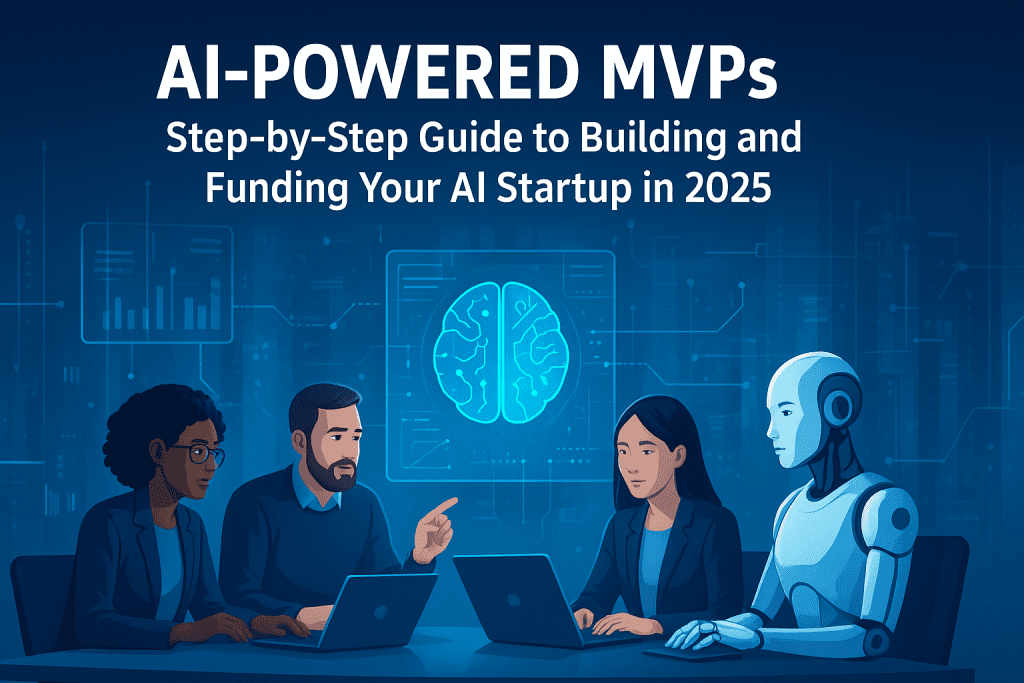
A diverse team of professionals and a humanoid robot collaborate in a futuristic office surrounded by holographic AI visuals and digital data charts, symbolizing innovation, technology, and AI-driven startup development.
Artificial Intelligence, startup

Step-by-Step Guide to Building and Funding Your AI Startup

Introduction Artificial Intelligence (AI) is the driving force behind the most exciting AI startup trends of 2025. From generative models to predictive analytics, AI is fueling a new generation of innovation across industries. For emerging startups, building an AI MVP (Minimum Viable Product) is the smartest way to test ideas and attract early investors. This guide will walk you through the step-by-step process of AI MVP development, explore AI funding strategies, and highlight artificial intelligence innovation that can turn your idea into a real-world business success. Step-by-Step Guide to Building Your MVP 1. Identify the Problem and Validate the IdeaStart with a real-world problem AI can solve. For example, automating resume screening, predicting health outcomes, or optimizing logistics. Conduct market research and user interviews to confirm demand before writing a single line of code. 2. Define Core Features (Keep It Lean)Focus on the one AI-driven feature that delivers the most value. Instead of building everything at once, design a prototype that showcases the core intelligence of your product — like a chatbot, image recognizer, or recommendation engine. 3. Choose the Right Tech StackSelect reliable tools for faster MVP development: Backend: Python (FastAPI, Flask) or Node.js Frontend: React.js or Next.js AI/ML Tools: TensorFlow, PyTorch, OpenAI API, Hugging Face Database: MongoDB, PostgreSQL Hosting: AWS, Google Cloud, or Azure 4. Build and Test IterativelyDevelop your MVP in short sprints. Gather feedback from beta testers and iterate quickly. Use analytics to understand user behavior and improve AI performance. 5. Launch and Collect DataOnce launched, track user engagement, model accuracy, and overall experience. The insights you gather will help refine your AI model and product roadmap. How to Raise Funding for Your MVP in 2025 1. Create a Compelling Pitch DeckHighlight your AI’s unique edge — what problem it solves and how it uses data intelligently. Investors want to see impact + scalability. 2. Showcase Early TractionEven small user metrics, pilot results, or demo videos can prove your MVP’s value. Show that your AI works and users love it. 3. Target the Right InvestorsReach out to AI-focused venture funds, tech accelerators, and angel investors who understand machine learning and automation potential. Examples: Sequoia India, Accel, Y Combinator, Techstars AI Track. 4. Emphasize Ethical AI and Data PrivacyIn 2025, investors are more cautious about AI ethics and compliance. Mention fairness, transparency, and responsible data handling in your pitch. 5. Use Funding PlatformsExplore modern fundraising options like: AngelList (for pre-seed rounds) Y Combinator’s Startup School PitchBook & Crunchbase (for investor connections) Crowdfunding with AI-based prototypes (Kickstarter, Indiegogo) Pro Tips  Start with No-Code or Low-Code AI Tools: Use platforms like Bubble, Builder.ai, or Lobe.ai to test MVP ideas quickly.  Focus on Data Quality: Your AI is only as smart as the data you train it on.  Leverage Open Source Models: Fine-tune pre-trained models instead of building from scratch.  Prioritize User Feedback: Iteration is your best teacher.  Integrate Ethics and Transparency: Build user trust through explainable AI features. Conclusion The AI boom of 2025 offers endless opportunities for innovative startups. Building a smart, efficient MVP is the best way to validate your idea and attract funding. By staying lean, focusing on real problems, and emphasizing responsible AI practices, you can turn your concept into a market-ready product. Remember — in AI startups, speed and adaptability matter more than perfection.   ❓ FAQ 1. What is an AI MVP?An AI MVP (Minimum Viable Product) is a lightweight version of an AI-based product built to test market demand and gather user feedback before full-scale development. 2. How long does it take to build an AI MVP?Typically 4–12 weeks, depending on complexity, data availability, and team size. 3. How much funding do AI startups usually raise initially?AI startups usually raise between $50,000 – $250,000 in seed or pre-seed rounds for MVP development. 4. What’s the best AI tech stack for startups in 2025?Python (for AI/ML), React (for frontend), and AWS or Google Cloud for deployment are the most popular combinations. 5. Can I build an AI MVP without coding?Yes! Tools like Lobe.ai, Peltarion, and Builder.ai allow non-technical founders to prototype AI solutions quickly. How to Build a Minimal Viable Product (MVP) and Raise Funding in 2025

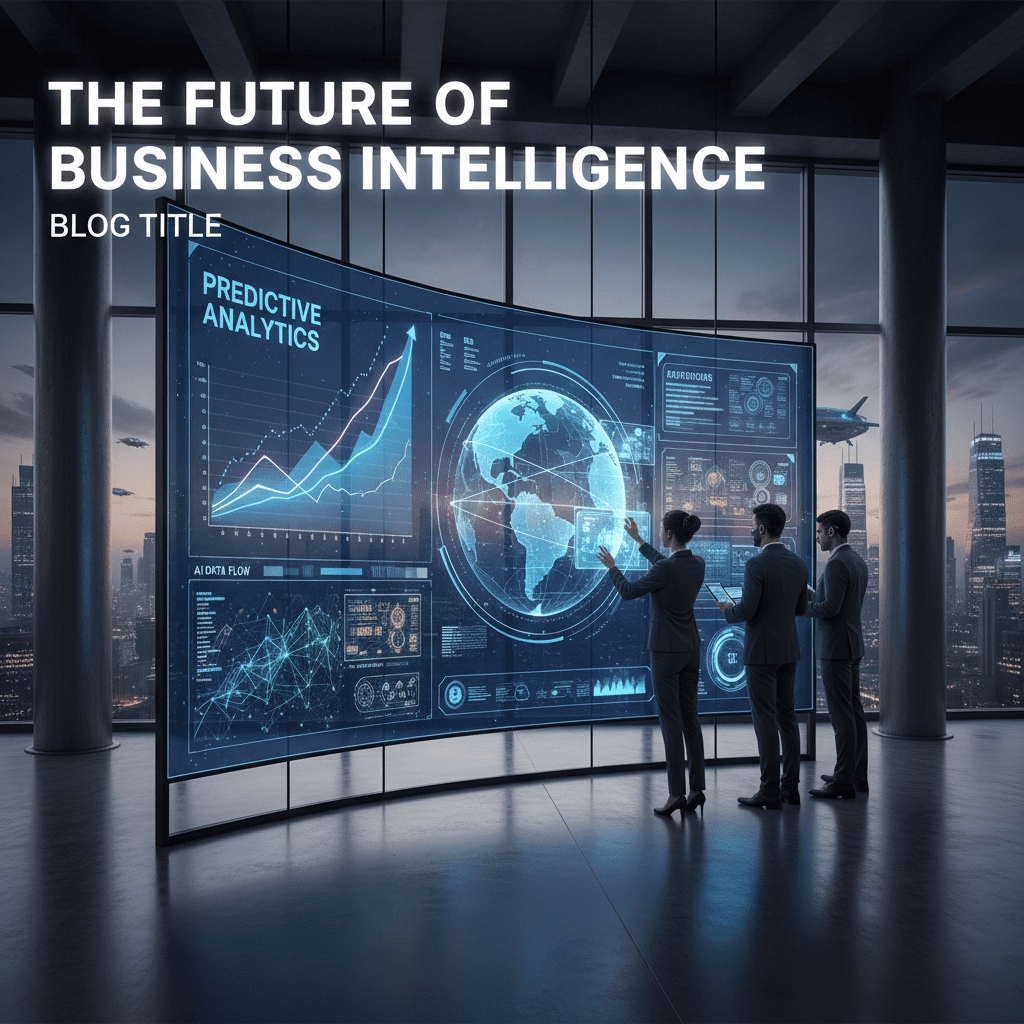
"Futuristic dashboard with predictive analytics graphs, AI data streams, and business professionals analyzing digital interfaces, representing software-driven business forecasting."
data science, Software development

Predictive Analytics Software Development

Introduction Predictive analytics software development is revolutionizing how organizations leverage their data to anticipate trends, reduce risk, and gain a competitive edge. By deploying machine learning, statistics, and advanced modeling, companies can turn historical and real-time data into actionable predictions—whether for sales forecasting, preventing fraud, or optimizing inventory. With mounting business complexity and data volumes, predictive analytics tools have become essential for organizations aiming to future-proof their strategies and drive smart decisions in an ever-changing market. What Is Predictive Analytics Software Development? Predictive analytics utilizes historical and live data, advanced algorithms, and machine learning to forecast future outcomes and recommend the best actions. Developing predictive analytics software typically involves identifying business needs, collecting and preparing data, building models, and integrating these models seamlessly into business applications for real-time insights. Modern predictive analytics systems can be custom-coded, built using data science tools, or integrated through user-friendly low-code platforms, making this technology accessible across industries. Key Features: Automated data ingestion and cleansing Model building, evaluation, and deployment Real-time prediction capabilities Integration with business processes and dashboards Ability to learn and adapt as new data arrives The Predictive Analytics Software Development Lifecycle Strategic Planning Define specific business problems such as churn prediction, fraud detection, or inventory optimization. Set measurable goals and align key stakeholders. Data Collection & Preparation Gather data from internal systems, external sources, and real-time feeds. Cleanse, transform, and annotate data to ensure quality input for models. Model Development Choose appropriate algorithms (e.g., regression, decision trees, neural networks). Train and validate models on historical data; iterate for accuracy and explainability. Integration & Deployment Embed predictive models into business systems like CRMs, ERPs, or supply chain tools for live predictions. Provide end-users, analysts, and leaders with intuitive dashboards or automated triggers. Monitoring, Maintenance, and Scaling Track accuracy; retrain models as conditions shift and new data is available. Continuously enhance with new features and data sources. Best Practices: Start small with a pilot project—optimize, then scale Prioritize data quality and governance early on Foster teamwork between IT, data science, and business units Focus on model transparency and compliance Embrace agile, iterative development for adaptability Business Benefits & Use Cases Improved Decision-Making: Predictive analytics drives proactive strategies by uncovering patterns and forecasting potential outcomes. Risk Reduction: Banks, insurers, and manufacturers leverage predictive models for fraud detection, credit scoring, risk assessment, and predictive maintenance. Enhanced Efficiency: Automated forecasting and resource allocation improve supply chain and operations management. Personalization: Retailers and marketers optimize targeting, recommendations, and retention using behavioral analytics. Healthcare: Early disease detection, readmission risk prediction, and personalized treatment planning lead to improved patient outcomes. Scalable Growth: Predictive software enables organizations to handle increasing data complexity and maintain a competitive edge. Conclusion Developing predictive analytics software equips organizations with the foresight to make smarter, data-driven decisions while automating processes and enhancing resiliency. By following best practices and leveraging modern development frameworks, businesses of all sizes can turn raw data into predictive power—unlocking new opportunities and sustainable growth. Call-to-Action: Explore predictive analytics software solutions tailored to your business needs—connect with expert developers today and turn your data into a strategic asset! FAQ What is predictive analytics software? It is a tool that uses historical and current data, along with algorithms and machine learning, to forecast future trends and inform smarter business decisions. How does predictive analytics benefit companies? It improves revenue prediction, reduces risk, enhances customer experience, streamlines operations, and delivers personalized recommendations. What are common use cases? Fraud detection, demand forecasting, maintenance planning, customer segmentation, and healthcare diagnosis are among the top applications. What is needed to build predictive analytics software? You need a well-defined problem, quality data, an experienced team, the right algorithms, and a plan for ongoing monitoring and refinement. How do you choose the right predictive model? Select based on the type of prediction needed—classification, regression, or time series—and evaluate with validation metrics before deployment

machine learning

Machine Learning in Banking – Use Cases and Implementation Process

Introduction The banking industry is rapidly embracing machine learning (ML) to enhance operational efficiency, manage risk, detect fraud, and deliver personalized customer experiences. As financial institutions face increasing competition, regulatory complexities, and evolving customer expectations, ML innovations are becoming central to banking digital transformation. This comprehensive blog explores prominent use cases of machine learning in banking, its business impact, and the structured implementation process, supported by current insights and examples from leading institutions and fintech innovators. Key Use Cases of Machine Learning in Banking 1. Fraud Detection and Risk Management Fraud detection is arguably the most critical application of ML in banking. Machine learning models analyze millions of transactions in real-time, identifying abnormal patterns and preventing unauthorized activities earlier and more accurately than traditional rule-based systems. Behavioral analytics track anomalies like unusual transaction locations or atypical spending. Models dynamically adapt to emerging fraud tactics without explicit reprogramming. Banks like Citi use ML-driven anomaly detection for enhanced transaction security. 2. Personalized Customer Experiences ML enables hyper-personalization by analyzing customer behavior, preferences, and financial histories to tailor products, services, and recommendations. Robo-advisors provide customized investment advice based on risk tolerance. Targeted financial products improve customer engagement and retention. AI-driven virtual assistants offer real-time support and guidance addressing individual needs. 3. Process Automation and Operational Efficiency ML automates back-office processes such as loan underwriting, document verification, compliance monitoring, and reconciliation, reducing human errors and increasing throughput. Optical Character Recognition (OCR) converts handwritten documents for digital processing. Robotic Process Automation (RPA) combined with ML streamlines regulatory compliance tasks. Automation shortens loan approval cycles and improves customer onboarding. 4. Conversational Banking and Virtual Assistants AI-powered chatbots and intelligent virtual assistants enhance customer service by providing 24/7 support for routine inquiries, transaction assistance, and fraud alerts. Natural Language Processing (NLP) allows human-like interactions. Automations reduce call center load and improve response times. Virtual agents assist with bill payments, balance checks, and card controls. 5. Algorithmic Trading and Investment Analysis ML models identify complex market trends using diverse datasets including news sentiment, social media, and historical prices, enabling data-driven trading strategies. High-frequency trading bots optimize transactional timing and portfolio performance. Predictive analytics improve risk forecasting and asset allocation. Fintech firms leverage advanced ML to outperform traditional trading approaches. Business Impact of Machine Learning in Banking Enhanced Security: ML reduces financial crime impact and regulatory penalties. Improved Customer Loyalty: Personalized offerings increase satisfaction and retention. Operational Cost Savings: Automation lowers manual processing costs. Accelerated Innovation: Agile data-driven decision-making supports new product launches. Increased Competitive Advantage: Banks implementing ML lead fintech innovation. Explore advanced AI solutions fostering risk management and customer personalization at TechOTD AI Services. Implementing Machine Learning in Banking: A Structured Process Step 1: Business Needs Assessment Identify critical banking processes that benefit from ML, such as fraud detection or customer segmentation. Define clear goals and success metrics aligned with strategic priorities. Step 2: Data Collection and Evaluation Gather relevant datasets spanning transactions, customer profiles, operational logs, and external market data. Data quality and completeness are paramount for effective ML models. Step 3: Model Development and Training Develop ML models tailored to use cases, including supervised classification for fraud, clustering for customer segmentation, and NLP for chatbots. Choose algorithms suitable for the complexity and dataset size. Employ techniques such as cross-validation and hyperparameter tuning. Leverage cloud platforms to manage computational demands efficiently TechOTD Cloud Solutions. Step 4: Model Testing and Validation Rigorous testing using historical and simulated data ensures models meet accuracy, precision, and fairness criteria before deployment. Step 5: Deployment and Integration Deploy ML models into banking systems, integrated with transactional platforms, CRM, and compliance tools for streamlined workflows. Use APIs for system communication. Ensure real-time inference capability for critical applications. Step 6: Monitoring and Maintenance Continue monitoring model performance, retraining with new data and adapting to evolving patterns such as new fraud tactics or regulatory changes. Challenges and Considerations Data Privacy and Security: Ensuring compliance with regulations like GDPR while leveraging sensitive customer data. Model Interpretability: Addressing regulatory needs for transparent, explainable AI decisions. Legacy Systems Integration: Bridging newer ML systems with traditional banking infrastructure. Organizational Readiness: Cultivating skilled teams and fostering ML adoption culture. Learn about overcoming challenges with expert consulting at TechOTD How We Work. Future Trends in Machine Learning for Banking Agentic AI: Autonomous AI agents driving higher-level decision making. Federated Learning: Enhancing privacy by training models collaboratively without sharing raw data. Continual Learning: Models that adapt continuously with minimal human intervention. Cross-Industry Data Integration: Leveraging diverse data sources for holistic financial insights. Enhanced NLP Capabilities: More sophisticated conversational banking and sentiment analysis. Stay updated on AI and ML advances at the TechOTD Blog. Conclusion Machine learning is revolutionizing banking by enabling data-driven risk management, operational efficiency, and personalized customer journeys. Financial institutions that strategically implement ML processes and technologies stand poised to lead industry innovation, enhance profitability, and improve regulatory compliance.

How would you like me to respond?

Select a personality for your AI assistant

Normal
Happy
Sad
Angry

Your selection will affect how the AI assistant responds to your messages

Chat Assistant

Let's discuss your project!

Hear from our clients and why 3000+ businesses trust TechOTD

Tell us what you need, and we'll get back with a cost and timeline estimate

Scroll to Top