
medical imaging

Artificial Intelligence, Healthcare & Fitness, Technology & Innovation

AI Use Cases in Healthcare

AI Use Cases in Healthcare: The Practical Blueprint for Clinical and Operational Excellence (2026) The healthcare sector has transcended basic digital record-keeping and entered the age of autonomous intelligence. Today, integrating Artificial Intelligence (AI) into healthcare systems is no longer a speculative technology play; it is a fundamental strategy for survival. Hospitals, clinics, and pharmaceutical enterprises face unprecedented challenges: severe clinician burnout, skyrocketing operational overhead, and a massive surge in unstructured patient data. When properly architected, AI workflow automation transforms this burden into an asset. By handing high-volume data parsing, clinical documentation, and predictive diagnostics over to specialized AI models, healthcare organizations can return clinicians to their primary calling—direct, high-quality patient care. This comprehensive guide details the highest-ROI use cases for AI in modern healthcare ecosystems, providing an implementation framework optimized for compliance, security, and clinical efficacy. 1. The Core Philosophy of Healthcare AI Automation Deploying AI in a medical context requires a fundamentally different philosophy than automating standard corporate workflows. In a traditional corporate setting, a 2% error rate from an AI model might mean minor data cleanup. In healthcare, a 2% error rate can result in catastrophic clinical outcomes. Therefore, modern healthcare AI systems are built on a framework of augmented intelligence. The goal is never to replace human medical judgment, but to eliminate the administrative and analytical friction that isolates clinicians from their patients. +———————————————————————–+ | THE HEALTHCARE AI PARADIGM | +———————————————————————–+ | RAW DATA INGESTION | HUMAN-IN-THE-LOOP (HITL) | | “Heavy Analytical Lifting” | “Ultimate Clinical Authority” | | • Ambient voice transcription | • Physician reviews drafted charts | | • Cross-referencing lab data | • Radiologist signs off on anomalies | | • Parsing historical patterns | • Care manager approves interventions | +———————————————————————–+ By enforcing a strict Human-in-the-Loop (HITL) protocol, medical enterprises can deploy probabilistic large language models (LLMs) and deterministic computer vision algorithms safely, ensuring that final diagnostic, therapeutic, and administrative actions are always validated by licensed professionals. 2. High-Impact Clinical Use Cases Clinical workflows are notoriously bottlenecked by manual administrative tasks and data fragmentation. Implementing targeted AI pipelines directly relieves these pain points across multiple clinical disciplines. A. Ambient Clinical Documentation and Charting The Friction Point: Physicians routinely spend up to two hours entering electronic health record (EHR) data for every single hour spent face-to-face with a patient, driving historic industry burnout. The AI Automation Solution: Ambient AI scribes utilize low-latency, medical-grade speech-to-text engines to listen natively to patient-doctor conversations. The system filters out casual small talk, structures the relevant clinical insights, and automatically populates a comprehensive SOAP (Subjective, Objective, Assessment, and Plan) note inside the EHR system. The physician simply reviews, edits, and signs off on the note, shrinking documentation time by over 60%. B. Intelligent Diagnostic Imaging Pipelines The Friction Point: Radiologists face an overwhelming volume of complex scans (CT, MRI, X-ray), leading to diagnostic delays and fatigue-induced oversight of minute anomalies. The AI Automation Solution: Specialized computer vision models act as an automated first-line triage system. As scans are completed, the AI automatically pre-screens the imagery to flag critical conditions like acute intracranial hemorrhages, pulmonary embolisms, or early-stage tumors. The pipeline automatically escalates high-risk cases to the top of the radiologist’s reading queue, appending bounding boxes and statistical heatmaps over anomalous tissues to accelerate diagnostic accuracy. C. Predictive Analytics for Patient Deterioration The Friction Point: Acute hospital wards must constantly monitor patients to catch sudden physiological declines before they escalate into cardiac arrest or septic shock. The AI Automation Solution: Predictive AI models continuously stream real-time data from ICU monitors, lab results, and nursing logs. By recognizing subtle, multi-variable patterns that human eyes might miss—such as a specific, concurrent fluctuation in heart rate, oxygen saturation, and white blood cell counts—the system calculates an automated “deterioration risk score.” It automatically triggers early-warning alerts to the floor nursing station hours before a code blue event occurs. 3. Operational and Administrative Transformation A hospital’s operational infrastructure is incredibly complex. Managing revenue cycles, scheduling resources, and matching staffing requirements directly impact an institution’s financial stability and capacity to deliver care. [Inbound Patient Intake] —> [AI Revenue Cycle Automation] —> [Optimized Payer Reimbursement] A. Automated Prior Authorization and Revenue Cycle Management (RCM) The Friction Point: The prior authorization process is manual, tedious, and prone to insurance company denials, delaying vital patient treatments. The AI Automation Solution: When a physician orders a complex procedure, an enterprise AI agent automatically extracts the patient’s historical chart notes, pairs them with the required medical coding, and cross-references them against the insurance payer’s specific medical necessity criteria. The AI automatically compiles, formats, and submits the prior authorization bundle via electronic clearinghouses, reducing approval cycles from weeks to minutes. B. Predictive Inpatient Capacity and Staffing Optimization The Friction Point: Managing emergency department (ED) surges and inpatient bed availability typically relies on historical guesswork, leading to understaffed shifts or costly over-scheduling. The AI Automation Solution: Machine learning models ingest historical admission data, regional epidemiological tracking, local weather forecasts, and community event schedules to predict emergency department inflow up to 72 hours in advance. The operational workflow automatically outputs recommended nurse-to-patient staffing configurations and projects bed clearance times, maximizing hospital throughput and minimizing patient wait times. 4. Selecting the Core AI Infrastructure Stack for Healthcare Building a medical AI pipeline requires selecting model ecosystems that provide elite reasoning capabilities, highly specialized training sets, and ironclad enterprise security arrangements. Capability / Requirement OpenAI Enterprise (via Azure) Anthropic (Claude via AWS Bedrock) Google Cloud (Gemini & MedLM via Vertex AI) Primary Healthcare Strength Fast conversational APIs for patient intake and ambient voice systems. Exceptionally detailed, nuanced parsing of complex, unstructured clinical charts. Specialized, medical-native model architectures (Med-PaLM 2 / MedLM) out of the box. Compliance Infrastructure SOC 2 / HIPAA BAA via Microsoft Azure environment. Enterprise data isolation and safety guardrails through AWS. Highly secure Google Cloud healthcare data engines with deep regional compliance. Best Analytical Use Case Interactive telehealth assistants and real-time transcription. Legal/Regulatory audit compliance and complex clinical research parsing.
Healthcare & Fitness

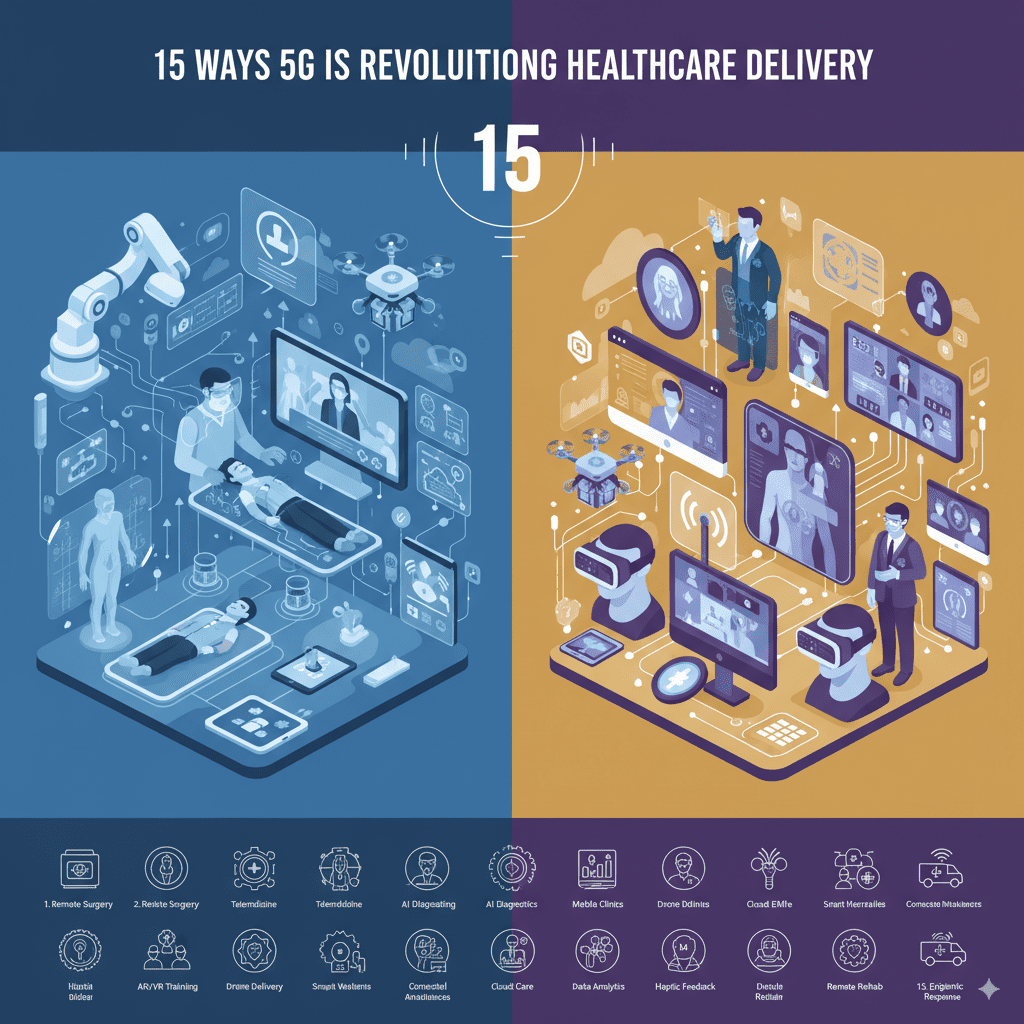
15 Ways 5G is Revolutionizing Healthcare Delivery

Introduction The healthcare industry is undergoing a seismic transformation powered by the emergence of 5G connectivity. The fifth generation of wireless networks offers blazing speeds, ultra-low latency, and the ability to connect unprecedented numbers of devices—all of which unlock new efficiencies and innovations in patient care. With a rapidly expanding global 5G healthcare market projected to surge from $70.94 billion in 2025 to nearly $390 billion by 2034, forward-looking providers are reimagining everything from diagnostics and surgery to patient monitoring and data management. This blog explores 15 practical ways 5G is revolutionizing healthcare delivery, empowering professionals and patients, and creating a smarter, more connected medical ecosystem. Real-Time Remote Patient Monitoring 5G networks support continuous remote patient monitoring (RPM) by seamlessly connecting wearables and IoT devices. Real-time transmission of vitals allows care teams to detect issues early and intervene before complications arise. Example: Heart monitors send instant readings via connected medical platforms, enabling faster doctor responses. High-Fidelity Telemedicine and Virtual Consultations Ultra-clear 4K+ video with almost zero lag dramatically enhances virtual medical visits. Doctors can visually inspect skin, wounds, or rashes in detail, building trust and accuracy in remote diagnosis. Example: Leading telehealth providers use 5G to connect diagnostic equipment during video consults. Connected Ambulances and Next-Gen Emergency Services 5G-equipped ambulances serve as “mobile ERs,” sharing live HD video and critical patient data with hospitals in real time. Paramedics receive expert guidance from remote clinicians during transport, improving life-saving outcomes. Example: University Hospitals in Birmingham piloted remote ultrasound guidance in 5G ambulances. Instantaneous Access to Electronic Health Records (EHR) 5G enables clinicians to access full EHRs—including large medical images—on tablets or devices anywhere in the hospital within seconds. Faster access means faster, more informed clinical decisions and workflow efficiency. Example: Rush University Medical Center’s private 5G boosts Epic system accessibility. The Rise of the Internet of Medical Things (IoMT) 5G enables thousands of connected IoMT devices in smart hospitals, powering smart beds, infusion pumps, and environmental sensors. Real-time data aggregation creates a digital twin of entire operations, driving clinical and operational optimization. Example: Philips HealthSuite manages data from millions of devices over robust 5G networks. Democratizing Expertise with Remote and Robotic Surgery Ultra-low 5G latency makes remote robotic surgery a reality. Surgeons in one location can perform delicate procedures on patients hundreds of miles away. Example: In China, remote thyroid surgeries have been performed thanks to 5G. Advanced Predictive Analytics for Patient Care Real-time sensor and medical record data flow enables AI-powered predictive models for sepsis risk, patient deterioration, and resource allocation. Enhanced clinician decision-making leads to proactive, personalized interventions. Example: The U.S. Veterans Affairs living lab uses 5G to power predictive analytics in chronic care. Immersive Medical Training with AR and VR Medical education evolves with 5G-fueled AR/VR, enabling virtual dissection, simulated surgeries, and lag-free team training. Complex procedures can be practiced in virtual operating rooms globally. Example: Multi-user platforms like GE HealthCare’s OmnifyXR allow remote collaborative training. Automated Hospital Kiosks and Self-Serve Stations 5G keeps smart kiosks and check-in stations fast and responsive, even during peak times. Automating patient intake, co-payment, and navigation streamlines operations and frees up staff. Example: Boston Children’s Hospital uses a hybrid 5G network for real-time registration and payments. Digital Twins for Personalized Treatment Planning Virtual patient “digital twins” simulate organs or systems for personalized planning and risk-free surgery rehearsal. High-throughput 5G transfers large imaging and modeling data seamlessly between systems and clinicians. Resilient Supply Chain and Smart Inventory Management 5G-powered sensors and tags track medical equipment, medications, and PPE in real time, reducing waste and shortages. Automated stock alerts and predictive maintenance lower costs and improve readiness. Enhanced Medical Imaging and Faster Diagnostics 5G dramatically reduces the time to transfer massive imaging files, accelerating diagnosis and treatment. Enables seamless collaboration among radiologists and AI-driven image analysis. Seamless Collaboration Between Healthcare Professionals Real-time, high-definition video and data sharing accelerate collaborative diagnosis, second opinions, and multidisciplinary decision-making. Teams work seamlessly—even across continents—improving complex case outcomes. Improved Patient Data Security and Privacy 5G’s network slicing and advanced encryption ensure that critical patient data is isolated from general traffic. Hospitals can deploy Zero Trust frameworks to verify every app, user, and device before access. Example: Advanced hospital networks use hardware-level isolation and separate encryption keys for security. Supporting Rural and Underserved Communities Fixed wireless access (FWA) over 5G delivers high-speed Internet to remote clinics, enabling telemedicine, specialist consults, and remote diagnostics. Rural patients gain access to advanced care previously only available in major cities. Example: T-Mobile’s Project 10Million brings 5G health services and virtual appointments to rural schools and clinics. Conclusion 5G is redefining the healthcare playbook, transforming both the patient and provider experiences with speed, scale, and intelligence never before possible. From telemedicine and robotic surgery to predictive analytics, immersive training, and robust supply chain management, the applications are far-reaching and evidence-based. Forward-thinking organizations are already moving quickly to integrate 5G, gaining efficiency, resilience, and a decisive edge in the pursuit of delivering better, more accessible care. Now is the time for healthcare leaders to prioritize bold adoption—and to build a digital health future where connectivity, compassion, and innovation go hand in hand. Ready to future-proof healthcare operations or deliver next-gen patient experiences? Contact a digital healthcare transformation expert for an in-depth 5G strategy assessment today. FAQ Q1: What is the biggest impact of 5G in healthcare? A: Remote patient monitoring and telemedicine provide continuous, real-time care and expand access to specialists for rural and urban populations alike. Q2: Is 5G safe and secure for patient information? A: Yes, 5G offers advanced security features such as network slicing and end-to-end encryption, helping protect sensitive medical data against cyber threats. Q3: How does 5G benefit hospital operations? A: 5G streamlines data flows, enhances collaboration, enables instant access to EHRs, and supports smart logistics—resulting in faster patient throughput, fewer errors, and reduced administrative burden. Q4: Can 5G enable surgeries performed from remote locations? A: Absolutely. 5G’s ultra-low latency allows surgeons to operate on patients miles away, democratizing access to cutting-edge specialized

How would you like me to respond?

Select a personality for your AI assistant

Normal
Happy
Sad
Angry

Your selection will affect how the AI assistant responds to your messages

Chat Assistant

Let's discuss your project!

Hear from our clients and why 3000+ businesses trust TechOTD

Tell us what you need, and we'll get back with a cost and timeline estimate

Scroll to Top