Flutter app development

App Development

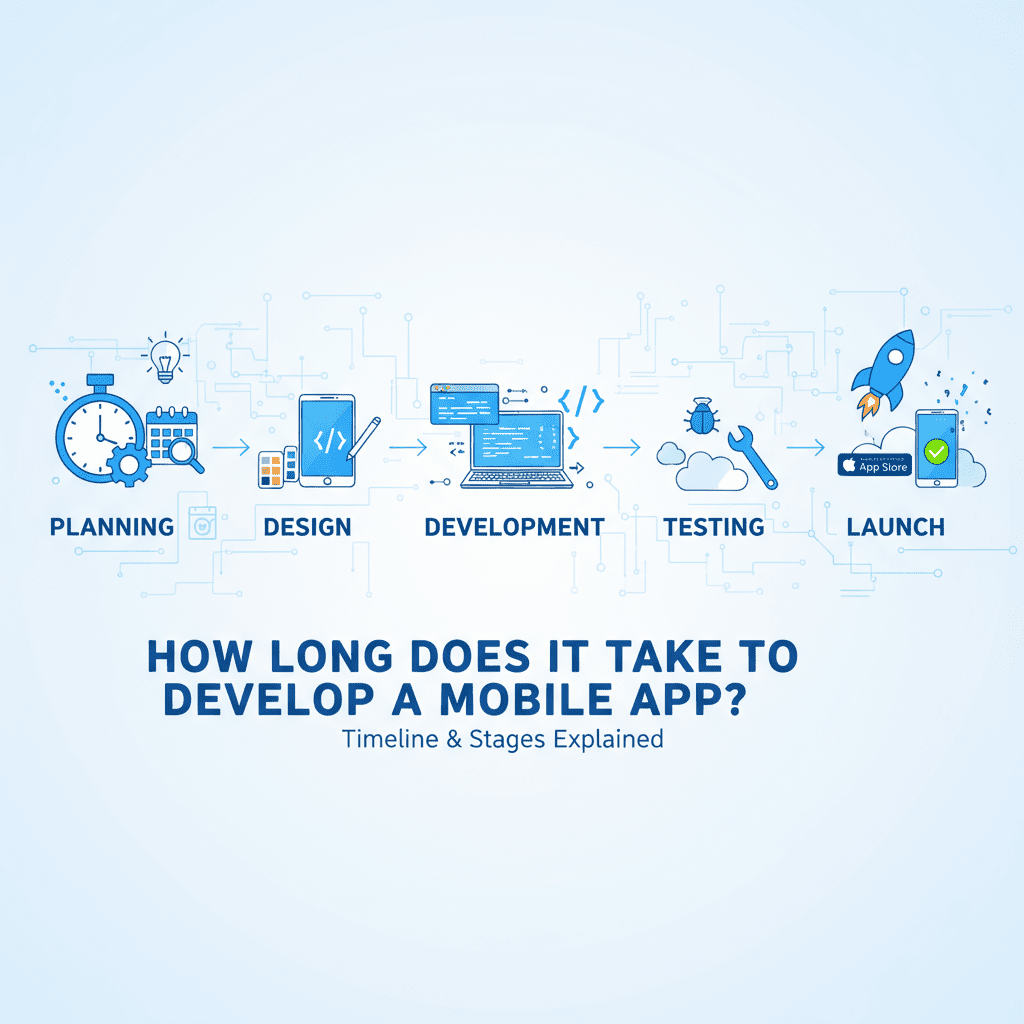
How Long Does It Take to Develop a Mobile App?

Introduction A common question for businesses and entrepreneurs planning mobile apps is: “How long will the development take?” The answer depends on many factors including app complexity, features, platforms, and team expertise. Understanding typical timeframes helps set the right expectations and plan budgets efficiently. App Development Timelines Based on Complexity Simple Apps (2 to 4 Months) Basic functionality with limited features Minimal backend or database integration Examples: Calculator, basic informational app, simple utilities Simple apps focus on core features with straightforward UI/UX and are ideal as MVPs or proof of concepts. Medium Complexity Apps (4 to 8 Months) Moderate feature set like user authentication, payment gateways Some backend integration and APIs Examples: Fitness trackers, food delivery apps, messaging platforms These apps require more testing, UI design, and cross-platform compatibility, extending development time. Complex Apps (8 to 12+ Months) Advanced features such as real-time data sync, AI, AR, video streaming Multiple user roles and third-party integrations Examples: E-commerce marketplaces, social networks, fintech solutions Complex apps often require scalable backend architecture, security compliance, and extensive QA cycles. Factors Influencing Development Time Feature Scope: More features mean longer development and testing periods. Platform Choice: Native apps for iOS and Android may take longer than cross-platform development. Design Complexity: Custom UI/UX design adds to project time. Third-Party Integrations: Payments, social media, maps, or AI APIs affect timelines. Team Size and Expertise: Larger or specialized teams can accelerate or delay schedules. Testing and Revisions: Time allocated for QA and feedback cycles can vary. Tips to Speed Up Development Start with an MVP to validate core features quickly. Use cross-platform frameworks like Flutter or React Native. Prioritize features using MoSCoW method (Must-have, Should-have, Could-have, Won’t-have). Automate testing and use CI/CD pipelines for faster releases. Work with experienced developers or agencies to avoid rework. Conclusion Typically, app development ranges from 2 months for simple projects to over a year for complex applications. Planning, clear requirements, and choosing the right technology are key to hitting your timeline. Setting realistic expectations helps businesses launch products faster and adapt to market feedback effectively. For expert mobile app development services and timeline consultation, explore TechOTD AI Services and follow industry trends on the TechOTD Blog.

Education app developement

how much does duolingo like app development cost?

Introduction Developing a language learning app like Duolingo involves various factors that impact the overall cost, ranging on average from around $25,000 to over $300,000 depending on complexity, features, platforms, and technologies used. This blog provides a detailed exploration of the estimated development cost, key features, stages of development, and strategic considerations to help businesses plan effectively for a Duolingo-like app.   In the growing edtech landscape, language learning apps have become immensely popular, with Duolingo leading the pack backed by advanced gamification, AI, and personalized user experiences. Building a similar app requires careful planning and investment in technology, design, and quality assurance. Learn about leveraging AI for educational apps and digital transformation at TechOTD AI Solutions. Factors Influencing Development Cost Platform Choice Single platform (Android or iOS): $25,000 – $100,000 Cross-platform/hybrid development: $80,000 – $150,000+ Web version (optional): Additional $10,000 – $20,000 App Complexity and Feature Set Basic: User registration, simple lessons, progress tracking — $50,000 – $100,000 Average: Gamification, AI-driven content suggestions, community features — $100,000 – $200,000 Advanced: Offline mode, live tutoring, advanced AI (speech recognition, personalization) — $200,000 – $300,000+ Explore AI-driven personalization and automation technologies at TechOTD Predictive Analytics. Key Features of a Duolingo-like App User Features Interactive lessons tailored to different skill levels Gamification elements: badges, points, leaderboards Multimedia content: audio, video, images for immersive learning Progress tracking, daily goals, and reminders AI-based adaptive learning paths and pronunciation feedback Admin and Backend Course management and content updates User analytics and performance dashboards AI/ML integration for personalization and scalability Secure authentication and data privacy compliance Development Stages and Cost Breakdown Stage Estimated Cost Range (USD) Description Market Research & Planning $5,000 – $10,000 Define goals, target audience, competitive analysis UI/UX Design $10,000 – $20,000 Design intuitive, engaging user experiences Frontend Development $20,000 – $40,000 Building the user interface on chosen platform(s) Backend Development $20,000 – $40,000 Server-side logic, database, APIs AI & Machine Learning $15,000 – $30,000 Custom algorithms for adaptive learning and feedback Testing & QA $5,000 – $10,000 Functional and performance testing Launch & Marketing $10,000 – $20,000 Deployment, user acquisition, promotion Technology and Tools Used Employing the right tech stack ensures scalability, performance, and maintainability. Frontend: Swift, Kotlin, React Native or Flutter Backend: Node.js, Python, Django, Ruby on Rails Database: PostgreSQL, MongoDB AI & ML Libraries: TensorFlow, OpenCV, Scikit-learn Cloud Platforms: AWS, Azure, Google Cloud Analytics and Monitoring: Grafana, Tableau Learn more about tech adoption and AI in education at TechOTD Education Impact Guide. Cost Optimization Strategies Start with a Minimum Viable Product (MVP) to test market response and reduce upfront costs Outsource development to cost-effective regions while maintaining quality Use open-source AI libraries and existing frameworks Implement phased feature rollouts based on user feedback Monetization and Growth Potential Language learning apps typically use a freemium model: Free access to basic content Premium subscriptions for advanced lessons, live tutoring, and ad-free experiences In-app purchases for certificates or special courses For strategic growth and customer journey optimization, visit TechOTD Customer Journey with AI. Closing Thoughts Building a Duolingo-like app is a significant but rewarding investment that combines technology, education expertise, and user-centric design. With AI and advanced analytics, such an app can deliver customized, engaging, and effective language learning experiences globally. For tailored development services and consulting, explore TechOTD Development Services and browse expert insights on the TechOTD Blog. Conclusion Developing a Duolingo-like language learning app is a significant investment, typically ranging from $80,000 to $300,000+, depending on features, platform, AI integration, and complexity. A phased approach starting with MVP ensures risk mitigation and better budget control.

App Development

How Long Does It Take to Develop a Mobile App?

Introduction In today’s digital-first world, mobile apps have become the backbone of customer engagement and business innovation. Whether it’s a food delivery app, a fintech platform, or an AI-powered productivity tool, businesses are investing heavily in mobile applications to capture new market opportunities. But one of the most common questions that arises during the planning phase is: how long does it take to develop a mobile app? The answer depends on factors such as app complexity, features, target platform (iOS, Android, or both), technology stack, and development methodology. In this blog, we will break down the step-by-step mobile app development timeline, explain different stages, and highlight how businesses can reduce time-to-market while still delivering a high-quality product. If you’re considering building an app in 2025, this guide will give you a realistic timeline and insights based on best practices. Factors Influencing Mobile App Development Timeline The time it takes to develop an app is rarely the same for every project. Each app idea and feature set comes with different timelines. Below are the key factors that directly impact development duration. 1. App Complexity Simple apps (basic features like login, profile, and information display): 2–4 months Medium-complexity apps (real-time updates, payment systems, API integration, push notifications): 4–8 months High-complexity apps (social media, AI-powered personalization, video streaming, enterprise-level apps): 9–15 months 2. Platforms and Technology Stack iOS only: Faster development due to fewer device variations. Android only: Slightly longer due to device fragmentation. Cross-platform development with frameworks like React Native or Flutter reduces time and cost. (Learn more about frameworks like React Native vs Swift). 3. Team Structure A dedicated development team of UI/UX designers, front-end developers, back-end developers, QA testers, and project managers accelerates timelines. Outsourcing to an experienced mobile app development company (TechOTD Mobile App Services) ensures faster delivery with expert resources. 4. Features & Functionality Some features add significant time to development: Artificial Intelligence (AI) & Machine Learning integration Cloud storage & synchronization In-app chat & video calling Blockchain-based security features (See Blockchain integration use cases in business) Predictive analytics (Explore Predictive Analytics Development) 5. Testing and Security Security compliance, bug fixing, and testing on multiple devices are crucial yet time-intensive stages. For industries like finance and healthcare, additional testing for compliance adds weeks to timelines. Typical Mobile App Development Timeline (Step-by-Step) Let’s break down the average timeline of 1700 words worth detailing into phases followed by realistic time estimates: Phase 1: Research & Planning (2–4 Weeks) Analyzing business requirements. Competitor research and feature set prioritization. Technical feasibility study. Choosing the right technology stack (AI, blockchain, cloud, etc.). ➡️ Example: TechOTD follows structured “How We Work” guidelines to first assess business needs (Details here). Phase 2: UI/UX Design (3–6 Weeks) Wireframes and mockups development. User journey mapping to ensure simplicity. Style guides and interactive prototypes. ➡️ Example: In modern apps, customer journey mapping has become crucial (Future of Customer Journey with AI). Phase 3: Development (4–12 Weeks or More) Frontend Development: Building the user interface (navigation, forms, dashboards). Backend Development: APIs, databases, servers, integration with AI/ML, NLP, or cloud solutions (Explore TechOTD AI services). Cross-platform support: React Native, Flutter, or native development. ➡️ Example: Flutter development teams speed up app creation significantly (Why hire Flutter teams?). Phase 4: Testing & QA (2–6 Weeks) Unit testing, integration testing, UI testing, and stress testing. Ensuring compliance with cloud security measures (CNAPP explained here). Fixing errors to guarantee seamless performance across devices. Phase 5: Deployment (2 Weeks) Publishing on Google Play Store and Apple App Store. Preparing app store optimization (ASO). Submitting for approval (usually takes 7–10 days per platform). Phase 6: Post-Launch Support (Ongoing) Bug fixes, user feedback improvements. Regular security patches and scalability improvements. Adding AI-driven updates like predictive recommendations or LLM integrations (LLMs in Finance explained). How Long Does It Really Take? (Overview) Basic App (MVP): 4–6 months Mid-level App: 6–9 months Enterprise/Feature-rich App: 9–15 months However, innovative approaches such as AI-driven automation (TechOTD AI-powered automation solutions) and agile iterative cycles can help cut down development times without compromising quality. Real-World Examples Food Delivery Apps Development timeline: 7–12 months Features: GPS tracking, real-time order updates, in-app payments Learn more: Food App Development Costs & Timelines Education Apps Development timeline: 6–10 months Features: Video content, gamification, progress tracking Related: Technology in Education for CEOs E-commerce Loyalty Apps Development timeline: 6–9 months Features: Rewards, discounts integration, customer analytics Explore in detail: Loyalty App Costs Conclusion The time it takes to develop a mobile app varies significantly depending on complexity, features, and the technologies involved. On average: Simple apps can take 3–6 months. End-to-end feature-rich apps can take 9–15 months. Working with a trusted partner like TechOTD ensures a structured, efficient process from planning to deployment with continuous post-launch support. If you are planning an app for 2025 and beyond, the right strategy is to balance speed with quality—leveraging AI, cross-platform frameworks, and expert development teams. 👉 Ready to bring your app idea to life? Contact TechOTD for a free consultation today and accelerate your mobile app development journey. FAQs 1. What is the fastest way to develop a mobile app? Using cross-platform frameworks like Flutter or React Native and adopting Agile methodology speeds up development. 2. How do I reduce time-to-market for my app? Start with a Minimum Viable Product (MVP) focusing on core features, then add advanced features later. 3. Can AI speed up mobile app development? Yes. AI-powered automation, predictive analytics, and machine learning reduce testing and coding efforts. 4. What makes enterprise apps take longer to build? Enterprise apps often include advanced features like integrations, compliance, AI/ML, and blockchain, which extend timelines. 5. How much does app development cost? On average, costs vary between $15,000 and $250,000, depending on feature scope and complexity.

App Development, Uncategorized

How to Build a Customer Loyalty Program App Like Flybuys: Complete Cost Guide

Introduction In today’s highly competitive retail and eCommerce market, customer loyalty is no longer just a “nice-to-have”—it is a strategic necessity. Apps like Flybuys in Australia have revolutionized how businesses retain customers, boost engagement, and increase repeat purchases. By rewarding users with points, cashback, and personalized offers, loyalty apps create a strong emotional and financial bond between customers and brands. According to Allied Market Research, the global loyalty management market is projected to reach $24 billion by 2030, driven by cloud technology, AI-powered personalization, and cross-industry partnerships. Developing a Flybuys-style customer loyalty program app requires careful planning, investment, and the right technology partner. In this comprehensive guide, we’ll cover: Key features your loyalty app must have Complete cost breakdown (from design to deployment) Factors influencing pricing Why TechOTD is the right partner for loyalty app development Detailed comparison table of features & costs FAQs for businesses considering loyalty solutions  Whether you’re a retailer, eCommerce platform, or tech startup, this guide will help you estimate costs, timelines, and strategies for building your next-gen loyalty program.  Key Features of a Flybuys-Style Loyalty App Building a loyalty app is more than just a points system—it’s about creating an ecosystem where customers feel valued and engaged. Here are the must-have features: User Registration & Profiles – Social login, personalized dashboards. Points Earning & Redemption – Track purchases, reward points, and redeem offers. Tiered Membership Levels – Bronze, Silver, Gold tiers with progressive perks. Personalized Offers & Notifications – AI-driven promotions powered by TechOTD AI solutions. Partner Integration – Collaboration with retail, travel, and service partners. Digital Wallet & Payment Integration – Secure transactions and rewards redemption. Analytics & Reporting – Data insights for businesses to optimize campaigns. Security & Compliance – GDPR, HIPAA, and PCI-DSS compliance for data protection. Gamification & Social Sharing – Leaderboards, badges, and referral bonuses. Multi-Platform Availability – iOS, Android, and Web with cross-platform frameworks.  For advanced app design & web integration, explore TechOTD’s Web Development services.  Cost Breakdown of Building a Loyalty Program App The total cost depends on features, integrations, and complexity. Below is a breakdown of typical expenses: Development Stage Description Estimated Cost (USD) Planning & Design Market research, competitor study, wireframes, UX/UI $5,000 – $12,000 Core Development Backend APIs, mobile app, cloud integration $20,000 – $50,000 Third-Party Integrations Payment gateways, CRM, partner APIs $5,000 – $15,000 Testing & Deployment QA, performance optimization, app store approvals $3,000 – $7,000 Ongoing Maintenance & Support Updates, hosting, bug fixes 15–20% of initial cost annually Total Cost Estimate: $35,000 – $80,000+ (depending on scale and features)  For scalable loyalty solutions, check TechOTD Partner Solutions.  Factors Affecting Loyalty App Costs App Complexity – Simple points-based apps cost less, while advanced AI-driven ones require higher investment. Loyalty Tier Design – Single-tier vs. multi-tier reward systems. AI & Personalization – Predictive offers and behavioral targeting. Integration Needs – POS systems, payment gateways, and eCommerce platforms. Security & Compliance – Meeting GDPR/HIPAA adds compliance costs. Platform Coverage – Native (iOS, Android) vs. Cross-platform. Industry Focus – Retail, travel, healthcare, or eCommerce-specific features.  Why Choose TechOTD for Loyalty App Development? TechOTD brings deep expertise in AI, cloud, and app development, offering end-to-end solutions that are secure, scalable, and innovative. Custom Web & App Development → Explore Web Development AI-Driven Personalization → AI Solutions Industry-Focused Expertise → eCommerce Loyalty Platforms Trusted Partnerships → TechOTD Partner Program Proven Track Record → About TechOTD 👉 With TechOTD as your development partner, you get future-ready loyalty apps designed to maximize ROI and customer engagement.  Key Takeaways Budget Required: $35K – $80K+ Timeline: 4–8 months Best Features: AI personalization, multi-tier rewards, secure payments Industries Benefiting Most: Retail, eCommerce, travel, hospitality, healthcare TechOTD Advantage: AI-driven, cloud-native, and scalable loyalty solutions  Conclusion Building a Flybuys-style loyalty program app is a game-changer for businesses looking to retain customers, increase engagement, and boost revenue. While initial costs vary, the long-term ROI is significant when done right. With the right features, security, and personalization strategies, your app can become the cornerstone of customer engagement. By partnering with TechOTD’s expert team, you gain a competitive edge with cutting-edge technology, AI-driven personalization, and industry-specific solutions.  Start your journey today—turn your customer base into loyal brand advocates with TechOTD. FAQ 1. How long does it take to build a loyalty program app?On average, 4–8 months, depending on features and integrations. 2. Can the app support multiple platforms?Yes, using cross-platform tools (Flutter, React Native) or native apps for iOS & Android. 3. Does TechOTD provide AI-driven personalization? Yes, with AI & Machine Learning solutions, TechOTD enables predictive offers and tailored promotions. 4. What ongoing costs should I expect?Annual costs include server hosting, maintenance, updates, and customer support (15–20% of initial cost). 5. How secure is user data in loyalty apps?Data is protected with end-to-end encryption, secure payment gateways, and compliance (GDPR, HIPAA).

Technology

5 Key Benefits of Hiring a Dedicated Flutter App Development Team

Introduction in today’s competitive mobile landscape, choosing the right development approach is essential. Flutter, Google’s powerful UI toolkit, is renowned for building performant cross-platform apps quickly. Hiring a dedicated Flutter app development team ensures focused expertise and superior results. This blog highlights five key benefits that make hiring a dedicated team the smart choice for your Flutter app project. For more tech insights, visit TechOTD Blog. Unleashing the Role of Data Analytics in Driving Smarter Banking Decisions Key Benefits of Hiring a Dedicated Flutter App Development Team Benefit Description Why It Matters Expertise and Specialization Dedicated teams bring deep Flutter expertise for quality and innovation. Ensures efficient problem-solving and advanced app features. Faster Time-to-Market Continuous focus speeds up development and iteration cycles. Capitalize quickly on market opportunities. Cost Efficiency Lower recruitment & overhead costs compared to full-time or freelance hiring. Better ROI and streamlined budgeting. Seamless Communication Regular updates and dedicated contacts improve project alignment. Reduces misunderstandings; boosts transparency. Scalability and Flexibility Easily scale team size or pivot features as business needs evolve. Adapt quickly to market and customer demands. 1. Expertise and Specialization A dedicated Flutter app development team possesses specialized skills focusing solely on Flutter, leading to innovative, high-quality applications. This dedicated knowledge contrasts with generalized teams who may lack Flutter-specific experience. For a deeper dive into application development trends, check out How Blockchain Integration is Optimizing Business Processes. 2. Faster Time-to-Market Dedicated teams work exclusively on your project, minimizing distractions and communication gaps. This singular focus results in faster development cycles and early market entry, giving your business a competitive edge. Learn more about agile development in Seamless Customer Journeys with AI. 3. Cost Efficiency Hiring a dedicated team avoids the hidden costs tied to recruitment, training, and infrastructure found in in-house teams. It also provides a predictable budget with fewer project delays, leading to overall savings. For insights on cost-related tech solutions, explore Predictive Analytics in Software Development.   4. Seamless Communication and Collaboration Effective communication is critical for app success. Dedicated teams maintain constant contact, provide timely updates, and align closely with your business goals. This collaboration ensures the app reflects your vision effectively. Related reading: Technology Impact on Education. 5. Scalability and Flexibility As your app grows, your development resources should too. Dedicated teams provide the ability to scale and pivot swiftly based on changing requirements without affecting ongoing processes. Understand platform options better in React Native vs Swift: Choosing the Right Framework. Conclusion Hiring a dedicated Flutter app development team is a strategic investment that offers technical expertise, accelerated delivery, cost savings, enhanced communication, and scalability. These benefits collectively empower businesses to launch compelling, high-performance apps that meet user expectations and adapt to market trends. For a comprehensive mobile app development service, visit TechOTD Mobile Apps Services. FAQ Q1: What is a dedicated Flutter app development team? A team of developers focused exclusively on Flutter app projects, possessing specialized skills and offering concentrated effort. Q2: Why is Flutter good for cross-platform apps? Flutter enables building apps for iOS and Android from a single codebase with native-like performance and beautiful UI. Q3: Is hiring a dedicated team more cost-effective? Yes, it reduces costs compared to in-house staff or multiple freelancers by streamlining workflows and cutting overhead. Q4: How often can I communicate with the team? Dedicated teams provide regular updates and have clear communication channels to ensure project transparency. Q5: Can the team size be adjusted as needed? Yes, dedicated teams offer flexibility to scale resources up or down depending on the project’s phase and requirements.

How would you like me to respond?

Select a personality for your AI assistant

Normal
Happy
Sad
Angry

Your selection will affect how the AI assistant responds to your messages

Chat Assistant

Let's discuss your project!

Hear from our clients and why 3000+ businesses trust TechOTD

Tell us what you need, and we'll get back with a cost and timeline estimate

Scroll to Top