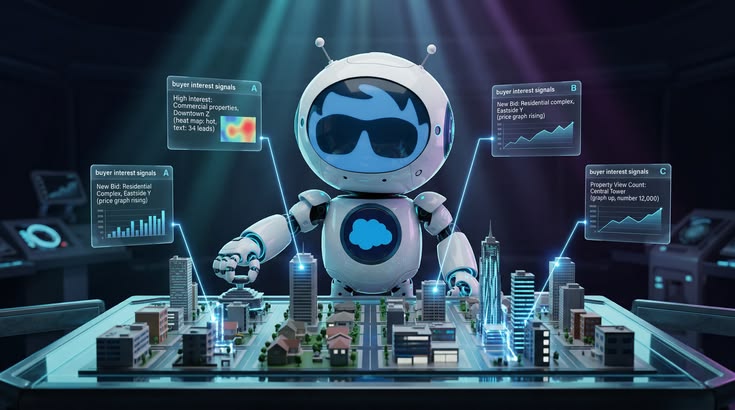
What is Agentforce? Unveiling Salesforce’s Game-Changing AI Platform
The End of the “Copilot” Era
For the last two years, the tech world has been obsessed with “assistants.” We’ve all used them: the little chat bubbles that help us summarize a long email or draft a polite rejection note. But in 2026, the novelty of the assistant is wearing off. Business leaders are no longer asking for a tool that tells them what to do; they are demanding a platform that simply does it.
Salesforce’s answer to this demand is Agentforce.
If the previous generation of AI (Einstein Copilot) was a co-pilot sitting in the passenger seat giving directions, Agentforce is the autonomous vehicle that drives the route itself. It represents a fundamental shift from “Predictive AI” and “Generative AI” to“Agentic AI.” This platform allows organizations to build, customize, and deploy autonomous agents that handle tasks end-to-end, across every department from Sales and Service to Marketing and Commerce.
1. The Secret Sauce: The Atlas Reasoning Engine
The most frequent question technical teams ask is:“How does it actually make decisions?” The answer lies in theAtlas Reasoning Engine.
Unlike standard LLMs that simply predict the next word in a sentence, Atlas is designed to reason through complex business logic. It operates on a continuous loop of:
-
Evaluation: Analyzing the user’s intent and the current state of the CRM data.
-
Refinement: Breaking down a vague request (e.g., “Fix this shipping delay”) into granular steps.
-
Execution: Selecting the right “tools”—whether that’s a Salesforce Flow, an Apex class, or a MuleSoft API call—to resolve the issue.
This reasoning engine ensures the agent doesn’t just “hallucinate” a solution; it follows the strict business processes already defined in your Salesforce environment.
2. Data Cloud: The Nervous System of the Agent
An agent is only as smart as the data it can access. This is why Agentforce is inextricably linked to Salesforce Data Cloud. In many organizations, customer data is “trapped” in silos—emails, PDFs, legacy databases, and call transcripts. Data Cloud acts as the nervous system, harmonizing this unstructured data and feeding it to the agent in real-time. This allows an Agentforce service agent to know that a customer just complained on Twitter, opened a high-priority ticket ten minutes ago, and has a contract expiring next month—all before the conversation even begins.
3. Building Without Code: The Agent Builder
Salesforce has always championed the “low-code” revolution, and Agentforce continues that legacy. Through theAgent Builder, admins can create a digital worker as easily as they would create a custom object.
The builder focuses on four key pillars:
-
Role: Defining exactly what the agent does (e.g., “Tier 1 Support Concierge”).
-
Knowledge: Pointing the agent to the right documentation and data sources.
-
Actions: Giving the agent “hands” to perform tasks like processing refunds or scheduling meetings.
-
Guardrails: Setting the ethical and operational boundaries the agent must never cross.
4. Real-World Impact: Beyond the Hype
The true value of Agentforce isn’t in its code, but in the hours it returns to human employees. Consider these 2026 benchmarks:
-
Customer Service: Early adopters are seeing agents resolve up to75% of common inquiries autonomously, from password resets to complex troubleshooting.
-
Sales Qualification: AI agents are now performing 100% of initial lead follow-ups within minutes, ensuring that human sales reps only step in when a deal is “warm.”
-
Operational Efficiency: In manufacturing, agents are being used to detect anomalies in field service data and automatically trigger repair workflows before a machine even fails.
5. The “Human-in-the-Loop” Security Model
Autonomy often triggers anxiety about security. Salesforce addresses this through theEinstein Trust Layer. This security framework ensures that sensitive customer data (like PII) is stripped away before being processed by an LLM and that every autonomous action leaves a clear audit trail.
Furthermore, Agentforce is built with a “Handoff Logic.” If the agent detects frustration in a customer’s tone or encounters a problem it isn’t authorized to solve, it seamlessly transfers the case to a human, providing a full summary of the interaction so the customer never has to repeat themselves.
6. Pricing and The “Consumption” Revolution
Moving into mid-2026, Salesforce has shifted its pricing model to match the agentic era. Instead of just paying “per seat,” many organizations are moving toward aconsumption-based model. *Flex Credits: Enterprises can purchase credits that are consumed as agents perform specific actions.
-
Conversation-Based Pricing: For customer-facing bots, a flat rate (typically around$2 per conversation) allows for predictable scaling without adding headcount.
Conclusion: Writing the Next Chapter of CRM
Salesforce Agentforce is more than just a new feature; it is the blueprint for the future of work. By moving from “assistants” to “agents,” Salesforce is allowing businesses to scale their operations at a rate previously thought impossible.
The companies that will win in the coming years are those that view AI not as a threat to their workforce, but as an expansion of it. Agentforce provides the platform to make that expansion safe, data-driven, and—most importantly—deeply human. We are no longer just managing relationships; we are orchestrating a symbiotic team of humans and agents, working together to drive success.
The Digital Colleague: How Agentic AI Will Work as a Coworker Alongside Your Team