
LangChain

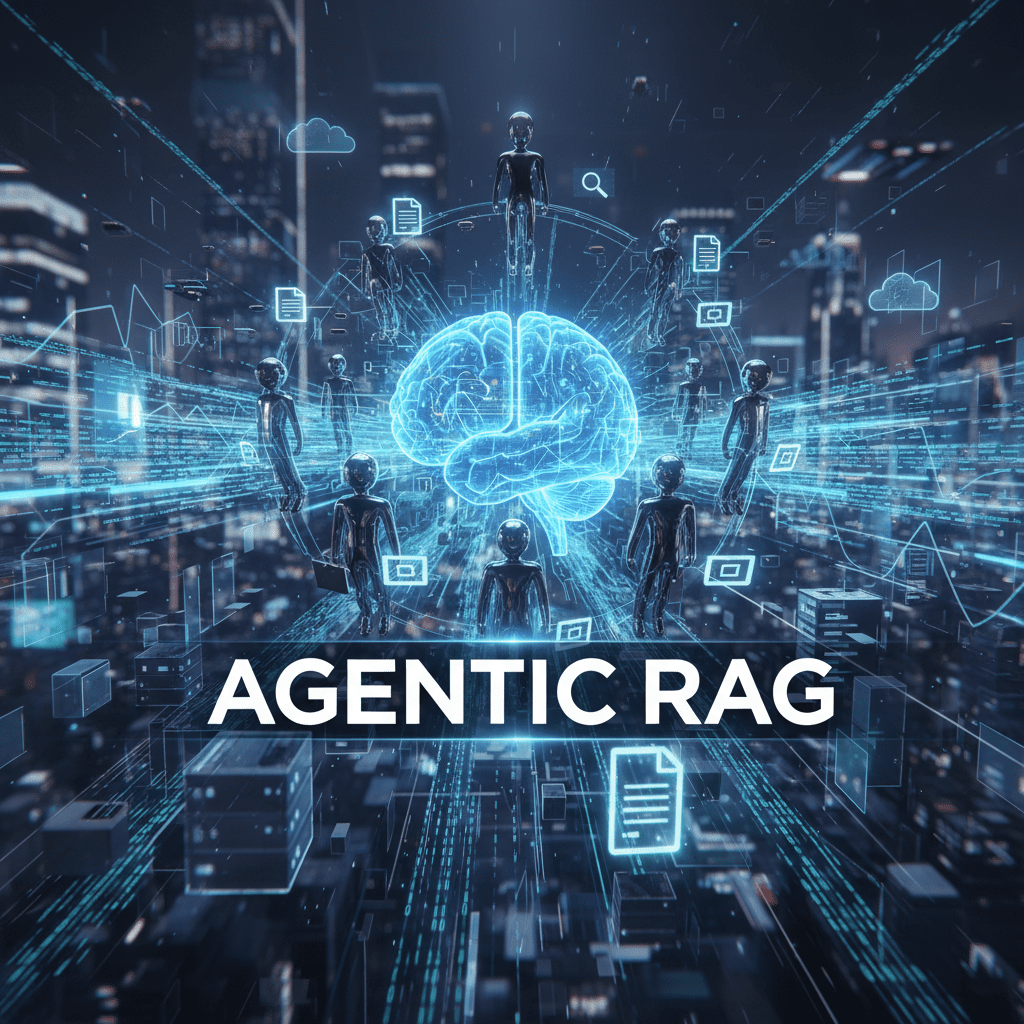
Futuristic business illustration showing a central AI brain connected to digital agent nodes and data streams, with document icons symbolizing smart retrieval. Bold title reads 'Agentic RAG
React native doveploment

Agentic RAG

Introduction Agentic RAG is transforming the way organizations approach information retrieval, research, and automation by combining the power of retrieval-augmented generation (RAG) with intelligent, autonomous agents. This advanced AI framework empowers systems to reason, plan, use external tools, and learn over time, resulting in highly accurate and context-aware outputs. As modern enterprises face exponential growth in data, agentic RAG offers new ways to access reliable information, automate workflows, and create advanced virtual assistants—ushering in a new era of scalable, adaptive business intelligence. What Is Agentic RAG? Agentic RAG merges retrieval-based AI models with generative language models, empowered by autonomous agents that go beyond static query matching. Agents can decide what information to retrieve, break down complex queries into sub-tasks, access external APIs, and synthesize data for comprehensive responses. Unlike classic RAG, agentic RAG adapts to new data and context dynamically, leveraging iterative planning and feedback to continually improve output quality. Key Features: Autonomous decision-making and reasoning Multi-step planning and query decomposition Dynamic retrieval from diverse sources (databases, APIs, knowledge bases) Enhanced accuracy, efficiency, and real-time adaptability Continual learning and context management Types of Agentic RAG Agentic RAG systems employ several types of agents based on function and complexity: Routing Agent: Directs queries to the most suitable RAG pipeline, using agentic reasoning to analyze tasks such as document summarization or question answering. One-Shot Query Planning Agent: Breaks queries into independent sub-queries, executes them in parallel, and synthesizes unified answers. Tool Use Agent: Integrates external tools and APIs for real-time or specialized data, enhancing generative responses. ReAct Agent (Reason + Act): Iteratively reasons and interacts with multiple sources or tools, adapting its approach mid-task for the most precise result. Dynamic Planning & Execution Agent: Manages multi-step and complex workflows, separating long-term plans from immediate execution. Utilizes computational graphs and orchestrates stepwise execution. Applications in Real-World Scenarios Agentic RAG offers transformative benefits across industries: Enterprise Knowledge Management: Streamlines access to organizational data, enabling employees to make fast, informed decisions. Automated Support & Virtual Assistants: Reduces workloads by providing instant, context-relevant answers in customer and employee support. Healthcare: Improves patient insights and research capabilities with agents that gather and contextualize medical knowledge. Legal Research & Finance: Accelerates analysis of documents, regulations, and market data with agents capable of domain-specific data synthesis. Innovation & Research: Assists in synthesizing ideas, comparing multiple sources, and driving strategic initiatives through intelligent information retrieval. How To Implement Agentic RAG Follow these steps for building an agentic RAG system: Define Objectives: Identify tasks suitable for agentic RAG, such as chatbots or automated research. Choose Core Components: Select a retrieval system (e.g., dense passage retrieval, hybrid search) and a generative AI model (e.g., GPT, BERT). Prepare Data: Collect, clean, and preprocess documents to ensure compatibility and maximize retrieval accuracy. Build the Retrieval Layer: Index documents for fast, context-aware search. Agent Integration: Introduce agents to orchestrate workflows—query planning, tool use, and multimodal integration. Fine-Tune & Feedback Loops: Continuously refine models with user feedback and retraining to maintain high performance. Deploy & Monitor: Set up APIs, real-time monitoring, and performance dashboards for ongoing optimization. Key Tools: LlamaIndex and LangChain for agent orchestration, reasoned workflows, and tool integration. Low-code platforms like ZBrain for business workflows and rapid issue response. Conclusion Agentic RAG is redefining the landscape of AI-driven knowledge management, automating complex information retrieval, and powering scalable enterprise solutions. Its combination of multi-agent intelligence, context-awareness, dynamic adaptation, and modular flexibility gives organizations the tools to succeed in an information-rich, rapidly evolving market. Unlock the power of agentic RAG to supercharge research, virtual assistants, and automated decision-making. Call-to-Action: Explore how agentic RAG can optimize workflows and revolutionize information access—connect with AI experts today to get started on a future-ready solution! FAQ What is Agentic RAG? Agentic RAG is a framework that empowers AI agents to retrieve and use external information, plan multi-step workflows, and generate intelligent, context-aware responses far beyond classic RAG capabilities. How does it differ from traditional RAG? Agentic RAG adds autonomous reasoning, multi-task orchestration, and external tool use—enabling more accurate and adaptable information synthesis. What are the main benefits for enterprises? Benefits include scalable automation, enhanced data accuracy, personalized user experiences, and efficiency with reduced costs and improved decision quality. What are common implementation challenges? Challenges involve complex system integration, managing data quality, ensuring scalability, and maintaining real-time performance. Which platforms support agentic RAG development? Popular frameworks are LlamaIndex, LangChain, and low-code platforms like ZBrain, offering flexible workflow design and seamless data integration. The Real Benefits of Hiring a React Native App Development Company
Artificial Intelligence

How to Develop a RAG-Powered Application: Process and Costs

Introduction Retrieval-Augmented Generation (RAG) is transforming how enterprises leverage artificial intelligence for accurate, dynamic, and context-aware applications. By blending the strengths of large language models (LLMs) with external, up-to-date data sources, RAG-powered apps solve the limitations of static, “hallucinating” AI and open doors to use cases like advanced chatbots, personalized search, and enterprise knowledge mining. But what’s involved in building such a solution—and what might it cost? This guide explores the full development process and provides a transparent cost breakdown to help you plan your journey into RAG-powered innovation. Understanding the RAG Workflow RAG apps operate at the intersection of AI-powered generation and real-time information retrieval. The core process involves: Data Preparation Collect raw, unstructured, or structured datasets (PDFs, docs, web data, databases). Clean, deduplicate, and segment this data into manageable “chunks” for easier indexing and retrieval. Indexing and Embedding Transform these chunks into semantic vector representations using embedding models. Store vectors in a vector database optimized for similarity search (like Pinecone, Weaviate, or Milvus). Retrieval and Generation At runtime, a user query triggers vector retrieval of relevant document chunks. The context from these chunks is paired with the user’s question, then provided as a prompt to an LLM to generate an accurate, grounded response. Application Layer Build a user-facing interface (chatbot, search, Q&A) and backend API to facilitate interactions, chain the workflow, and orchestrate the RAG pipeline with tools like LangChain or LlamaIndex. Deployment and Monitoring Deploy your solution, set up monitoring for quality, latency, and performance, and continuously improve through data updates and model tuning. Key Steps in Building a RAG-Powered Application Collect and Clean Data Use libraries/tools (BeautifulSoup, PyPDF2, PDFplumber) for document parsing. Ensure high-quality input data—“garbage in, garbage out” rings especially true for RAG pipelines. Embed and Index Choose or train a suitable embedding model. Store embeddings in a scalable vector database that fits your use case size. Orchestrate the Pipeline Connect data ingestion, retrieval, and generation components with orchestration tools. Implement retrieval strategies (hybrid search, query rewriting, reranking) for search accuracy. Develop User Interface & API Design intuitive UIs and robust APIs to let users interact with the system seamlessly. Test and Deploy Rigorous QA to assess retrieval accuracy, response quality, latency. Deploy in your preferred environment (cloud, on-prem, hybrid). Monitor and Optimize Track user queries, feedback, and model performance for ongoing refinement. Development and Operational Costs One-Time Develoment costs Basic RAG App: $40,000–$200,000 Small knowledge base, simple pipeline, limited interface, minimal prompt engineering. Small team (1–2 developers) over a few months. Medium Complexity: $300,000–$500,000 Robust production features, hybrid search, advanced pipelines, integrations with enterprise tools, more data types, and larger datasets. Team of AI/ML and backend engineers. Advanced/Enterprise-Grade: $600,000–$1,000,000+ Custom models, multi-hop reasoning, agent workflows, streaming data, massive scale. Large, senior team, several months of dev, dedicated GPU infrastructure, security compliance, comprehensive testing. Ongoing (Operational) Costs Vector Database: Examples: Pinecone starts ~$70/month (beyond free tier); Weaviate from $25/month plus $0.095 per million vector dimensions. Costs scale with data size and query volume. Compute Resources: Embedding computation, retrieval, LLM inference—price depends on size and speed requirements. High-performance GPUs, high-memory CPUs, and cloud fees for scalable deployment. Software Maintenance: Continuous data updates, monitoring, bug fixes, compliance. Cloud Services & Support: Storage, bandwidth, uptime SLAs, security protocols. Cost drivers include dataset scale, desired app complexity, user load, integration depth, compliance needs, and response speed. Conclusion Developing a RAG-powered application is a strategic investment for businesses aiming to provide accurate, current, and reliable AI-driven experiences. The core process—data prepping, embedding, retrieval, generation, and user-facing delivery—is supported by a diverse tech ecosystem. While basic solutions are increasingly accessible, costs grow swiftly as data size, complexity, and enterprise requirements increase. For best results, start with a clear understanding of your use case, dataset, and performance needs, and partner with experienced AI specialists to optimize value for every dollar spent. Ready to explore a tailored RAG solution? Assess your data, define your requirements, and seek expert guidance to build a future-ready application that scales with your business. FAQ 1. What is a RAG-powered application? A RAG-powered app combines retrieval of relevant data from external/internal sources with text generation using large language models to provide accurate, factual outputs. 2. How long does it take to build a RAG solution? Simple prototypes can be built within a few months; advanced, production-grade apps may require 6–12+ months, depending on requirements. 3. What are the biggest cost drivers? Team expertise, dataset size, interface complexity, required performance (speed/accuracy), and recurring infrastructure (cloud/vector DB). 4. What skills are needed to develop a RAG app? Data engineering, AI/ML modeling, API/backend development, cloud deployment, UI/UX design, and ongoing monitoring/QA. 5. Can I use open-source tools for RAG development? Absolutely—frameworks like LangChain, LlamaIndex, and vector databases (e.g., Milvus, Qdrant) can lower costs and speed up development.

How would you like me to respond?

Select a personality for your AI assistant

Normal
Happy
Sad
Angry

Your selection will affect how the AI assistant responds to your messages

Chat Assistant

Let's discuss your project!

Hear from our clients and why 3000+ businesses trust TechOTD

Tell us what you need, and we'll get back with a cost and timeline estimate

Scroll to Top