
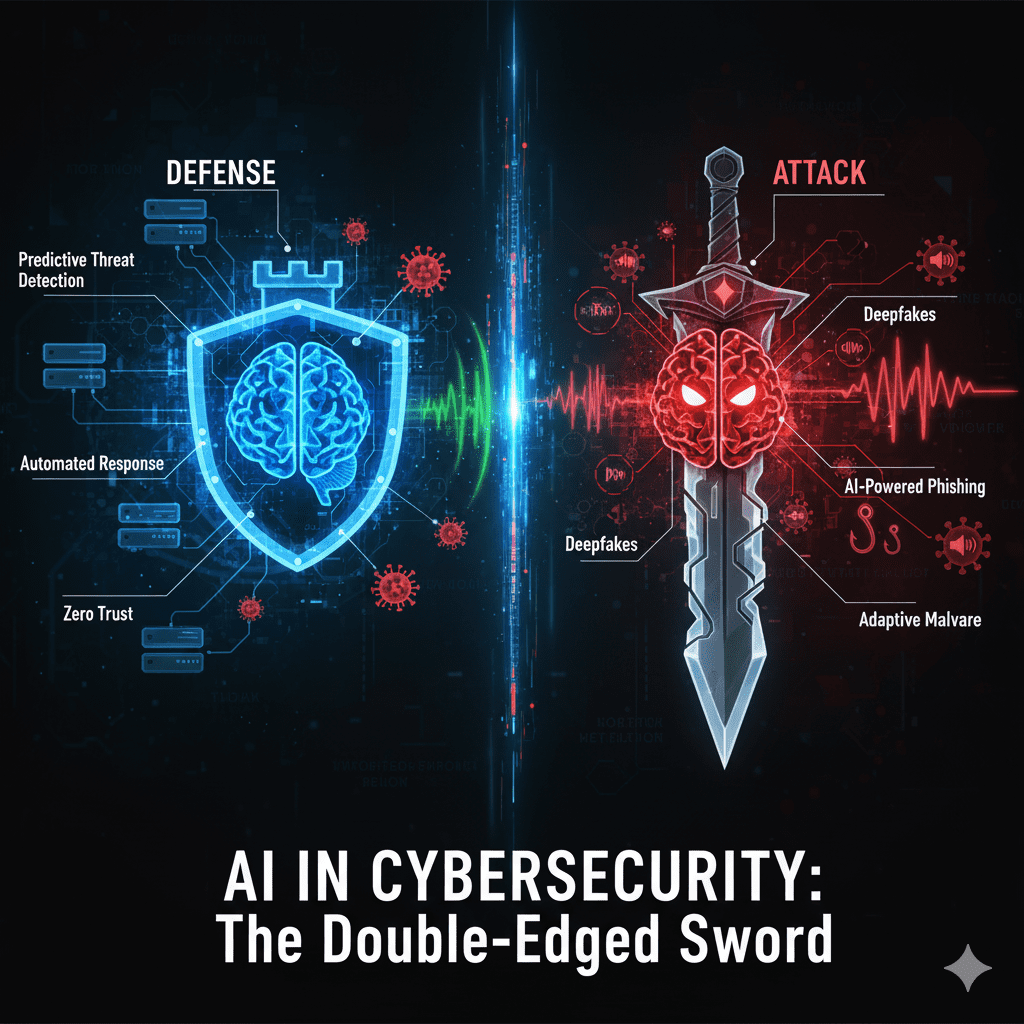
incident response

PREDICTIVE THREAT DETECTION and AUTOMATED RESPONSE
cybersecurity

Digital Armor: Defending Against Cyber Threats

Introduction For decades, the world of cybersecurity has been a high-stakes cat-and-mouse game. Security professionals build a wall, and hackers find a way over it. But today, this game is being fundamentally transformed by a powerful new player: Artificial Intelligence. AI is not just another tool; it’s a revolutionary force acting as both the strongest shield and the most dangerous new weapon. This article explores the dual role of AI in Cybersecurity, breaking down how it’s creating unprecedented defenses while simultaneously arming attackers with terrifying new capabilities The New Shield: AI as a Defensive Powerhouse The primary advantage of AI in a defensive role is its ability to process and analyze data at a scale and speed no human team could ever hope to match. While a human analyst sleeps, an AI security model is monitoring billions of events, looking for the one tiny anomaly that signals an attack. 1. Predictive Threat Detection Before AI, most security systems were reactive. They relied on “signatures”—the digital fingerprints of known malware. This meant a virus had to successfully attack someone first before it could be identified and blocked. AI, specifically machine learning, is predictive. It learns the normal, baseline behavior of your network, your users, and your devices. It can then spot suspicious deviations before a full-blown breach occurs. This includes: Behavioral Analysis: Is a user account that normally works from 9-to-5 suddenly trying to access sensitive files at 3:00 AM from a different country? AI flags this instantly. Anomaly Detection: Does a “smart” device like a thermostat suddenly start trying to communicate with an unknown server? AI can see this as a potential IoT (Internet of Things) attack. Pattern Recognition: AI can analyze global threat feeds and identify new attack patterns as they emerge, proactively blocking them before they even reach your network. 2. Automated Incident Response In a cyberattack, every second counts. A ransomware attack can encrypt an entire company’s files in minutes. AI doesn’t need to wait for approval; it can act in milliseconds. This is known as SOAR (Security Orchestration, Automation, and Response). Here’s a typical automated response scenario: Detect: An AI-powered sensor identifies a new, unknown program exhibiting ransomware-like behavior (e.g., rapidly encrypting files) on an employee’s laptop. Isolate: The AI immediately executes a predefined rule: it automatically disconnects that specific laptop from the company network, containing the threat. Investigate: The AI gathers all relevant data—what the program was, where it came from, what files it touched—and creates a report. Alert: It then sends an alert to a human security analyst, presenting the report and the action it took. The threat is neutralized before it could spread. The Future: An AI vs. AI Battleground This leads to an inevitable future: the front line of AI in Cybersecurity will be an AI-versus-AI battle. It will be a silent, high-speed war fought in milliseconds, with defensive AI models trying to detect and stop offensive AI-driven attacks. In this new era, the old security model of “trust but verify” is dead. The new model, which AI is perfect for, is Zero Trust. Zero Trust Architecture means you trust nothing and no one by default. It doesn’t matter if a login request comes from inside the office or outside; it must be verified. AI helps enforce this by continuously analyzing behavior. Just because you entered the right password doesn’t mean you are who you say you are. If your “logged-in” account suddenly starts acting suspiciously, the AI can force you to re-authenticate or block your access. Conclusion AI in Cybersecurity is a revolutionary, double-edged sword. It offers our most powerful hope for a secure digital future, capable of analyzing threats and responding at superhuman speeds. At the same time, it arms our adversaries with tools to create highly deceptive scams and intelligent malware. The key takeaway is that we can’t ignore it. For businesses, investing in modern, AI-powered defensive tools is no longer an option—it’s a necessity for survival. For individuals, it requires a new level of vigilance. In this new world, adaptability is everything. The future of security will be defined by who has the smarter, faster, and more adaptable AI. FAQ Q1: What is AI in Cybersecurity? AI in Cybersecurity refers to the use of artificial intelligence and machine learning to detect, predict, prevent, and respond to cyber threats. It moves beyond traditional, rule-based security by learning from data to identify new and unknown threats based on behavioral anomalies. Q2: Can AI replace human cybersecurity professionals? No, AI is a tool to augment human professionals, not replace them. AI can handle the massive, high-speed data analysis, but it still lacks human intuition, creativity, and strategic decision-making. AI flags the problem and contains it; the human analyst investigates the “why” and “how” to build a stronger long-term strategy. Q3: What is the biggest threat from AI in cyberattacks? Currently, the most accessible and dangerous threat is AI-powered social engineering, including deepfake audio and video. These attacks target the weakest link in any security system—human psychology—and are incredibly difficult to defend against with technology alone. Q4: How can a small business afford AI-powered security? While developing a custom AI model is expensive, most AI-powered security is now sold “as-a-service.” Many modern antivirus, firewall, and email security providers (like Microsoft, Google, and CrowdStrike) have already integrated AI and machine learning into their standard products, making it accessible and affordable for businesses of all sizes.
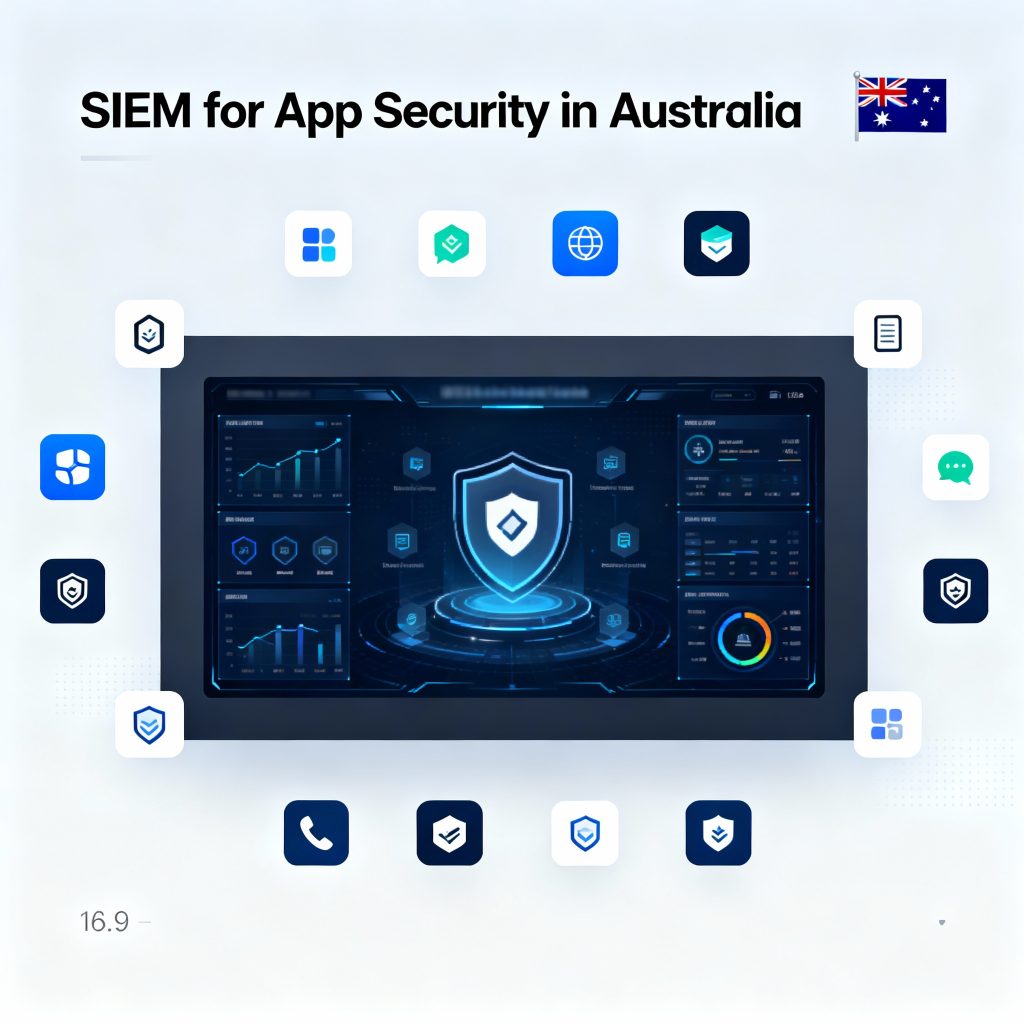
Futuristic SIEM dashboard interface overlayed with application security icons and the Australian flag, representing application security solutions for Australia
Artificial Intelligence

SIEM for App Security in Australia

Introduction Organisations in Australia are grappling with a rapidly evolving cyber threat landscape where application-layer attacks are more frequent and far-reaching than ever before. As digital infrastructures grow more complex and interconnected, security teams need efficient solutions to detect, investigate, and respond to threats targeting their applications. Security Information and Event Management (SIEM) platforms have emerged as a vital line of defense, providing both real-time visibility and advanced analytics to help businesses stay ahead of attackers. This blog explores why SIEM has become indispensable for Australian organisations seeking robust application security—and how it serves as a strategic weapon against the next generation of threats.​ SIEM for App Security in Australia How SIEM Protects Modern Applications Centralised Log Management: SIEM consolidates logs from across your entire stack—web apps, APIs, databases, and cloud services—transforming fragmented data into one coherent intelligence stream.​ Real-Time Threat Detection: Automated monitoring and correlation engines analyse events at scale, detecting suspicious behaviours and potential breaches before they escalate.​ Incident Response Enablement: SIEM alerts analysts to actionable threats, allowing them to prioritise and respond quickly, preventing damage and downtime.​ Compliance Support: With Australia’s data privacy regulations and the Security of Critical Infrastructure Act, SIEM helps organisations maintain auditable records and meet regulatory requirements efficiently.​ Key Benefits Early Breach Identification: By connecting seemingly minor events, SIEM unmasks coordinated attacks—like credential-stuffing or API abuse—that could remain undetected in siloed systems.​ Streamlined Security Operations: Automating event triage and investigation reduces the manual workload for security professionals and accelerates incident remediation.​ Integration with SOAR: Many SIEM platforms now work alongside Security Orchestration, Automation, and Response (SOAR) tools, further improving response times and consistency.​ SIEM in the Australian Security Landscape Australian businesses face increasingly complex and sophisticated attacks, prompting widespread adoption of SIEM solutions. According to recent market analysis:​ Growth Driven by Compliance and Threats: Demand for SIEM is surging as organisations strive to comply with the Australia Cyber Security Strategy and protect critical infrastructure, especially in sectors like BFSI, IT, and government.​ Rise of AI and Automation: Modern SIEM systems leverage artificial intelligence and machine learning to detect threats and automate responses, addressing the skills shortage and increasing detection accuracy.​ Operational Challenges: Integrating SIEM with legacy infrastructures, managing the volume of security data, and controlling costs remain significant hurdles for Australian businesses.​ Use Cases & Statistics Essential Eight Maturity: SIEM is a cornerstone for achieving the Australian Signals Directorate’s Essential Eight maturity model, translating to better preparedness and faster detection.​ Incident Response Uptake: 86% of Australian entities had an active incident response plan in 2024, showing a maturing industry that sees SIEM as critical to readiness.​ Market Outlook: The SIEM market in Australia is set for robust growth, fueled by both enterprise and SME adoption, as real-time detection and actionable security analytics become business imperatives.​ Conclusion SIEM has become a non-negotiable pillar for application security in Australia’s cyber threat environment. By centralising log data, delivering advanced analytics, and supporting compliance, SIEM empowers organisations to defend against evolving threats efficiently and confidently. Investing in SIEM today means not just meeting regulatory demands, but enabling your team to spot sophisticated attacks much earlier—and respond faster. As cyber risks grow, the question is not if, but how soon your organisation will face them. Make SIEM the cornerstone of your cyber strategy and stay a step ahead. Ready to take your application security to the next level? Explore advanced SIEM platforms or consult with a cybersecurity expert to start protecting your business today! FAQ 1. What is SIEM and why is it important for Australian businesses? SIEM stands for Security Information and Event Management—a platform to collect, analyse, and correlate security data in real-time, crucial for early threat detection and regulatory compliance.​ 2. How does SIEM help meet Australian compliance standards? SIEM provides auditable logs, automated reporting, and breach detection, helping organisations comply with regulations like the Privacy Act and Security of Critical Infrastructure Act.​ 3. What kinds of threats can SIEM detect in applications? SIEM detects credential stuffing, API abuse, insider threats, and targeted cyber-attacks by correlating anomalous events across application layers.​ 4. Are SIEM platforms suitable for both large enterprises and SMEs? Yes, both large enterprises and small-to-medium businesses are increasingly adopting SIEM to strengthen their security posture and compliance readiness.​ 5. What trends are shaping SIEM adoption in Australia? AI-powered analytics, automation, and integration with SOAR are top trends, addressing complexity and improving response speeds in the face of rising threats.

How would you like me to respond?

Select a personality for your AI assistant

Normal
Happy
Sad
Angry

Your selection will affect how the AI assistant responds to your messages

Chat Assistant

Let's discuss your project!

Hear from our clients and why 3000+ businesses trust TechOTD

Tell us what you need, and we'll get back with a cost and timeline estimate

Scroll to Top