Healthcare Technology

Blockchain & Technology, Digital Transformation, Educational Technology, enterprise

Blockchain Beyond Cryptocurrency: Real-World Enterprise Applications

Introduction When most people hear the word blockchain, their minds immediately jump to cryptocurrencies like Bitcoin. While digital currencies played a significant role in introducing blockchain to the world, the technology has evolved far beyond its original purpose. Today, organizations across industries are leveraging blockchain to improve transparency, security, efficiency, and trust in business operations. From managing global supply chains to securing healthcare records and streamlining financial transactions, blockchain is emerging as a powerful tool for enterprise transformation. As businesses continue their digital transformation journeys, blockchain is increasingly becoming a strategic technology rather than merely a foundation for cryptocurrencies. This article explores how blockchain is being applied in real-world enterprise environments, the benefits it offers, the challenges organizations face, and what the future holds for this revolutionary technology. Understanding Blockchain Technology At its core, blockchain is a distributed digital ledger that records transactions across multiple computers. Unlike traditional databases controlled by a central authority, blockchain stores information in a decentralized manner. Each transaction is grouped into a block, and once verified, it becomes linked to the previous block, forming a chain of records. This structure creates an immutable and transparent history of transactions that cannot be altered without consensus from the network. Several characteristics make blockchain particularly valuable for enterprises: Transparency and auditability Enhanced security through cryptography Decentralized data management Reduced risk of fraud Improved trust among stakeholders Automation through smart contracts These capabilities have encouraged organizations to explore blockchain applications beyond digital currencies. Why Enterprises Are Investing in Blockchain Modern businesses operate in increasingly complex ecosystems involving suppliers, customers, partners, regulators, and service providers. Managing information across these networks often creates inefficiencies, duplication, and security risks. Blockchain addresses many of these challenges by providing a shared source of truth that all authorized participants can trust. Organizations are investing in blockchain because it can: Reduce operational costs Improve transaction speed Enhance transparency Strengthen cybersecurity Increase regulatory compliance Eliminate unnecessary intermediaries Improve customer trust As a result, blockchain adoption is growing across various sectors, including finance, healthcare, manufacturing, logistics, retail, and government services. Supply Chain Management and Traceability One of the most successful enterprise applications of blockchain is supply chain management. Traditional supply chains involve multiple parties, including manufacturers, distributors, suppliers, transportation providers, and retailers. Tracking products throughout this journey can be difficult, especially when data is stored in separate systems. Blockchain creates a shared ledger where every participant can record and verify information in real time. Product Traceability Companies can track products from raw material sourcing to final delivery. This visibility helps organizations verify authenticity, prevent counterfeiting, and ensure compliance with industry standards. For example, food producers can trace agricultural products back to their source within seconds. If contamination occurs, affected products can be identified and removed quickly, reducing risks and costs. Improved Transparency Customers increasingly demand information about where products originate and how they are manufactured. Blockchain enables businesses to provide transparent records regarding: Product origins Manufacturing processes Transportation history Sustainability practices Ethical sourcing standards This transparency strengthens consumer confidence and brand reputation. Reduced Fraud Counterfeit goods cost businesses billions of dollars annually. Blockchain records make it significantly more difficult for fraudulent products to enter legitimate supply chains. Smart Contracts and Business Automation Smart contracts are self-executing digital agreements stored on a blockchain. These contracts automatically perform actions when predefined conditions are met, reducing the need for manual intervention. Automating Payments Businesses can automate supplier payments when goods are delivered and verified. This eliminates delays and minimizes administrative overhead. Streamlining Procurement Procurement processes often involve extensive paperwork and approvals. Smart contracts can automatically: Verify purchase orders Confirm deliveries Trigger payments Update inventory systems This automation reduces processing time and human error. Insurance Claims Processing Insurance companies can use smart contracts to automatically process claims when specific conditions are verified. For example, travel insurance policies can issue compensation immediately when a flight delay is confirmed through trusted data sources. Blockchain in Financial Services Although blockchain originated within the financial sector, enterprise applications extend far beyond cryptocurrency trading. Cross-Border Payments Traditional international payments often involve multiple intermediaries and lengthy processing times. Blockchain networks can facilitate faster and more cost-effective cross-border transactions by reducing dependency on intermediary institutions. Trade Finance Trade finance processes frequently rely on paper-based documentation and manual verification. Blockchain helps digitize: Letters of credit Shipping documents Trade agreements Payment records This improves efficiency while reducing fraud and administrative costs. Fraud Prevention Financial institutions are adopting blockchain to strengthen transaction security and reduce fraudulent activities. The technology’s immutable records create reliable audit trails that make unauthorized alterations extremely difficult. Digital Identity Verification Banks and financial organizations can use blockchain-based identity systems to streamline customer verification procedures while enhancing privacy and security. Healthcare and Medical Records Management Healthcare organizations generate massive amounts of sensitive data. Managing patient records securely while ensuring accessibility remains a major challenge. Secure Patient Records Blockchain allows healthcare providers to store and share patient information securely. Authorized medical professionals can access accurate records while maintaining strict privacy controls. Improved Interoperability Medical records are often fragmented across multiple systems and providers. Blockchain can create unified patient histories accessible across healthcare networks, improving care coordination. Drug Supply Chain Verification Counterfeit medications represent a serious global concern. Blockchain enables pharmaceutical companies to track medications throughout the supply chain, ensuring authenticity and patient safety. Clinical Research Researchers can use blockchain to maintain transparent and tamper-proof records of clinical trial data, enhancing trust and regulatory compliance. Digital Identity and Access Management Identity verification is becoming increasingly important in the digital economy. Traditional identity systems often expose users to data breaches and identity theft. Blockchain-based identity solutions allow individuals to maintain greater control over their personal information. Self-Sovereign Identity Users can manage and share verified credentials without relying entirely on centralized databases. Benefits include: Enhanced privacy Reduced identity fraud Simplified verification processes Better user control Enterprise Access Control Organizations can use blockchain to manage employee credentials, system access permissions, and authentication processes more securely. Blockchain in Real Estate Real estate transactions typically
Healthcare & Fitness

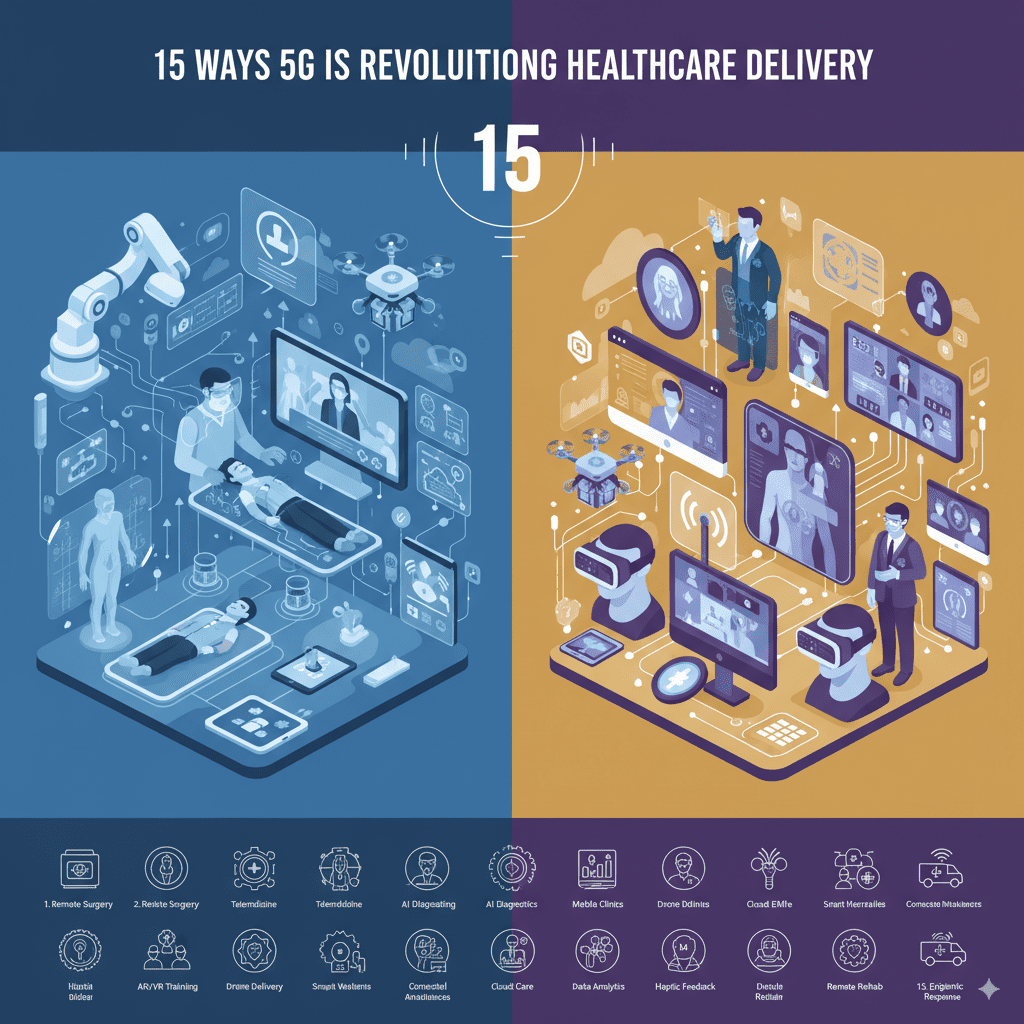
15 Ways 5G is Revolutionizing Healthcare Delivery

Introduction The healthcare industry is undergoing a seismic transformation powered by the emergence of 5G connectivity. The fifth generation of wireless networks offers blazing speeds, ultra-low latency, and the ability to connect unprecedented numbers of devices—all of which unlock new efficiencies and innovations in patient care. With a rapidly expanding global 5G healthcare market projected to surge from $70.94 billion in 2025 to nearly $390 billion by 2034, forward-looking providers are reimagining everything from diagnostics and surgery to patient monitoring and data management. This blog explores 15 practical ways 5G is revolutionizing healthcare delivery, empowering professionals and patients, and creating a smarter, more connected medical ecosystem. Real-Time Remote Patient Monitoring 5G networks support continuous remote patient monitoring (RPM) by seamlessly connecting wearables and IoT devices. Real-time transmission of vitals allows care teams to detect issues early and intervene before complications arise. Example: Heart monitors send instant readings via connected medical platforms, enabling faster doctor responses. High-Fidelity Telemedicine and Virtual Consultations Ultra-clear 4K+ video with almost zero lag dramatically enhances virtual medical visits. Doctors can visually inspect skin, wounds, or rashes in detail, building trust and accuracy in remote diagnosis. Example: Leading telehealth providers use 5G to connect diagnostic equipment during video consults. Connected Ambulances and Next-Gen Emergency Services 5G-equipped ambulances serve as “mobile ERs,” sharing live HD video and critical patient data with hospitals in real time. Paramedics receive expert guidance from remote clinicians during transport, improving life-saving outcomes. Example: University Hospitals in Birmingham piloted remote ultrasound guidance in 5G ambulances. Instantaneous Access to Electronic Health Records (EHR) 5G enables clinicians to access full EHRs—including large medical images—on tablets or devices anywhere in the hospital within seconds. Faster access means faster, more informed clinical decisions and workflow efficiency. Example: Rush University Medical Center’s private 5G boosts Epic system accessibility. The Rise of the Internet of Medical Things (IoMT) 5G enables thousands of connected IoMT devices in smart hospitals, powering smart beds, infusion pumps, and environmental sensors. Real-time data aggregation creates a digital twin of entire operations, driving clinical and operational optimization. Example: Philips HealthSuite manages data from millions of devices over robust 5G networks. Democratizing Expertise with Remote and Robotic Surgery Ultra-low 5G latency makes remote robotic surgery a reality. Surgeons in one location can perform delicate procedures on patients hundreds of miles away. Example: In China, remote thyroid surgeries have been performed thanks to 5G. Advanced Predictive Analytics for Patient Care Real-time sensor and medical record data flow enables AI-powered predictive models for sepsis risk, patient deterioration, and resource allocation. Enhanced clinician decision-making leads to proactive, personalized interventions. Example: The U.S. Veterans Affairs living lab uses 5G to power predictive analytics in chronic care. Immersive Medical Training with AR and VR Medical education evolves with 5G-fueled AR/VR, enabling virtual dissection, simulated surgeries, and lag-free team training. Complex procedures can be practiced in virtual operating rooms globally. Example: Multi-user platforms like GE HealthCare’s OmnifyXR allow remote collaborative training. Automated Hospital Kiosks and Self-Serve Stations 5G keeps smart kiosks and check-in stations fast and responsive, even during peak times. Automating patient intake, co-payment, and navigation streamlines operations and frees up staff. Example: Boston Children’s Hospital uses a hybrid 5G network for real-time registration and payments. Digital Twins for Personalized Treatment Planning Virtual patient “digital twins” simulate organs or systems for personalized planning and risk-free surgery rehearsal. High-throughput 5G transfers large imaging and modeling data seamlessly between systems and clinicians. Resilient Supply Chain and Smart Inventory Management 5G-powered sensors and tags track medical equipment, medications, and PPE in real time, reducing waste and shortages. Automated stock alerts and predictive maintenance lower costs and improve readiness. Enhanced Medical Imaging and Faster Diagnostics 5G dramatically reduces the time to transfer massive imaging files, accelerating diagnosis and treatment. Enables seamless collaboration among radiologists and AI-driven image analysis. Seamless Collaboration Between Healthcare Professionals Real-time, high-definition video and data sharing accelerate collaborative diagnosis, second opinions, and multidisciplinary decision-making. Teams work seamlessly—even across continents—improving complex case outcomes. Improved Patient Data Security and Privacy 5G’s network slicing and advanced encryption ensure that critical patient data is isolated from general traffic. Hospitals can deploy Zero Trust frameworks to verify every app, user, and device before access. Example: Advanced hospital networks use hardware-level isolation and separate encryption keys for security. Supporting Rural and Underserved Communities Fixed wireless access (FWA) over 5G delivers high-speed Internet to remote clinics, enabling telemedicine, specialist consults, and remote diagnostics. Rural patients gain access to advanced care previously only available in major cities. Example: T-Mobile’s Project 10Million brings 5G health services and virtual appointments to rural schools and clinics. Conclusion 5G is redefining the healthcare playbook, transforming both the patient and provider experiences with speed, scale, and intelligence never before possible. From telemedicine and robotic surgery to predictive analytics, immersive training, and robust supply chain management, the applications are far-reaching and evidence-based. Forward-thinking organizations are already moving quickly to integrate 5G, gaining efficiency, resilience, and a decisive edge in the pursuit of delivering better, more accessible care. Now is the time for healthcare leaders to prioritize bold adoption—and to build a digital health future where connectivity, compassion, and innovation go hand in hand. Ready to future-proof healthcare operations or deliver next-gen patient experiences? Contact a digital healthcare transformation expert for an in-depth 5G strategy assessment today. FAQ Q1: What is the biggest impact of 5G in healthcare? A: Remote patient monitoring and telemedicine provide continuous, real-time care and expand access to specialists for rural and urban populations alike. Q2: Is 5G safe and secure for patient information? A: Yes, 5G offers advanced security features such as network slicing and end-to-end encryption, helping protect sensitive medical data against cyber threats. Q3: How does 5G benefit hospital operations? A: 5G streamlines data flows, enhances collaboration, enables instant access to EHRs, and supports smart logistics—resulting in faster patient throughput, fewer errors, and reduced administrative burden. Q4: Can 5G enable surgeries performed from remote locations? A: Absolutely. 5G’s ultra-low latency allows surgeons to operate on patients miles away, democratizing access to cutting-edge specialized

Healthcare & Fitness

Cloud Infrastructure and DevOps in Healthcare Apps

Introduction The intersection of cloud infrastructure and DevOps is revolutionizing how healthcare applications are built, deployed, and maintained, making healthcare systems more agile, compliant, and patient-centered. These advances empower providers to store vast amounts of sensitive data securely, deliver real-time services to patients worldwide, and quickly innovate in response to emerging needs and regulatory guidelines. Explore how AI-powered healthcare applications are transforming patient experiences and operations—see more on cloud-based AI services and their integration journey. The Role of Cloud Infrastructure in Healthcare Apps Scalability and Flexibility Cloud platforms such as AWS, Azure, and Google Cloud enable healthcare organizations to scale resources up or down dynamically, adapting to fluctuating workloads, seasonal spikes, or pandemic-driven surges in demand. This elasticity is essential for electronic health records (EHR), big data analytics, telemedicine, and remote monitoring applications. Multicloud and hybrid architectures are gaining traction, allowing seamless integration to meet stringent compliance needs and local storage guidelines. Private clouds cater to high-security environments such as large hospitals and research institutions, while public clouds efficiently handle analytics, appointments, and remote care. For a detailed breakdown of cloud-driven innovation in healthcare, visit TechOTD’s main blog. Secure Data Storage and Compliance Sensitive medical data demands the highest levels of security and compliance. Cloud vendors offer HIPAA- and GDPR-compliant solutions that maintain data privacy, encryption, and integrity. End-to-end encryption, auditing, and identity management are embedded in modern cloud services. Automated backups and disaster recovery protocols minimize downtime and data loss. To understand how TechOTD addresses privacy and compliance in healthcare, see the Privacy & Cookies policy. Accelerating Digital Health with AI and Analytics Cloud infrastructure empowers healthcare organizations to leverage advanced AI, machine learning, and predictive analytics. Key applications include: Standardizing precision diagnostics with massive image datasets, Predicting patient risks using trend analysis and real-time telemetry, Automating administrative documentation with NLP engines. Discover feature-rich use cases in predictive analytics on TechOTD’s dedicated analytics page. Enabling Telehealth and Remote Patient Monitoring The adoption of telemedicine surged during the COVID-19 pandemic, with cloud platforms facilitating: Real-time video consultations, Remote patient monitoring using IoT wearables, Synchronous data sharing among care teams. Integration details for mobile healthcare solutions are documented in TechOTD’s mobile app services section. DevOps: The Engine of Continuous Healthcare Innovation What Is DevOps in Healthcare? DevOps combines software development (Dev) and IT operations (Ops) to foster automation, collaboration, and rapid deployments. In healthcare, this approach: Shortens application release cycles, Ensures continuous integration and delivery (CI/CD), Facilitates ongoing feedback and quality improvements. Explore practical examples of workflow optimization on the TechOTD blog. Key Benefits of DevOps for Healthcare Faster Time to Market Automates deployments, enabling rapid roll-out of new features and critical patches. Provides a competitive edge in launching telehealth and AI-driven apps. Improved Patient Outcomes Supports continuous monitoring and rapid issue resolution, which enhances clinical reliability and patient trust. Real-time data analytics drive timely decisions at the point of care. Security and Compliance Implements DevSecOps to integrate security into every phase of the application lifecycle. Ensures adherence to sector-specific regulations (HIPAA, GDPR, etc.) using automated compliance checks. See TechOTD’s structured approach to secure software on their How We Work page. Cost and Resource Efficiency Applies Infrastructure as Code (IaC) principles, minimizing manual tasks and human error. Optimizes cloud spend by enabling demand-driven resource allocation. Case studies on cost savings and operational improvements can be found in TechOTD’s blog industry section. AI and Predictive Analytics Support Maintains stable environments for AI/ML-powered healthcare applications. Accelerates the development of smart diagnostics, triaging, and personalized medicine. For examples of large language models in regulated sectors, see LLMs in Finance. Implementing Cloud and DevOps for Healthcare Apps: A Step-by-Step Roadmap 1. Assess Business Needs and Regulatory Requirements Conduct a deep analysis of the existing tech ecosystem and compliance landscape. Evaluate suitability for cloud migration and DevOps adoption. Explore a real-world blueprint on TechOTD’s services overview. 2. Data Strategy and Cloud Architecture Selection Identify sensitive and non-sensitive datasets. Choose optimal cloud deployment models: public, private, hybrid, or multicloud. 3. Develop Secure, Scalable Applications Using DevOps Practices Implement CI/CD pipelines for all healthcare modules: EHRs, billing, telemedicine, and connected health IoT solutions. Automate testing, code reviews, and compliance checks to guarantee quality and security. 4. Integrate AI, Analytics, and Automation Leverage cloud APIs and frameworks for real-time analytics, predictive insights, and automated workflows. Explore how AI supports preventive care and operational efficiency in TechOTD’s AI service models. 5. Continuous Monitoring, Maintenance, and Support Use cloud-based monitoring tools (e.g., Grafana, Azure Monitor) for uptime, performance, and security event tracking. Establish mechanisms for ongoing maintenance, data retraining, and customer support. For workflow strategies, check out customer journey mapping with AI. Emerging Trends and Future Directions AI-Powered Healthcare and Predictive Care Increasing adoption of generative AI, chatbots for patient triage, and risk stratification tools. Integration of real-time wearable IoT data with cloud-hosted analytics engines. Get a comprehensive review of technology trends in healthcare and beyond at TechOTD’s blog. Blockchain Integration for Secure Health Data Blockchain ensures transparent, immutable transaction logging, critical for audit trails in clinical trials, medication administration, and consent management. Find an in-depth analysis at TechOTD’s blockchain blog post. Regulatory Evolution and Interoperability Ongoing standards development for seamless data exchange (HL7 FHIR, DICOM) and international interoperability. Enhanced focus on privacy-preserving machine learning and federated learning architectures. Challenges in Cloud and DevOps Adoption Legacy systems and data silos limiting seamless migration. Addressing complex multi-region compliance and data residency requirements. Upfront investments in talent, training, and DevOps/Cloud tooling. Best practices, pitfalls, and CRM integration insights can be found at TechOTD’s mobile app frameworks guide. Conclusion: Cloud and DevOps as Healthcare’s Innovation Backbone The synergy of cloud infrastructure and DevOps is shaping a future where healthcare is more agile, resilient, and patient-focused than ever before. With ongoing advancements in AI, predictive analytics, and compliance automation, healthcare providers are set to deliver faster, more effective, and more personalized care. For more guidance, industry news, and in-depth resources, visit: Privacy & AI Solutions TechOTD Blog Home How We Work at TechOTD Predictive Analytics Features Mobile Application Services Advanced Industry Insights Customer-Centric AI Journeys LLMs in Finance Use Cases Technology for Modern Education Gadgets for

Healthcare & Fitness

Smart Hospitals: Revolutionizing Healthcare Operations with Modern Technology

Introduction Healthcare is undergoing a digital revolution, and at the center of this transformation are Smart Hospitals. With the integration of technologies like IoT (Internet of Things), AI, Big Data, Cloud Computing, and Blockchain, hospitals are no longer just physical spaces for treatment — they are evolving into intelligent ecosystems that provide seamless care, improved efficiency, and enhanced patient outcomes. In this blog, we’ll explore how smart hospitals are redefining healthcare operations, their key technologies, benefits, challenges, and future opportunities. What Are Smart Hospitals? A Smart Hospital uses modern digital technologies to optimize operations, enhance patient care, and improve decision-making. Unlike traditional hospitals, which rely heavily on manual processes, smart hospitals employ connected devices, automated systems, predictive analytics, and AI-driven decision-making to deliver data-powered healthcare solutions. These hospitals are not only focused on clinical improvements but also on operational efficiency, patient experience, and cost reduction. Key Technologies Powering Smart Hospitals The smart hospital ecosystem is built upon several transformative technologies: 1. IoT (Internet of Things) IoT connects medical devices, wearables, and hospital equipment, enabling real-time patient monitoring and automated data collection. For example, wearable devices can track patient vitals and immediately alert doctors in case of anomalies. Learn how IoT is reshaping industries in this blog. 2. Artificial Intelligence (AI) AI assists in diagnostics, personalized treatment recommendations, and predictive analytics. From detecting diseases in early stages to streamlining hospital workflows, AI is the backbone of smart hospitals. Explore how AI enhances service excellence in this article. 3. Electronic Health Records (EHRs) and Cloud Computing Cloud-based EHR systems ensure seamless data sharing among healthcare professionals, allowing for collaborative care and better treatment decisions. For more insights into AI and data applications, check AI in Finance use cases. 4. Robotics and Automation Robotic surgical systems, automated medication dispensers, and AI-powered diagnostic assistants reduce human error and increase accuracy. 5. Predictive Analytics & Big Data By analyzing historical health data, predictive analytics can anticipate patient needs, optimize staffing schedules, and improve resource allocation. See how predictive analytics is applied in this detailed guide. 6. Blockchain Technology Blockchain ensures secure, tamper-proof medical data sharing across systems, reducing fraud and enhancing patient trust. Benefits of Smart Hospitals Enhanced Patient Care – Real-time monitoring and AI-driven diagnostics improve treatment accuracy. Operational Efficiency – Automation reduces waiting times and optimizes staff workload. Data-Driven Decision Making – Analytics empower healthcare providers to make better choices. Cost Reduction – Preventive care and predictive maintenance reduce unnecessary expenses. Patient Experience – Virtual assistants, telehealth, and mobile health apps provide personalized and convenient care. For example, mobile app solutions for healthcare are already transforming the industry. Learn more about custom development in mobile app services. Challenges in Implementing Smart Hospitals Despite their promise, smart hospitals face several challenges: High Initial Investment – Implementing advanced technologies requires significant funding. Cybersecurity Risks – With massive data flow, hospitals become vulnerable to cyberattacks. Integration Issues – Legacy systems often cannot integrate seamlessly with modern solutions. Staff Training – Healthcare workers need training to adapt to new digital workflows. Regulatory Compliance – Hospitals must follow strict data privacy and healthcare regulations. Use Cases of Smart Hospitals Remote Patient Monitoring – Wearables and connected devices monitor patients beyond hospital walls. Smart Beds – Beds equipped with sensors track patient movement and vitals. AI-Powered Imaging – AI improves the speed and accuracy of CT, MRI, and X-ray scans. Telemedicine Platforms – Virtual consultations allow patients to access specialists remotely. Mobile Health Apps – Patients manage appointments, prescriptions, and records via smartphones. Explore app development strategies in this React Native vs Swift comparison. Future of Smart Hospitals Smart hospitals are expected to evolve further with: 5G-enabled healthcare solutions AI-driven predictive healthcare models Digital twins for personalized treatment Advanced robotics in surgeries Sustainable and green hospital infrastructure The convergence of healthcare with AI, IoT, and mobile apps is creating a new era of precision medicine and patient-centric care. SEO Backlinks Integration Throughout this blog, we have naturally integrated useful links from TechOTD to enhance user experience and provide additional resources: AI-driven insights TechOTD Blog Hub Blockchain in Business Processes How We Work Large Language Models in Finance AI for Customer Journeys Best Gadgets for Programmers Predictive Analytics in Software Development Technology in Education React Native vs Swift Industries Blog Page Mobile App Development Services FAQs About Smart Hospitals 1. What is the meaning of a smart hospital? A smart hospital leverages AI, IoT, cloud computing, and automation to improve patient care and hospital operations. 2. How do smart hospitals improve patient care? By using real-time monitoring, predictive analytics, and AI-based diagnostics, smart hospitals ensure faster and more accurate treatments. 3. Are smart hospitals expensive to build? Yes, the initial setup requires a high investment, but long-term benefits include reduced costs, better efficiency, and improved outcomes. 4. What technologies are most important for smart hospitals? Key technologies include IoT, AI, robotics, blockchain, and cloud-based EHR systems. 5. What is the future of smart hospitals? The future involves 5G, AI-driven personalized medicine, robotic surgeries, and eco-friendly hospital designs. Conclusion Smart hospitals are not just a vision of the future—they are already becoming a reality today. By integrating technologies like AI, IoT, robotics, blockchain, and predictive analytics, they are transforming the way healthcare is delivered. For patients, smart hospitals promise personalized and efficient care. For doctors and staff, they reduce administrative burdens and improve treatment accuracy. And for healthcare providers, they ensure long-term sustainability with reduced costs and optimized resources. As we move forward, hospitals that embrace these technologies will lead the way in providing next-generation healthcare services. The journey towards smart hospitals is challenging, but the rewards in terms of patient outcomes, cost efficiency, and innovation are unparalleled.

How would you like me to respond?

Select a personality for your AI assistant

Normal
Happy
Sad
Angry

Your selection will affect how the AI assistant responds to your messages

Chat Assistant

Let's discuss your project!

Hear from our clients and why 3000+ businesses trust TechOTD

Tell us what you need, and we'll get back with a cost and timeline estimate

Scroll to Top