
future of robotics

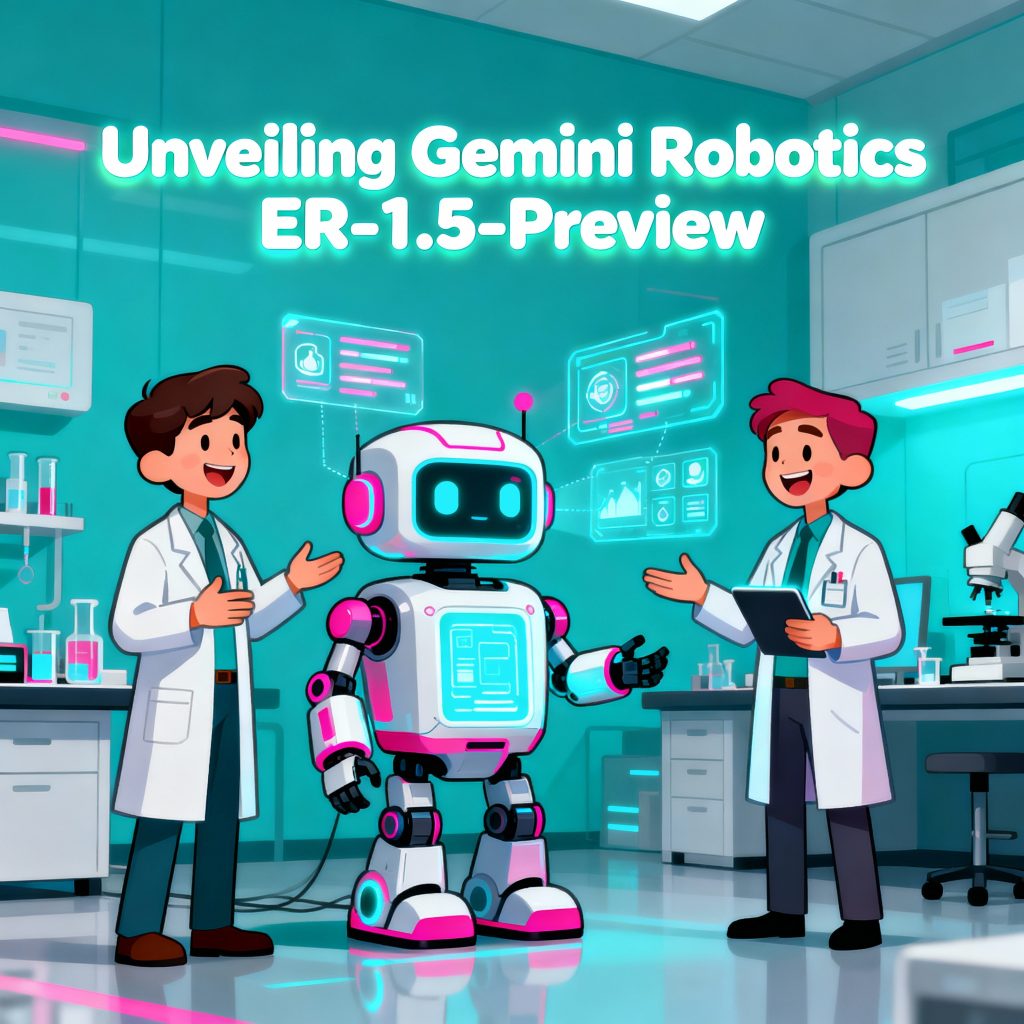
Cartoon-style illustration showing a futuristic robot in a laboratory, digital interface panels, vision overlays, and scientists interacting, representing Gemini Robotics ER-1.5-Preview
Artificial Intelligence

A Glimpse into the Future of Robotic Intelligence

Introduction The world of robotics is experiencing a seismic shift with the introduction of Gemini Robotics ER-1.5-Preview, Google DeepMind’s next-generation reasoning engine for robotics. This breakthrough system isn’t just a technical upgrade—it is a philosophical leap toward artificial agents that can perceive, plan, and act safely in our complex physical world. ER-1.5 is an important preview of the future, where robots seamlessly integrate vision, reasoning, and natural language understanding to perform sophisticated, real-world tasks with new levels of adaptability. Data Analytics in Banking: Transforming Finance in 2025 What Makes Gemini Robotics ER-1.5 Revolutionary? Advanced Vision-Language Reasoning: ER-1.5 enables robots to process images, video, and audio, understanding objects, environments, and even spatial-temporal relationships. Natural Language Task Management: Issue a command like “find the banana” or “clean up the table,” and Gemini breaks it down, plans, sequences subtasks, and orchestrates the robot’s actions accordingly. Agentic Autonomy: Gemini can act as a high-level “brain” for robots, performing spatial reasoning, task decomposition, and precise orchestration across a wide range of real-world scenarios—from sorting recyclables based on online guidelines to complex household or industrial automation. Safety and Adaptability: The model is designed with safety checks, semantic understanding for responsible action, and can adapt behaviors across diverse robots, from dual-arm platforms to humanoids. Developer Friendly: The ER-1.5 Preview is available now for testing and implementation via Google AI Studio and Gemini API. Developers can build, experiment, and deploy intelligent agentic robotics with ease. Use Cases and Practical Explanations Industrial Robotics: Robots can now identify parts, understand spatial layouts, and sequence actions for precision assembly, inspection, or transport. Household Automation: Tasks like sorting trash or tidying up are handled by understanding both physical objects and contextual online knowledge, allowing for true “general purpose” agents. Healthcare & Assisted Living: Adaptive robots can take nuanced instructions, reason about safety and comfort, and work in dynamic human spaces. Education & Research: Developers and researchers can now train robots in simulated or real-world environments, driving faster innovation in embodied AI. Safety, Transparency & Thinking Budget Safety by Design: ER-1.5 includes multi-layered safeguards, semantic safety policies, and low-level safety mechanisms, reducing risks of unintended or unsafe robot behavior. Transparent Reasoning: The system can offer explicit step-by-step plans, explain its logic, and adapt on the fly by referencing internet sources or executing custom functions. Thinking Budget: Gemini allows control over the “thinking budget”—balancing fast responses for routine tasks and deeper, higher-accuracy thinking for complex actions. Why This Preview Matters Gemini Robotics ER-1.5-Preview is not merely another AI model—it’s a foundation for safer, more intelligent, and universally adaptable robotics. The separation of “planner” and “executor” functions, natural language interfaces, and agentic autonomy point toward an era where general-purpose robots are feasible for businesses, households, and beyond. This is a crucial inflection point in robotics AI, celebrated by experts worldwide as the dawn of embodied, reliable AI agents. Conclusion Gemini Robotics ER-1.5-Preview is setting the stage for the next decade of intelligent, adaptable, and safe robotics across domains. As AI and robotics become inseparable, tools like ER-1.5 will empower innovators, startups, and industry giants to create game-changing solutions for real-world problems. Now is the time to start building, testing, and imagining the robotic world of tomorrow. FAQ What is Gemini Robotics ER-1.5-Preview? It’s a high-level, vision-language agentic model that enables robots to perceive, reason, and act in complex real-world environments using natural language instructions. How can developers use it? Preview access is available through Google AI Studio and the Gemini API, making rapid prototyping and deployment possible. What sets ER-1.5 apart from other robotics AI? It offers revolutionary separation of planning and execution, deep safety mechanisms, support for multiple robot types, and natural multi-tasking. Is Gemini ER-1.5 safe for real-world use? Yes, with layered safety, transparent planning, and strong semantic controls, but human oversight and best practices remain required. Where can I learn more about real-world applications and benchmarks? See Gemini Robotics-ER documentation and DeepMind’s latest blog. TechOTD Internal Backlinks TechOTD Blog Confidential AI Cloud Computing – An Ultimate Guide for Businesses Predictive Analytics Software Development Agentic RAG: What It Is, Types, Applications and Implementation Large Language Models (LLMs) in Finance How Blockchain Integration Is Optimizing Business Processes in Dubai
Artificial Intelligence

From Robots to Smart Machines: 10 Game-Changing Use Cases of Physical AI

Introduction Artificial Intelligence (AI) has transformed the digital realm with advanced data analytics, natural language processing, and automation. Yet, the next frontier is the realm of Physical AI—where smart machines and autonomous robots interact with the physical world intelligently, dynamically adapting to their environments and tasks. Physical AI combines sensing, computation, and actuation to power smart robotics, autonomous vehicles, intelligent drones, and other machines able to think and act autonomously in real space. This blog reveals 10 game-changing use cases of Physical AI fundamentally reshaping industries and everyday life. It also explores how innovations fueled by AI-driven tools from companies like TechOTD drive this transformation further (TechOTD AI services). What Is Physical AI? Physical AI integrates algorithms with sensors and actuators to enable machines to perceive, understand, and perform complex physical actions autonomously. Unlike software-only AI focused on data or decision-making in virtual spaces, Physical AI endows machines with physical autonomy—allowing them to sense their environment, learn continuously, and dynamically act without human intervention. This technology underpins autonomous vehicles, robotic arms in manufacturing, surgical robots, and smart drones, blending AI models with real-time feedback control systems. Such machines optimize efficiency, safety, and productivity by reacting adaptively to unpredictable real-world scenarios. 1. Autonomous Delivery Robots Autonomous delivery robots have transformed last-mile logistics by navigating urban and suburban environments to deliver parcels efficiently. These robots avoid obstacles, handle diverse weather conditions, and solve traditional delivery challenges such as parking limit and package theft. For example, Amazon Scout, deployed in select neighborhoods, reliably carries packages up to 30 pounds and operates seamlessly in pedestrian zones. This represents a major cost-effective disruption in delivery services—reducing dependency on human drivers and enabling 24/7 delivery capabilities. 2. Surgical Robots in Healthcare Physical AI-powered surgical systems enhance procedural precision and reduce patient recovery times. These robots stabilize surgical implements eliminating hand tremors and allow minimally invasive procedures through keyhole-sized openings. Johnson & Johnson’s Ottava system, for instance, enables complex operations with accelerated recovery and reduced hospital stays. Such AI-driven robotic surgery revolutionizes healthcare delivery, improving outcomes in specialties like urology, gynecology, and cardiothoracic surgery (Learn more about AI in healthcare). 3. Intelligent Robotic Assembly in Manufacturing Factories benefit immensely from Physical AI through intelligent robotic assembly lines. Robots equipped with AI learn continuously to adjust to variations in parts and production specifications, optimizing efficiency and minimizing human error. This flexibility means factories rapidly adapt product designs or volumes without expensive retooling, exemplifying the future of smart manufacturing and digital twins—where virtual models simulate and optimize physical processes (How We Work at TechOTD). 4. Autonomous Vehicles and Fleet Management From self-driving cars to autonomous trucks, Physical AI drives the future of transportation. Autonomous vehicles use extensive sensor arrays combined with AI to perceive surroundings, make split-second navigation decisions, and control driving actions. Fleet operators leverage these technologies to reduce accidents, optimize fuel consumption, and enable predictive maintenance. This paradigm shift in logistics helps streamline supply chains and decrease operational costs while reducing carbon footprints (Blockchain integration in business). 5. Smart Agricultural Equipment AI-powered farming machinery deploys drones, robotic harvesters, and smart irrigation systems to maximize crop yield and resource use. These machines analyze soil quality, monitor crop health with imaging sensors, and perform precision planting and harvesting autonomously. Physical AI in agriculture reduces labor demands, minimizes waste, and helps meet growing food production needs sustainably. This transformation supports efficient food supply chains crucial for global populations (Predictive analytics software). 6. Autonomous Cleaning and Maintenance Robots Commercial cleaning and maintenance robots maintain hospital hygiene, airport sanitation, and office cleanliness with minimal human supervision. They map facilities, optimize their cleaning paths, and adjust intensity based on usage patterns. These robots help reduce hospital-acquired infections and maintain consistent standards across large, complex environments—ultimately improving safety and operational efficiency. 7. Intelligent Security and Surveillance Robots Physical AI-driven surveillance robots continuously patrol facilities, using facial recognition and behavioral analysis to detect potential threats proactively. These machines operate in risky or inaccessible areas, coordinating with human security teams for comprehensive coverage. Organizations deploying these robotic guards benefit from extended coverage, faster threat identification, and reduced manpower fatigue (Seamless customer journeys with AI). 8. Autonomous Drones for Wildlife and Environmental Monitoring Mounted with non-invasive sensors, AI drones monitor wildlife movement, habitat health, and environmental changes without disturbing natural ecosystems. They collect data critical for conservation efforts, resource management, and climate science. This use case highlights Physical AI’s capacity to merge humanitarian and environmental benefits with advanced technology (Technology impact on education). 9. Smart Warehouse Robots and Inventory Management Robotic systems in warehouses automate picking, packing, and sorting—ensuring faster fulfillment cycles and higher accuracy. Physical AI enables these robots to navigate cluttered spaces, collaborate with human workers, and adapt to changing inventory needs. This technology enhances eCommerce capabilities and supports scalable, efficient supply chains (Mobile app services). 10. AI-Enabled Construction Equipment Heavy machinery empowered by Physical AI analyzes terrain in real-time and optimizes operations autonomously. Smart bulldozers, cranes, and excavators reduce fuel consumption and improve safety through predictive obstacle detection and automated project coordination. Companies like Caterpillar are leaders in smart construction tech, boosting productivity on large-scale infrastructure projects (Best gadgets for programmers). Conclusion: Embracing the Physical AI Revolution Physical AI is redefining how industries operate—enabling machines to perform with autonomy, intelligence, and adaptability never seen before. From healthcare to logistics to agriculture, these smart machines transform operations, reduce costs, and improve safety and quality. Businesses seeking to future-proof their operations must explore innovative Physical AI applications integrated with AI-driven analytics and automation solutions. TechOTD offers cutting-edge AI services to help organizations harness these powerful technologies and achieve new levels of operational excellence (Explore TechOTD AI solutions). FAQs Q1: How is Physical AI different from traditional robotics? Traditional robots operate on pre-defined rules and programming. Physical AI robots continuously learn and adapt from sensor inputs and environments, enabling greater autonomy and flexibility. Q2: What industries benefit most from Physical AI? Healthcare, manufacturing, logistics, agriculture, construction, retail, and security are rapidly adopting Physical AI to optimize processes

How would you like me to respond?

Select a personality for your AI assistant

Normal
Happy
Sad
Angry

Your selection will affect how the AI assistant responds to your messages

Chat Assistant

Let's discuss your project!

Hear from our clients and why 3000+ businesses trust TechOTD

Tell us what you need, and we'll get back with a cost and timeline estimate

Scroll to Top