cybersecurity

cybersecurity, DEVOPs

DevSecOps Best Practices

DevSecOps Best Practices: The Ultimate Blueprint for Secure, High-Velocity Software Delivery In the traditional software development lifecycle, security was often treated as the “final gate.” Developers would spend months building a product, operations would prepare the infrastructure, and just before launch, the security team would sweep in to perform a vulnerability audit. The result? A massive bottleneck. Security teams were viewed as the “Department of No,” pushing deadlines back by weeks or months to fix critical flaws discovered at the eleventh hour. In today’s hyper-accelerated digital landscape—where organizations deploy updates multiple times a day—this siloed approach is no longer sustainable. Enter DevSecOps. By embedding security directly into every stage of the continuous integration and continuous delivery (CI/CD) pipeline, DevSecOps ensures that software is not just fast, but inherently secure from the very first line of code. This comprehensive guide breaks down the core pillars, essential phases, actionable best practices, and real-world implementation strategies required to build a mature, human-centric DevSecOps culture. 1. Demystifying DevSecOps: Shift-Left and Shift-Right To successfully implement DevSecOps, it is critical to understand its two defining operational philosophies: Shifting Left and Shifting Right. [ Plan ] ──> [ Code ] ──> [ Build ] ──> [ Test ] ──> [ Deploy ] ──> [ Monitor ] │ │ │ │ │ │ └────────────┴────────────┴─────────────┴────────────┴───────────────┴──────── Security Focus Shifting Left: Proactive Security Shifting left means moving security practices earlier in the development lifecycle. Instead of waiting for a compiled build or a staged environment to run security scans, shift-left introduces security during the Planning, Coding, and Building phases. Why it matters: Fixing a software vulnerability during the design or coding phase can be up to 60 times cheaper than fixing it after it has been deployed to production. Core activities: Threat modeling, secure code reviews, IDE-integrated linting, and Static Application Security Testing (STAST). Shifting Right: Continuous Resilience While shifting left prevents bugs from reaching production, shifting right focuses on security during the Deployment, Operation, and Monitoring phases. It acknowledges that no system is entirely impenetrable and that runtime threats require continuous vigilance. Why it matters: Real-world exploits, zero-day vulnerabilities, and configuration drifts only happen in live environments. Shifting right ensures you spot and contain breaches instantly. Core activities: Runtime Application Self-Protection (RASP), penetration testing, chaos engineering, and continuous compliance monitoring. 2. The Cultural Pillar: Fostering a Shared-Responsibility Mindset The greatest misconception about DevSecOps is that it is purely a tooling problem. You can purchase the most expensive scanning software on the market, but if your organizational culture remains siloed, your DevSecOps initiative will fail. Breaking Down the Silos Historically, developers were incentivized purely by speed and functionality, while security teams were incentivized by risk mitigation. This created conflicting goals. DevSecOps requires a cultural alignment where security becomes a shared responsibility. Developers must accept ownership of the code’s security posture. Security Teams must transition from “gatekeepers” to “enablers,” providing the tools, automation, and guidance that developers need to work securely without losing velocity. Implementing a Security Champions Program A highly effective way to bridge the gap between engineering and security is by appointing Security Champions. What they are: Security Champions are regular software engineers, QA testers, or product managers who possess a keen interest in security. They remain embedded within their respective product teams. Their role: They act as the primary point of contact for security matters, help scale security knowledge across the engineering department, and ensure that security considerations are brought up during initial sprint planning sessions. 3. The DevSecOps Lifecycle: Step-by-Step Integration Integrating security into the CI/CD workflow requires tailored security gates at every single phase of the delivery pipeline. Let’s look at how to embed security seamlessly from planning to production. Phase 1: Plan (Threat Modeling & Risk Assessment) Security starts before a single line of code is written. During the planning phase, product teams map out features alongside potential attack vectors. Threat Modeling: Use frameworks like STRIDE (Spoofing, Tampering, Repudiation, Information Disclosure, Denial of Service, and Elevation of Privilege) to visually map out application architecture and discover architectural flaws early. Defining Security Requirements: Establish clear cryptographic standards, data classification rules, and compliance mandates (e.g., GDPR, HIPAA, PCI-DSS) during user story creation. Phase 2: Code (Secure Coding & IDE Assistance) When developers begin writing code, immediate feedback loops prevent vulnerable patterns from ever leaving their local workstations. Pre-Commit Hooks: Use lightweight scripts (like Git hooks) to prevent developers from accidentally committing sensitive data, such as plain-text API keys, AWS tokens, or private certificates, to version control. IDE Plugins: Equip developers with tools like SonarLint or Snyk extensions directly within VS Code or IntelliJ. These operate like spell-checkers for security, highlighting risky functions or outdated packages in real time. Phase 3: Build (Automated Code & Dependency Analysis) Once code is pushed to a shared repository, automated CI servers (like Jenkins, GitHub Actions, or GitLab CI) take over to build the application and trigger deeper security analyses. Static Application Security Testing (SAST): SAST tools analyze the source code or compiled binaries without executing the program. They look for classic vulnerabilities like SQL injection, Cross-Site Scripting (XSS), and buffer overflows. Software Composition Analysis (SCA): Modern applications are heavily built on open-source libraries. SCA tools scan your package.json, pom.xml, or requirements.txt files against databases of known public vulnerabilities (CVEs) to ensure you aren’t inheriting compromised third-party code. Phase 4: Test (Dynamic Evaluation & Testing) In the testing phase, the application is deployed into a staging or QA environment, allowing security tools to interact with it dynamically. Dynamic Application Security Testing (DAST): Unlike SAST, DAST tests the application from the outside-in by simulating a malicious hacker. It probes active endpoints, forms, and APIs to find vulnerabilities that only manifest when the application is running (e.g., authentication flaws or session management issues). Interactive Application Security Testing (IAST): IAST combines the benefits of both SAST and DAST. By deploying an agent within the application runtime, it monitors code execution while simultaneously running functional automated testing suites, yielding incredibly accurate results with fewer false positives.


Business leaders discussing strategy with IT consulting professionals
IT consulting

Why Every Business Needs a Strategic IT Consulting Partner

Why Every Business Needs a Strategic IT Consulting Partner In today’s rapidly evolving digital world, technology is the foundation of every successful organization. However, managing IT infrastructure, security, and innovation in-house can be complex and expensive. This is where a strategic IT consulting partner becomes invaluable. Whether it’s developing long-term technology roadmaps, optimizing processes, or securing data, IT consultants bring specialized knowledge that helps businesses achieve efficiency and scalability. Let’s explore why every modern business needs a strategic IT consulting partner in 2025. The Value of Strategic IT Partnerships A strategic IT consulting partner acts as an extension of your team, aligning technology initiatives with business goals. Rather than offering one-time solutions, these partners focus on long-term growth and adaptability. They analyze your existing systems, identify gaps, and design custom strategies that enhance productivity, reduce costs, and support innovation. The key difference between a vendor and a strategic IT partner lies in collaboration—consultants work closely with management teams to make technology decisions that drive business success. For small and mid-sized businesses, strategic IT partnerships provide enterprise-level expertise without the overhead of a full-time IT department. Aligning IT with Business Objectives One of the biggest challenges companies face is bridging the gap between business strategy and IT execution. A strategic IT consulting partner ensures that technology investments align with business objectives, not just technical requirements. For example, if your company aims to expand internationally, consultants can recommend cloud-based systems that support global operations. If improving customer experience is your focus, they might help implement CRM platforms and automation tools. By aligning IT with business goals, organizations gain agility, efficiency, and measurable ROI from their technology decisions. Driving Innovation and Digital Transformation Digital transformation is no longer optional—it’s a competitive necessity. Strategic IT consultants help organizations identify opportunities to innovate through automation, artificial intelligence (AI), and data-driven insights. They assess which emerging technologies can deliver real value, whether it’s cloud migration, process automation, or IoT integration. Consultants also ensure smooth transitions by managing risk, change, and employee adaptation. Businesses that partner with IT consultants can stay ahead of the curve by continuously improving operations and delivering exceptional customer experiences through innovation. Strengthening Cybersecurity and Compliance Cybersecurity threats are evolving faster than ever. Without a strong defense, businesses risk losing sensitive data, money, and reputation. A strategic IT consulting partner provides expertise in developing and maintaining robust security frameworks. Consultants perform security audits, vulnerability assessments, and penetration testing to identify potential risks. They implement tools like multi-factor authentication (MFA), encryption, and network monitoring to ensure 24/7 protection. Moreover, IT consultants help companies stay compliant with data protection laws such as GDPR, HIPAA, or CCPA. This proactive approach to cybersecurity minimizes risks and builds customer trust. Enhancing Operational Efficiency A well-structured IT strategy improves workflows and reduces downtime. IT consulting partners introduce automation, integrate digital tools, and streamline processes across departments. For example, consultants may recommend project management platforms like Jira or Asana, or cloud-based ERP systems like SAP and Oracle NetSuite to enhance collaboration and data management. By simplifying complex systems, businesses save both time and resources—allowing employees to focus on innovation and customer satisfaction instead of repetitive manual tasks. Cost Optimization and Resource Management Many companies overspend on technology due to poor planning or redundant systems. Strategic IT consultants perform cost analysis to identify areas where expenses can be reduced without compromising performance. They negotiate software licenses, recommend open-source alternatives, and implement scalable solutions that grow with the business. By optimizing cloud usage, consultants also help reduce monthly operational costs. This financial transparency enables companies to allocate resources more effectively, improving profitability and long-term sustainability. Building Long-Term Resilience In the digital era, resilience is key. A strategic IT consulting partner prepares businesses for unexpected challenges such as system failures, data breaches, or market disruptions. Through disaster recovery planning and business continuity strategies, consultants ensure that your organization can quickly recover and maintain operations even during crises. They also focus on scalability—ensuring that IT systems evolve alongside business growth. This proactive, forward-thinking approach helps companies remain competitive in any market condition. Fostering a Culture of Continuous Improvement Technology evolves rapidly, and staying updated is crucial. IT consulting partners foster a culture of continuous improvement by regularly reviewing performance, updating tools, and introducing innovation opportunities. They provide ongoing employee training to ensure teams can use new technologies efficiently. This commitment to growth ensures that businesses stay ahead of technological disruptions and remain future-ready. Conclusion A strategic IT consulting partner is not just a service provider—it’s a growth enabler. By aligning technology with business objectives, driving innovation, ensuring cybersecurity, and optimizing costs, IT consultants empower companies to thrive in a digital-first economy. As businesses navigate 2025 and beyond, partnering with an experienced IT consulting firm can mean the difference between merely surviving and truly succeeding. When strategy, technology, and execution come together, digital transformation becomes a sustainable reality. FAQs 1. What does a strategic IT consulting partner do?They provide expert guidance to align technology with business goals, improve efficiency, and drive digital transformation. 2. How can IT consulting improve business performance?Consultants streamline operations, enhance security, and implement technologies that support innovation and growth. 3. Is IT consulting only for large companies?No, small and medium-sized businesses also benefit from IT consulting to scale efficiently without high costs. 4. How does an IT consulting partner help with cybersecurity?They perform security audits, deploy protective tools, and ensure compliance with international data protection laws. 5. Why is long-term IT strategy important for businesses?A long-term IT strategy ensures technology investments support ongoing growth, resilience, and competitive advantage. Connect with us.

Startup founders discussing IT consulting strategies for business scalability
IT consulting

IT Consulting for Startups — Turning Ideas into Scalable Businesses

IT Consulting for Startups — Turning Ideas into Scalable Businesses Launching a startup is exciting — but turning an idea into a successful, scalable business requires more than passion. It demands the right technology, strategy, and execution. That’s where IT consulting for startups plays a crucial role. IT consultants help new businesses build a strong technological foundation, optimize operations, and make smart digital investments. This blog explores how IT consulting empowers startups to grow efficiently and sustainably. Building a Scalable Tech Foundation Every successful startup begins with a solid technical foundation. IT consultants assess the startup’s goals, budget, and business model to design a robust IT infrastructure that supports growth. For example, instead of relying on outdated systems or fragmented tools, consultants help implement cloud-based and modular architectures that scale with the business. They ensure that servers, databases, and software applications are aligned with long-term expansion plans. A well-designed tech foundation not only reduces future upgrade costs but also prevents downtime and performance bottlenecks. Whether it’s an e-commerce startup, fintech app, or SaaS product, IT consulting ensures the technology backbone is reliable, secure, and scalable from day one. Choosing the Right Technology Stack Selecting the right technology stack (frontend, backend, databases, and frameworks) is one of the most critical decisions for any startup. Poor tech choices can lead to integration issues, security risks, and limited scalability. IT consultants evaluate factors such as performance, flexibility, team expertise, and maintenance requirements before recommending a tech stack. For example: For web startups, they might suggest React.js, Node.js, or Qwik for high performance. For app-based startups, frameworks like Flutter or React Native offer cross-platform efficiency. For backend and database management, consultants may recommend AWS, MongoDB, or Firebase depending on the use case. By choosing wisely early on, startups save both time and money while ensuring their products evolve smoothly as they grow. Cost-Effective Cloud Solutions Cloud computing is a game-changer for startups with limited budgets. IT consultants guide entrepreneurs in adopting cloud-first solutions that minimize upfront hardware costs and provide flexibility. Using platforms like Amazon Web Services (AWS), Google Cloud, or Microsoft Azure, startups can host their applications, store data, and deploy services on-demand. Consultants ensure the cloud setup includes backup systems, data redundancy, and cost optimization. Moreover, cloud-based tools enable startups to collaborate efficiently with remote teams and scale instantly when demand rises — a vital feature for fast-growing companies. Consultants also monitor usage patterns to prevent unnecessary expenses, ensuring startups get maximum value from every cloud investment. Ensuring Security and Compliance Startups often overlook cybersecurity until it’s too late. Data breaches or cyberattacks can destroy brand reputation and customer trust. That’s why IT consultants prioritize security from the start. They perform risk assessments, identify vulnerabilities, and implement strong defense mechanisms like firewalls, encryption, and access control. Consultants also ensure compliance with data protection regulations (such as GDPR or CCPA) to avoid legal risks. Additionally, security training for employees helps prevent phishing and insider threats — common weak points for startups. By integrating cybersecurity into every stage of business development, consultants safeguard the company’s digital assets and ensure customer data remains protected. Streamlining Operations with Automation Automation is a major advantage that IT consulting brings to startups. By integrating automated workflows, startups can reduce manual errors, save time, and focus on growth. IT consultants deploy automation tools for project management, customer onboarding, data entry, and marketing campaigns. CRM systems like HubSpot or Salesforce, and workflow tools like Zapier or Asana, are often implemented to streamline repetitive processes. Automation not only improves efficiency but also enhances consistency and customer satisfaction — key ingredients for scaling successfully. Developing Scalable Digital Strategies Beyond technology, IT consultants help startups craft digital growth strategies aligned with market trends and business objectives. This includes everything from building online presence and digital marketing integration to analyzing data for informed decision-making. Consultants often provide digital transformation roadmaps, guiding startups through product evolution, customer engagement, and market expansion. This strategic partnership ensures startups can adapt quickly and sustain growth in competitive industries. Providing Ongoing Support and IT Maintenance IT consulting doesn’t end after setup. Ongoing support is crucial for startups to remain efficient and secure. Consultants provide continuous monitoring, system updates, and performance optimization. Whether it’s troubleshooting software bugs or scaling up infrastructure during rapid growth phases, consultants ensure technology never becomes a barrier to innovation. Many also offer managed IT services that provide startups with enterprise-level reliability without the cost of an in-house team. Conclusion IT consulting is the backbone of modern startup success. By combining technology expertise with business insight, consultants help entrepreneurs turn ideas into profitable realities. From choosing the right tech stack and cloud solutions to ensuring security and scalability, IT consulting provides startups with the roadmap to thrive in a digital-first world. For startups looking to accelerate growth, collaborating with experienced IT consultants isn’t just an option — it’s a necessity for sustainable success. FAQs 1. Why do startups need IT consulting?Startups need IT consulting to build scalable infrastructure, choose the right technologies, and implement secure, cost-effective digital strategies. 2. What are the key benefits of IT consulting for startups?Key benefits include better technology decisions, reduced costs, enhanced security, and faster time-to-market. 3. How do IT consultants help with scalability?Consultants design flexible architectures and recommend cloud-based solutions that grow with your business needs. 4. Are IT consulting services expensive for startups?Not necessarily. Most consultants offer scalable pricing or project-based models suitable for startups with limited budgets. 5. Can IT consulting help improve cybersecurity for startups?Yes, consultants implement robust security frameworks, ensure data compliance, and provide employee training to protect sensitive information. Connect with us.

IT consultants analyzing future technology trends using data analytics dashboard
IT consulting

Top IT Consulting Trends Shaping the Future of Business

Top IT Consulting Trends Shaping the Future of Business In today’s rapidly evolving digital world, IT consulting plays a crucial role in helping organizations stay ahead of the competition. From automation to sustainability, consultants are guiding businesses through technological innovation and transformation. Let’s explore the key IT consulting trends shaping the future of business in 2025 and beyond. Artificial Intelligence and Automation Artificial Intelligence (AI) and automation are revolutionizing the IT consulting landscape. Consultants are helping businesses leverage AI to optimize operations, reduce manual workload, and enhance decision-making accuracy. AI-powered automation tools are being deployed in data management, cybersecurity, and customer service. Chatbots now handle 24/7 customer queries, predictive algorithms forecast sales trends, and AI-based analytics provide deep insights into consumer behavior. Moreover, automation in IT processes such as system updates, bug detection, and maintenance reduces downtime and improves reliability. By adopting AI, organizations can achieve smarter workflows, boost productivity, and make better business decisions in real time. Cloud-First Strategies The cloud-first approach has become a fundamental trend in IT consulting. With the rise of remote work and digital collaboration, businesses are migrating to cloud platforms for scalability, flexibility, and cost-effectiveness. IT consultants assist in designing and executing seamless cloud migration strategies while ensuring minimal disruption to daily operations. They evaluate whether a public, private, or hybrid cloud solution fits the company’s needs and security policies. Cloud computing also empowers global collaboration—employees can access data and applications anytime, anywhere. As cybersecurity risks increase, consultants play a crucial role in implementing encryption, identity management, and compliance standards across cloud infrastructures. Cybersecurity as a Priority As businesses embrace digital transformation, cybersecurity has become a top concern. With cyberattacks growing more sophisticated, IT consultants are focusing on proactive security planning and defense strategies. Modern IT consulting emphasizes risk management, real-time monitoring, and multi-layered security frameworks. Consultants perform penetration testing, vulnerability assessments, and employee security training to strengthen defenses. They also recommend Zero Trust Architecture (ZTA), ensuring that every device and user is verified before accessing any data. This trend demonstrates a significant shift from reactive security to preventive protection, where cybersecurity is embedded in every layer of the business ecosystem. Data-Driven Decision Making Data has become the new oil in today’s economy. Businesses that effectively utilize data can unlock insights to drive smarter decisions. IT consultants are helping organizations design data-driven frameworks that transform raw data into actionable strategies. Through advanced analytics and business intelligence tools like Power BI and Tableau, companies can measure performance, track customer preferences, and predict future trends. Consultants help establish data governance models, ensuring data integrity and compliance with privacy regulations like GDPR and CCPA. Predictive analytics, powered by AI, is enabling organizations to anticipate market shifts, optimize inventory, and personalize customer experiences. The ability to make data-backed decisions gives companies a competitive edge and improves overall operational efficiency. Sustainable IT Consulting Sustainability is no longer just a corporate buzzword—it’s a necessity. IT consulting is now embracing eco-friendly technologies to reduce environmental impact while maintaining performance. Consultants advise on optimizing energy consumption in data centers, implementing virtual infrastructure, and adopting cloud solutions that cut down hardware waste. They also perform Green IT audits to assess an organization’s carbon footprint and recommend eco-conscious practices. Sustainable IT consulting not only benefits the planet but also reduces operational costs and strengthens brand reputation. By investing in green technology, businesses appeal to environmentally conscious customers and investors alike. Emergence of Remote IT Consulting The global shift toward hybrid and remote work has opened new opportunities for remote IT consulting. Businesses can now access expertise from consultants across the world through virtual collaboration tools. This trend has reduced operational costs while increasing access to a broader talent pool. IT consultants can remotely perform tasks such as system audits, security analysis, and software deployment. As digital communication tools become more advanced, remote consulting will remain a key trend in the years ahead. Conclusion The IT consulting industry is at the forefront of technological change, helping businesses navigate complex challenges and embrace innovation. From artificial intelligence and cloud-first strategies to cybersecurity and sustainability, consultants are shaping the future of digital transformation. Organizations that stay informed about these trends and work with experienced IT consultants will not only enhance efficiency but also build long-term resilience in an ever-changing digital economy. By aligning technology with business goals, IT consulting ensures that companies remain agile, secure, and future-ready in 2025 and beyond. FAQs 1. What are the biggest IT consulting trends in 2025?The major trends include AI automation, cloud-first strategies, cybersecurity enhancement, data-driven insights, and sustainable IT solutions. 2. How does IT consulting help in business growth?IT consultants identify technology opportunities, streamline processes, and implement strategies that increase efficiency and reduce costs. 3. What role does cloud computing play in IT consulting?Cloud computing enables flexibility, scalability, and remote collaboration, making it a central component of IT consulting services. 4. Why is data-driven decision-making important?It allows organizations to make strategic choices based on real insights rather than assumptions, improving performance and customer satisfaction. 5. How does sustainability impact IT consulting?Sustainable IT consulting promotes eco-friendly technologies that lower energy consumption, reduce costs, and improve corporate responsibility. Connect with us

Digital padlock representing cybersecurity and data protection.
cybersecurity, Data Privacy & Security

Cybersecurity in the Digital Age: Protecting Data in a Connected World

Introduction We live in an age where data travels faster than thought — from cloud storage to smartphones, from online banking to social media. But as our digital world expands, so do the cyber threats lurking behind every connection. From global ransomware attacks to phishing scams and data breaches, cybercrime has evolved into one of the biggest challenges of the 21st century. In 2024 alone, the global cost of cybercrime was estimated to surpass $10 trillion, making it more profitable than the illegal drug trade. In this digital age, cybersecurity isn’t optional — it’s essential for individuals, businesses, and governments alike. What Is Cybersecurity? Cybersecurity refers to the practice of protecting systems, networks, and data from unauthorized access, attacks, and damage. It involves technologies, processes, and best practices designed to secure: Computers and servers Mobile devices Networks Cloud environments User data Core Objectives of Cybersecurity — The CIA Triad: Element Meaning Purpose Confidentiality Keeping data private Prevent unauthorized access Integrity Maintaining data accuracy Ensure data isn’t altered maliciously Availability Ensuring accessibility Keep systems online and functional Together, these principles form the foundation of all cybersecurity systems. ⚙️ Types of Cybersecurity Cybersecurity covers a wide range of protection layers designed to defend different parts of the digital ecosystem. 1. Network Security Protects internal networks from intruders using firewalls, intrusion detection systems, and VPNs. 2. Information Security (InfoSec) Ensures data privacy and protects sensitive information from leaks or misuse. 3. Cloud Security Secures cloud-based infrastructure, applications, and data stored in remote servers. 4. Endpoint Security Defends devices such as laptops, phones, and IoT gadgets that connect to a network. 5. Application Security Prevents vulnerabilities during software development through encryption, code testing, and patch management. 6. Operational Security (OpSec) Focuses on the policies and procedures to handle data and protect assets. 7. Disaster Recovery and Business Continuity Ensures systems can recover quickly from attacks or data loss events. Common Cyber Threats Cyberattacks come in many forms — some target individuals, others target global corporations. Here are the most common types of cyber threats: Type Description Example Phishing Fraudulent emails trick users into revealing credentials Fake bank alerts Ransomware Encrypts data and demands payment WannaCry, LockBit Malware Software designed to damage or steal information Viruses, Trojans Denial of Service (DoS/DDoS) Overloads servers to make them crash Attacks on websites or networks Man-in-the-Middle (MitM) Intercepts data during transmission Wi-Fi eavesdropping SQL Injection Inserts malicious code into databases Web form exploits Zero-Day Exploit Targets unpatched vulnerabilities Newly discovered software flaws Insider Threats Employees misuse access privileges Data theft by insiders The increasing sophistication of cyberattacks means no organization is immune — prevention and vigilance are key. Essential Cybersecurity Tools Modern cybersecurity strategies rely on a mix of software, AI, and human expertise. Commonly Used Tools: Antivirus Software: Protects against malware and viruses (e.g., Bitdefender, Norton) Firewalls: Blocks unauthorized access to networks Encryption Tools: Secures data in transit and at rest Password Managers: Protects user credentials VPNs: Masks IP addresses for secure browsing Intrusion Detection Systems (IDS): Monitors networks for suspicious activity Multi-Factor Authentication (MFA): Adds an extra security layer beyond passwords The Role of Artificial Intelligence in Cybersecurity AI is becoming a game-changer in the fight against cyber threats. How AI Helps: Detects anomalies in real-time Predicts potential attacks before they occur Automates incident response Reduces false alerts and improves accuracy Example: AI-driven tools like Darktrace and CrowdStrike use machine learning to identify unusual network behavior and block cyberattacks instantly. Cybersecurity in Business Organizations of all sizes — from startups to multinationals — are prime targets for hackers. Key Areas of Focus for Businesses: Employee Awareness Training: Human error is the top cause of breaches. Data Encryption: Sensitive data must be encrypted at all stages. Regular Security Audits: Identify vulnerabilities before hackers do. Zero-Trust Architecture: Verify every access attempt, even inside the network. Incident Response Plans: Prepare for attacks with structured recovery strategies. Example:In 2023, several global firms adopted Zero Trust Security Models, ensuring users and devices are verified every time they access company data — drastically reducing internal breaches. Cybersecurity in the Cloud With more organizations migrating to cloud services like AWS, Azure, and Google Cloud, securing cloud infrastructure is vital. Cloud security ensures: Data encryption Identity and access management (IAM) Secure APIs and regular patching Providers also follow shared responsibility models, meaning both the provider and the client share the duty of maintaining security. Cybersecurity for Individuals Cybersecurity isn’t just for corporations — individuals must also stay alert. Personal Cyber Hygiene Tips: Use strong and unique passwords for every account. Enable two-factor authentication (2FA). Avoid clicking on suspicious links or attachments. Update software and systems regularly. Use secured Wi-Fi networks. Regularly back up important data. The Future of Cybersecurity The coming years will see cybersecurity evolve alongside AI, quantum computing, and the Internet of Things (IoT). 🔮 Key Future Trends: AI-powered threat detection Quantum encryption for unbreakable security Zero Trust Architecture becoming the global standard Biometric authentication (face, fingerprint, voice) Cyber resilience — not just prevention but rapid recovery Cybersecurity is no longer about building walls — it’s about creating adaptive, intelligent systems that learn and evolve faster than attackers. Conclusion In the digital era, data is power, and protecting it is non-negotiable. Cybersecurity is the first line of defense against a world of invisible threats. Whether it’s an individual securing personal data or a multinational corporation safeguarding billions of records, awareness and preparation are the strongest shields. As technology advances, so must our commitment to cybersecurity — ensuring a safer, more resilient digital future for everyone. FAQs 1. What is cybersecurity in simple terms?Cybersecurity is the protection of computers, networks, and data from digital attacks or unauthorized access. 2. Why is cybersecurity important?It prevents data theft, financial loss, and system damage caused by hackers or malware. 3. What are common cyber threats?Phishing, ransomware, malware, DDoS attacks, and insider threats are among the most common. 4. How can individuals improve cybersecurity?Use strong passwords, enable two-factor authentication, and avoid suspicious emails or downloads. 5.

Artificial intelligence network scanning for cyber threats and data protection.
Artificial Intelligence, cybersecurity

The Role of Artificial Intelligence in Cybersecurity

Introduction In a world where cyberattacks are growing more sophisticated by the day, traditional defense systems are no longer enough. Businesses, governments, and individuals face threats ranging from phishing scams to ransomware and identity theft. To combat this, Artificial Intelligence (AI) has emerged as a game-changing weapon in the field of cybersecurity. By combining machine learning (ML), predictive analytics, and automation, AI helps security teams identify, prevent, and respond to attacks — often before they occur. As per IBM’s Cost of a Data Breach Report 2025, organizations using AI-driven cybersecurity tools save an average of $3 million per breach compared to those without it. Clearly, the future of cybersecurity is AI-powered. What Is AI in Cybersecurity? Artificial Intelligence in Cybersecurity involves using algorithms and machine learning models to analyze data, detect anomalies, and automatically respond to threats. Unlike traditional security systems that rely on pre-defined rules, AI systems learn and adapt to new threats dynamically — making them ideal for handling today’s complex digital environments.     Core Functions: Real-time threat detection Automated response and mitigation Behavioral analysis Network monitoring Predictive analytics Why AI Is Essential in Cybersecurity Traditional cybersecurity relies on human experts and static rule-based systems. However, with billions of daily data points and evolving attack patterns, humans alone can’t keep up. AI brings: Speed: Instantly processes large datasets to identify threats. Accuracy: Reduces false positives compared to manual analysis. Scalability: Monitors thousands of endpoints simultaneously. Adaptability: Learns from new data and evolving attacks. AI acts as a force multiplier — enhancing human intelligence rather than replacing it. Key Applications of AI in Cybersecurity 1. Threat Detection and Prediction AI systems analyze historical attack data to predict potential threats. By learning patterns, AI can detect zero-day vulnerabilities that traditional systems might miss. Example: Darktrace uses AI to continuously learn an organization’s network behavior and identify anomalies in real-time. 2. Behavioral Analytics AI monitors user and system behavior to detect suspicious activities such as unauthorized access or data transfers. Example: If an employee’s account suddenly downloads huge amounts of data at odd hours, AI can flag and isolate that activity. 3. Automated Incident Response AI can automate the initial response to threats — such as isolating infected devices or blocking suspicious IP addresses — reducing the time between detection and action. Example: SOAR (Security Orchestration, Automation, and Response) platforms use AI to streamline security workflows. 4. Phishing and Email Security Machine learning models analyze email content, sender patterns, and URLs to detect phishing attacks before they reach users’ inboxes. Example: Google’s Gmail AI blocks over 100 million phishing emails daily using ML filters. 5. Malware Detection AI-powered systems can detect new malware strains by studying code structure and execution patterns — even if the malware hasn’t been seen before. Example: Cylance uses AI models trained on millions of malicious files to predict threats in real-time. 6. Network Security and Monitoring AI helps track massive network traffic volumes, identifying abnormalities that might signal cyberattacks like DDoS (Distributed Denial of Service). Example: AI tools detect unusual spikes in network activity and alert administrators instantly. 7. Fraud Detection Banks and e-commerce companies use AI to analyze user transactions and detect fraudulent behavior. Example: Mastercard’s Decision Intelligence uses AI to evaluate transaction risks within milliseconds.  Advantages of Using AI in Cybersecurity Advantage Impact Speed & Efficiency Real-time threat detection and mitigation Improved Accuracy Fewer false alarms and better prioritization Cost Reduction Reduced operational costs and data breach impact Predictive Capabilities Prevents attacks before they occur 24/7 Monitoring Continuous protection without downtime Adaptive Learning Evolves with emerging cyber threats Challenges and Limitations While AI offers immense potential, it’s not without challenges. 1. Adversarial AI Attacks Hackers use AI to create smarter malware or bypass security systems by mimicking legitimate behavior. 2. High Implementation Costs Building and training AI models require significant investment in infrastructure and expertise. 3. False Positives Poorly trained AI systems may still misclassify safe activities as threats, leading to unnecessary alerts. 4. Data Privacy Concerns AI models need large datasets to train — which sometimes include sensitive user data. 5. Skill Gap The shortage of AI and cybersecurity professionals makes it difficult for many organizations to deploy AI effectively. The Future of AI in Cybersecurity The next era of cybersecurity will be autonomous, predictive, and intelligent. Key Trends to Watch: AI + Blockchain Integration: For tamper-proof data verification. Quantum AI Security: Defending against quantum computing-based attacks. Self-Healing Systems: Networks that can automatically detect, isolate, and repair vulnerabilities. Edge AI: Real-time protection for IoT and edge devices. AI-driven Cyber Threat Intelligence (CTI): Collaborative global databases for predictive defense. By 2030, AI will be the central pillar of all major cybersecurity infrastructures — empowering organizations to respond to threats faster than hackers can act. Real-World Case Studies IBM Watson for Cybersecurity Uses natural language processing and machine learning to analyze millions of security reports, helping security teams make faster decisions. Capital One Implements AI to monitor billions of transactions in real time, protecting customers from credit card fraud and identity theft. Healthcare Networks Hospitals use AI-based security tools to protect sensitive patient records and detect ransomware attacks. Conclusion The rise of Artificial Intelligence has redefined the battle against cybercrime. From predictive threat detection to automated defense mechanisms, AI enables businesses to stay one step ahead of hackers. As digital transformation accelerates, the fusion of AI and cybersecurity will become the cornerstone of trust and resilience in the online world. However, with great power comes responsibility — ensuring AI is used ethically, transparently, and securely will be crucial for a safer digital future. In short, AI is not just defending the digital world — it’s redefining it. FAQs 1. How is AI used in cybersecurity?AI analyzes patterns, detects anomalies, and automates responses to identify and mitigate cyber threats in real time. 2. Can AI prevent cyberattacks completely?AI reduces risks and improves detection, but human oversight remains essential for complex decision-making. 3. What are the main benefits of AI in cybersecurity?Faster detection, improved accuracy,

telecom

The Evolution of Telecommunications

How 5G and Beyond Are Transforming Our Connected World   The telecommunications industry stands at the forefront of technological innovation, continuously reshaping how we communicate, work, and live. From the early days of telegraph systems to today’s ultra-fast 5G networks, telecom has been the backbone of global connectivity. In this post, we’ll explore the current state of telecommunications and what the future holds for this dynamic industry.   The 5G Revolution: More Than Just Speed   Fifth-generation wireless technology (5G) represents a quantum leap in mobile connectivity. While most people associate 5G with faster download speeds, its impact extends far beyond streaming videos more quickly. Key Benefits of 5G Technology: Ultra-Low Latency: 5G networks can achieve latency as low as 1 millisecond, making real-time applications like remote surgery and autonomous vehicles possible. Massive Device Connectivity: 5G can support up to 1 million devices per square kilometer, essential for the expanding Internet of Things (IoT) ecosystem. Enhanced Reliability: Network slicing allows telecom operators to create virtual networks tailored to specific use cases, ensuring consistent performance for critical applications. Energy Efficiency: Despite higher speeds, 5G technology is designed to be more energy-efficient per bit of data transmitted compared to 4G. The Rise of Edge Computing in Telecom Edge computing is revolutionizing how telecom networks process data. By moving computation closer to data sources, edge computing reduces latency and bandwidth usage while improving response times. Telecom companies are deploying edge data centers at cell tower locations, enabling applications that require immediate processing, such as augmented reality, virtual reality, and real-time analytics. This distributed architecture is crucial for supporting the massive data flows generated by 5G networks and IoT devices. IoT and Smart Cities: Telecom’s Role in Urban Transformation Telecommunications infrastructure forms the nervous system of smart cities. As urban areas become more connected, telecom networks enable: Smart Traffic Management: Real-time traffic monitoring and adaptive signal control reduce congestion and emissions Public Safety Systems: Integrated surveillance and emergency response networks improve security Utility Management: Smart grids and water systems optimize resource consumption Environmental Monitoring: Sensor networks track air quality, noise levels, and weather conditions The deployment of 5G networks accelerates smart city development by providing the bandwidth and reliability needed for millions of connected devices to operate simultaneously. Cybersecurity Challenges in Modern Telecom As telecom networks become more complex and interconnected, cybersecurity has emerged as a critical concern. The industry faces several challenges: Network Vulnerabilities: The transition to software-defined networks and virtualized infrastructure creates new attack surfaces that must be protected. IoT Device Security: Billions of connected devices often lack robust security features, making them potential entry points for cyberattacks. Data Privacy: With networks carrying sensitive personal and business data, telecom companies must implement stringent privacy protections to comply with regulations like GDPR and maintain customer trust. Leading telecom operators are investing heavily in AI-powered security systems that can detect and respond to threats in real-time, ensuring network integrity and customer data protection. The Path to 6G: What’s Next? While 5G deployment continues worldwide, researchers are already developing sixth-generation (6G) wireless technology. Expected to launch commercially around 2030, 6G promises: Terahertz frequencies: Enabling speeds up to 100 times faster than 5G AI-native networks: Deep integration of artificial intelligence into network operations Holographic communications: Supporting truly immersive telepresence experiences Sensing capabilities: Networks that can detect environmental conditions and object locations 6G will likely integrate terrestrial and non-terrestrial networks, incorporating satellites and high-altitude platforms to ensure truly global coverage. Sustainability in Telecommunications The telecom industry is increasingly focused on environmental sustainability. Network infrastructure consumes significant energy, and companies are taking steps to reduce their carbon footprint: Transitioning to renewable energy sources for data centers and cell towers Implementing energy-efficient equipment and cooling systems Optimizing network traffic to reduce unnecessary energy consumption Promoting device recycling and circular economy initiatives Major telecom operators have committed to achieving net-zero carbon emissions by 2040 or earlier, recognizing their responsibility in addressing climate change. Conclusion: Staying Connected in an Evolving Landscape The telecommunications industry continues to evolve at a breathtaking pace, driven by technological innovation and changing consumer demands. From 5G networks enabling new applications to the promise of 6G on the horizon, telecom remains central to our increasingly digital lives. As we look to the future, the successful telecom companies will be those that balance innovation with security, performance with sustainability, and global reach with local relevance. The connected world of tomorrow is being built today, one cell tower, fiber optic cable, and software update at a time.  

Symbolic image of digital data protection and cybersecurity.
Data Privacy & Security

Data Privacy & Security: Protecting Your Digital Footprint in the Age of AI

Introduction In today’s hyper-connected world, data is the new currency. Every click, login, and online purchase leaves behind a trail of information — your digital footprint. But as technology evolves, so do cyber threats. From phishing scams to ransomware, the fight for data privacy and security has become one of the biggest challenges of our digital age. This blog explores the importance of data privacy and security in 2025, the growing influence of AI in cybersecurity, and practical steps you can take to protect personal and business data. 1. What is Data Privacy and Security? Data Privacy refers to controlling who can access your personal information and how it’s used. Data Security focuses on protecting that data from unauthorized access, corruption, or theft. Together, they ensure that your personal, financial, and organizational information remains safe and confidential. 2. Why Data Privacy Matters More Than Ever With billions of people online, sensitive data — like bank details, passwords, and health records — can be easily exploited.Key reasons why privacy matters: Identity Protection: Prevents identity theft and fraud. Trust & Compliance: Businesses must comply with GDPR, CCPA, and India’s DPDP Act. Control Over Information: Gives individuals power over how their data is used. Did you know? Over 80% of consumers are more likely to trust brands that prioritize data transparency. 3. AI’s Role in Modern Cybersecurity Artificial Intelligence (AI) has become both a shield and a sword in the cybersecurity landscape. How AI Strengthens Security Threat Detection: AI can analyze millions of data points in real time to detect suspicious activity. Automated Response: Reduces human error by instantly isolating infected systems. Predictive Analysis: Identifies vulnerabilities before hackers exploit them. But Beware — AI Can Be Misused Hackers are also using AI to create deepfakes, phishing bots, and malware that can bypass traditional defenses. 4. Top Data Security Challenges in 2025 Cloud Vulnerabilities: As more businesses move to the cloud, weak configurations lead to data leaks. Ransomware Attacks: Criminals lock systems and demand payment in cryptocurrency. IoT Device Risks: Smart home devices can become entry points for hackers. Insider Threats: Employees can unintentionally or maliciously leak information. AI-Driven Cybercrime: Automated attacks powered by generative AI tools. 5. Best Practices to Protect Your Data Here are proven steps to strengthen your personal and organizational data security: Use Strong Passwords: Combine uppercase, lowercase, symbols, and numbers. Enable Multi-Factor Authentication (MFA): Adds an extra security layer. Encrypt Sensitive Files: Ensure data is unreadable without authorization. Regular Software Updates: Patch vulnerabilities frequently. Educate Employees: Conduct cybersecurity awareness training. Backup Regularly: Keep offline and cloud backups of crucial data. Limit Data Sharing: Share only what’s necessary and with trusted sources. 6. The Future of Data Privacy: Regulation & Ethics Governments across the globe are tightening data protection laws. Europe: GDPR continues to evolve with stricter AI governance. India: The Digital Personal Data Protection (DPDP) Act 2023 emphasizes user consent and accountability. Global Trend: Companies now appoint Data Protection Officers (DPOs) to ensure compliance. As we step into an AI-driven decade, ethical handling of data will determine brand reputation and customer loyalty. 7. Pro Tips for Individuals & Businesses Regularly review app permissions. Avoid connecting to public Wi-Fi for financial transactions. Use VPNs to secure browsing. For businesses — adopt Zero Trust Architecture, ensuring “never trust, always verify.” Remember: Data privacy isn’t a one-time effort — it’s a continuous process. Conclusion Data privacy and security aren’t just IT concerns — they’re human rights and business essentials. As AI and digital technologies evolve, protecting your digital footprint is no longer optional. It’s your strongest defense against cyber threats. Whether you’re an individual user or a global enterprise, the message is clear:                                             “Stay private. Stay secure. Stay aware.” FAQ Section Q1. Why is data privacy important in 2025?Because the amount of personal data collected by companies and AI systems is higher than ever, increasing the risk of misuse. Q2. What’s the difference between data privacy and data security?Privacy is about control and consent; security is about protection and prevention. Q3. How does AI help improve cybersecurity?AI helps detect threats faster, automates responses, and predicts future attacks. Q4. What are common threats to data security?Phishing, ransomware, insider leaks, and cloud misconfigurations. Q5. What’s the best way to secure personal data?Use strong passwords, enable MFA, encrypt files, and stay alert online.

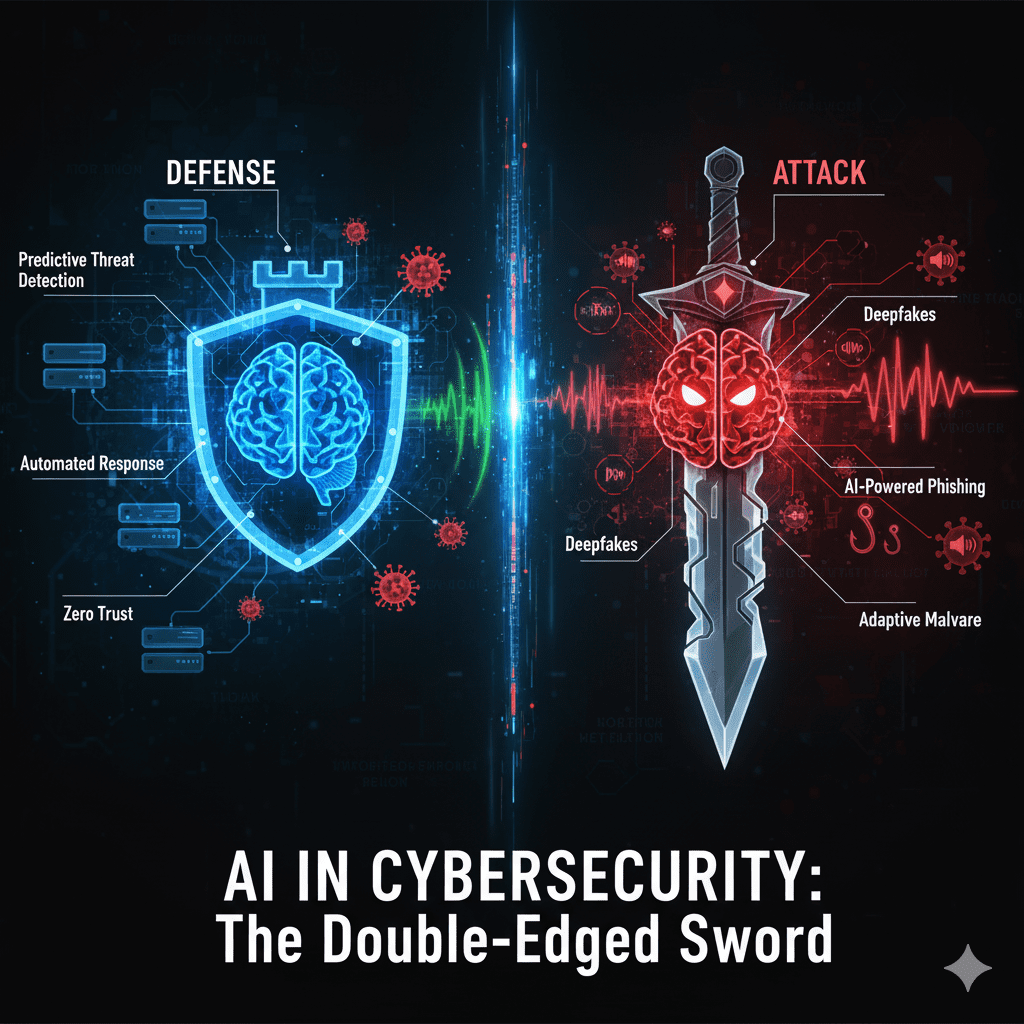
PREDICTIVE THREAT DETECTION and AUTOMATED RESPONSE
cybersecurity

Digital Armor: Defending Against Cyber Threats

Introduction For decades, the world of cybersecurity has been a high-stakes cat-and-mouse game. Security professionals build a wall, and hackers find a way over it. But today, this game is being fundamentally transformed by a powerful new player: Artificial Intelligence. AI is not just another tool; it’s a revolutionary force acting as both the strongest shield and the most dangerous new weapon. This article explores the dual role of AI in Cybersecurity, breaking down how it’s creating unprecedented defenses while simultaneously arming attackers with terrifying new capabilities The New Shield: AI as a Defensive Powerhouse The primary advantage of AI in a defensive role is its ability to process and analyze data at a scale and speed no human team could ever hope to match. While a human analyst sleeps, an AI security model is monitoring billions of events, looking for the one tiny anomaly that signals an attack. 1. Predictive Threat Detection Before AI, most security systems were reactive. They relied on “signatures”—the digital fingerprints of known malware. This meant a virus had to successfully attack someone first before it could be identified and blocked. AI, specifically machine learning, is predictive. It learns the normal, baseline behavior of your network, your users, and your devices. It can then spot suspicious deviations before a full-blown breach occurs. This includes: Behavioral Analysis: Is a user account that normally works from 9-to-5 suddenly trying to access sensitive files at 3:00 AM from a different country? AI flags this instantly. Anomaly Detection: Does a “smart” device like a thermostat suddenly start trying to communicate with an unknown server? AI can see this as a potential IoT (Internet of Things) attack. Pattern Recognition: AI can analyze global threat feeds and identify new attack patterns as they emerge, proactively blocking them before they even reach your network. 2. Automated Incident Response In a cyberattack, every second counts. A ransomware attack can encrypt an entire company’s files in minutes. AI doesn’t need to wait for approval; it can act in milliseconds. This is known as SOAR (Security Orchestration, Automation, and Response). Here’s a typical automated response scenario: Detect: An AI-powered sensor identifies a new, unknown program exhibiting ransomware-like behavior (e.g., rapidly encrypting files) on an employee’s laptop. Isolate: The AI immediately executes a predefined rule: it automatically disconnects that specific laptop from the company network, containing the threat. Investigate: The AI gathers all relevant data—what the program was, where it came from, what files it touched—and creates a report. Alert: It then sends an alert to a human security analyst, presenting the report and the action it took. The threat is neutralized before it could spread. The Future: An AI vs. AI Battleground This leads to an inevitable future: the front line of AI in Cybersecurity will be an AI-versus-AI battle. It will be a silent, high-speed war fought in milliseconds, with defensive AI models trying to detect and stop offensive AI-driven attacks. In this new era, the old security model of “trust but verify” is dead. The new model, which AI is perfect for, is Zero Trust. Zero Trust Architecture means you trust nothing and no one by default. It doesn’t matter if a login request comes from inside the office or outside; it must be verified. AI helps enforce this by continuously analyzing behavior. Just because you entered the right password doesn’t mean you are who you say you are. If your “logged-in” account suddenly starts acting suspiciously, the AI can force you to re-authenticate or block your access. Conclusion AI in Cybersecurity is a revolutionary, double-edged sword. It offers our most powerful hope for a secure digital future, capable of analyzing threats and responding at superhuman speeds. At the same time, it arms our adversaries with tools to create highly deceptive scams and intelligent malware. The key takeaway is that we can’t ignore it. For businesses, investing in modern, AI-powered defensive tools is no longer an option—it’s a necessity for survival. For individuals, it requires a new level of vigilance. In this new world, adaptability is everything. The future of security will be defined by who has the smarter, faster, and more adaptable AI. FAQ Q1: What is AI in Cybersecurity? AI in Cybersecurity refers to the use of artificial intelligence and machine learning to detect, predict, prevent, and respond to cyber threats. It moves beyond traditional, rule-based security by learning from data to identify new and unknown threats based on behavioral anomalies. Q2: Can AI replace human cybersecurity professionals? No, AI is a tool to augment human professionals, not replace them. AI can handle the massive, high-speed data analysis, but it still lacks human intuition, creativity, and strategic decision-making. AI flags the problem and contains it; the human analyst investigates the “why” and “how” to build a stronger long-term strategy. Q3: What is the biggest threat from AI in cyberattacks? Currently, the most accessible and dangerous threat is AI-powered social engineering, including deepfake audio and video. These attacks target the weakest link in any security system—human psychology—and are incredibly difficult to defend against with technology alone. Q4: How can a small business afford AI-powered security? While developing a custom AI model is expensive, most AI-powered security is now sold “as-a-service.” Many modern antivirus, firewall, and email security providers (like Microsoft, Google, and CrowdStrike) have already integrated AI and machine learning into their standard products, making it accessible and affordable for businesses of all sizes.

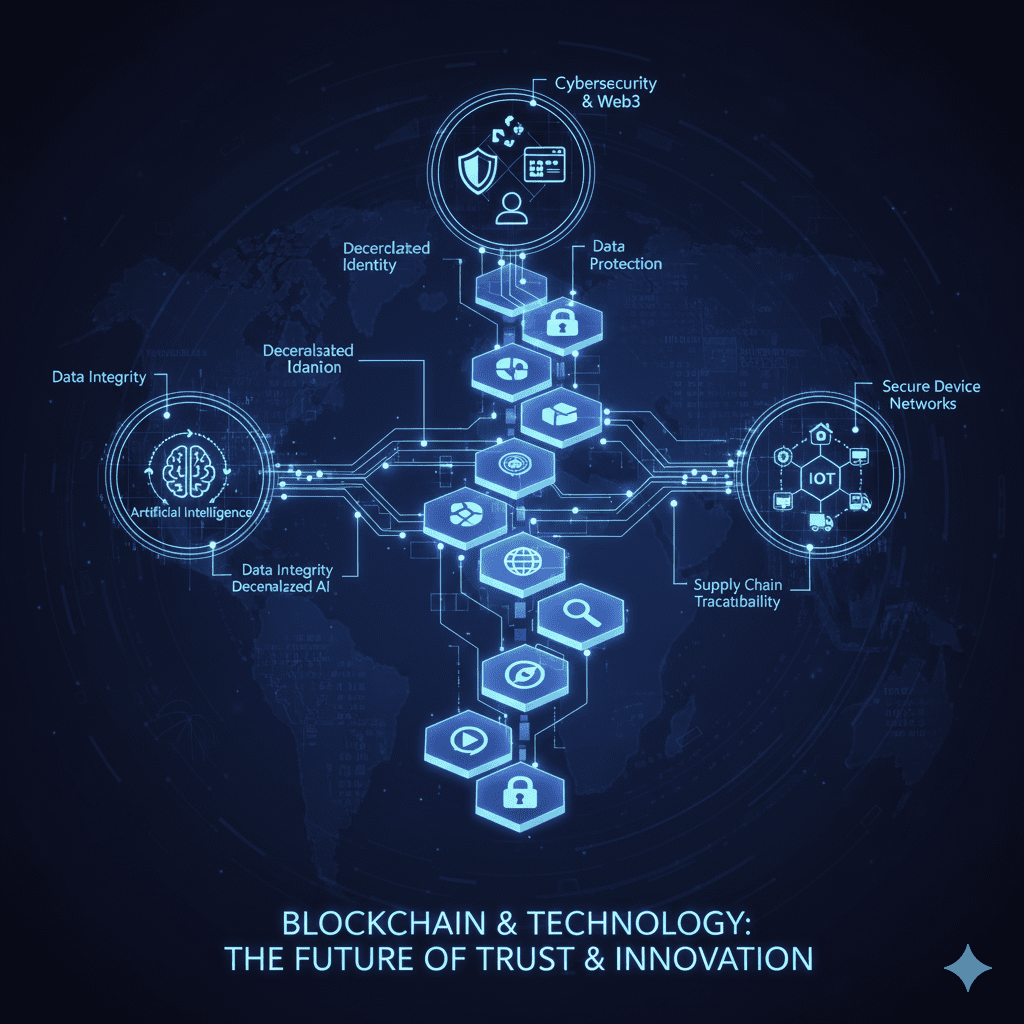
A futuristic infographic titled 'BLOCKCHAIN & TECHNOLOGY,' showing a central blockchain icon connected to other technologies like AI, IoT, Cybersecurity, DeFi, NFTs, and Web3.
Blockchain & Technology

Blockchain’s Role in Building Tomorrow’s Tech

Introduction What do AI, cybersecurity, and the future of the internet (Web3) have in common? They all have critical problems with trust, security, and centralization. Blockchain technology is emerging as the key solution to all three. It’s the invisible architecture that provides the security for our data, the transparency for our transactions, and the ownership of our digital assets. Let’s dive into the technology ecosystem that blockchain is building right now. What is Blockchain? At its simplest, a blockchain is a secure, digital ledger that is shared among many computers in a network. Once a piece of information (a “block”) is added to the ledger, it is linked to the previous block using cryptography, creating a “chain.” This structure makes it immutable, meaning once data is recorded, it is extremely difficult to change or remove. Core Components Decentralization: Instead of one person or company controlling the ledger (like a single bank), the ledger is copied and spread across many computers. This means no single entity has control, and there is no single point of failure. Cryptography: Every transaction is secured and verified using advanced math. This ensures that only the rightful owner can access their assets and that all records are authentic. Blocks: These are the “pages” of the ledger. Each block contains a batch of recent, verified transactions. Consensus Mechanism: This is the “rulebook” that the network follows to agree on which transactions are valid and can be added to the chain (e.g., Proof-of-Work or Proof-of-Stake). The Big Trends: Web3, DeFi, and NFTs Blockchain is the foundational technology for several major trends: Web3: This is the idea of a new, decentralized internet. Web1 was the “read-only” internet (static websites). Web2 is the “read-write” internet we use today (social media, user-generated content), but it’s controlled by large tech companies. Web3 aims to be a “read-write-own” internet, where users control their own data and identity using blockchain. DeFi (Decentralized Finance): This is an entire ecosystem of financial applications built on blockchain. It aims to recreate traditional financial systems (like lending, borrowing, and trading) without the need for intermediaries like banks. Users interact directly with smart contracts. NFTs (Non-Fungible Tokens): An NFT is a unique digital certificate of ownership for an asset (like a piece of digital art, a collectible, or even a real-world item). “Non-fungible” means it’s one-of-a-kind and cannot be replaced by another, unlike a dollar bill, which is fungible. This ownership is recorded and verifiable on the blockchain. Blockchain’s Integration with Other Technologies Blockchain doesn’t exist in a bubble. Its real power is unlocked when combined with other technologies. 1. Artificial Intelligence (AI) Data Integrity: AI models are only as good as the data they’re trained on. Blockchain can provide an immutable, verifiable audit trail for AI training data, ensuring it hasn’t been tampered with and proving its origin. Decentralized AI: It enables “Federated Learning,” where an AI model can be trained across multiple devices without the users’ private data ever leaving their device. The blockchain is used to log and verify the model’s updates, protecting user privacy. 2. Internet of Things (IoT) Security: IoT networks often have thousands of simple devices (like sensors) that are vulnerable to hacking. Blockchain can create a secure, decentralized network for these devices to communicate directly and verifiably, preventing a central server from being hacked. Traceability: For supply chains, an IoT sensor can log a package’s temperature and location to a blockchain at every step. This creates a tamper-proof record that all parties (the producer, the shipper, the customer) can trust. 3. Cybersecurity Decentralized Identity: Instead of relying on Google or Facebook to log in to websites, blockchain allows for Self-Sovereign Identity (SSI). You would control your own digital identity, stored securely, and grant specific, temporary access to services that need to verify it. Mitigating Attacks: By decentralizing data storage, blockchain can help prevent large-scale data breaches. It also makes systems more resilient to Distributed Denial of Service (DDoS) attacks, as there is no single central server to overwhelm Conclusion In conclusion, blockchain has evolved far beyond its origins in cryptocurrency. It is now the essential “trust layer” for the next generation of technology. By providing a decentralized, immutable, and transparent ledger, it solves the critical vulnerabilities in our current systems. It’s the thread that securely connects AI models to verifiable data, enables IoT devices to communicate without a central point of failure, and provides the very foundation for a user-owned internet in Web3, DeFi, and NFTs. As we move forward, it’s clear that blockchain isn’t just another technology in the stack; it’s the fundamental architecture the future is being built on. FAQ Q1: What is blockchain in the simplest terms? Blockchain is a digital ledger, like a shared notebook, that is duplicated and spread across many computers. Once a transaction (a “block”) is added to this notebook, it’s cryptographically linked to the one before it, creating a “chain.” This structure makes the data immutable, meaning it’s nearly impossible to change or tamper with. Q2: Isn’t blockchain just for Bitcoin and cryptocurrency? No. While Bitcoin was the first major application, it’s just one use case. Blockchain is the underlying technology that enables cryptocurrencies, but its core value is in providing a secure and decentralized way to record any kind of data. It’s now being used in supply chains, healthcare, voting systems, cybersecurity, and more. Q3: What’s the difference between Blockchain and Web3? Think of blockchain as the tool and Web3 as the movement. Blockchain is the specific technology (a decentralized ledger). Web3 is the broader vision for a new, decentralized internet built using tools like blockchain, crypto, and decentralized networks. Web3’s goal is to shift control from large tech companies to individual users. Q4: How does blockchain work with Artificial Intelligence (AI)? Blockchain can be seen as the “source of truth” for AI. Data Integrity: It provides a tamper-proof log of the data used to train an AI model, so you can verify its origin and quality. Privacy: It enables federated learning,

How would you like me to respond?

Select a personality for your AI assistant

Normal
Happy
Sad
Angry

Your selection will affect how the AI assistant responds to your messages

Chat Assistant

Let's discuss your project!

Hear from our clients and why 3000+ businesses trust TechOTD

Tell us what you need, and we'll get back with a cost and timeline estimate

Scroll to Top