
custom development

Gaming

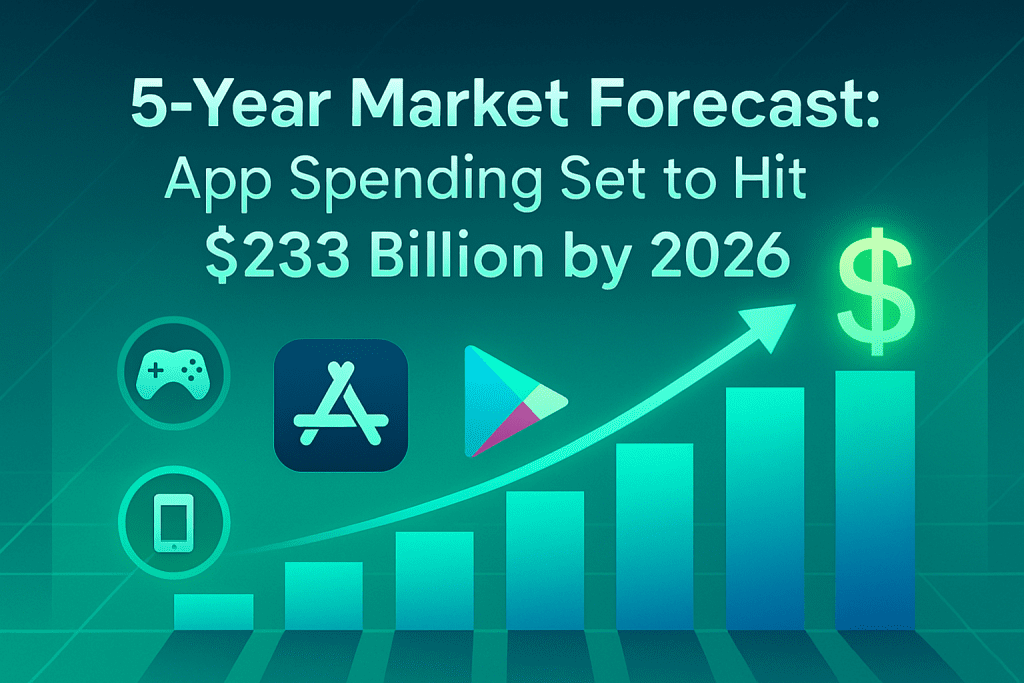
5-Year Market Forecast: App Spending Set to Hit $233 Billion by 2026

Introduction As the digital economy continues its explosive growth, mobile app spending is breaking new records. By 2026, global expenditures in mobile apps—including premium downloads, in-app purchases, and subscriptions—are forecasted to reach an unprecedented $233 billion. For businesses, developers, and tech leaders, understanding this evolving landscape is essential to maximize growth and make future-ready decisions. In this blog, we analyze the market’s trajectory, highlight key growth drivers, and provide actionable insights—with direct links to TechOTD’s expert IT, AI, and development services to help you capitalize on these booming trends.   2021–2026 App Economy Surge Global app spend is projected to hit $233 billion by 2026—a 77% leap from $132 billion in 2021. This growth is powered by the ongoing digital transformation seen across industries and regions. Platform Breakdown Apple App Store: Anticipated to reach $161 billion in revenue with a CAGR of 13.7%. Google Play Store: Forecasted to grow to $72 billion, with an 8.9% CAGR. Regional Insights United States: Leads global growth, forecasted at $86 billion (16.5% CAGR). Asia-Pacific: Remains the largest market for first-time downloads, fueled by rising smartphone penetration and affordable connectivity. Emerging Categories Non-gaming app categories such as entertainment, productivity, and healthcare are now rivaling gaming, with non-gaming apps expected to comprise 57% of iOS revenue by 2026. Top Factors Driving Market Growth 1. Digital Acceleration Post-2020 Pandemic-driven habits (remote work, remote learning, online buying) have become permanent, boosting demand for both consumer and enterprise apps. Brands are expanding digital offerings to stay competitive—see how digital solutions can modernize your workflows at TechOTD. 2. Rise of Non-Gaming App Revenue Beyond mobile games, categories like social networking, streaming, business, and eCommerce apps are seeing record growth. Leverage industry-focused app innovation and strategy through TechOTD’s AI Solutions and Industry Services. 3. Recurring Revenue Models (Subscriptions) Subscription-based revenue is dominating app monetization, leading to higher lifetime value per user. Ensure your app’s backend supports scalable infrastructure by partnering with TechOTD’s Web & App Development Team. 4. Continued First-Time Downloads App downloads are projected to hit 181 billion in 2026, led by emerging markets and expanding internet access. Businesses must optimize onboarding and long-term retention, strategies that TechOTD can help implement for both consumer and B2B apps. Actionable Insights for Business and Developers Invest in Non-Gaming Vertical Apps As user preferences diversify, now’s the time to innovate with apps in finance, health, education, and productivity. Capitalize on Subscriptions & Cloud Integration Build for recurring revenue and global scale. TechOTD’s cloud and AI expertise ensures seamless growth and personalized experiences. Optimize for Regional Growth Hotspots Adapt user journeys and payment strategies for growth markets like Asia-Pacific and North America. Future-Proof with AI and Analytics Data-driven insights and machine learning will be at the heart of profitable apps—explore custom AI integration at TechOTD AI. Partner for End-to-End Excellence From ideation to deployment and lifecycle support, trust TechOTD for web, mobile, and enterprise application success. Conclusion Mobile app spending is on track to redefine the global digital economy, soaring toward $233 billion in just five years. For brands, startups, and enterprises, opportunity lies in pairing innovative products with robust development and growth strategies. As digital transformation accelerates worldwide, let your app leverage the tools, partnerships, and expertise of leaders like TechOTD—and secure your place at the frontier of the $233 billion app economy. FAQ 1. What is the projected global app spending in 2026? Global app expenditure is forecasted to reach $233 billion by 2026, led by strong growth in both iOS and Android markets. 2. Which platform will be the biggest revenue driver? The Apple App Store will continue to lead in overall revenue, while Google Play drives a majority of downloads from emerging regions. 3. Will non-gaming apps overtake games in revenue share? Yes, on the App Store, non-gaming apps are expected to comprise 57% of total revenue by 2026. 4. What is the CAGR for overall global app spending? The compound annual growth rate is predicted at 12% from 2021 to 2026. 5. How can I position my app for success in this market? Focus on solving real problems, leverage cloud and AI, invest in scalable infrastructure, and partner with comprehensive IT experts like TechOTD.
Software development

Custom Development vs White Label Solutions: Choosing What’s Best for Your Business

Introduction In today’s hyper-competitive digital world, selecting the right software strategy is crucial for business growth. Should your business invest in a bespoke solution tailored to your unique vision through custom development, or opt for a white label solution for fast, cost-effective deployment? This guide explores the key differences, benefits, and limitations of both approaches—empowering you to make an informed decision in line with your growth targets, market, and resources. Key Differences Between Custom Development and White Label Solutions Aspect Custom Development White Label Solutions Customization Built from scratch to fit your business’s requirements. Full control over features, branding, scalability, and security. Web & Software Development Pre-built, ready-to-deploy software. Customizable mainly for branding/interface. Explore Solutions Investment Higher upfront investment, potentially lower long-term cost (no ongoing vendor licenses). Your dedicated development partner: About Techotd Lower initial cost, but ongoing subscription/licensing fees may add up over time. Deployment Speed Requires skilled team and longer timelines—often months to years for complex projects. Rapid market entry—often deployable in weeks. eCommerce & More Support & Updates Managed by your in-house or dedicated team. Requires continuous investment in updates/security. Partner for Innovation Vendor provides technical support and product updates. Autonomy may be limited by provider’s roadmap. Scalability Infinite scalability and evolving features tailored to your growth. AI/ML Expertise Scalability is dependent on the vendor’s platform capabilities. Modifications are restricted. Use Cases Custom Development: Best for highly regulated industries (fintech, healthcare), unique SaaS, solutions demanding maximum compliance, complex workflows. See: Healthcare Solutions White Label Solutions: Ideal for startups, agencies, e-commerce businesses, and organizations needing fast, low-risk entry. See: eCommerce Platforms Weighing the Pros and Cons Advantages Custom Development Unique features and branding for a true competitive edge. Unlimited scalability and flexibility. Security tailored to compliance and industry specifics. May lower total cost of ownership in the long run. In-house or dedicated support ensures alignment and faster innovation. White Label Solutions Go live in weeks, not months. Low initial costs—make technology accessible for any size business. Pre-tested, vendor-maintained software means fewer technical hurdles. Focus on your core business; tech is managed by the solution provider. Limitations Custom Development High upfront investment and long project cycles. Ongoing expenses for maintenance, security, updates. Risk of delays or overruns if requirements change or expertise is lacking. White Label Solutions Limited ability to differentiate your brand. Customization confined mainly to aesthetics and minor features. Vendor lock-in risks and recurring costs. Scalability and compliance may be hindered by vendor limitations. Support and updates are dictated by the solution provider’s priorities. Conclusion Choosing between custom development and white label solutions depends on your organization’s vision, resource availability, and growth ambitions. If rapid launch and minimal investment are your priorities, a white label approach is practical. For businesses focused on unique positioning, advanced features, and long-term competitiveness, investing in custom development is a strategic move. Ready to elevate your business? Connect with TechOTD’s experts, assess your needs, and prepare for future-ready digital growth. FAQ 1. What is the biggest difference between custom development and white label solutions? Custom development is fully tailored, while white label is ready-made and limited to superficial customization. 2. Which approach is more cost-effective? White label is cheaper up front, but custom solutions may cost less long-term by avoiding subscription/vendor fees. 3. Does custom development guarantee faster business growth? It boosts long-term competitiveness via uniqueness and scalability, but doesn’t guarantee immediate gains. 4. Can white label solutions be customized for unique needs? Mostly limited to branding/interface tweaks—not deep feature or workflow changes. 5. When should I choose a white label solution? If you need to go to market quickly, have a limited budget, or don’t need complex integrations.

How would you like me to respond?

Select a personality for your AI assistant

Normal
Happy
Sad
Angry

Your selection will affect how the AI assistant responds to your messages

Chat Assistant

Let's discuss your project!

Hear from our clients and why 3000+ businesses trust TechOTD

Tell us what you need, and we'll get back with a cost and timeline estimate

Scroll to Top