

business agility

DEVOPs

DevOps Maturity: Why It Matters and How Business Leaders Can Achieve It

Introduction DevOps maturity is no longer a luxury; it’s a strategic imperative for organizations competing in today’s fast-paced digital world. Achieving higher levels of DevOps maturity moves businesses from manual, error-prone deployments to automated, collaborative, and adaptive operations. For business leaders, understanding and investing in DevOps maturity means faster releases, more reliable software, and sustained innovation. Platforms like TechOTD offer guidance, tools, and proven practices to help enterprises accelerate this journey. What is DevOps Maturity and Why Does It Matter? DevOps maturity is a measure of how fully an organization has adopted and integrated DevOps practices across culture, automation, and measurement. The maturity model typically features five stages: Initial: Manual processes, siloed teams, minimal collaboration. Managed: Introduction of automation, some repeatability, and improved collaboration. Defined: Widespread automation, standardized processes, organization-wide DevOps adoption. Measured: Data-driven decision-making, performance tracked against key metrics, continuous improvement. Optimized: Full integration, ongoing innovation, and seamless, secure operations. Why It Matters Accelerated Delivery: Mature DevOps teams rapidly release software, shorten feedback loops, and respond faster to market changes. Enhanced Reliability: Automated testing, deployment, and monitoring reduce downtime, failures, and manual errors. Operational Efficiency: Streamlining workflows and boosting resource usage helps lower costs and maximize value. Innovation and Scalability: Organizations with mature DevOps are better positioned to try new ideas and scale both systems and teams. Cross-Functional Collaboration: Collaboration across development, operations, and security improves quality and agility while reducing bottlenecks. How Business Leaders Can Achieve DevOps Maturity Secure Executive Buy-In Leadership commitment is crucial for resource investment and company-wide alignment around DevOps principles. Assess Current State Conduct honest maturity assessments to pinpoint strengths, gaps, and the starting baseline. Involve engineers and stakeholders for a holistic view. Set Stage-Wise, Realistic Goals Don’t attempt “perfection” immediately. Set achievable milestones for each maturity stage: automation, CI/CD rollout, cultural transformation, etc.. Foster a Collaborative Culture Break down silos by encouraging collaboration, transparent communication, and a shared sense of ownership between teams. Prioritize Automation (But Iterate Wisely) Automate where it brings the most value—think CI/CD, infrastructure provisioning, and deployment pipelines. Document improvements, expand gradually, and address bottlenecks. Measure, Adapt, and Improve Use key metrics (like deployment frequency, change failure rate, lead time, and MTTR) to monitor progress and tie efforts back to business results. Scale & Standardize Best Practices Share successes across teams, create playbooks, and encourage feedback cycles that spread hard-won lessons throughout the organization. Conclusion DevOps maturity is a journey—not a final destination. As business leaders, driving this progression means delivering software faster, safer, and more reliably, which fuels innovation and competitive advantage. Invest in cultural shifts, automation, and continuous improvement—leveraging platforms like TechOTD for tailored solutions—so your organization can thrive in an always-evolving digital ecosystem. FAQ 1. What are the most important DevOps maturity metrics for leaders? Deployment frequency, lead time for changes, change failure rate, and mean time to recovery (MTTR) are industry benchmarks. 2. How do cultural changes affect DevOps maturity? Culture is foundational; transparency, trust, and collaboration are what break down silos and empower innovation. 3. Can small teams achieve high DevOps maturity? Absolutely! Smaller teams often move quickly and can be early adopters—maturity can then be scaled organization-wide. 4. What’s the biggest hurdle for most companies? Aligning culture and processes; technology can be adopted, but mindset change and cross-functional collaboration take conscious leadership. 5. Where do I start if my organization is at Level 1 or 2? Begin with foundational automation (like version control and CI), foster collaboration, and build feedback loops through measurement
Cloud

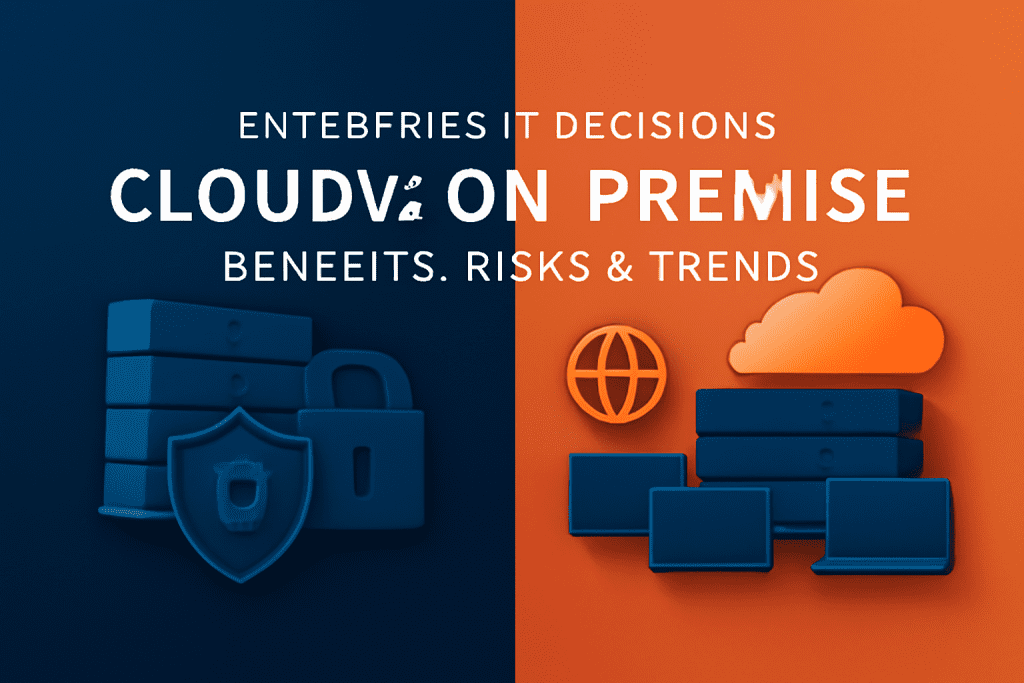
Enterprise IT Decisions: Comparing Cloud and On-Premise Benefits & Risks

Introduction In today’s era of digital acceleration, choosing the right IT infrastructure—cloud or on-premise—is a major strategic decision that can fuel your enterprise’s performance, security, and innovation. As market demands shift toward agility, scalability, and compliance, understanding the advantages, challenges, and modernization trends for each option is essential. This blog unpacks core differences, sector-specific examples, benefits, limitations, and real-world adoption trends—so you can make an informed, future-focused IT choice that propels your business forward. What Are Cloud and On-Premise IT Infrastructures? Cloud: IT services (servers, storage, databases, networking, analytics, and software) delivered over the internet by external providers. Explore Cloud Solutions On-Premise: Computing resources are installed and maintained on-site at your organization’s facility, with full direct control by your IT team. IT Consulting & On-Premises Solutions Key Differences: Cloud vs On-Premise Aspect Cloud On-Premise Deployment Off-site (third-party provider), accessed via internet. Cloud Services On-site (organization’s premises), your IT manages setup. IT Consulting Cost Low upfront investment (OpEx); subscription/pay-per-use billing. AI Solutions High upfront investment (CapEx); ongoing hardware/software costs. Scalability Elastic—scale up/down instantly. Data Analytics Scaling requires buying/installing new hardware—slower and costlier. Security & Control Provider-managed security and compliance certifications; some loss of direct control. Full direct data/control management; meets strict regulatory/industry needs. Accessibility Global access, ideal for hybrid/remote teams. Physical/campus access; remote requires extra configuration. Maintenance Provider manages updates, patches, disaster recovery. Your IT team maintains everything, from system updates to security. Vendor Lock-In Potential for dependency/migration challenges. No vendor lock, but older systems can be hard/expensive to integrate. Performance Flexible capacity, variable latency based on network quality. Direct control for ultra-low latency and critical workloads. Benefits & Risks: Cloud vs On-Premise Cloud Benefits Agility: Deploy new resources, apps, and sites quickly—supporting market expansion and innovation. Cost-Efficiency: Only pay for what you use; no expensive upfront hardware. Reduced IT Burden: Provider manages uptime, upgrades, and security. Business Continuity: Robust backup and disaster recovery. Remote-Ready: Enables global collaboration and hybrid teams. Cloud Risks Internet outages can cause downtime. Less direct control over sensitive data. Vendor lock-in risk if not planned for from the start. Ongoing operational costs. On-Premise Benefits Full Control: Customize security, compliance, hardware, and integrations for your needs. Regulatory Compliance: Simpler to meet industry/national data regulations (e.g., finance, healthcare). Performance: Low latency for mission-critical real-time operations. Customization: Tailor IT systems for unique or legacy workflows. On-Premise Risks Large upfront investment in hardware/facilities. All maintenance, upgrades, and support handled internally. Scaling and modernization can be slow and disruptive. Requires a larger, skilled IT team. Enterprise Use Cases & Industry Examples When Cloud Excels Retail: Instantly scale resources for sales peaks and geographic expansion. SaaS/Startups: Launch quickly, experiment safely, avoid infrastructure investment. Remote Collaboration: Enable global teams, file sharing, secure mobile and desktop access. Data Analytics/ML: Run big data or AI workloads dynamically. When On-Premise Is Ideal Banking/Finance: Regulatory oversight, data residency, high-frequency trading. Healthcare: HIPAA, medical record security, legacy system integration. Energy/Government: National security, control over access, strict privacy compliance. Modern Trends: Hybrid and Multi-Cloud Today’s enterprises often blend cloud and on-premise environments (“hybrid” or “multi-cloud”) to balance speed, compliance, and cost efficiency. Hybrid: Keep sensitive/regulated workloads on-premise and leverage cloud for agility, collaboration, and scale. Edge Computing: Combine on-premise/edge servers with cloud for ultra-fast operations (e.g., smart manufacturing, logistics). Stay ahead: Contact TechOTD’s experts for a custom roadmap Conclusion There’s no universal choice—your decision should reflect your unique business goals, industry requirements, and growth strategy. Choose cloud for agility, cost savings, and digital transformation. Choose on-premise for total control, compliance, and customized performance. For many, a hybrid strategy maximizes the advantages of both worlds. Ready to transform your IT? Visit TechOTD’s solutions hub or connect with our experts to shape the future of your enterprise IT. FAQ 1. Is cloud or on-premise more secure? Cloud vendors offer strong security, but on-premise gives you direct oversight. The safest path depends on compliance needs and your IT team’s expertise. 2. Which option costs less long-term? Cloud is cheaper up front and for dynamic workloads; on-premise may save money at scale, but needs careful management. 3. Can enterprises mix cloud with on-premise? Yes—the hybrid approach is powerful for balancing flexibility with control. 4. How do I avoid vendor lock-in with cloud? Choose platforms supporting open standards and plan migration strategies early. 5. Is on-premise IT outdated? No. It’s vital for compliance-heavy sectors and advanced when integrated with cloud or edge.

How would you like me to respond?

Select a personality for your AI assistant

Normal
Happy
Sad
Angry

Your selection will affect how the AI assistant responds to your messages

Chat Assistant

Let's discuss your project!

Hear from our clients and why 3000+ businesses trust TechOTD

Tell us what you need, and we'll get back with a cost and timeline estimate

Scroll to Top