
backend development

Cloud Computing and Technology, Software development, Technology & Product Development

Firebase vs Supabase

Firebase vs Supabase: The Ultimate Architectural and Backend Comparison When building a modern Software-as-a-Service (SaaS) application, mobile app, or web platform, speed-to-market is everything. Writing boilerplate backend code—handling user authentication, provisioning databases, managing object storage, and setting up WebSocket servers for real-time synchronization—is no longer a productive use of engineering time. This reality gave rise to the Backend-as-a-Service (BaaS) paradigm. For years, Google’s Firebase was the undisputed champion of the BaaS landscape. However, the developer ecosystem has witnessed a massive structural shift with the rise of Supabase, a powerful, open-source alternative built on a completely different architectural philosophy. Choosing between Firebase and Supabase is not just a preference of brands; it is a foundational architectural decision that dictates how your data is structured, how your application scales, and whether your engineering team will face massive vendor lock-in. This production-grade guide breaks down the core technical differences between these two titans. 1. Core Philosophy: Proprietary NoSQL vs. Open-Source Relational The most significant divergence between Firebase and Supabase lies in their underlying data storage engines and licensing models. Firebase Architecture (Proprietary Document NoSQL) [App Client] —> [Firestore API] —> [Nested JSON Documents] (Schemaless, Implicit Relationships) Supabase Architecture (Open-Source Relational SQL) [App Client] —> [PostgREST / Kong] —> [PostgreSQL Engine] (Strict Schema, Relations, Foreign Keys) Firebase: The Document-Based Monolith Firebase is a proprietary suite of tools managed entirely by Google. At its core sits Cloud Firestore, a cloud-hosted, schemaless, document-oriented NoSQL database. Data Layout: Data is stored as collections of JSON-like documents. Relationships are implicit, often requiring data duplication (denormalization) or complex sub-collections to structure enterprise assets. The Lock-In Reality: Firebase’s underlying infrastructure is closed-source. Moving away from Firebase later in an application’s lifecycle requires a complete rewrite of your database schema, query logic, and client-side SDK code. Supabase: The Power of Raw PostgreSQL Supabase frames its entire identity around a simple premise: giving developers the scalability of a BaaS without sacrificing the power of a relational database. Supabase is completely open-source and built on top of an enterprise-grade PostgreSQL database engine. Data Layout: Data is structured strictly in tables with defined schemas, explicit data types, primary keys, and foreign key relationships. The Open-Source Escape Hatch: Because Supabase is a wrapper around standard PostgreSQL, there is zero vendor lock-in. If you ever outgrow the Supabase platform, you can export your raw SQL dump and host it on AWS RDS, DigitalOcean, or your own bare-metal servers with absolute ease. 2. Database Performance and Query Capabilities Your database’s ability to filter, aggregate, and process complex data relationships directly impacts application latency and frontend responsiveness. Complex Queries and Data Relations Firebase Constraints: Firestore scales read operations incredibly well because every query is shallow—it fetches only the documents you ask for. However, because it is NoSQL, executing complex relational joins, full-text searches, or multi-attribute aggregations (like calculating a cumulative average across millions of rows) is notoriously difficult. Developers are often forced to write extensive client-side code or cloud functions to stitch data back together. Supabase Flexibility: Because Supabase exposes the full power of PostgreSQL, you can write native SQL joins, views, and complex aggregations directly via their JavaScript/TypeScript SDK. Utilizing tools like PostgREST, Supabase translates your client-side queries into highly optimized SQL execution paths automatically. Machine Learning and AI Readiness The modern engineering landscape demands native support for vector tracking to build AI-driven features like semantic search, recommendation algorithms, or RAG models. Firebase: Relies on third-party integrations (like Pinecone or Google Cloud Vertex AI extensions) to handle heavy vector embeddings outside the primary Firestore database environment. Supabase: Features native integration with pgvector, a highly efficient PostgreSQL extension. This allows developers to store vector embeddings, generate high-dimensional data profiles, and execute similarity searches directly within their core relational database tables. 3. Real-Time Synchronization Architecture Both platforms excel at pushing instantaneous data updates to connected clients (e.g., updating a live chat feed, collaborative dashboards, or real-time location maps), but their network mechanics are fundamentally different. Firebase Realtime Database and Firestore Listeners Firebase establishes a persistent WebSocket connection between the client app and Google’s cloud network. When data changes in a document, Firebase pushes the entire updated document snapshot down to the listening clients. This architecture is highly optimized for scale, but it can become expensive and bandwidth-heavy if large documents change frequently, as users download the entire JSON payload on every minor variable update. Supabase Realtime Server Supabase achieves real-time functionality through a dedicated, open-source Elixir server called Realtime, which listens directly to PostgreSQL’s Write-Ahead Log (WAL). How It Works: When an INSERT, UPDATE, or DELETE transaction hits the PostgreSQL database, the Realtime engine intercepts the change from the log file and broadcasts it down to listening client sockets. Granular Control: Supabase allows you to toggle real-time replication on a per-table basis. You can broadcast only specific data rows or narrow column value changes, drastically reducing client-side data consumption. 4. Authentication, Security, and Row-Level Security (RLS) Securing data on a backend-less application requires robust mechanisms to ensure users can only read or write information they are explicitly authorized to access. Firebase Security Rules Firebase utilizes a proprietary declarative scripting language to secure Firestore documents and Storage buckets. JavaScript // Firebase Security Rules Example match /databases/{database}/documents { match /orders/{orderId} { allow read, write: if request.auth != null && request.auth.uid == resource.data.userId; } } While flexible, Firebase rules can quickly become complex, verbose, and difficult to test locally as an application’s permission matrix grows. Supabase Row-Level Security (RLS) Supabase entirely offloads security logic to the database layer by utilizing native PostgreSQL Row-Level Security (RLS). SQL — Supabase PostgreSQL RLS Example CREATE POLICY “Users can only view their own orders” ON orders FOR SELECT USING (auth.uid() = user_id); Because authorization logic is tied directly to your core SQL definitions, your data remains impenetrable whether a user attempts to access it via the JavaScript SDK, a direct GraphQL endpoint, a backend migration tool, or raw SQL access. 5. Pricing Models and Token Economics A platform’s pricing structure can make or break a

cybersecurity, Digital Transformation, Software development, Technology & Innovation

Serverless Architecture Explained

Serverless Architecture Explained: The Ultimate Guide to Event-Driven, No-Ops Development For decades, deploying a software application followed a predictable, rigid formula: lease a physical server, configure the operating system, set up web servers, and pray your traffic estimations were accurate. If you undershot, your site crashed under unexpected load. If you overshot, you wasted thousands of dollars maintaining idle computing power. The cloud era mitigated this via virtualization and auto-scaling, but developers still had to manage, patch, secure, and scale those virtual machines. Serverless architecture completely shatters this paradigm. Despite the name, “serverless” doesn’t mean servers are no longer involved; it means developers are completely abstracted from them. The cloud vendor handles provisioning, scaling, maintaining, and upgrading the infrastructure automatically. You write the code; the cloud takes care of the rest. This 3,000+ word deep-dive will break down the mechanics, core components, operational benefits, patterns, pitfalls, and future outlook of serverless development to give you a definitive implementation blueprint. 1. Defining Serverless Architecture: The Core Pillars To understand serverless, we must look past the marketing hype and focus on its four foundational engineering characteristics: ┌────────────────────────────────────────────────────────┐ │ The 4 Pillars of Serverless │ ├───────────────────────────┬────────────────────────────┤ │ 1. Zero Infrastructure │ 2. Automated Hyper-Scaling │ │ Management │ (Scale-to-Zero) │ ├───────────────────────────┼────────────────────────────┤ │ 3. Pay-per-Use Billing │ 4. Built-in Fault │ │ (Down to the Millisecond)│ Tolerance │ └───────────────────────────┴────────────────────────────┘ Zero Infrastructure Management: Developers do not provision, patch, manage, or maintain underlying operating systems, runtimes, or container hardware. Automated Hyper-Scaling: The infrastructure automatically scales up or down in precise correlation to incoming traffic. If you receive one request, one instance runs. If you receive 100,000 simultaneous requests, the vendor instantly provisions thousands of execution environments. Scale-to-Zero (Pay-per-Use): When your application is idle, zero computing resources are active. You pay absolutely nothing for idle time. Billing is calculated down to the millisecond of actual execution time and memory consumed. Built-in Fault Tolerance: Serverless services inherently span multiple availability zones and regions by default, providing high availability without manual setup. 2. FaaS vs. BaaS: The Two Sides of Serverless Serverless architecture is broadly divided into two complementary conceptual spaces: Function-as-a-Service (FaaS) and Backend-as-a-Service (BaaS). Function-as-a-Service (FaaS) FaaS is the computational heartbeat of serverless. Instead of deploying a monolithic web application that sits running continuously, developers break application logic down into small, ephemeral, single-purpose functions. These functions are completely stateless and are triggered exclusively by specific system events (e.g., an HTTP request, a new file upload, or a database modification). Key Characteristics: Short lifespans (typically timed out after 15 minutes), stateless execution, and rapid startup times. Examples: AWS Lambda, Google Cloud Functions, Azure Functions. Backend-as-a-Service (BaaS) A serverless ecosystem cannot survive on stateless computation alone; it requires supporting cloud services that follow the exact same serverless scaling and billing principles. This is BaaS. Instead of deploying and managing a database cluster (like PostgreSQL) or a message broker (like RabbitMQ), developers leverage fully managed, API-driven cloud services. Databases: Serverless NoSQL or SQL options (e.g., Amazon DynamoDB, Google Cloud Firestore, Aurora Serverless). Authentication: Managed identity solutions (e.g., AWS Cognito, Auth0). Storage: Scalable object stores (e.g., Amazon S3, Google Cloud Storage). 3. The Lifecycle of an Event-Driven Serverless Function Unlike traditional server environments where an application loops continuously listening for requests on a port, serverless runs on a strictly event-driven architecture. ┌───────────┐ ┌───────────────┐ ┌───────────────────────┐ ┌────────────┐ │ Event │ ───> │ API Gateway / │ ───> │ Function Execution │ ───> │ BaaS / DB │ │ Trigger │ │ Event Router │ │ (Ephemeral Container) │ │ Write │ └───────────┘ └───────────────┘ └───────────────────────┘ └────────────┘ The Request Execution Chain: The Trigger: An external event occurs. For example, a user uploads a high-resolution image to a cloud storage bucket. The Routing: The cloud provider detects the bucket state change and maps it to a designated FaaS function handler. Container Provisioning: If no active container instance is waiting (a “cold start”), the provider initializes an isolated micro-container environment, loads your code package, and spins up the language runtime. Execution: The function executes its explicit single purpose (e.g., reads the image, resizes it into a thumbnail, and writes it back to another bucket). Teardown or Freeze: Once the function returns a response, the container is frozen for a brief period to handle immediate subsequent requests. If no other requests arrive, it is destroyed. 4. Comprehensive Architecture Comparison Architectural Metric Traditional Tiered (IaaS/PaaS) Serverless Architecture (FaaS/BaaS) Scaling Capacity Manual or rule-based auto-scaling (e.g., Scale when CPU > 70%). Takes minutes. Instantaneous, micro-second scaling matching request concurrency perfectly. Cost Efficiency Paid hourly/monthly per instance, regardless of actual load or idle status. Paid strictly per execution count, memory allocation, and run duration. Maintenance Overheads OS updates, security vulnerability patching, and runtime updates required. Vendor manages full OS, base images, software environments, and updates. State Management State can be easily held locally in server memory or local disk file sessions. Inherently stateless. State must be externalized to cache layers or databases. Max Execution Limits Indefinite. Long-running processes, cron jobs, and background workers run forever. Strict runtime limits (e.g., 15 minutes max per invocation on AWS Lambda). 5. Architectural Blueprints & Design Patterns Serverless shines brightest when combined with modern design patterns optimized for decentralized systems. Let’s look at three standard operational patterns. Pattern 1: The Modern REST API / Microservice In a serverless web API, traditional frameworks like Express.js or Spring Boot are replaced by decoupled event-handlers connected to an intelligent proxy gateway. [ Client Request ] ──> [ API Gateway ] ──> [ AWS Lambda ] ──> [ DynamoDB ] API Gateway: Acts as the public-facing router, handling SSL termination, rate limiting, CORS configurations, and routing public endpoints to explicit functions. Lambda Functions: Each endpoint route (e.g., POST /orders, GET /orders/{id}) executes an independent function, isolating failures completely. Pattern 2: Asynchronous Data Processing Pipelines Processing intensive operations asynchronously keeps frontend services responsive and prevents system bottlenecks. [ Large File Upload ] ──> [ S3 Bucket ] ──> [ S3 Event Trigger ] ──> [ Lambda Processor ] Execution:

Frontend vs backend vs full stack software development comparison
Software development

Frontend vs Backend vs Full Stack Development: A Complete Software Development Guide

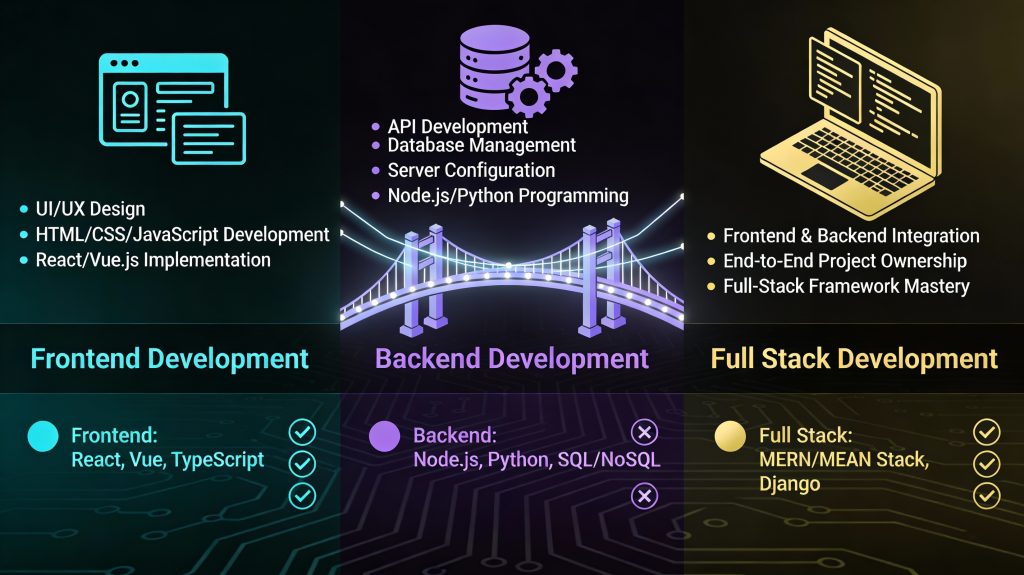
Introduction Modern software applications are built using multiple layers of technology, each responsible for a specific part of the system. To manage this complexity, software development roles are commonly divided into frontend, backend, and full stack development. Understanding these roles is essential for businesses planning projects and individuals choosing a career in software development. Each role requires different skills, tools, and responsibilities but works together to create functional, user-friendly applications. In this blog, we’ll explore frontend vs backend vs full stack development, compare their responsibilities, technologies, career paths, and help you decide which role best fits your goals. What Is Frontend Development? Frontend development focuses on the user interface (UI) and user experience (UX) of an application. It involves everything users see and interact with in a browser or mobile app. Key Responsibilities Designing layouts and user interfaces Implementing responsive designs Optimizing performance Ensuring cross-browser compatibility Frontend Technologies HTML, CSS, JavaScript Frameworks: React, Angular, Vue Styling tools: Tailwind, Bootstrap Build tools: Webpack, Vite Skills Required UI/UX principles Responsive design Performance optimization Frontend developers ensure that applications are visually appealing, intuitive, and fast. What Is Backend Development? Backend development handles the server-side logic that powers an application. It ensures data is processed, stored, and delivered securely. Key Responsibilities Building APIs Managing databases Handling authentication and authorization Ensuring scalability and security Backend Technologies Programming languages: Java, Python, Node.js, PHP Databases: MySQL, PostgreSQL, MongoDB Frameworks: Spring Boot, Django, Express Skills Required Data modeling API design Security practices Backend developers ensure applications function correctly behind the scenes. What Is Full Stack Development? Full stack development combines both frontend and backend responsibilities. A full stack developer can work across the entire application stack. Key Responsibilities Designing user interfaces Developing APIs Managing databases Deploying applications Popular Full Stack Stacks MERN (MongoDB, Express, React, Node.js) MEAN (MongoDB, Express, Angular, Node.js) LAMP (Linux, Apache, MySQL, PHP) Skills Required Frontend and backend expertise System design DevOps basics Full stack developers offer versatility and efficiency. Frontend vs Backend vs Full Stack: Comparison Aspect Frontend Backend Full Stack Focus UI/UX Server & data End-to-end Skills Design, JS Logic, databases Both Tools React, CSS APIs, databases Full stack tools Career Flexibility Moderate Moderate High Which Role Should You Choose? Choose Frontend If You enjoy design and visuals You like user interaction Choose Backend If You enjoy logic and data You prefer system performance Choose Full Stack If You want versatility You enjoy problem-solving across layers Career Opportunities Frontend Developer Backend Developer Full Stack Developer Software Engineer Each role offers strong career growth and demand. Conclusion Frontend, backend, and full stack development are all essential to software development. Each role offers unique challenges and opportunities. Understanding these roles helps teams collaborate effectively and individuals choose the right career path. Frequently Asked Questions (FAQs) 1. Is full stack development harder than frontend or backend? Full stack development requires broader knowledge but offers greater flexibility. 2. Can a frontend developer become full stack? Yes, many developers transition to full stack roles. 3. Which role pays more? Pay depends on skills and experience, not just the role. 4. Do full stack developers replace specialists? No, specialists are still essential for complex projects. 5. Which role is best for beginners? Frontend is often considered beginner-friendly. 6. Are full stack developers in demand? Yes, full stack developers are highly sought after. Connect with us:https://www.facebook.com/profile.php?id=61555452386126  

frontend developer coding modern user interface
Frontend Developer

Frontend vs Backend Development

Introduction When you open a website like Amazon or Netflix, everything you see — from the design to the search bar — is part of the frontend. But when you log in, make a purchase, or stream a movie, the backend is working silently behind the scenes. Both frontend and backend development are essential pillars of modern web development. Though they work together, they involve different skills, tools, and technologies. In this guide, you’ll learn the exact differences between frontend and backend development, the languages used, roles, salaries, and how to choose the right path in 2025. What is Frontend Development? Frontend development, also called client-side development, is all about creating what users see and interact with in their browsers. Frontend developers transform UI/UX designs into functional interfaces using: HTML (Structure) CSS (Styling) JavaScript (Functionality) They ensure the website is responsive, fast, accessible, and user-friendly. Common Frontend Frameworks (2025) React.js — Most popular, backed by Meta. Next.js — For server-side rendering and SEO optimization. Vue.js — Lightweight and easy to learn. Angular — Backed by Google, great for large apps. Example: When you hover over a button and it changes color — that’s frontend. What is Backend Development? Backend development, or server-side development, powers the behind-the-scenes logic that connects the website to the database and manages user requests. It handles: User Authentication (Login/Signup) Database Management Server Logic API Integration Common Backend Languages and Frameworks Node.js (JavaScript) Python (Django, Flask) PHP (Laravel) Java (Spring Boot) Ruby (Rails) Example: When you submit a login form, your details go to the server, get verified, and send a response — that’s backend. Frontend vs Backend — Key Differences Table Feature Frontend Development Backend Development Focus Area User interface (UI) and visuals Logic, database, and server Languages HTML, CSS, JavaScript Node.js, Python, PHP, Java Frameworks React, Vue, Angular Express, Django, Laravel Responsibility Design and interactivity Data handling and business logic Tools VS Code, Figma, Chrome DevTools Postman, Git, Docker Output Visual web pages Functional database connections Goal Better user experience Stable data management How Frontend and Backend Work Together Web development is a collaborative process where frontend and backend communicate constantly. Frontend: Collects user input (like a login form). Backend: Validates and processes the input via an API. Database: Stores or retrieves the data. Frontend: Displays results to the user. Example: When you search for a product on an e-commerce website — Frontend: Displays the search box and product results. Backend: Fetches matching data from the database. Together, they form a Full Stack Web Application. Frontend Developer Role Frontend developers are responsible for building: Responsive web pages Smooth navigation Interactive features (menus, sliders, animations) UI optimization for mobile and desktop They often work closely with UI/UX designers to implement visually appealing and consistent interfaces. Backend Developer Role Backend developers ensure: Secure data management API creation and integration Server configuration Performance optimization They work with databases like MySQL, MongoDB, and PostgreSQL to handle large amounts of data efficiently. Which Has Better Career Scope in 2025? Both roles are in high demand. However, trends show increasing need for frontend developers skilled in React and Next.js, as well as backend developers familiar with Node.js and cloud technologies. Role Demand (2025) Average Salary (India) Frontend Developer Very High ₹5–12 LPA Backend Developer High ₹6–14 LPA Full Stack Developer Extremely High ₹8–20 LPA If you love visuals, creativity, and UI — choose Frontend.If you enjoy logic, databases, and problem-solving — go for Backend. You can also combine both and become a Full Stack Developer for even more opportunities. Required Skills for Both Roles Frontend Skills: HTML5, CSS3, JavaScript Responsive Design Frameworks (React, Vue) Git/GitHub API consumption Backend Skills: Programming language (Node.js/Python) Database Management (SQL/NoSQL) Server setup (AWS, DigitalOcean) Authentication (JWT, OAuth) API creation Tools for Collaboration Modern developers use collaboration tools like: GitHub: Version control Postman: API testing Figma: UI design previews Slack: Team communication Jira: Project tracking FreeCodeCamp Full Stack Roadmap – a trusted source to learn both frontend and backend development. Future of Web Development In 2025 and beyond, AI integration, WebAssembly, and serverless technologies are changing the way websites are built. The line between frontend and backend is blurring due to full-stack JavaScript (React + Node.js). Developers who learn both sides are highly valued. Conclusion Both frontend and backend development are crucial in building modern web applications. The frontend gives users a delightful experience, while the backend ensures that everything works smoothly behind the scenes. If you’re starting your journey in web development, begin with frontend — it’s visual, intuitive, and gives quick results. Then, gradually explore backend technologies to become a versatile full-stack developer. No matter which you choose, consistent learning and hands-on projects will make you a successful developer in 2025. FAQs 1. Which is easier: frontend or backend?Frontend is easier to start with, while backend requires more logic and database knowledge. 2. Can one person do both frontend and backend?Yes, such developers are called Full Stack Developers. 3. Which language is best for backend in 2025?Node.js and Python are the top choices. 4. Which pays more — frontend or backend?Backend usually pays slightly higher, but frontend developers with React expertise earn equally well. 5. Can I switch from frontend to backend later?Yes, both share JavaScript as a common ground if you use Node.js. 6. Do backend developers need design skills?Not necessarily, but understanding UI/UX helps in better collaboration.

How would you like me to respond?

Select a personality for your AI assistant

Normal
Happy
Sad
Angry

Your selection will affect how the AI assistant responds to your messages

Chat Assistant

Let's discuss your project!

Hear from our clients and why 3000+ businesses trust TechOTD

Tell us what you need, and we'll get back with a cost and timeline estimate

Scroll to Top