
Introduction
Modern software applications are built using multiple layers of technology, each responsible for a specific part of the system. To manage this complexity, software development roles are commonly divided into frontend, backend, and full stack development.
Understanding these roles is essential for businesses planning projects and individuals choosing a career in software development. Each role requires different skills, tools, and responsibilities but works together to create functional, user-friendly applications.
In this blog, we’ll explore frontend vs backend vs full stack development, compare their responsibilities, technologies, career paths, and help you decide which role best fits your goals.
What Is Frontend Development?
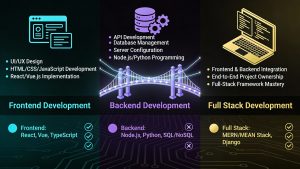
Frontend development focuses on the user interface (UI) and user experience (UX) of an application. It involves everything users see and interact with in a browser or mobile app.
Key Responsibilities
-
Designing layouts and user interfaces
-
Implementing responsive designs
-
Optimizing performance
-
Ensuring cross-browser compatibility
Frontend Technologies
-
HTML, CSS, JavaScript
-
Frameworks: React, Angular, Vue
-
Styling tools: Tailwind, Bootstrap
-
Build tools: Webpack, Vite
Skills Required
-
UI/UX principles
-
Responsive design
-
Performance optimization
Frontend developers ensure that applications are visually appealing, intuitive, and fast.
What Is Backend Development?
Backend development handles the server-side logic that powers an application. It ensures data is processed, stored, and delivered securely.
Key Responsibilities
-
Building APIs
-
Managing databases
-
Handling authentication and authorization
-
Ensuring scalability and security
Backend Technologies
-
Programming languages: Java, Python, Node.js, PHP
-
Databases: MySQL, PostgreSQL, MongoDB
-
Frameworks: Spring Boot, Django, Express
Skills Required
-
Data modeling
-
API design
-
Security practices
Backend developers ensure applications function correctly behind the scenes.
What Is Full Stack Development?
Full stack development combines both frontend and backend responsibilities. A full stack developer can work across the entire application stack.
Key Responsibilities
-
Designing user interfaces
-
Developing APIs
-
Managing databases
-
Deploying applications
Popular Full Stack Stacks
-
MERN (MongoDB, Express, React, Node.js)
-
MEAN (MongoDB, Express, Angular, Node.js)
-
LAMP (Linux, Apache, MySQL, PHP)
Skills Required
-
Frontend and backend expertise
-
System design
-
DevOps basics
Full stack developers offer versatility and efficiency.
Frontend vs Backend vs Full Stack: Comparison
| Aspect | Frontend | Backend | Full Stack |
|---|---|---|---|
| Focus | UI/UX | Server & data | End-to-end |
| Skills | Design, JS | Logic, databases | Both |
| Tools | React, CSS | APIs, databases | Full stack tools |
| Career Flexibility | Moderate | Moderate | High |
Which Role Should You Choose?
Choose Frontend If
-
You enjoy design and visuals
-
You like user interaction
Choose Backend If
-
You enjoy logic and data
-
You prefer system performance
Choose Full Stack If
-
You want versatility
-
You enjoy problem-solving across layers
Career Opportunities
-
Frontend Developer
-
Backend Developer
-
Full Stack Developer
-
Software Engineer
Each role offers strong career growth and demand.
Conclusion
Frontend, backend, and full stack development are all essential to software development. Each role offers unique challenges and opportunities. Understanding these roles helps teams collaborate effectively and individuals choose the right career path.
Frequently Asked Questions (FAQs)
1. Is full stack development harder than frontend or backend?
Full stack development requires broader knowledge but offers greater flexibility.
2. Can a frontend developer become full stack?
Yes, many developers transition to full stack roles.
3. Which role pays more?
Pay depends on skills and experience, not just the role.
4. Do full stack developers replace specialists?
No, specialists are still essential for complex projects.
5. Which role is best for beginners?
Frontend is often considered beginner-friendly.
6. Are full stack developers in demand?
Yes, full stack developers are highly sought after.
Connect with us:https://www.facebook.com/profile.php?id=61555452386126