
automotive innovation

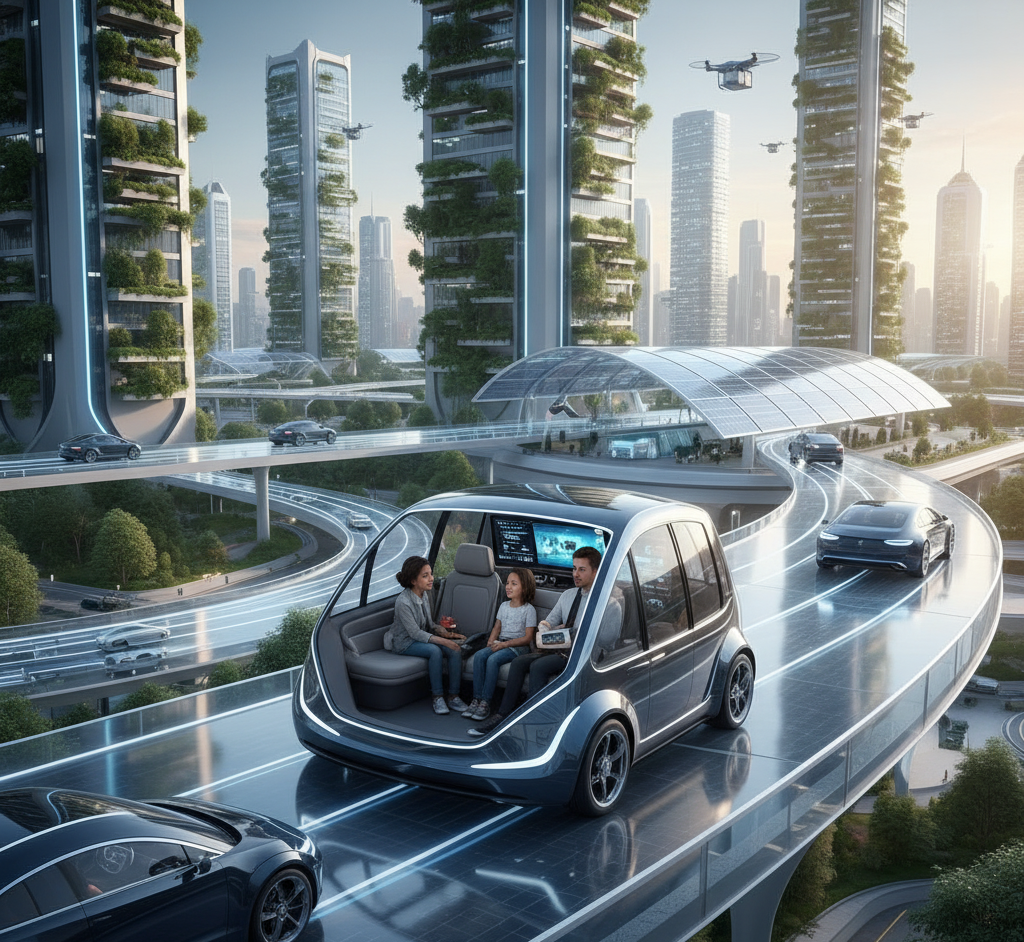
A family traveling in an autonomous car on a futuristic smart highway surrounded by green skyscrapers and drones
Automobile

Future of Autonomous Vehicles

The Future of Autonomous Vehicles: Understanding Self-Driving Car Technology The automotive industry stands at the threshold of its most revolutionary transformation. Autonomous vehicles promise to reshape transportation, urban planning, and daily life in ways we’re only beginning to understand. Self-driving technology combines artificial intelligence, sensor systems, and connectivity to create vehicles capable of navigating without human intervention. Understanding Autonomous Vehicle Levels The Society of Automotive Engineers defines six levels of driving automation, ranging from zero automation to full autonomy. Understanding these levels clarifies the current state and future potential of self-driving technology. Level 0 represents no automation, where drivers perform all tasks. Most older vehicles fall into this category, though they may include warning systems. Level 1 automation includes single automated features like adaptive cruise control or lane-keeping assistance. The driver remains fully engaged and monitors the environment constantly. Level 2 systems combine multiple automated functions, allowing the vehicle to control steering and acceleration simultaneously under specific conditions. The driver must remain attentive and ready to intervene immediately. Many modern vehicles offer Level 2 capabilities through advanced driver assistance systems. Level 3 automation allows the vehicle to handle all driving tasks under certain conditions, but requires drivers to be ready to take control when requested. This level remains rare in consumer vehicles due to regulatory and liability complexities. Level 4 vehicles operate autonomously in specific geographic areas or conditions without requiring human intervention. These systems include robust safety mechanisms to handle situations when autonomous operation becomes impossible. Level 5 represents full automation under all conditions, eliminating the need for human drivers entirely. True Level 5 vehicles remain in development, with significant technical and regulatory hurdles to overcome. Core Technologies Enabling Autonomy Self-driving vehicles rely on sophisticated sensor arrays to perceive their environment. LiDAR systems use laser pulses to create detailed three-dimensional maps of surroundings, detecting objects, pedestrians, and road features with precision. Radar sensors complement LiDAR by providing reliable detection in adverse weather conditions. Multiple radar units monitor different zones around the vehicle, tracking movement and measuring distances. Camera systems provide visual information that machine learning algorithms interpret to recognize traffic signs, signals, lane markings, and road users. Multiple cameras create a comprehensive view around the vehicle. Ultrasonic sensors handle close-range detection for parking and low-speed maneuvering. These sensors detect nearby obstacles and assist with precise vehicle positioning. GPS and mapping systems provide location data and route information. High-definition maps include detailed information about road geometry, traffic patterns, and regulatory requirements. Artificial Intelligence and Machine Learning The brain of autonomous vehicles consists of powerful AI systems processing massive amounts of sensor data in real-time. Machine learning algorithms trained on millions of miles of driving data enable vehicles to recognize patterns, predict behavior, and make appropriate decisions. Neural networks analyze sensor inputs to classify objects, predict movements, and plan safe paths through complex environments. These systems continuously learn from new situations, improving performance over time. Decision-making algorithms evaluate multiple factors simultaneously, considering safety, efficiency, and legal requirements. The challenge involves programming vehicles to handle edge cases and unexpected situations that human drivers navigate intuitively. Current State of Autonomous Technology Today’s autonomous vehicles operate primarily in testing environments and limited deployment scenarios. Several companies run autonomous taxi services in specific cities with safety drivers or remote monitoring. Advanced driver assistance systems available in consumer vehicles provide significant autonomy for highway driving, parking, and traffic jam situations. These systems reduce driver workload and improve safety but require constant human supervision. Commercial applications like autonomous trucking for specific routes and delivery robots for last-mile logistics are progressing rapidly. These controlled environments with defined routes suit current technological capabilities better than general-purpose urban driving. Safety Considerations and Benefits Safety represents both the primary promise and challenge of autonomous vehicles. Proponents argue that eliminating human error could prevent the vast majority of accidents caused by distraction, impairment, or poor judgment. Autonomous systems never tire, get distracted, or drive impaired. They maintain constant vigilance and react faster than human drivers to emerging hazards. Comprehensive sensor coverage eliminates blind spots and provides awareness in all directions simultaneously. However, autonomous systems must prove they can handle rare but critical scenarios that human drivers navigate through experience and intuition. Establishing reliability standards and building public trust requires extensive real-world testing and transparent safety reporting. Regulatory and Legal Challenges Governments worldwide grapple with creating frameworks to regulate autonomous vehicles while encouraging innovation. Key questions include liability in accidents, safety standards, data privacy, and cybersecurity requirements. Insurance models must adapt to scenarios where vehicles, not drivers, make operational decisions. Determining fault in accidents involving autonomous vehicles requires new legal frameworks and investigation procedures. Infrastructure and Connectivity Fully realizing autonomous vehicle benefits requires infrastructure upgrades. Smart traffic signals communicating with vehicles optimize flow and reduce delays. Road markings and signage must meet standards that autonomous sensors can reliably detect. Vehicle-to-vehicle and vehicle-to-infrastructure communication creates cooperative systems where cars share information about conditions, hazards, and intentions. This connectivity multiplies the effectiveness of individual vehicle sensors. Social and Economic Impacts Autonomous vehicles promise transformative social benefits. Elderly individuals and people with disabilities gain independent mobility. Urban areas could reduce parking infrastructure as shared autonomous vehicles remain in constant use. Professional drivers face uncertainty as automation threatens jobs in trucking, taxi services, and delivery sectors. Society must address these workforce transitions through retraining programs and economic policies. The Road Ahead The path to widespread autonomous vehicle adoption extends across decades rather than years. Technology continues advancing, but achieving the reliability and safety required for true driverless operation remains challenging. Near-term developments focus on expanding Level 2 and Level 3 capabilities in consumer vehicles and deploying Level 4 systems in controlled environments. These incremental advances build the foundation for eventual Level 5 autonomy. Public acceptance will grow as people experience the benefits of increasing automation. Education about capabilities and limitations helps set realistic expectations while building trust in the technology. The autonomous vehicle revolution will unfold gradually, driven by technological progress, regulatory evolution, and market acceptance.

A futuristic blue electric car charging at a sleek, solar-powered station
Automobile

Electric Vehicles 2025: Complete Guide to EV Benefits, Costs & Best Models

The Electric Vehicle Revolution: Your Complete Guide to Going Electric in 2025 The automotive industry is experiencing its most significant transformation in over a century. Electric vehicles have moved from novelty to mainstream, offering drivers an environmentally friendly, cost-effective alternative to traditional gasoline-powered cars. Whether you’re considering your first EV purchase or simply curious about this technology, understanding the electric vehicle landscape is essential. Understanding Electric Vehicles Electric vehicles use one or more electric motors powered by rechargeable battery packs instead of internal combustion engines. This fundamental difference creates a ripple effect of benefits that extend far beyond just eliminating tailpipe emissions. Modern EVs come in various forms. Battery electric vehicles run purely on electricity, while plug-in hybrids combine electric motors with traditional engines for extended range. Each type serves different needs and lifestyles. The Benefits of Going Electric The advantages of electric vehicles extend across environmental, financial, and practical dimensions. Environmental benefits top the list, with EVs producing zero direct emissions and significantly reducing your carbon footprint when charged with renewable energy sources. Financial savings materialize in multiple ways. Electricity costs substantially less than gasoline per mile driven. EVs require minimal maintenance since they lack oil changes, transmission repairs, and many components that wear out in conventional vehicles. Brake systems last longer thanks to regenerative braking technology. Performance enthusiasts appreciate the instant torque delivery that electric motors provide. This translates to rapid acceleration and smooth, quiet operation that makes every drive more enjoyable. Charging Your Electric Vehicle Charging infrastructure has expanded dramatically, addressing one of the earliest concerns about EV ownership. Home charging remains the most convenient option for most owners. Installing a Level 2 charger in your garage allows overnight charging that ensures your vehicle starts each day with a full battery. Public charging networks continue growing rapidly. Fast-charging stations along highways enable long-distance travel, while destination chargers at shopping centers and workplaces provide convenient top-ups during daily activities. Understanding charging speeds helps manage expectations. Level 1 charging through standard outlets works for overnight charging but delivers power slowly. Level 2 chargers offer faster home and public charging. DC fast chargers provide the quickest charging for road trips, adding significant range in 20 to 30 minutes. Battery Technology and Range Modern EV batteries deliver impressive range and longevity. Most new electric vehicles offer between 250 and 400 miles per charge, eliminating range anxiety for typical driving patterns. Battery technology continues advancing, with newer models offering even greater range and faster charging capabilities. Battery degradation concerns have proven largely unfounded. Quality EVs retain approximately 80 to 90 percent of their original capacity after 100,000 miles. Manufacturers typically warranty batteries for eight years or more, providing peace of mind for buyers. Cost Considerations and Incentives Electric vehicle prices have become increasingly competitive with conventional vehicles. While initial purchase prices may run higher, total cost of ownership often favors EVs when factoring in fuel savings, maintenance reductions, and available incentives. Federal tax credits up to several thousand dollars reduce purchase prices for qualifying vehicles. Many states and local utilities offer additional rebates and incentives. Some regions provide perks like carpool lane access and reduced registration fees. Top Electric Vehicles for 2025 The EV market offers diverse options across all price points and vehicle types. Luxury manufacturers have introduced stunning electric sedans and SUVs with cutting-edge technology. Mainstream brands deliver affordable, practical EVs perfect for daily driving. Pickup trucks and commercial vehicles are joining the electric revolution, expanding choices for all buyers. Making the Switch Transitioning to an electric vehicle requires minimal lifestyle adjustment for most drivers. Evaluate your daily driving distance to ensure an EV meets your needs. Consider your charging options at home and work. Test drive multiple models to experience different features and performance characteristics. The electric vehicle revolution represents more than just a new type of car. It signals a fundamental shift toward sustainable transportation that benefits drivers, communities, and the environment. As technology advances and infrastructure expands, electric vehicles will continue defining the future of personal mobility. Conclusion The transition to electric vehicles represents an inevitable and exciting evolution in automotive history. From their environmental benefits and lower operating costs to impressive performance and advancing technology, EVs offer compelling advantages that make them increasingly attractive to diverse drivers. While concerns about charging infrastructure and upfront costs remain valid, rapid improvements in both areas continue removing barriers to adoption. Making the switch to an electric vehicle no longer means compromising on range, performance, or practicality. Whether you prioritize sustainability, enjoy cutting-edge technology, or simply want to reduce your fuel expenses, today’s electric vehicle market offers options to suit virtually every need and budget. As battery technology improves, charging networks expand, and more manufacturers enter the space, the case for going electric grows stronger each year. The question is no longer if electric vehicles will dominate our roads, but when. For many drivers, that time is now. By understanding the technology, evaluating your personal needs, and exploring available options, you can determine whether joining the electric vehicle revolution makes sense for your lifestyle. The future of transportation is electric, and it’s arriving faster than most people imagined. FAQs Q1: How long does it take to charge an electric vehicle? Charging time varies by charger type and battery size. Home Level 2 chargers typically fully charge an EV overnight in 6 to 10 hours. Public DC fast chargers can add 200 miles of range in 30 minutes. Standard wall outlets take 24 to 48 hours for a full charge. Q2: How much does it cost to charge an electric vehicle? Electricity costs average 3 to 5 cents per mile for home charging, compared to 10 to 15 cents per mile for gasoline vehicles. A full charge at home typically costs between 8 and 15 dollars, depending on your local electricity rates and battery size. Q3: What is the lifespan of an EV battery? Modern EV batteries are designed to last 15 to 20 years or more. Most manufacturers warranty

Software development

Why Every Automotive CEO Needs an SDV Strategy: Benefits, Architecture, Challenges & More

Introduction As the automotive industry races toward a software-driven future, Software-Defined Vehicles (SDV) have shifted from a buzzword to an urgent business imperative. In 2025, OEMs and suppliers who fail to adopt an SDV strategy risk falling behind not only in product features but also in efficiency, customer experience, revenue models, and security. Here’s why every automotive CEO must lead the SDV transformation—plus the benefits, architecture insights, and toughest challenges along the way. For turnkey digital solutions, see TechOTD and their advanced AI services, or explore the company’s about page, industry expertise, partner program, and comprehensive web development capabilities. What Is a Software-Defined Vehicle (SDV)? An SDV is a vehicle whose core functions—performance, safety, comfort, connectivity, and even after-sales features—are enabled and continually updated by software. Unlike traditional cars, SDVs evolve and improve over their lifetime via over-the-air updates, AI-powered analytics, and continuous data integration. Why SDV Strategy is Essential for Automotive CEOs Continuous Customer Value: Over-the-air (OTA) updates let automakers deliver new features, infotainment enhancements, and safety upgrades to vehicles already on the road—eliminating “feature freeze” at the factory. Enhances brand loyalty and customer engagement by ensuring the car improves during its lifecycle. Recurring Revenue & Monetization: SDVs turn vehicles into platforms for digital services, opening new revenue streams like subscriptions (for seat heating, premium navigation, or autonomous driving features) and on-demand upgrades. Moves business models from one-time sales to ongoing monetization, increasing lifetime customer value. Efficiency & Cost Control: Decoupling software from hardware means faster innovation cycles, less hardware rework, and simplified product portfolios. Enables more predictable R&D budgets and reduces SKUs, benefiting large and complex organizations. Enhanced Personalization & Experience: Vehicles can be tailored to individual drivers, offering customizable user profiles, infotainment, real-time navigation, and AI voice assistants for a truly digital driving experience. Predictive maintenance and remote diagnostics add operational efficiency and improved safety. SDV Architecture: The New Automotive Backbone Adopting SDV requires reimagining automotive architecture from hardware-centric designs to software-focused, centralized platforms. Here’s what that looks like: Domain & Centralized Controllers: Traditional vehicles use multiple electronic control units (ECUs) for each function. SDVs consolidate these into powerful domain or central controllers, managed by a high-performance System-on-Chip (SoC). Artificial intelligence capabilities are built-in for real-time, safety-critical tasks. Layered Software Stack: Embedded operating systems manage functions and prioritize safety over entertainment. Middleware ensures secure communication between hardware, applications, and the cloud. Applications deliver features directly to the end-user and may run onboard or in a hybrid cloud configuration. Connected Systems: Telecom infrastructure and cloud backend enable continuous data exchange, fleet-wide updates, real-time diagnostics, and smart city integration. Core Challenges in Building an SDV Strategy   Legacy & Organizational Barriers: Existing platforms are heavily tied to legacy ECUs, software silos, and supply chains focused on hardware. Transitioning demands organizational transformation as much as technical change. Cybersecurity Risks: Fully connected vehicles create larger attack surfaces. Security must be built into every architectural layer, not treated as an afterthought. Skill Gaps & Talent Shortages: SDV innovation needs a blend of embedded, cloud, AI, and cybersecurity talent—expertise most automakers currently lack. Regulatory Uncertainty: Navigating evolving global and regional rules for OTA updates, data privacy, and liability requires legal agility and transparency. Supply Chain Complexity: The rise of SDVs demands new partnerships across tech, chipmakers, cloud companies, and compliance solution vendors—testing traditional OEM-supplier relationships. Why CEOs Need an SDV Strategy Software as the new differentiator: Real customer value comes from in-cabin features, digital experiences, and upgrade flexibility—all enabled by software. Competitive advantage: First movers unlock new revenue streams (subscriptions, digital services), move faster to market, and gain stronger customer loyalty. Continuous evolution: SDVs can fix bugs, add features, and customize experiences instantly, keeping vehicles “fresh” and future-proof. Regulatory readiness: Software-driven architecture allows fast rollout of compliance features (cybersecurity, emissions, safety). The Benefits of SDV Adoption Personalization & Flexibility: Update UIs, infotainment, and features for different users or regions, even post-sale. Remote Services & Maintenance: OTA updates, remote diagnostics, and predictive maintenance lower costs and minimize recalls. Enhanced Safety & Security: Deploy new ADAS and emergency features rapidly and maintain robust security. New Revenue Streams: Microtransactions, feature unlocks, or third-party app ecosystems are possible. Sustainability: Less hardware, optimized energy, and better support for electric and connected mobility. Core SDV Architecture Principles Centralized Computing: Fewer, high-powered compute domains replace many fragmented ECUs, enabling software/hardware decoupling. Cloud-Native & Edge Integration: Advanced analytics, storage, and multi-vehicle services in the cloud; real-time safety on edge devices. Modular, API-Driven Design: Rapid feature integration, better interoperability, and streamlined DevOps. Secure-by-Design: Security and safety are core to the stack—from ISA/SOC standards to privacy compliance. The Biggest Challenges in SDV Transformation Software Complexity: Modern vehicles run tens of millions of code lines—robust QA and cross-disciplinary teams are essential. Cybersecurity: Greater complexity and connectivity increase attack surfaces, requiring strong, layered defense and constant vigilance. Legacy Integration: Migrating from legacy hardware/software to modern SDV architectures is costly and complex. Supply Chain & Talent: Collaboration across chipmakers, cloud providers, and digital talent is critical. Global Compliance: Regulations (like ISO 26262, ISO/SAE 21434) evolve rapidly, demanding agile, embedded compliance processes. Strategic Advice for Automotive Executives Set a bold SDV vision: Make the SDV model central to future products and culture. Invest in digital talent: Hire and upskill in software, AI, DevOps, and cybersecurity. Develop the right partnerships: Work with technology providers, consultancies, and AI/cloud platforms to accelerate transformation. Consider becoming a TechOTD partner. Prioritize secure architecture: Focus on defense-in-depth, robust OTA, modular systems, and continuous compliance. Center on user experience: Prioritize personalization, upgradability, and feedback loops. Start small, scale rapidly: Use MVPs, pilots, and agile rollouts to minimize risk and drive learning, then expand. Conclusion A software-defined future is already unfolding on the roads. For automotive CEOs, standing still means falling behind. SDV strategies empower automakers to deliver dynamic, upgradeable products, create resilient revenue streams, transform customer satisfaction, and lead in the digital mobility marketplace. Now is the moment to invest in software talent, rethink platform architecture, prioritize security by design, and build future-ready ecosystems. The next generation of industry winners will be defined by their mastery of software—and their willingness to lead this transformation. Accelerate your SDV journey: Get in touch for strategy, AI, integration, and secure web development with TechOTD’s expert services, explore their AI solutions, or review the about page for industry insights and partnership opportunities. Useful Links & Backlinks TechOTD – Digital Transformation AI-Powered

How would you like me to respond?

Select a personality for your AI assistant

Normal
Happy
Sad
Angry

Your selection will affect how the AI assistant responds to your messages

Chat Assistant

Let's discuss your project!

Hear from our clients and why 3000+ businesses trust TechOTD

Tell us what you need, and we'll get back with a cost and timeline estimate

Scroll to Top