AI agents

Artificial Intelligence, Digital Transformation, Software development, Technology

Navigating the Next Tech Horizon: A Human Guide to the Innovations Reshaping Our Digital World

Introduction:- Remember when “the future” meant having a computer in your pocket? Today, we carry the processing power of a mid-90s supercomputer in our jeans, and yet we find ourselves standing on the precipice of an even more radical shift. The tech world isn’t just evolving; it’s rewriting its foundational code. As we navigate through 2026, the conversations around technology have shifted from basic automation to deep, systemic intelligence. We are no longer just building better tools; we are co-authoring a new reality with our machines. From the way developers write software to how global enterprises secure their data in the cloud, the digital landscape is undergoing a massive paradigm shift. Let’s pull back the curtain on the massive shifts defining the tech world today—broken down not just in code, but in human terms. 1. The Future of AI: Beyond the Chatbot Hype For a couple of years, the world was obsessed with generative AI that could write poems or generate quirky images. But the honeymoon phase is over. The future of AI isn’t about chatbots that mimic human speech; it’s about Agentic AI—autonomous systems capable of reasoning, planning, and executing complex workflows without constant human hand-holding. From Prompting to Partnering Early AI required meticulous prompting. If you didn’t phrase your question perfectly, the output was useless. Today, AI has developed contextual awareness. We are moving from a “command-and-control” dynamic to a truly collaborative partnership. Autonomous Agents: Imagine an AI assistant that doesn’t just book a flight when asked, but monitors your calendar, anticipates a business conflict, negotiates a rescheduled meeting with a client’s AI assistant, and books the optimal flight based on your historical preferences—all in the background. Multimodal Maturity: AI now naturally processes voice, video, text, and physical gestures simultaneously. This has broken down the barriers between digital intent and physical execution. The Human Element: Emotional Intelligence (EQ) Meets AI As AI handles the heavy analytical lifting, the premium on human emotional intelligence has skyrocketed. The most successful implementations of AI aren’t those that replace humans, but those that augment human empathy, creativity, and ethical judgment. We are the directors; AI is the ultimate crew. 2. Next-Gen Software Development: The Democratization of Code The software engineering landscape is experiencing its most significant disruption since the invention of high-level programming languages. Next-gen software development is defined by a symbiosis between human intuition and AI-driven development engines. The Rise of the “Architect” Mindset Writing syntax—the actual typing of loops, brackets, and boilerplate code—is increasingly being handled by AI co-pilots. Does this mean software engineers are obsolete? Absolutely not. Instead, their role has elevated. [Traditional Development] ──> Focus on Syntax, Debugging, & Boilerplate [Next-Gen Development] ──> Focus on Architecture, System Design, & Security Developers are transitioning from code writers to system architects. The value shifts from knowing how to write a function to understanding how systems interact, scale, and remain secure. Low-Code, No-Code, and the Citizen Developer We are seeing a massive democratization of technology. Business analysts, healthcare professionals, and educators are now building sophisticated enterprise applications using natural language interfaces. By bridging the gap between an idea and a working application, innovation is no longer bottlenecked by the availability of software engineering teams. 3. Cloud Computing Trends: The Distributed Cloud and Edge Renaissance The cloud is no longer a distant, centralized data center owned by a tech giant. Current cloud computing trends point toward a hyper-distributed model where data processing happens exactly where it makes the most sense. Edge Computing Comes of Age With the proliferation of IoT devices, smart cities, and autonomous vehicles, sending data back to a central cloud server introduces unacceptable latency. Example: An autonomous vehicle traveling at 60 mph cannot wait 200 milliseconds for a cloud server to process a “stop” command. The decision must happen at the “edge”—directly within the vehicle’s onboard processing unit. Sovereign Clouds and Data Privacy Geopolitics has firmly entered the cloud space. Nations and regions are demanding that their citizens’ data remain within geographical boundaries, governed by local laws. This has led to the rise of sovereign clouds, forcing global enterprises to rethink their infrastructure to ensure compliance without sacrificing performance. 4. Cyber Resilience: Shifting from Defense to Survival In the modern tech ecosystem, a data breach is no longer a matter of if, but when. Because of this harsh reality, the conversation has shifted from traditional cybersecurity (building taller walls) to cyber resilience (how well you can take a punch and keep standing). The Zero Trust Imperative The old security model assumed that everything inside a corporate network was safe. Today’s decentralized workforce has thoroughly shattered that perimeter. “Zero Trust” operates on a simple, human-like skepticism: Never trust, always verify. Every user, device, and connection must continuously prove its identity and authorization. Preparing for the Quantum Leap While practical quantum computers are still on the horizon, the cryptographic threat they pose is already reshaping current security strategies. Bad actors are actively harvesting encrypted data today, intending to decrypt it years later when quantum computing matures. Progressive organizations are already implementing Post-Quantum Cryptography (PQC) to ensure their data remains secure tomorrow. 5. Digital Transformation 2026: The Cultural Revolution True digital transformation 2026 isn’t about buying new software or migrating to the cloud just to tick a box. It is fundamentally a cultural shift that requires organizations to fundamentally reimagine how they deliver value to humans. Breaking Down Silos For decades, IT departments lived in isolation, speaking a language the rest of the business couldn’t comprehend. True digital transformation breaks these walls down. Technology is now deeply woven into every department—from HR using predictive analytics for talent retention, to marketing utilizing real-time AI generation for hyper-personalized campaigns. The Sustainability Metric Modern digital transformation is no longer just measured in ROI (Return on Investment), but also in its environmental impact. Data centers consume massive amounts of electricity and water. Forward-thinking companies are auditing their “digital carbon footprint,” optimizing their code for energy efficiency, and choosing cloud providers that run entirely on renewable

Artificial Intelligence, Software development, Technology & Innovation

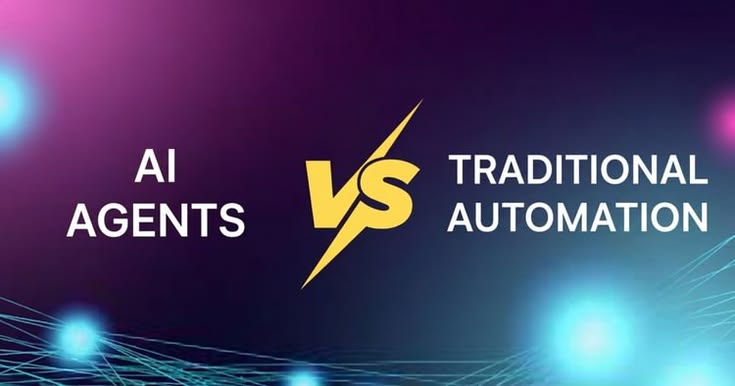
AI Agents vs. Traditional Automation: What’s Changing in 2026?

Introduction: The Evolution from Rules to Reasoning For decades, digital transformation was defined by a single, unwavering engineering paradigm: determinism. If you wanted a machine to execute a task, you had to explicitly map out every single variable, branch, and conditional statement beforehand. If an input deviated by even a single character from the expected schema, the automation would crash. This rigid framework birthed the massive market for Robotic Process Automation (RPA) and standard backend API integrations. By 2026, this deterministic wall has completely crumbled. We are currently witnessing a massive architectural migration from standard rule-based workflows to autonomous AI Agents. Unlike traditional software that simply accelerates data transmission across static structures, AI agents possess a cognitive layer. They don’t just execute instructions; they reason, interpret intent, adapt to unpredictable runtime changes, and dynamically formulate their own execution paths. This guide explores the deep technical divides between these two methodologies, maps out the core mechanics of agentic systems, and provides an enterprise blueprint for managing this massive shift. Section 1: Defining the Technical Boundary To understand this architectural evolution, we must establish clear technical boundaries between traditional automation and an actual AI agent. Traditional Automation: Rule-Based Systems Traditional automation operates entirely on if-this-then-that (IFTTT) execution graphs. A software engineer constructs a explicit pipeline using tools like Selenium, UiPath, or custom cron jobs. The software intercepts an input, references a hardcoded template or static database schema, maps fields explicitly, and routes the data to a destination API. The software has zero contextual understanding of the data it manipulates. If a vendor changes a button’s CSS selector on a billing portal, or if an invoice shifts a line item by five pixels, the script breaks. It cannot problem-solve because its world consists exclusively of binary conditions and explicitly coded paths. AI Agents: Goal-Oriented Systems An AI Agent is a software entity that leverages a Large Language Model (LLM) or Large Multimodal Model (LMM) as its central processing unit, running inside a continuous, stateful loop. Instead of receiving a step-by-step instruction set, an agent is given an objective, a set of constraints, and access to an array of external tools. The agent evaluates the current state of its environment, breaks down the main objective into an ordered series of sub-tasks, selects the appropriate tool for the immediate sub-task, analyzes the output of that tool, and continuously modifies its strategy based on real-time feedback. It handles unstructured data natively because it interprets semantic meaning rather than just looking for exact string matches. Section 2: Architectural Comparison: Static Pipelines vs. Cognitive Loops The foundational code paths of these two systems look fundamentally different under the hood. The Linear Pipeline Structure Traditional automation relies on linear or predictable branching logic. The execution flow looks like this: [Inbound Webhook] —> [Parse Exact JSON Schema] —> [Conditional Branching] —> [Write to Destination API] If any link in this chain encounters an anomaly, the execution thread fails, records an error log, and requires human intervention to patch the underlying code. The Agentic Cognitive Loop An autonomous AI agent runs within a non-linear, dynamic cognitive loop, often structured around the OODA Loop (Observe, Orient, Decide, Act) framework: +—————————————+ | Goal Formulation | +—————————————+ | v +———————————————+ —–> | Perception & Observation (Ingest Context) | | +———————————————+ | | | v | +———————————————+ | | Reasoning & Planning (LLM Evaluation) | | +———————————————+ | | | v | +———————————————+ | | Tool Selection & Execution (Take Action) | | +———————————————+ | | +—————————–+ The Core Pillars of Agent Architecture 1. The Planning Core The planning engine decomposes the primary target into manageable milestones. Modern agents utilize advanced prompt-engineering frameworks like Chain-of-Thought (CoT) or Tree-of-Thoughts (ToT) to explore multiple reasoning paths simultaneously, evaluating the probability of success for each direction before executing code. 2. Contextual Memory Systems Agents rely on two distinct memory tiers to maintain consistency over long-running operations: Short-Term Memory: Managed directly via the model’s active context window, keeping track of immediate conversational turns, tool outputs, and local state variables. Long-Term Memory: Powered by an external vector database or graph database. The agent saves past executions, successful problem-solving strategies, and corporate guidelines, retrieving them via semantic search whenever a similar task boundary arises. 3. Tool Utilization (Function Calling) Tools are the hands of the agent. A tool can be a database connection, an internal API, a web scraper, or a command-line terminal. The agent reads the documentation of these tools (written in clear, natural language schemas), determines which tool matches the current sub-task, formats the payload dynamically, executes the call, and parses the returned data to determine the next course of action. Section 3: In-Depth Comparison Matrix Technical Capability Traditional Automation (RPA/APIs) Autonomous AI Agents (2026 Paradigm) Input Type Access Strictly Structured (JSON, XML, CSV) Fully Unstructured (Audio, Video, PDFs, Free Text) Execution Paths Static, Pre-compiled, Deterministic Dynamic, Emergent, Goal-Oriented Error Handling Hardcoded try/catch blocks; immediate crash Autonomous Self-Healing and Error Correction Maintenance Profile High overhead; breaks on UI/API changes Self-adapting; updates strategies based on UI shifts Data Processing Exact string matching and regex parsers Semantic interpretation and conceptual mapping Compute Overhead Negligible; ultra-lightweight execution Substantial; high dependency on token throughput and inference speeds Section 4: Deep Dive into Multi-Agent Orchestration Systems As enterprise environments scale up, relying on a single, massive monolithic agent becomes inefficient. The complexity of managing massive context windows and disparate tool sets introduces latency and hallucinations. The industry has shifted heavily toward Multi-Agent Systems (MAS). In a multi-agent framework, complex corporate operations are divided among specialized, narrow AI agents that communicate with each other over structured protocol buses. +———————————–+ | Enterprise Controller | | (Manager/Router Agent) | +———————————–+ | +———————–+———————–+ | | v v +———————–+ +———————–+ | Security Audit Agent | | Data Extraction Agent | | – Validates Code | <== (Internal Bus) => | – Parses Documents | | – Monitors Regs | | – Cleans Inbound APIs| +———————–+ +———————–+ The Hierarchical Topology In this architecture, a Manager Agent intercepts user intents

Artificial Intelligence

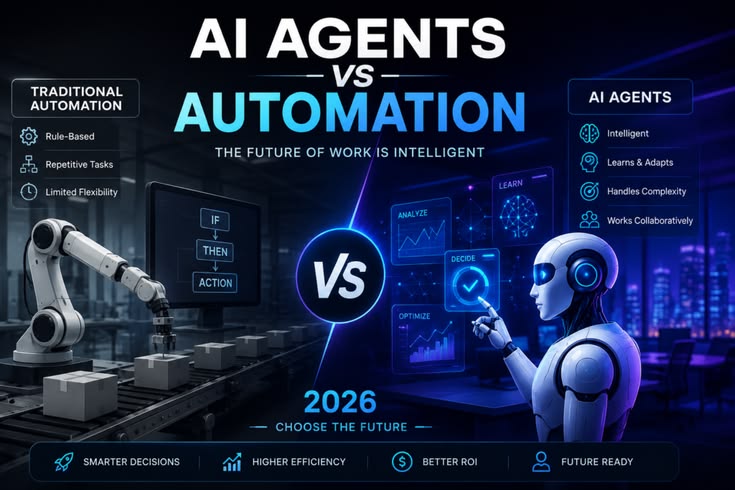
AI Agents vs Traditional Automation: What’s Changing in 2026?

Introduction:- Automation has been a cornerstone of digital transformation for decades. Businesses have long relied on software to eliminate repetitive tasks, reduce operational costs, and improve efficiency. From manufacturing lines to customer relationship management systems, traditional automation has helped organizations streamline workflows and maintain consistency. However, the technological landscape in 2026 is undergoing a significant shift. Organizations are no longer satisfied with systems that simply follow predefined rules. They increasingly require software that can understand context, adapt to changing situations, make informed decisions, and collaborate with humans. This demand has accelerated the adoption of AI agents, one of the most influential developments in modern artificial intelligence. Unlike traditional automation, AI agents are designed to reason, plan, and act toward specific goals. They can analyze large amounts of information, interact with multiple applications, learn from feedback, and even coordinate with other AI systems. Rather than replacing simple automation, AI agents expand what automation can achieve by handling more dynamic and complex tasks. This article explores how AI agents differ from traditional automation, why organizations are investing in intelligent systems, and how businesses can prepare for the next generation of digital operations. Understanding Traditional Automation Traditional automation refers to software that performs predefined actions based on fixed rules. These systems execute workflows exactly as they were programmed, making them highly reliable for repetitive processes. Examples include: Automated invoice generation Payroll processing Scheduled email campaigns Data backups Manufacturing assembly lines Basic customer support chatbots Rule-based approval workflows The primary advantage of traditional automation is consistency. Once configured correctly, it performs the same task repeatedly with minimal errors. It is ideal for environments where processes rarely change. However, these systems have clear limitations. They cannot interpret ambiguous information, adapt to unexpected scenarios, or make decisions beyond their programmed rules. If the business process changes, developers often need to redesign or update the automation. What Are AI Agents? AI agents are intelligent software systems capable of perceiving information, reasoning about it, making decisions, and taking actions to achieve defined objectives. Unlike conventional automation tools, AI agents do not rely solely on fixed rules. They use technologies such as large language models, machine learning, natural language processing, retrieval systems, and external tools to solve problems dynamically. For example, an AI customer support agent can: Read a customer’s email. Identify the issue and urgency. Search internal documentation. Check order status. Draft a personalized response. Escalate complex cases when necessary. Learn from user feedback over time. Instead of executing a single scripted workflow, the agent evaluates the situation and chooses the most appropriate action. Traditional Automation vs AI Agents Feature Traditional Automation AI Agents Decision-making Rule-based Context-aware Learning No Yes, through AI models and feedback Flexibility Low High Handles unstructured data Limited Excellent Human-like communication Minimal Advanced Adaptability Requires reprogramming Can adjust to changing inputs Best suited for Repetitive tasks Complex, evolving workflows Why 2026 Marks a Turning Point Several technological trends have converged to make AI agents practical at scale. Large language models have become significantly more capable, enabling agents to understand natural language and generate useful responses. Cloud infrastructure now provides the computing power needed to run advanced AI workloads efficiently. Businesses have also accumulated vast amounts of digital data, creating opportunities for AI systems to deliver meaningful insights and automation. At the same time, organizations are under pressure to improve productivity, reduce costs, and respond faster to customer expectations. AI agents address these needs by automating tasks that previously required human judgment. Real-World Business Applications Customer Service Modern AI agents can resolve support tickets, summarize conversations, translate languages, and personalize responses while maintaining a consistent customer experience. Software Development Development teams use AI agents to generate code, review pull requests, identify bugs, write documentation, and automate testing. These capabilities accelerate delivery while allowing engineers to focus on architecture and innovation. Cybersecurity Security operations centers increasingly deploy AI agents to monitor logs, detect anomalies, investigate suspicious behavior, and recommend remediation steps. This helps analysts respond more quickly to emerging threats. Cloud Operations Cloud management platforms benefit from AI agents that optimize infrastructure, monitor resource utilization, predict outages, and recommend cost-saving opportunities. They can assist administrators in maintaining reliable and scalable environments. Healthcare Hospitals and healthcare providers use intelligent agents to organize patient records, assist with appointment scheduling, summarize clinical notes, and support administrative workflows, enabling staff to spend more time on patient care. Benefits of AI Agents Organizations adopting AI agents are seeing improvements in several areas: Increased productivity through intelligent task automation. Faster decision-making based on real-time data. Improved customer experiences with personalized interactions. Reduced operational costs by minimizing manual work. Better scalability across departments. Continuous learning and optimization through AI-driven feedback loops. These advantages make AI agents an important part of digital transformation strategies across industries. AI Governance in 2026: Balancing Innovation and Regulation  

Artificial Intelligence, Business Analytics, enterprice

The Impact of Agentic AI on Enterprise Productivity

The Impact of Agentic AI on Enterprise Productivity Artificial Intelligence has evolved rapidly over the past few years. What started as chatbots, recommendation engines, and predictive analytics has now entered a new phase known as Agentic AI. Unlike traditional AI systems that primarily respond to commands or analyze data, Agentic AI can independently plan, execute, monitor, and optimize tasks to achieve specific goals. As organizations continue their digital transformation journeys, Agentic AI is emerging as one of the most influential technologies reshaping enterprise productivity. Businesses are no longer looking at AI merely as a tool that assists employees; instead, they are deploying AI agents capable of acting as digital workers that can handle complex workflows with minimal human intervention. From customer service and IT operations to finance, marketing, and supply chain management, Agentic AI is helping enterprises operate more efficiently, reduce costs, improve decision-making, and unlock new levels of productivity. As we move through 2026, companies across industries are recognizing that the future of work will involve close collaboration between humans and autonomous AI agents. Understanding Agentic AI Agentic AI refers to artificial intelligence systems that possess the ability to act autonomously toward achieving predefined objectives. Unlike conventional AI applications that require constant prompts or supervision, Agentic AI can make decisions, initiate actions, adapt to changing environments, and complete multi-step tasks independently. For example, a traditional AI chatbot may answer customer questions based on available information. An Agentic AI system, however, can handle an entire customer support process—from receiving the request and identifying the issue to processing refunds, updating records, and following up with customers. The key capabilities that distinguish Agentic AI include: Goal-oriented decision-making Autonomous workflow execution Continuous learning and adaptation Multi-step task management Context awareness Integration with enterprise systems Proactive problem-solving These characteristics enable Agentic AI to function more like a virtual employee rather than a simple software application. Why Enterprises Are Adopting Agentic AI Organizations are under increasing pressure to improve efficiency, reduce operational expenses, and maintain competitiveness in rapidly changing markets. Traditional automation solutions can handle repetitive tasks, but they often struggle with complex processes that require decision-making and adaptability. Agentic AI fills this gap by bringing intelligence and autonomy to business operations. Several factors are driving enterprise adoption: Growing Operational Complexity Modern businesses manage enormous volumes of data, processes, and interactions. Human teams often struggle to keep up with increasing complexity. Agentic AI can process information at scale and coordinate multiple tasks simultaneously. Demand for Faster Decision-Making Markets move quickly, and delays can be costly. AI agents analyze data in real time and provide immediate actions or recommendations, helping organizations respond more rapidly to opportunities and challenges. Workforce Productivity Challenges Many industries continue to face talent shortages and increasing workloads. Agentic AI helps organizations maximize productivity without significantly expanding headcount. Cost Optimization Businesses are continuously seeking ways to reduce expenses. AI agents can automate labor-intensive processes, reducing operational costs while maintaining service quality. Digital Transformation Initiatives Organizations investing in cloud computing, analytics, and automation increasingly view Agentic AI as a natural extension of their digital transformation strategies. Workflow Automation Beyond Traditional RPA Robotic Process Automation (RPA) has been used for years to automate repetitive tasks. However, RPA systems generally follow predefined rules and struggle when unexpected situations arise. Agentic AI enhances automation by introducing intelligence into workflows. For example, instead of simply processing invoices according to fixed rules, an AI agent can: Identify anomalies Communicate with vendors Request missing information Resolve exceptions Complete approvals automatically This significantly reduces manual intervention and accelerates business processes. Enhanced Employee Productivity One of the most important benefits of Agentic AI is its ability to augment human workers. Employees often spend significant time on administrative tasks such as: Data entry Scheduling Reporting Documentation Research Information retrieval AI agents can handle these responsibilities, allowing employees to focus on strategic, creative, and high-value work. Rather than replacing workers, Agentic AI often acts as a productivity multiplier, enabling teams to accomplish more with the same resources. Faster Decision-Making Data-driven decision-making has become essential for modern enterprises. However, analyzing large datasets can be time-consuming. Agentic AI systems continuously monitor: Market trends Customer behavior Operational performance Financial metrics Supply chain activities They can identify patterns, generate insights, and recommend actions in real time. Executives and managers benefit from faster access to actionable intelligence, improving organizational agility and responsiveness. Improved Customer Service Operations Customer experience has become a major competitive differentiator. Agentic AI is transforming customer support by enabling intelligent automation. AI agents can: Resolve support tickets Handle account updates Process refunds Schedule appointments Escalate complex issues Follow up with customers Because these systems operate around the clock, businesses can provide faster and more consistent service while reducing support costs. Knowledge Management and Information Access Large enterprises often struggle with fragmented information spread across multiple systems. Employees may spend considerable time searching for documents, policies, procedures, and data. Agentic AI can act as an intelligent knowledge assistant that: Retrieves relevant information Summarizes documents Generates reports Provides recommendations Answers internal queries This improves productivity by reducing time spent searching for information. Supply Chain Optimization Supply chain management involves numerous interconnected activities, making it an ideal environment for Agentic AI deployment. AI agents can: Monitor inventory levels Predict demand fluctuations Optimize procurement Coordinate logistics Identify supply chain risks Recommend corrective actions These capabilities help organizations improve efficiency while minimizing disruptions. Financial Operations Efficiency Finance departments often deal with repetitive and time-consuming processes. Agentic AI can streamline activities such as: Invoice processing Expense management Budget forecasting Financial reporting Compliance monitoring Fraud detection As a result, finance teams can focus more on strategic planning and business growth initiatives. IT Operations and Infrastructure Management Enterprise IT environments continue to grow in complexity. Agentic AI is increasingly being used to manage infrastructure and support operations. AI agents can: Detect system anomalies Monitor performance Resolve incidents Apply security updates Allocate resources Predict failures This proactive approach improves system reliability while reducing operational workloads. Marketing and Sales Productivity Marketing and sales teams are

Artificial Intelligence, Business Intelligence

The Rise of AI Employees: Will Digital Workers Become Mainstream?

The Rise of AI Employees: Will Digital Workers Become Mainstream? Artificial Intelligence has already transformed the way businesses operate, from automating repetitive tasks to enhancing customer experiences. However, a new evolution in AI technology is beginning to reshape workplaces on a much larger scale: AI employees. Unlike traditional software tools that assist workers with specific tasks, AI employees are designed to function more like digital coworkers. They can manage workflows, communicate with customers, analyze data, make recommendations, and even execute complex business processes with minimal human intervention. As organizations continue to seek greater efficiency, lower operational costs, and improved productivity, AI employees are rapidly moving from experimental projects to practical business solutions. Technology leaders, startups, and enterprise organizations are investing heavily in AI-powered agents that can perform roles traditionally handled by humans. This shift raises important questions. Will digital workers become a standard part of every organization? How will they impact jobs and workplace dynamics? What benefits and challenges do they bring? Understanding the rise of AI employees provides valuable insight into the future of work and the next phase of digital transformation. Understanding AI Employees The term “AI employee” refers to an artificial intelligence system capable of performing work-related tasks autonomously or semi-autonomously. These systems go beyond simple automation tools because they can understand context, learn from interactions, make decisions, and adapt to changing business requirements. AI employees often leverage advanced technologies such as machine learning, natural language processing, large language models, and workflow automation platforms. They can interact with humans through chat interfaces, email, voice communication, and enterprise software systems. Unlike traditional automation software, AI employees can handle more dynamic responsibilities, including: Responding to customer inquiries Scheduling meetings Managing project workflows Conducting research Generating reports Processing business documents Supporting sales operations Assisting human resources teams Monitoring cybersecurity threats Managing inventory and supply chains The growing capabilities of AI systems are enabling businesses to treat them as active contributors rather than passive tools. Why Businesses Are Adopting AI Employees Organizations face increasing pressure to remain competitive while controlling costs and improving operational efficiency. AI employees offer several advantages that make them attractive to businesses of all sizes. Increased Productivity One of the primary reasons companies adopt AI employees is productivity improvement. Digital workers can operate continuously without breaks, allowing organizations to complete tasks faster and maintain around-the-clock operations. Routine administrative activities that once consumed significant employee time can now be handled automatically, enabling human workers to focus on strategic and creative responsibilities. Cost Efficiency Hiring, training, and retaining employees involves substantial expenses. While AI systems require investment, they can significantly reduce operational costs over time by automating repetitive processes and minimizing manual workloads. For businesses managing large volumes of customer interactions, transactions, or documentation, AI employees can provide substantial financial benefits. Faster Decision-Making AI employees can process vast amounts of data within seconds. This capability enables organizations to make informed decisions more quickly than traditional methods. From analyzing market trends to identifying operational bottlenecks, AI-powered systems can generate insights that help leaders respond to opportunities and challenges in real time. Improved Customer Service Modern consumers expect instant responses and personalized experiences. AI employees can deliver both. Digital customer service agents can answer questions, resolve common issues, and guide customers through processes at any time of day. This enhances customer satisfaction while reducing the workload on support teams. Scalability Human teams often require significant resources to expand operations. AI employees can scale much more efficiently. Whether a company experiences seasonal demand spikes or rapid business growth, AI-powered systems can often adapt without requiring large increases in staffing. The Evolution from Chatbots to Digital Workers Many people associate AI in business with chatbots, but AI employees represent a major advancement beyond traditional conversational systems. Early chatbots followed scripted workflows and could only answer predefined questions. Their capabilities were limited and often frustrating for users. Today’s AI employees can: Understand complex requests Maintain conversational context Access multiple business systems Complete multi-step tasks Generate original content Learn from interactions Collaborate with human employees This evolution has transformed AI from a customer support tool into a versatile workforce solution capable of contributing across entire organizations. Industries Leading the Adoption of AI Employees Several industries are already embracing AI employees and demonstrating how digital workers can create measurable value. Customer Service Customer support remains one of the largest areas for AI adoption. AI employees can manage inquiries, process requests, provide technical assistance, and resolve common issues without human intervention. This reduces response times and improves service availability. Healthcare Healthcare organizations use AI employees to support administrative operations, appointment scheduling, patient communication, and medical documentation. These systems help reduce administrative burdens and allow healthcare professionals to focus more on patient care. Financial Services Banks and financial institutions increasingly rely on AI employees for fraud detection, risk analysis, compliance monitoring, and customer assistance. The ability to analyze large datasets quickly makes AI particularly valuable in the financial sector. Human Resources Recruitment and employee management involve many repetitive tasks that AI employees can handle efficiently. Digital workers assist with resume screening, candidate communication, interview scheduling, onboarding, and employee support. Marketing Marketing teams are leveraging AI employees to create content, analyze campaign performance, conduct audience research, and personalize customer engagement strategies. These capabilities help organizations improve marketing effectiveness while reducing manual effort. Manufacturing Manufacturers use AI employees to monitor equipment performance, optimize production schedules, predict maintenance needs, and improve supply chain operations. The result is greater operational efficiency and reduced downtime. How AI Employees Are Changing Workplace Roles The introduction of AI employees does not necessarily mean the elimination of human workers. Instead, it often changes how work is performed. Employees increasingly spend less time on repetitive administrative tasks and more time on activities that require creativity, critical thinking, emotional intelligence, and strategic planning. Many organizations are adopting a collaborative model where humans and AI employees work together. For example: Sales representatives use AI to analyze customer data. Marketers use AI to generate campaign ideas. Project managers use

Artificial Intelligence, cybersecurity, Educational Technology, Technology

The Rise of Personal AI Assistants: Beyond Chatbots

The Rise of Personal AI Assistants: Beyond Chatbots Artificial Intelligence has rapidly evolved over the last few years, moving far beyond simple chatbots that could only answer basic questions or follow scripted commands. In 2026, personal AI assistants are becoming smarter, more personalized, and significantly more capable than ever before. They are no longer limited to responding to text prompts; instead, they are transforming into intelligent digital companions that can understand user preferences, manage tasks, automate workflows, and even make recommendations based on individual needs. From helping professionals manage their schedules to assisting students with learning and supporting businesses with daily operations, personal AI assistants are becoming an integral part of modern life. As advancements in machine learning, natural language processing, and generative AI continue to accelerate, these assistants are reshaping the way people interact with technology. Understanding the Evolution of AI Assistants The first generation of AI assistants focused primarily on basic voice commands and simple information retrieval. Users could ask for weather updates, set reminders, or search the internet. While these features were useful, the assistants often struggled with context, personalization, and complex requests. Today’s AI assistants are vastly different. They can understand conversations, remember preferences, learn from user interactions, and provide more meaningful responses. Modern AI systems are capable of handling multiple tasks simultaneously, analyzing data, generating content, and assisting with decision-making. This evolution has transformed AI assistants from reactive tools into proactive digital partners that can anticipate user needs and provide relevant support before being asked. What Makes Modern AI Assistants Different? The biggest difference between traditional chatbots and modern AI assistants is personalization. Instead of treating every interaction as a separate conversation, advanced AI assistants build contextual understanding over time. They can remember preferred writing styles, frequently used applications, work schedules, and personal interests. This enables them to deliver responses and recommendations that feel more relevant and tailored to individual users. For example, an AI assistant helping a marketing professional might automatically suggest content ideas based on industry trends, schedule social media posts, and summarize important emails. Meanwhile, a student using the same assistant may receive personalized study plans, learning resources, and exam preparation support. The ability to adapt to individual needs is making AI assistants significantly more valuable across different use cases. The Shift from Chat to Action One of the most important developments in personal AI technology is the transition from conversation-based assistance to action-based assistance. Modern AI assistants are increasingly capable of performing tasks instead of merely providing instructions. Rather than explaining how to complete a process, they can often execute portions of the workflow directly. Examples include: Scheduling meetings automatically Managing emails Organizing files and documents Generating reports Creating presentations Drafting content Tracking project deadlines Managing customer interactions This shift allows users to focus on higher-value work while routine tasks are handled by AI systems. As integration with software platforms continues to improve, AI assistants are becoming capable of interacting with multiple applications simultaneously, creating seamless digital workflows. Personalized Productivity and Time Management Productivity is one of the areas where personal AI assistants are creating the greatest impact. Modern professionals often deal with information overload, endless notifications, and growing workloads. AI assistants help reduce this burden by organizing information and prioritizing tasks. Instead of manually reviewing hundreds of emails, users can receive AI-generated summaries highlighting only the most important messages. Meeting transcripts can be automatically generated and converted into actionable tasks. Calendar management can be optimized based on priorities and availability. These capabilities allow individuals to spend less time managing work and more time focusing on meaningful activities. As AI becomes more context-aware, productivity assistance will become increasingly proactive, helping users identify opportunities, risks, and deadlines before they become problems. AI Assistants in Education Education is another sector experiencing significant transformation through personal AI assistants. Students can now access personalized tutoring experiences that adapt to their learning pace and knowledge level. AI assistants can explain difficult concepts, generate practice questions, create study schedules, and provide instant feedback. Unlike traditional learning resources, AI-powered educational tools can adjust their teaching methods based on student performance. If a learner struggles with a specific topic, the assistant can provide additional explanations and targeted exercises. Teachers are also benefiting from AI technology. Administrative tasks such as grading, lesson planning, and content creation can be streamlined, allowing educators to spend more time supporting students. As educational AI systems continue to improve, personalized learning experiences are expected to become more accessible worldwide. The Role of AI Assistants in Business Businesses are increasingly deploying AI assistants to improve efficiency and reduce operational costs. Customer support teams use AI assistants to handle routine inquiries, allowing human agents to focus on more complex issues. Sales teams leverage AI to analyze customer behavior, generate leads, and personalize communication. Project managers benefit from AI-generated status reports, automated documentation, and workflow tracking. Human resources departments use AI assistants for recruitment support, employee onboarding, and internal communication. The growing ability of AI systems to interact with enterprise software platforms is enabling organizations to automate processes that previously required significant human effort. As a result, businesses can improve productivity while maintaining a high level of service quality. The Emergence of AI Agents A major trend driving the future of personal AI assistants is the rise of AI agents. Unlike traditional assistants that respond only when prompted, AI agents can independently perform tasks, monitor objectives, and take action within defined boundaries. For example, an AI agent might: Monitor market trends Track project progress Analyze customer feedback Generate reports automatically Schedule follow-up actions Coordinate multiple software tools These capabilities represent a significant step toward autonomous digital assistants capable of managing entire workflows. While human oversight remains essential, AI agents are increasingly functioning as virtual team members rather than simple software tools. Privacy and Data Security Challenges As AI assistants become more personalized, concerns regarding privacy and data security are becoming increasingly important. Personalized experiences require access to user information, including schedules, preferences, communication history, and behavioral patterns.

Artificial Intelligence, Business Analytics, Business Intelligence, Data Privacy & Security, Digital Transformation

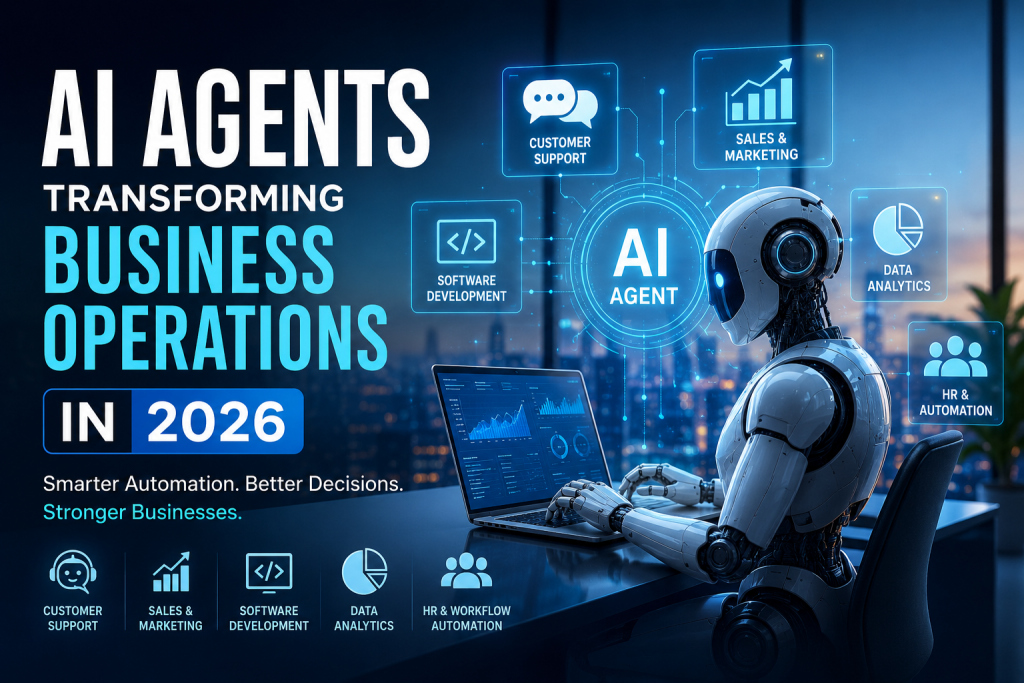
AI Agents in 2026: How Autonomous Systems Are Transforming Business Operations

Introduction Artificial Intelligence has moved far beyond simple chatbots and recommendation engines. In 2026, AI agents are becoming one of the most influential technologies shaping modern businesses. These intelligent systems are capable of understanding goals, making decisions, performing tasks, and even coordinating with other software tools with minimal human intervention. What once required teams of employees and multiple software platforms can now be managed by autonomous AI systems that work continuously and efficiently. The rise of AI agents marks a significant shift in how organizations approach productivity, operations, and decision-making. Rather than serving only as assistants, AI systems are increasingly acting as digital workers that can execute complex workflows, analyze large volumes of information, and adapt to changing business conditions in real time. As companies continue to invest in automation and digital transformation, AI agents are emerging as a critical component of business strategy. Their ability to reduce operational costs, improve efficiency, and accelerate innovation is changing the way organizations operate across industries. What Are AI Agents? AI agents are autonomous software systems designed to perform tasks on behalf of users or organizations. Unlike traditional automation tools that follow predefined rules, AI agents can understand context, learn from interactions, make decisions, and take actions to achieve specific objectives. These systems combine advanced artificial intelligence technologies such as large language models, machine learning, natural language processing, and workflow automation. They can interact with applications, access databases, communicate with users, and execute tasks without requiring constant human supervision. For example, an AI agent can receive a request to prepare a market research report, gather information from multiple sources, analyze trends, generate insights, create a presentation, and deliver the final report automatically. Instead of performing one isolated function, it manages an entire process from start to finish. This capability is what makes AI agents fundamentally different from conventional software automation solutions. Why AI Agents Are Gaining Momentum in 2026 Several factors are contributing to the rapid adoption of AI agents across industries. Businesses are generating more data than ever before, creating a growing need for systems that can process and interpret information quickly. At the same time, organizations face increasing pressure to improve efficiency while reducing operational costs. Advancements in generative AI and large language models have significantly improved the reasoning and decision-making abilities of AI systems. Modern AI agents can understand complex instructions, maintain context across multiple tasks, and interact naturally with both humans and software applications. Cloud computing infrastructure has also made it easier for businesses to deploy and scale AI-powered solutions. Organizations no longer need extensive hardware investments to access advanced AI capabilities. The combination of these technological developments has created an environment where AI agents can deliver measurable business value across a wide range of functions. How AI Agents Work At their core, AI agents operate through a cycle of perception, reasoning, action, and learning. First, the agent gathers information from its environment. This may include user requests, business data, emails, documents, databases, or external sources. Next, the system analyzes the information and determines the best course of action based on predefined objectives. Advanced reasoning models help the agent evaluate different possibilities and choose appropriate responses. Once a decision is made, the AI agent executes the required actions. This may involve sending emails, updating records, generating reports, scheduling meetings, processing transactions, or interacting with other software systems. Finally, the agent learns from outcomes and feedback to improve future performance. Over time, this continuous learning process helps the system become more effective and accurate. This ability to independently manage workflows makes AI agents particularly valuable in complex business environments. Transforming Customer Service Operations Customer service is one of the areas experiencing the most significant impact from AI agents. Traditional customer support often involves long wait times, repetitive inquiries, and high operational costs. AI agents are helping organizations overcome these challenges by providing instant, personalized, and scalable support. Modern AI customer service agents can understand customer questions, access relevant information, resolve issues, process requests, and escalate complex cases when necessary. They operate around the clock, ensuring customers receive assistance whenever needed. Beyond answering questions, AI agents can proactively identify potential issues, recommend solutions, and follow up with customers to ensure satisfaction. Businesses using AI-powered customer support systems are reporting faster response times, improved customer experiences, and reduced service costs. Revolutionizing Human Resources Management Human Resources departments are increasingly adopting AI agents to streamline administrative tasks and improve employee experiences. Recruitment is one area where these systems are delivering significant benefits. AI agents can screen resumes, schedule interviews, communicate with candidates, and identify suitable applicants based on specific job requirements. Employee onboarding processes are also becoming more efficient. AI agents can guide new hires through documentation, answer common questions, provide training materials, and ensure compliance requirements are completed. In addition, AI systems can assist with performance evaluations, workforce planning, employee engagement initiatives, and professional development recommendations. By automating routine administrative work, HR teams can focus more on strategic initiatives and employee relationships. Enhancing Sales and Marketing Performance Sales and marketing teams are using AI agents to improve customer engagement, generate leads, and optimize campaigns. AI-powered sales agents can identify potential customers, analyze purchasing behavior, personalize outreach efforts, and recommend next steps for sales representatives. These capabilities help organizations improve conversion rates and accelerate revenue growth. Marketing teams benefit from AI agents that can create content, monitor campaign performance, analyze audience behavior, and adjust strategies based on real-time insights. For example, an AI agent may automatically identify underperforming advertisements, suggest improvements, allocate budgets more effectively, and generate detailed performance reports. This level of automation allows businesses to respond more quickly to market changes and customer preferences. Improving Financial Operations Financial management is another area where AI agents are creating substantial value. Organizations handle large volumes of financial data every day, making accuracy and efficiency critical. AI agents can automate invoice processing, expense management, budgeting, forecasting, and financial reporting. These systems can identify unusual transactions, detect potential fraud, and alert financial teams to

Artificial Intelligence, Business Intelligence

AI Agents in the Workplace: From Assistants to Autonomous Decision Makers

AI Agents in the Workplace: From Assistants to Autonomous Decision Makers Artificial Intelligence has already transformed the way businesses operate, but a new generation of AI technology is pushing workplace innovation even further. While most people are familiar with AI assistants that answer questions, schedule meetings, or help draft emails, today’s AI agents are becoming capable of much more. They can analyze information, make decisions, execute tasks, and continuously learn from outcomes with minimal human intervention. The shift from AI assistants to autonomous AI agents represents one of the most significant technological developments of the decade. Organizations across industries are exploring how these intelligent systems can streamline operations, improve customer experiences, and increase efficiency while reducing operational costs. As businesses continue their digital transformation journeys, AI agents are quickly becoming valuable team members rather than just software tools. Understanding how AI agents work, what benefits they offer, and the challenges they present is essential for organizations looking to remain competitive in an increasingly AI-driven world. Understanding AI Agents Traditional AI assistants are designed to respond to user requests. They wait for instructions, process queries, and provide outputs based on predefined interactions. Examples include virtual assistants that answer customer questions, generate content, or help employees find information. AI agents, however, take things a step further. Instead of simply responding to commands, they can independently plan, execute, monitor, and optimize tasks to achieve specific objectives. These systems are goal-oriented and capable of making decisions based on real-time data and changing circumstances. An AI agent typically combines several capabilities: Natural language understanding Data analysis and interpretation Decision-making logic Task execution Continuous learning and adaptation Integration with business systems and applications This combination allows AI agents to function more like digital coworkers than traditional software applications. The Evolution of Workplace AI The journey of workplace AI has evolved through several distinct phases. Initially, businesses used rule-based automation systems to handle repetitive tasks. These systems followed fixed instructions and could not adapt to unexpected situations. The next phase introduced AI-powered assistants capable of understanding human language and providing intelligent responses. These tools improved productivity by helping employees access information more efficiently. Today, AI agents represent the latest stage of this evolution. Rather than simply assisting users, they can independently complete complex workflows that previously required human involvement. This transition is changing how organizations think about productivity, workforce management, and operational efficiency. Businesses are moving from asking, “How can AI help employees?” to asking, “Which tasks can AI complete on its own?” How AI Agents Are Transforming the Workplace AI agents are being deployed across various departments and business functions. Their ability to operate autonomously enables organizations to automate increasingly sophisticated processes. Customer Service and Support Customer service is one of the areas experiencing the greatest impact from AI agents. Traditional chatbots could answer basic questions, but modern AI agents can handle entire customer interactions from start to finish. They can: Understand customer intent Access customer records Resolve issues automatically Process refunds Escalate complex cases when necessary Follow up after resolution This reduces response times while improving customer satisfaction and lowering operational costs. Human Resources HR departments are increasingly using AI agents to manage administrative tasks and improve employee experiences. AI agents can: Screen resumes Schedule interviews Answer employee questions Assist with onboarding Track compliance requirements Generate HR reports By automating routine activities, HR professionals can focus on strategic initiatives such as talent development and employee engagement. Sales and Marketing Sales and marketing teams generate large amounts of data daily. AI agents help transform this data into actionable insights. These systems can: Identify sales opportunities Qualify leads Personalize marketing campaigns Monitor customer behavior Predict purchasing trends Optimize advertising strategies As a result, businesses can improve conversion rates and create more targeted customer experiences. Finance and Accounting Financial operations require accuracy, speed, and compliance. AI agents are becoming valuable assets in managing these responsibilities. Applications include: Invoice processing Expense management Financial forecasting Fraud detection Budget analysis Regulatory compliance monitoring By automating these tasks, organizations reduce errors and improve financial decision-making. IT Operations and Cybersecurity Modern IT environments are highly complex, making them ideal candidates for AI-driven automation. AI agents can: Monitor networks continuously Detect anomalies Respond to security threats Troubleshoot system issues Manage software updates Optimize infrastructure performance This proactive approach helps organizations strengthen security and minimize downtime. The Rise of Autonomous Decision-Making One of the most transformative aspects of AI agents is their growing ability to make decisions independently. Autonomous decision-making does not mean replacing human judgment entirely. Instead, AI agents handle routine and data-intensive decisions while humans maintain oversight of strategic and high-risk choices. For example, an AI agent managing inventory can automatically reorder products when stock levels fall below predefined thresholds. It can analyze sales trends, supplier performance, and seasonal demand to determine the optimal purchasing strategy without requiring constant human intervention. Similarly, in customer service environments, AI agents can decide the best course of action for resolving common issues based on historical outcomes and customer preferences. As AI systems become more sophisticated, their decision-making capabilities will continue expanding across industries. Benefits of AI Agents in the Workplace Organizations adopting AI agents are experiencing a wide range of benefits that extend beyond simple automation. Increased Productivity AI agents work around the clock without breaks, allowing businesses to complete tasks faster and more consistently. Employees spend less time on repetitive work and more time on high-value activities. Improved Accuracy Human errors can lead to costly mistakes, especially in areas such as finance, compliance, and data management. AI agents help reduce errors by following standardized processes and analyzing data systematically. Faster Decision-Making Businesses generate enormous volumes of data every day. AI agents can process this information in real time, enabling quicker and more informed decisions. Cost Reduction Automating routine tasks reduces labor costs and improves operational efficiency. Organizations can achieve more with existing resources while maintaining service quality. Enhanced Customer Experiences Customers increasingly expect instant responses and personalized interactions. AI agents can deliver consistent, high-quality

Artificial Intelligence, Business Intelligence, Digital Transformation, enterprise

Agentic AI: How Autonomous AI Agents Are Changing Business Workflows

Agentic AI: How Autonomous AI Agents Are Changing Business Workflows Artificial Intelligence has rapidly evolved from being a futuristic concept to becoming a critical component of modern business operations. Over the past few years, organizations have adopted AI-powered tools to automate repetitive tasks, improve customer experiences, and enhance decision-making. However, the latest advancement in this technological journey is Agentic AI—a new generation of AI systems capable of acting autonomously, making decisions, and completing complex workflows with minimal human intervention. Unlike traditional AI systems that require continuous prompts and instructions, Agentic AI can independently analyze situations, plan actions, execute tasks, and adapt based on outcomes. This shift represents one of the most significant developments in business technology, offering organizations unprecedented levels of efficiency, productivity, and scalability. As businesses face increasing competition and growing operational complexity, Agentic AI is emerging as a powerful solution capable of transforming how work gets done. From customer service and sales to software development and project management, autonomous AI agents are redefining business workflows across industries. In this article, we’ll explore what Agentic AI is, how it works, its business applications, benefits, challenges, and why it is poised to become a cornerstone of future enterprise operations. Understanding Agentic AI Agentic AI refers to artificial intelligence systems designed to operate as autonomous agents. These agents can perceive their environment, understand goals, create plans, make decisions, and take actions without requiring constant human supervision. Traditional AI tools generally perform specific tasks based on direct user input. For example, a chatbot may answer questions, or an AI image generator may create images based on prompts. Agentic AI goes several steps further. Instead of merely responding to commands, autonomous AI agents can: Understand objectives Break down complex tasks into smaller actions Gather necessary information Make decisions based on available data Execute workflows independently Learn from outcomes and adjust strategies This capability transforms AI from a passive assistant into an active digital worker capable of managing entire business processes. The Evolution from Traditional AI to Agentic AI The development of Agentic AI represents the next stage in the evolution of artificial intelligence. Traditional Automation Early automation systems followed predefined rules. They could execute repetitive tasks but lacked flexibility and intelligence. Examples include: Email automation Data entry automation Scheduled reporting systems Machine Learning Systems Machine learning introduced predictive capabilities. These systems could identify patterns and make recommendations based on data. Examples include: Recommendation engines Fraud detection systems Predictive analytics tools Generative AI Generative AI expanded AI capabilities by creating content such as text, images, code, and videos. Examples include: AI writing assistants Image generation platforms Coding assistants Agentic AI Agentic AI combines reasoning, planning, memory, and action capabilities. Instead of assisting users with individual tasks, autonomous agents can complete entire workflows from start to finish. This progression marks a fundamental shift from AI tools that simply respond to requests toward AI systems that actively pursue objectives. How Agentic AI Works To understand its business value, it’s important to know how Agentic AI functions. 1. Goal Understanding An AI agent begins by understanding the objective provided by the user or organization. For example: “Generate a market research report for the healthcare industry.” The agent interprets the request and identifies the required steps. 2. Planning The system creates a strategic plan to accomplish the objective. This may involve: Researching industry data Gathering competitor information Analyzing trends Creating visual reports Drafting conclusions 3. Execution The AI agent performs tasks independently using available tools and resources. It may: Search databases Access internal documents Analyze spreadsheets Generate reports Send notifications 4. Monitoring Throughout execution, the agent evaluates progress and adjusts actions when necessary. 5. Learning Advanced agents continuously improve performance by learning from previous experiences and outcomes. This combination of reasoning, planning, execution, and adaptation enables Agentic AI to handle increasingly sophisticated business processes. Why Businesses Are Embracing Agentic AI Organizations worldwide are investing heavily in Agentic AI because of its ability to improve operational efficiency while reducing costs. Several factors are driving adoption: Growing Data Volumes Businesses generate enormous amounts of data daily. Human teams often struggle to process and analyze this information efficiently. Agentic AI can monitor, analyze, and extract insights from large datasets in real time. Need for Faster Decision-Making Competitive markets require rapid responses. Autonomous agents can process information and make recommendations significantly faster than traditional workflows. Workforce Productivity Employees spend substantial time on repetitive administrative tasks. AI agents can automate these activities, allowing workers to focus on strategic and creative responsibilities. Cost Optimization Reducing manual effort leads to lower operational expenses while maintaining high levels of productivity. Business Applications of Agentic AI Agentic AI is transforming numerous departments across organizations. Customer Support Customer service is one of the most impactful areas for AI adoption. Autonomous agents can: Handle customer inquiries Resolve common issues Process refunds Escalate complex cases Provide 24/7 support This improves customer satisfaction while reducing support costs. Sales and Lead Generation Sales teams spend considerable time identifying prospects and nurturing leads. AI agents can: Research potential customers Qualify leads Schedule meetings Send follow-up emails Generate sales insights As a result, sales professionals can focus on closing deals rather than administrative work. Marketing Automation Marketing departments can leverage Agentic AI for: Content creation Campaign optimization Audience segmentation Competitor analysis Social media management AI agents continuously monitor performance and make adjustments to improve results. Human Resources HR teams are increasingly using AI agents to streamline recruitment and employee management. Applications include: Resume screening Candidate ranking Interview scheduling Employee onboarding Performance tracking This reduces hiring time and improves recruitment efficiency. Software Development Agentic AI is making a major impact in software engineering. AI agents can: Write code Detect bugs Conduct testing Generate documentation Monitor system performance Development teams benefit from faster release cycles and improved software quality. Finance and Accounting Financial departments use autonomous AI agents for: Invoice processing Expense tracking Financial forecasting Fraud detection Compliance monitoring These capabilities reduce errors and improve financial accuracy. Benefits of Agentic AI for Businesses Increased Productivity

Futuristic business illustration showing a central AI brain connected to digital agent nodes and data streams, with document icons symbolizing smart retrieval. Bold title reads 'Agentic RAG
React native doveploment

Agentic RAG

Introduction Agentic RAG is transforming the way organizations approach information retrieval, research, and automation by combining the power of retrieval-augmented generation (RAG) with intelligent, autonomous agents. This advanced AI framework empowers systems to reason, plan, use external tools, and learn over time, resulting in highly accurate and context-aware outputs. As modern enterprises face exponential growth in data, agentic RAG offers new ways to access reliable information, automate workflows, and create advanced virtual assistants—ushering in a new era of scalable, adaptive business intelligence. What Is Agentic RAG? Agentic RAG merges retrieval-based AI models with generative language models, empowered by autonomous agents that go beyond static query matching. Agents can decide what information to retrieve, break down complex queries into sub-tasks, access external APIs, and synthesize data for comprehensive responses. Unlike classic RAG, agentic RAG adapts to new data and context dynamically, leveraging iterative planning and feedback to continually improve output quality. Key Features: Autonomous decision-making and reasoning Multi-step planning and query decomposition Dynamic retrieval from diverse sources (databases, APIs, knowledge bases) Enhanced accuracy, efficiency, and real-time adaptability Continual learning and context management Types of Agentic RAG Agentic RAG systems employ several types of agents based on function and complexity: Routing Agent: Directs queries to the most suitable RAG pipeline, using agentic reasoning to analyze tasks such as document summarization or question answering. One-Shot Query Planning Agent: Breaks queries into independent sub-queries, executes them in parallel, and synthesizes unified answers. Tool Use Agent: Integrates external tools and APIs for real-time or specialized data, enhancing generative responses. ReAct Agent (Reason + Act): Iteratively reasons and interacts with multiple sources or tools, adapting its approach mid-task for the most precise result. Dynamic Planning & Execution Agent: Manages multi-step and complex workflows, separating long-term plans from immediate execution. Utilizes computational graphs and orchestrates stepwise execution. Applications in Real-World Scenarios Agentic RAG offers transformative benefits across industries: Enterprise Knowledge Management: Streamlines access to organizational data, enabling employees to make fast, informed decisions. Automated Support & Virtual Assistants: Reduces workloads by providing instant, context-relevant answers in customer and employee support. Healthcare: Improves patient insights and research capabilities with agents that gather and contextualize medical knowledge. Legal Research & Finance: Accelerates analysis of documents, regulations, and market data with agents capable of domain-specific data synthesis. Innovation & Research: Assists in synthesizing ideas, comparing multiple sources, and driving strategic initiatives through intelligent information retrieval. How To Implement Agentic RAG Follow these steps for building an agentic RAG system: Define Objectives: Identify tasks suitable for agentic RAG, such as chatbots or automated research. Choose Core Components: Select a retrieval system (e.g., dense passage retrieval, hybrid search) and a generative AI model (e.g., GPT, BERT). Prepare Data: Collect, clean, and preprocess documents to ensure compatibility and maximize retrieval accuracy. Build the Retrieval Layer: Index documents for fast, context-aware search. Agent Integration: Introduce agents to orchestrate workflows—query planning, tool use, and multimodal integration. Fine-Tune & Feedback Loops: Continuously refine models with user feedback and retraining to maintain high performance. Deploy & Monitor: Set up APIs, real-time monitoring, and performance dashboards for ongoing optimization. Key Tools: LlamaIndex and LangChain for agent orchestration, reasoned workflows, and tool integration. Low-code platforms like ZBrain for business workflows and rapid issue response. Conclusion Agentic RAG is redefining the landscape of AI-driven knowledge management, automating complex information retrieval, and powering scalable enterprise solutions. Its combination of multi-agent intelligence, context-awareness, dynamic adaptation, and modular flexibility gives organizations the tools to succeed in an information-rich, rapidly evolving market. Unlock the power of agentic RAG to supercharge research, virtual assistants, and automated decision-making. Call-to-Action: Explore how agentic RAG can optimize workflows and revolutionize information access—connect with AI experts today to get started on a future-ready solution! FAQ What is Agentic RAG? Agentic RAG is a framework that empowers AI agents to retrieve and use external information, plan multi-step workflows, and generate intelligent, context-aware responses far beyond classic RAG capabilities. How does it differ from traditional RAG? Agentic RAG adds autonomous reasoning, multi-task orchestration, and external tool use—enabling more accurate and adaptable information synthesis. What are the main benefits for enterprises? Benefits include scalable automation, enhanced data accuracy, personalized user experiences, and efficiency with reduced costs and improved decision quality. What are common implementation challenges? Challenges involve complex system integration, managing data quality, ensuring scalability, and maintaining real-time performance. Which platforms support agentic RAG development? Popular frameworks are LlamaIndex, LangChain, and low-code platforms like ZBrain, offering flexible workflow design and seamless data integration. The Real Benefits of Hiring a React Native App Development Company

How would you like me to respond?

Select a personality for your AI assistant

Normal
Happy
Sad
Angry

Your selection will affect how the AI assistant responds to your messages

Chat Assistant

Let's discuss your project!

Hear from our clients and why 3000+ businesses trust TechOTD

Tell us what you need, and we'll get back with a cost and timeline estimate

Scroll to Top