
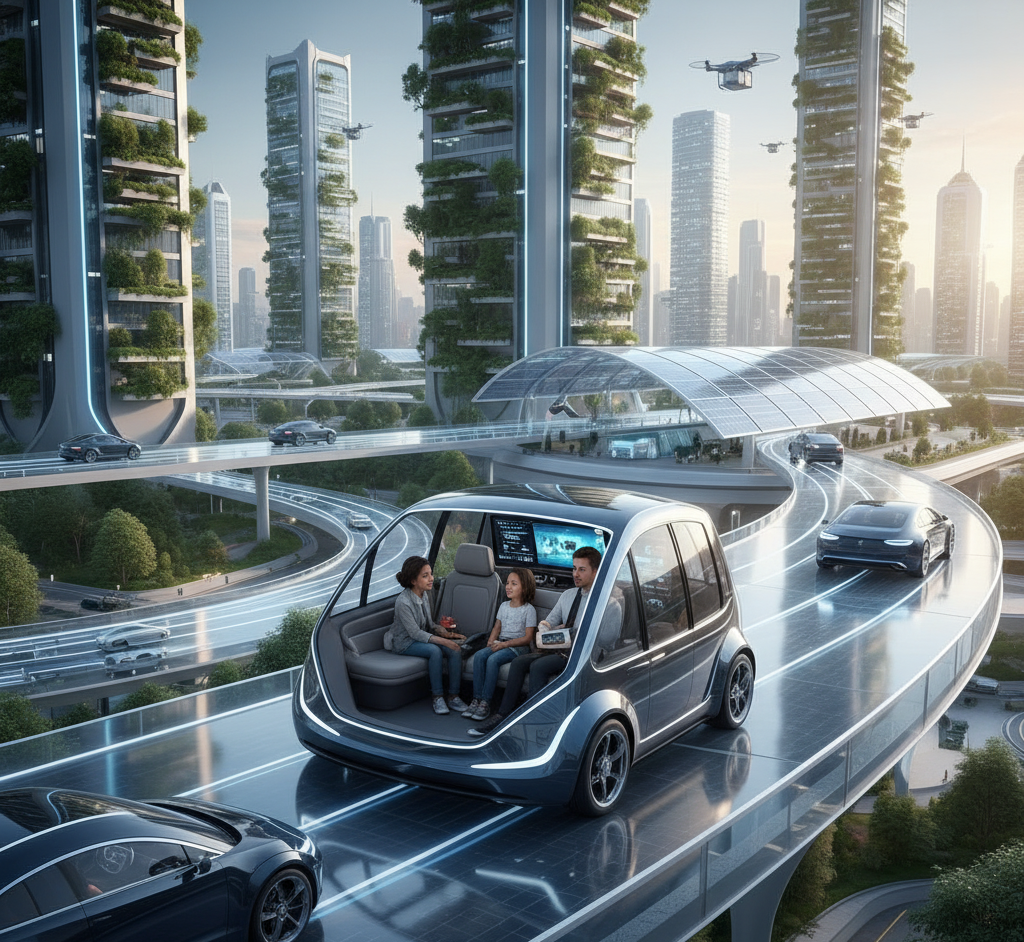
Future of Autonomous Vehicles
The Future of Autonomous Vehicles: Understanding Self-Driving Car Technology The automotive industry stands at the threshold of its most revolutionary transformation. Autonomous vehicles promise to reshape transportation, urban planning, and daily life in ways we’re only beginning to understand. Self-driving technology combines artificial intelligence, sensor systems, and connectivity to create vehicles capable of navigating without human intervention. Understanding Autonomous Vehicle Levels The Society of Automotive Engineers defines six levels of driving automation, ranging from zero automation to full autonomy. Understanding these levels clarifies the current state and future potential of self-driving technology. Level 0 represents no automation, where drivers perform all tasks. Most older vehicles fall into this category, though they may include warning systems. Level 1 automation includes single automated features like adaptive cruise control or lane-keeping assistance. The driver remains fully engaged and monitors the environment constantly. Level 2 systems combine multiple automated functions, allowing the vehicle to control steering and acceleration simultaneously under specific conditions. The driver must remain attentive and ready to intervene immediately. Many modern vehicles offer Level 2 capabilities through advanced driver assistance systems. Level 3 automation allows the vehicle to handle all driving tasks under certain conditions, but requires drivers to be ready to take control when requested. This level remains rare in consumer vehicles due to regulatory and liability complexities. Level 4 vehicles operate autonomously in specific geographic areas or conditions without requiring human intervention. These systems include robust safety mechanisms to handle situations when autonomous operation becomes impossible. Level 5 represents full automation under all conditions, eliminating the need for human drivers entirely. True Level 5 vehicles remain in development, with significant technical and regulatory hurdles to overcome. Core Technologies Enabling Autonomy Self-driving vehicles rely on sophisticated sensor arrays to perceive their environment. LiDAR systems use laser pulses to create detailed three-dimensional maps of surroundings, detecting objects, pedestrians, and road features with precision. Radar sensors complement LiDAR by providing reliable detection in adverse weather conditions. Multiple radar units monitor different zones around the vehicle, tracking movement and measuring distances. Camera systems provide visual information that machine learning algorithms interpret to recognize traffic signs, signals, lane markings, and road users. Multiple cameras create a comprehensive view around the vehicle. Ultrasonic sensors handle close-range detection for parking and low-speed maneuvering. These sensors detect nearby obstacles and assist with precise vehicle positioning. GPS and mapping systems provide location data and route information. High-definition maps include detailed information about road geometry, traffic patterns, and regulatory requirements. Artificial Intelligence and Machine Learning The brain of autonomous vehicles consists of powerful AI systems processing massive amounts of sensor data in real-time. Machine learning algorithms trained on millions of miles of driving data enable vehicles to recognize patterns, predict behavior, and make appropriate decisions. Neural networks analyze sensor inputs to classify objects, predict movements, and plan safe paths through complex environments. These systems continuously learn from new situations, improving performance over time. Decision-making algorithms evaluate multiple factors simultaneously, considering safety, efficiency, and legal requirements. The challenge involves programming vehicles to handle edge cases and unexpected situations that human drivers navigate intuitively. Current State of Autonomous Technology Today’s autonomous vehicles operate primarily in testing environments and limited deployment scenarios. Several companies run autonomous taxi services in specific cities with safety drivers or remote monitoring. Advanced driver assistance systems available in consumer vehicles provide significant autonomy for highway driving, parking, and traffic jam situations. These systems reduce driver workload and improve safety but require constant human supervision. Commercial applications like autonomous trucking for specific routes and delivery robots for last-mile logistics are progressing rapidly. These controlled environments with defined routes suit current technological capabilities better than general-purpose urban driving. Safety Considerations and Benefits Safety represents both the primary promise and challenge of autonomous vehicles. Proponents argue that eliminating human error could prevent the vast majority of accidents caused by distraction, impairment, or poor judgment. Autonomous systems never tire, get distracted, or drive impaired. They maintain constant vigilance and react faster than human drivers to emerging hazards. Comprehensive sensor coverage eliminates blind spots and provides awareness in all directions simultaneously. However, autonomous systems must prove they can handle rare but critical scenarios that human drivers navigate through experience and intuition. Establishing reliability standards and building public trust requires extensive real-world testing and transparent safety reporting. Regulatory and Legal Challenges Governments worldwide grapple with creating frameworks to regulate autonomous vehicles while encouraging innovation. Key questions include liability in accidents, safety standards, data privacy, and cybersecurity requirements. Insurance models must adapt to scenarios where vehicles, not drivers, make operational decisions. Determining fault in accidents involving autonomous vehicles requires new legal frameworks and investigation procedures. Infrastructure and Connectivity Fully realizing autonomous vehicle benefits requires infrastructure upgrades. Smart traffic signals communicating with vehicles optimize flow and reduce delays. Road markings and signage must meet standards that autonomous sensors can reliably detect. Vehicle-to-vehicle and vehicle-to-infrastructure communication creates cooperative systems where cars share information about conditions, hazards, and intentions. This connectivity multiplies the effectiveness of individual vehicle sensors. Social and Economic Impacts Autonomous vehicles promise transformative social benefits. Elderly individuals and people with disabilities gain independent mobility. Urban areas could reduce parking infrastructure as shared autonomous vehicles remain in constant use. Professional drivers face uncertainty as automation threatens jobs in trucking, taxi services, and delivery sectors. Society must address these workforce transitions through retraining programs and economic policies. The Road Ahead The path to widespread autonomous vehicle adoption extends across decades rather than years. Technology continues advancing, but achieving the reliability and safety required for true driverless operation remains challenging. Near-term developments focus on expanding Level 2 and Level 3 capabilities in consumer vehicles and deploying Level 4 systems in controlled environments. These incremental advances build the foundation for eventual Level 5 autonomy. Public acceptance will grow as people experience the benefits of increasing automation. Education about capabilities and limitations helps set realistic expectations while building trust in the technology. The autonomous vehicle revolution will unfold gradually, driven by technological progress, regulatory evolution, and market acceptance.