
Deepfakes

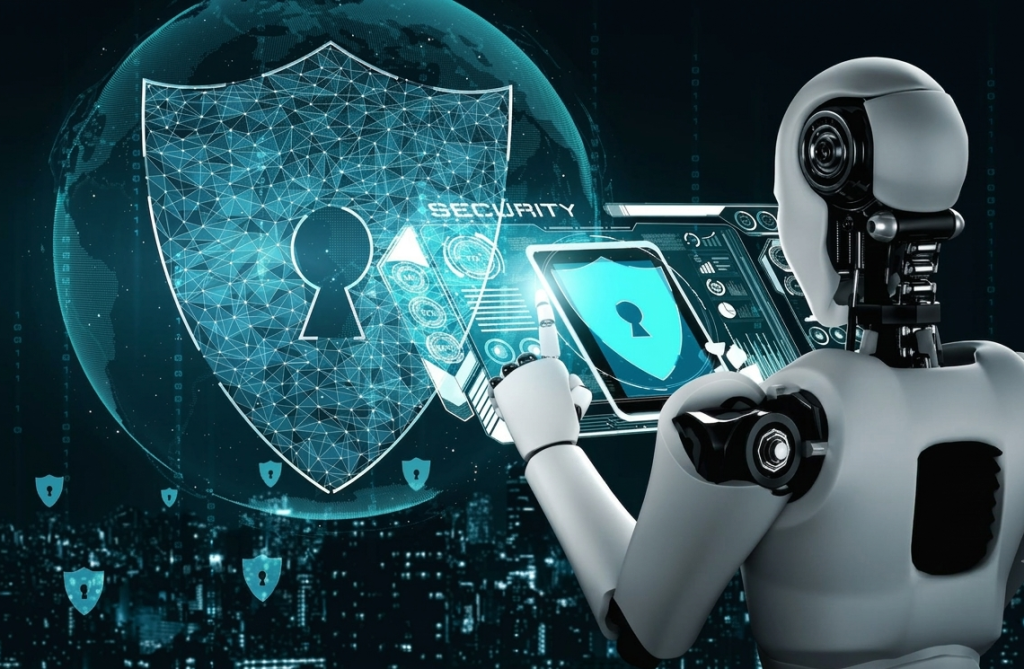
Cybersecurity team analyzing AI-driven cyber attack patterns, phishing threats, deepfakes, and adaptive malware risks on a digital dashboard.
cybersecurity

How Cyber Attacks Are Changing in the Age of AI

Introduction Cyber attacks have always evolved alongside technology, but AI has changed the pace and scale of that evolution. What once required skilled attackers, long preparation, and manual effort can now be partially or fully automated, allowing criminals to launch more attacks in less time. This means organizations are no longer dealing with isolated threats; they are facing industrialized cybercrime that can adapt quickly and target more victims at once. One of the biggest shifts is in social engineering. AI makes phishing messages sound more natural, personalized, and believable, which increases the chances that people will click, reply, or share sensitive information. Attackers are also using deepfake audio and video to impersonate executives, coworkers, or trusted contacts, turning identity fraud into a much more serious threat. AI is also improving the speed and precision of technical attacks. Criminals can use it to scan for vulnerabilities, optimize exploit attempts, and adjust malware behavior in real time. This makes attacks harder to stop because they can change their method as defenders respond. Another major change is that cyberattacks are becoming multi-channel. Instead of relying only on email, attackers now combine messaging apps, phone calls, collaboration tools, social platforms, and even legitimate authentication flows to reach targets. This creates a more realistic and coordinated attack path that is harder for users and security teams to recognize quickly. AI is also affecting the defensive side of security, because the same technology used by attackers can help defenders detect unusual behavior, analyze threats, and respond faster. But the overall risk is rising because attackers often move faster than organizations can adapt. As a result, cybersecurity teams are being pushed to focus more on prevention, identity verification, and resilience than on detection alone. Key changes Phishing is becoming more personalized and convincing. Deepfakes are making impersonation attacks more dangerous. Malware is becoming more adaptive and difficult to detect. Attacks are happening across more channels than email alone. Attackers are using AI to move faster than traditional defense teams. Conclusion Cyber attacks in the age of AI are faster, smarter, and more scalable than before. That means companies and individuals must become more careful about identity verification, suspicious messages, and security habits. The future of cyber defense will depend on using AI wisely, improving awareness, and building systems that can stop attacks before they spread. In this new environment, speed matters on both sides, but defense must become more proactive and resilient.extension. FAQ How is AI changing cyber attacks? AI is making attacks more automated, personalized, and difficult to detect by helping attackers create better phishing, deepfakes, malware, and multi-channel campaigns. What is the most common AI-powered attack? Phishing is one of the most common because AI can make messages sound more believable and targeted. Are deepfakes really a cybersecurity threat? Yes, deepfakes can be used to impersonate leaders, employees, or trusted contacts and trick people into sharing money or information. Can AI help defenders too? Yes, AI can help security teams detect threats, analyze patterns, and respond faster, but attackers are also using it aggressively. Why are AI attacks harder to stop? They are harder to stop because they can adapt in real time, operate across many channels, and move at machine speed. What should businesses do now? Businesses should improve employee awareness, verify identities carefully, strengthen security controls, and prepare for more advanced AI-driven threats.
Artificial Intelligence, cybersecurity, Technology, Technology & Innovation

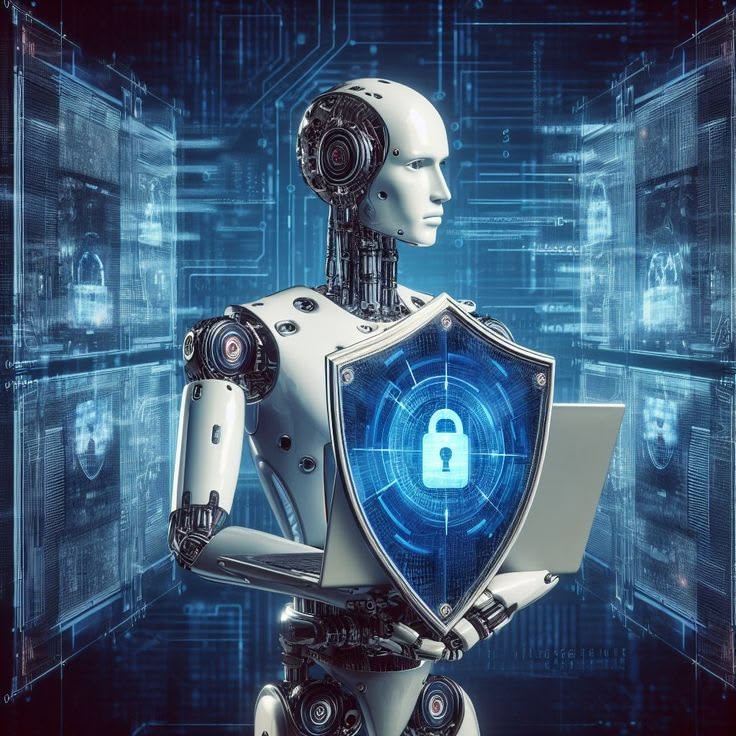
The New Cybersecurity Frontier: Defending Against AI-Driven Exploits and Autonomous Threats

The New Cybersecurity Frontier: Defending Against AI-Driven Exploits and Autonomous Threats The battleground of digital security has shifted from static defenses to dynamic, algorithmic warfare. For decades, the foundational rules of cybersecurity revolved around predictable patterns. A human attacker wrote malicious code, a security researcher analyzed its signature, and an enterprise deployed a patch or an antivirus definition to block it. This cat-and-mouse game was bounded by the limits of human speed, requiring human hours to discover vulnerabilities, write exploits, and configure defenses. That era has officially drawn to a close. The consumerization and rapid maturation of advanced artificial intelligence frameworks have handed both adversaries and defenders a radically new toolset. Today, security professionals are no longer just fighting human threat actors; they are confronting autonomous, self-learning software agents capable of executing multi-stage attacks at network speeds. When machine learning models can instantly scan millions of lines of code for zero-day vulnerabilities, dynamically mutate payload signatures to evade behavioral detection, and generate hyper-personalized social engineering campaigns at an industrial scale, traditional defensive measures collapse. The infrastructure of tomorrow cannot be protected by the manual workflows of yesterday. Understanding this new paradigm requires looking deep into how weaponized artificial intelligence operates, where it breaches existing defenses, and how enterprises must adapt to survive. The Anatomy of an AI-Driven Cyberattack To defend against an automated adversary, engineering teams must dissect how machine learning alters the traditional cyberkill chain. In a conventional attack blueprint, an offensive operation requires weeks of manual reconnaissance. Attackers trace network perimeters, map out employee organizational charts on professional networks, and carefully audit public-facing infrastructure for unpatched software versions. Artificial intelligence compresses this reconnaissance phase from weeks to seconds. Large language models and specialized code-analysis patterns can ingest massive swaths of public and private data, mapping out corporate attack surfaces with terrifying precision. An automated scanning agent can systematically probe an enterprise’s entire cloud footprint, identifying subtle logic flaws or forgotten API endpoints that a human analyst might overlook during a routine security audit. Once a vulnerability is identified, the weaponization phase begins. Historically, modifying an exploit to bypass a specific endpoint detection and response system required deep assembly-level knowledge and hours of trial and error. Weaponized AI models automate this entirely through a process known as polymorphic code mutation. The malicious agent evaluates the target environment’s defenses and dynamically alters its own structure—changing variable names, modifying execution flows, and encrypting payloads uniquely for that specific machine—ensuring that signature-based antivirus tools remain completely blind to the threat. The execution phase introduces the concept of autonomous decision-making in the wild. Traditional malware relies on a continuous back-and-forth connection with an external command-and-control server to receive instructions from a human operator. This network traffic is highly visible and often triggers behavioral alarms within modern network monitoring suites. An AI-driven malicious agent, however, carries its neural net logic directly within its payload. It can make independent, real-time decisions inside a compromised network—such as choosing when to lie dormant to avoid detection, which high-value databases to target for lateral movement, and how to quietly exfiltrate data without triggering data loss prevention systems. The Weaponization of Large Language Models and Deepfakes Beyond pure code execution, the intersection of generative artificial intelligence and social engineering represents one of the most immediate financial hazards to modern enterprises. Social engineering has always relied on human psychology, but it was historically limited by language barriers, stylistic inconsistencies, and the sheer time required to engage with targets. Generative text models have completely democratized the production of flawless phishing campaigns. Phishing emails used to be easy to spot, often plagued by broken grammar, generic greetings, and suspicious formatting. Today, specialized malicious LLMs can generate perfectly written, context-aware correspondence tailored to a specific target’s industry jargon, corporate hierarchy, and historical writing style. By scraping an executive’s public presentations, blog posts, and social media presence, an automated agent can construct emails that are virtually indistinguishable from legitimate corporate communications, drastically increasing the success rate of business email compromise attacks. Simultaneously, the maturation of synthetic audio and video generation—commonly referred to as deepfakes—has added an entirely new dimension to identity theft and corporate fraud. Threat actors no longer rely solely on written words to trick financial departments into executing fraudulent wire transfers. They deploy real-time voice cloning tools during active phone calls, mimicking the exact cadence, tone, and vocal characteristics of a company’s Chief Financial Officer or Chief Executive Officer. In advanced scenarios, attackers execute highly coordinated multi-media deceptions. They schedule video conference calls where an AI-generated avatar of a trusted corporate leader directs a mid-level manager to bypass standard verification protocols for an urgent, confidential corporate acquisition. The psychological impact of seeing a familiar face and hearing a familiar voice completely bypasses the traditional skepticism employees have been trained to maintain, revealing that the human element remains the most vulnerable interface in the corporate security stack. Vulnerabilities Inherent in the AI Lifecycle As companies rush to integrate artificial intelligence into their own products and internal workflows, they inadvertently introduce an entirely new category of software vulnerabilities. These are not standard software bugs like buffer overflows or SQL injections; they are flaws native to the data structures, training pipelines, and architectural design of machine learning systems. The first major vulnerability is data poisoning. Machine learning models are entirely products of the data they consume during training. If a threat actor managed to subtly corrupt the training dataset of an enterprise model—for instance, by injecting malicious code samples labeled as benign into an automated code-review model—the resulting neural network would inherently inherit that blind spot. The model would systematically approve malicious patterns in production, creating an architectural vulnerability that is incredibly difficult to detect through standard source-code analysis. The second critical risk vector is prompt injection, which specifically targets applications built on top of large language models. Because these systems process user inputs and system instructions within the same linguistic context window, an attacker can craft input strings that overwrite the model’s core

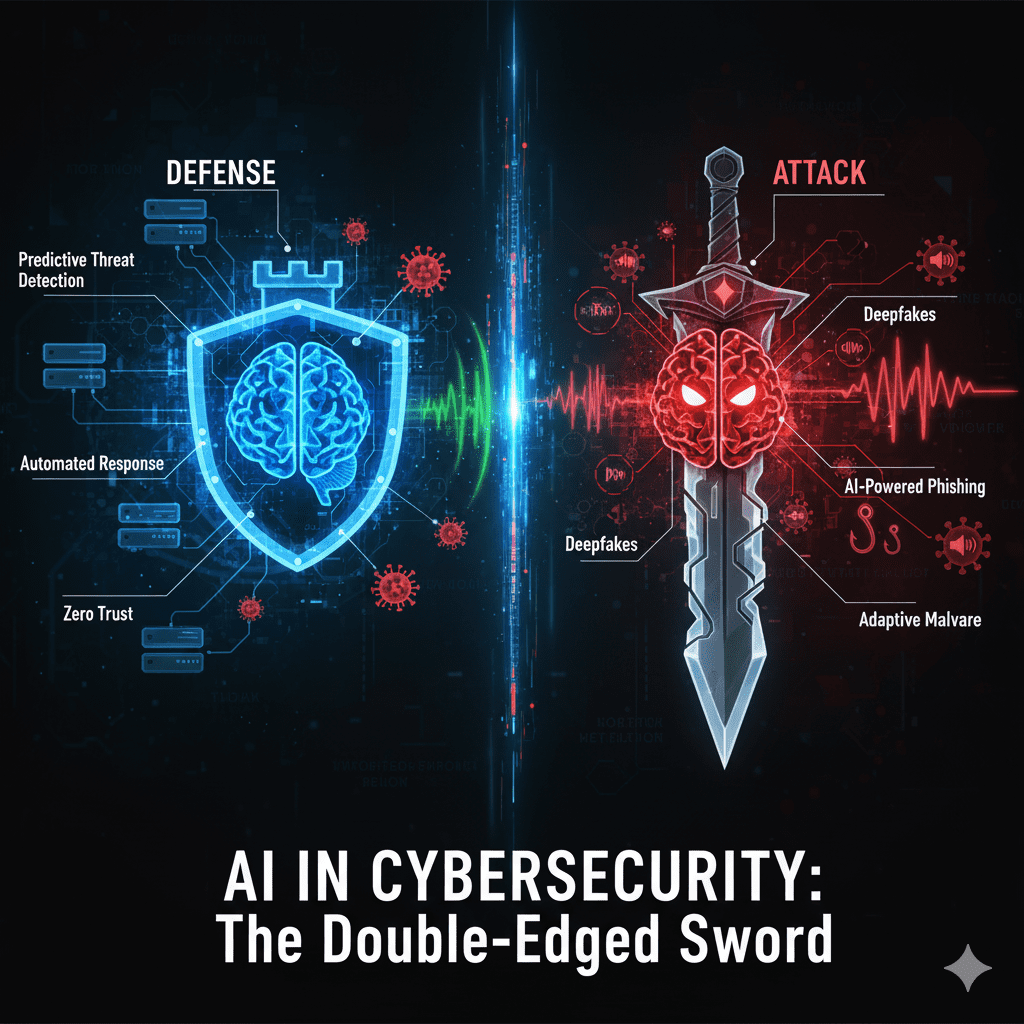
PREDICTIVE THREAT DETECTION and AUTOMATED RESPONSE
cybersecurity

Digital Armor: Defending Against Cyber Threats

Introduction For decades, the world of cybersecurity has been a high-stakes cat-and-mouse game. Security professionals build a wall, and hackers find a way over it. But today, this game is being fundamentally transformed by a powerful new player: Artificial Intelligence. AI is not just another tool; it’s a revolutionary force acting as both the strongest shield and the most dangerous new weapon. This article explores the dual role of AI in Cybersecurity, breaking down how it’s creating unprecedented defenses while simultaneously arming attackers with terrifying new capabilities The New Shield: AI as a Defensive Powerhouse The primary advantage of AI in a defensive role is its ability to process and analyze data at a scale and speed no human team could ever hope to match. While a human analyst sleeps, an AI security model is monitoring billions of events, looking for the one tiny anomaly that signals an attack. 1. Predictive Threat Detection Before AI, most security systems were reactive. They relied on “signatures”—the digital fingerprints of known malware. This meant a virus had to successfully attack someone first before it could be identified and blocked. AI, specifically machine learning, is predictive. It learns the normal, baseline behavior of your network, your users, and your devices. It can then spot suspicious deviations before a full-blown breach occurs. This includes: Behavioral Analysis: Is a user account that normally works from 9-to-5 suddenly trying to access sensitive files at 3:00 AM from a different country? AI flags this instantly. Anomaly Detection: Does a “smart” device like a thermostat suddenly start trying to communicate with an unknown server? AI can see this as a potential IoT (Internet of Things) attack. Pattern Recognition: AI can analyze global threat feeds and identify new attack patterns as they emerge, proactively blocking them before they even reach your network. 2. Automated Incident Response In a cyberattack, every second counts. A ransomware attack can encrypt an entire company’s files in minutes. AI doesn’t need to wait for approval; it can act in milliseconds. This is known as SOAR (Security Orchestration, Automation, and Response). Here’s a typical automated response scenario: Detect: An AI-powered sensor identifies a new, unknown program exhibiting ransomware-like behavior (e.g., rapidly encrypting files) on an employee’s laptop. Isolate: The AI immediately executes a predefined rule: it automatically disconnects that specific laptop from the company network, containing the threat. Investigate: The AI gathers all relevant data—what the program was, where it came from, what files it touched—and creates a report. Alert: It then sends an alert to a human security analyst, presenting the report and the action it took. The threat is neutralized before it could spread. The Future: An AI vs. AI Battleground This leads to an inevitable future: the front line of AI in Cybersecurity will be an AI-versus-AI battle. It will be a silent, high-speed war fought in milliseconds, with defensive AI models trying to detect and stop offensive AI-driven attacks. In this new era, the old security model of “trust but verify” is dead. The new model, which AI is perfect for, is Zero Trust. Zero Trust Architecture means you trust nothing and no one by default. It doesn’t matter if a login request comes from inside the office or outside; it must be verified. AI helps enforce this by continuously analyzing behavior. Just because you entered the right password doesn’t mean you are who you say you are. If your “logged-in” account suddenly starts acting suspiciously, the AI can force you to re-authenticate or block your access. Conclusion AI in Cybersecurity is a revolutionary, double-edged sword. It offers our most powerful hope for a secure digital future, capable of analyzing threats and responding at superhuman speeds. At the same time, it arms our adversaries with tools to create highly deceptive scams and intelligent malware. The key takeaway is that we can’t ignore it. For businesses, investing in modern, AI-powered defensive tools is no longer an option—it’s a necessity for survival. For individuals, it requires a new level of vigilance. In this new world, adaptability is everything. The future of security will be defined by who has the smarter, faster, and more adaptable AI. FAQ Q1: What is AI in Cybersecurity? AI in Cybersecurity refers to the use of artificial intelligence and machine learning to detect, predict, prevent, and respond to cyber threats. It moves beyond traditional, rule-based security by learning from data to identify new and unknown threats based on behavioral anomalies. Q2: Can AI replace human cybersecurity professionals? No, AI is a tool to augment human professionals, not replace them. AI can handle the massive, high-speed data analysis, but it still lacks human intuition, creativity, and strategic decision-making. AI flags the problem and contains it; the human analyst investigates the “why” and “how” to build a stronger long-term strategy. Q3: What is the biggest threat from AI in cyberattacks? Currently, the most accessible and dangerous threat is AI-powered social engineering, including deepfake audio and video. These attacks target the weakest link in any security system—human psychology—and are incredibly difficult to defend against with technology alone. Q4: How can a small business afford AI-powered security? While developing a custom AI model is expensive, most AI-powered security is now sold “as-a-service.” Many modern antivirus, firewall, and email security providers (like Microsoft, Google, and CrowdStrike) have already integrated AI and machine learning into their standard products, making it accessible and affordable for businesses of all sizes.

How would you like me to respond?

Select a personality for your AI assistant

Normal
Happy
Sad
Angry

Your selection will affect how the AI assistant responds to your messages

Chat Assistant

Let's discuss your project!

Hear from our clients and why 3000+ businesses trust TechOTD

Tell us what you need, and we'll get back with a cost and timeline estimate

Scroll to Top