
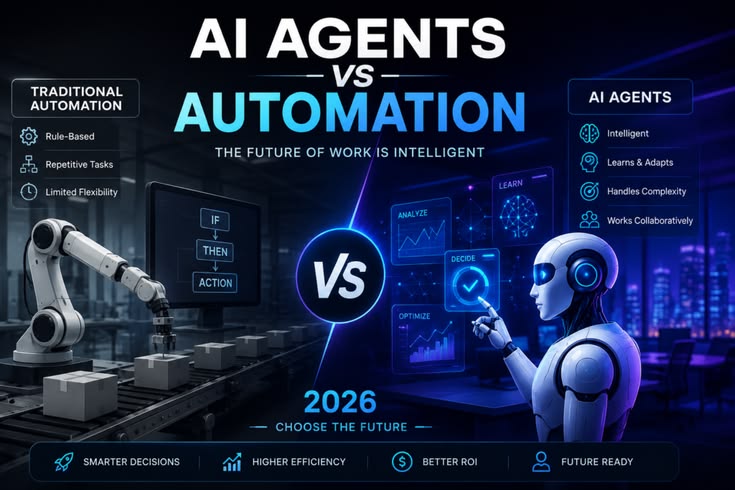
AI Agents vs. Traditional Automation: What’s Changing in 2026?
Introduction: The Evolution from Rules to Reasoning For decades, digital transformation was defined by a single, unwavering engineering paradigm: determinism. If you wanted a machine to execute a task, you had to explicitly map out every single variable, branch, and conditional statement beforehand. If an input deviated by even a single character from the expected schema, the automation would crash. This rigid framework birthed the massive market for Robotic Process Automation (RPA) and standard backend API integrations. By 2026, this deterministic wall has completely crumbled. We are currently witnessing a massive architectural migration from standard rule-based workflows to autonomous AI Agents. Unlike traditional software that simply accelerates data transmission across static structures, AI agents possess a cognitive layer. They don’t just execute instructions; they reason, interpret intent, adapt to unpredictable runtime changes, and dynamically formulate their own execution paths. This guide explores the deep technical divides between these two methodologies, maps out the core mechanics of agentic systems, and provides an enterprise blueprint for managing this massive shift. Section 1: Defining the Technical Boundary To understand this architectural evolution, we must establish clear technical boundaries between traditional automation and an actual AI agent. Traditional Automation: Rule-Based Systems Traditional automation operates entirely on if-this-then-that (IFTTT) execution graphs. A software engineer constructs a explicit pipeline using tools like Selenium, UiPath, or custom cron jobs. The software intercepts an input, references a hardcoded template or static database schema, maps fields explicitly, and routes the data to a destination API. The software has zero contextual understanding of the data it manipulates. If a vendor changes a button’s CSS selector on a billing portal, or if an invoice shifts a line item by five pixels, the script breaks. It cannot problem-solve because its world consists exclusively of binary conditions and explicitly coded paths. AI Agents: Goal-Oriented Systems An AI Agent is a software entity that leverages a Large Language Model (LLM) or Large Multimodal Model (LMM) as its central processing unit, running inside a continuous, stateful loop. Instead of receiving a step-by-step instruction set, an agent is given an objective, a set of constraints, and access to an array of external tools. The agent evaluates the current state of its environment, breaks down the main objective into an ordered series of sub-tasks, selects the appropriate tool for the immediate sub-task, analyzes the output of that tool, and continuously modifies its strategy based on real-time feedback. It handles unstructured data natively because it interprets semantic meaning rather than just looking for exact string matches. Section 2: Architectural Comparison: Static Pipelines vs. Cognitive Loops The foundational code paths of these two systems look fundamentally different under the hood. The Linear Pipeline Structure Traditional automation relies on linear or predictable branching logic. The execution flow looks like this: [Inbound Webhook] —> [Parse Exact JSON Schema] —> [Conditional Branching] —> [Write to Destination API] If any link in this chain encounters an anomaly, the execution thread fails, records an error log, and requires human intervention to patch the underlying code. The Agentic Cognitive Loop An autonomous AI agent runs within a non-linear, dynamic cognitive loop, often structured around the OODA Loop (Observe, Orient, Decide, Act) framework: +—————————————+ | Goal Formulation | +—————————————+ | v +———————————————+ —–> | Perception & Observation (Ingest Context) | | +———————————————+ | | | v | +———————————————+ | | Reasoning & Planning (LLM Evaluation) | | +———————————————+ | | | v | +———————————————+ | | Tool Selection & Execution (Take Action) | | +———————————————+ | | +—————————–+ The Core Pillars of Agent Architecture 1. The Planning Core The planning engine decomposes the primary target into manageable milestones. Modern agents utilize advanced prompt-engineering frameworks like Chain-of-Thought (CoT) or Tree-of-Thoughts (ToT) to explore multiple reasoning paths simultaneously, evaluating the probability of success for each direction before executing code. 2. Contextual Memory Systems Agents rely on two distinct memory tiers to maintain consistency over long-running operations: Short-Term Memory: Managed directly via the model’s active context window, keeping track of immediate conversational turns, tool outputs, and local state variables. Long-Term Memory: Powered by an external vector database or graph database. The agent saves past executions, successful problem-solving strategies, and corporate guidelines, retrieving them via semantic search whenever a similar task boundary arises. 3. Tool Utilization (Function Calling) Tools are the hands of the agent. A tool can be a database connection, an internal API, a web scraper, or a command-line terminal. The agent reads the documentation of these tools (written in clear, natural language schemas), determines which tool matches the current sub-task, formats the payload dynamically, executes the call, and parses the returned data to determine the next course of action. Section 3: In-Depth Comparison Matrix Technical Capability Traditional Automation (RPA/APIs) Autonomous AI Agents (2026 Paradigm) Input Type Access Strictly Structured (JSON, XML, CSV) Fully Unstructured (Audio, Video, PDFs, Free Text) Execution Paths Static, Pre-compiled, Deterministic Dynamic, Emergent, Goal-Oriented Error Handling Hardcoded try/catch blocks; immediate crash Autonomous Self-Healing and Error Correction Maintenance Profile High overhead; breaks on UI/API changes Self-adapting; updates strategies based on UI shifts Data Processing Exact string matching and regex parsers Semantic interpretation and conceptual mapping Compute Overhead Negligible; ultra-lightweight execution Substantial; high dependency on token throughput and inference speeds Section 4: Deep Dive into Multi-Agent Orchestration Systems As enterprise environments scale up, relying on a single, massive monolithic agent becomes inefficient. The complexity of managing massive context windows and disparate tool sets introduces latency and hallucinations. The industry has shifted heavily toward Multi-Agent Systems (MAS). In a multi-agent framework, complex corporate operations are divided among specialized, narrow AI agents that communicate with each other over structured protocol buses. +———————————–+ | Enterprise Controller | | (Manager/Router Agent) | +———————————–+ | +———————–+———————–+ | | v v +———————–+ +———————–+ | Security Audit Agent | | Data Extraction Agent | | – Validates Code | <== (Internal Bus) => | – Parses Documents | | – Monitors Regs | | – Cleans Inbound APIs| +———————–+ +———————–+ The Hierarchical Topology In this architecture, a Manager Agent intercepts user intents