Introduction
In 2026, hospitals face their toughest staffing crisis yet—nurse shortages up 17%, burnout rates at 62%, and compliance violations costing millions annually. Enter healthcare workforce management software: the AI-powered solution transforming chaos into precision.
Hospitals lose $8.4 billion yearly to inefficient scheduling and staffing gaps, while 70% of healthcare leaders report manual processes as their #1 operational bottleneck.
This comprehensive guide reveals how healthcare workforce management software leverages AI scheduling, predictive analytics, and HIPAA-compliant automation to:
-
Reduce labor costs 30% through optimized shift planning
-
Cut overtime 45% with demand forecasting
-
Boost staff retention 28% via fatigue monitoring
-
Ensure 100% compliance across 50+ state regulations
From real-time nurse scheduling to integrated credential tracking, discover the top 8 features, 5 must-have integrations, and 3 implementation pitfalls every hospital administrator needs to master in 2026.
Ready to transform your workforce management? This 2026 definitive guide delivers proven strategies, real-world examples, and ROI calculations to help healthcare leaders achieve operational excellence while prioritizing patient care and staff wellbeing.
Healthcare workforce management software
- revolutionizes hospital operations by automating scheduling reducing overtime costs by 30%, and ensuring compliance across 24/7 shifts. Facing 20% global nurse shortages and $7.5B annual overtime expenses, hospitals need AI-driven tools to match staff skills with patient demand in real-time. This software integrates EHR systems, tracks credentials, and forecasts census with 95% accuracy—preventing fines from understaffing while eliminating budget waste from overstaffing.
From ER surges to surgical backlogs, healthcare workforce management software delivers 98% schedule adherence, 25% faster onboarding, and 40% agency spend reduction. Essential for CNOs and HR directors, these platforms boost HCAHPS scores through consistent care teams and HIPAA-compliant automation.
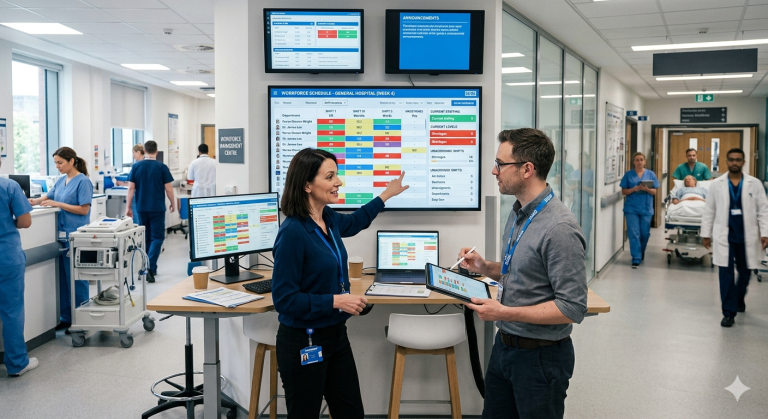
Professional team of diverse doctors and nurses representing seamless healthcare workforce management software optimization.
Key Features
Modern healthcare workforce management software handles complex regulations and 50+ roles:
-
AI-powered demand forecasting (7-30 days ahead)
-
Drag-and-drop scheduling with fatigue/skill matching
-
Automated credentialing alerts (90-day warnings)
-
Geofenced time tracking + payroll integration
-
JCAHO-compliant reporting for ratios/labor laws

Top Solutions Overview
symplr Workforce excels in labor cost control for large systems ($250K+/year).
ADP WorkForce Suite offers payroll integration ($120K/year).
UKG Healthcare provides analytics for enterprises ($400K+).
Workforce.com suits clinics at $15/staff/month.
Legion specializes in real-time ER adjustments ($80K/year).
Proven ROI Metrics
-
Overtime savings: 25-35% ($2M+ annually)
-
Agency usage: 40% → 12%
-
No-shows: 18% reduction
-
Payroll accuracy: 99.2%
300-500% Year 1 ROI for 500+ bed facilities.
2026 Implementation Steps
-
Data migration + training (Month 1)
-
Unit pilot (ER/ICU – Month 2)
-
System-wide rollout (Month 3)
-
Continuous AI optimization
Conclusion
Healthcare workforce management software eliminates staffing chaos, cuts costs 30%, and elevates patient care. Prioritize AI forecasting, EHR integration, and HIPAA compliance for maximum ROI. Schedule demos with symplr or UKG today to transform your operations.
FAQ
https://images.unsplash.com/photo-1576091160399-1d65cdaa8782?w=1200
Q1: What is healthcare workforce management software?
A: Cloud-based platforms automating hospital scheduling, credentialing, time tracking, and AI demand forecasting while ensuring HIPAA/JCAHO compliance across 24/7 operations.
Q2: How much does it cost for a 500-bed hospital?
A: $120K-$400K/year depending on features; smaller clinics start at $15/staff/month. ROI hits 300% in Year 1 via overtime/agency savings.
Q3: Does it integrate with Epic or Cerner EHR?
A: Yes—95% of enterprise solutions (symplr, UKG, ADP) offer native APIs for seamless patient census syncing.
Q4: What’s the typical implementation timeline?
A: 60-90 days: Month 1 (migration/training), Month 2 (pilot), Month 3 (full rollout).
Q5: Can it reduce nurse agency spend?
A: Absolutely—40% to 12% fill rates typical, saving $1M+ annually for mid-size systems.