The Digital Colleague: How Agentic AI Will Work as a Coworker Alongside Your Team
The Great Shift: From Tools to Teammates
For years, we’ve treated Artificial Intelligence like a high-powered calculator or a sophisticated filing cabinet. We gave it a command, it gave us an output. But as we move through 2026, that relationship is fundamentally changing. We are no longer just “using” AI; we are “working with” it.
Enter Agentic AI. Unlike the generative AI of 2023 or 2024, which waited for a prompt to act, Agentic AI hasagency. It understands goals, plans multi-step processes, and executes them with minimal hand-holding. It doesn’t just write an email; it researches the recipient, checks your calendar for meeting times, drafts the invite, and follows up if there’s no response.
This isn’t just automation—it’s a new kind of social contract in the workplace. It’s about moving from “Software as a Service” to “Service as a Colleague.”
1. Understanding the “Agency” in Agentic AI
To work effectively with a new coworker, you have to understand how they think. Agentic AI operates on a loop ofReasoning, Planning, and Execution.
-
Reasoning: If you tell a digital colleague, “We need to prep for the Q3 board meeting,” it doesn’t just search for “Q3.” It reasons that a board meeting requires financial reports, project updates, and a slide deck.
-
Planning: It breaks the massive goal into bite-sized tasks. First, it pings the finance agent for the latest spreadsheets. Second, it summarizes the last three months of Jira tickets.
-
Execution: It uses tools. It opens PowerPoint, populates the charts, and leaves a draft in your inbox with a note: “I’ve noticed a slight dip in August productivity—should I add a slide exploring why?”
This level of initiative is what transforms AI from a “search bar” into a “seat at the table.”
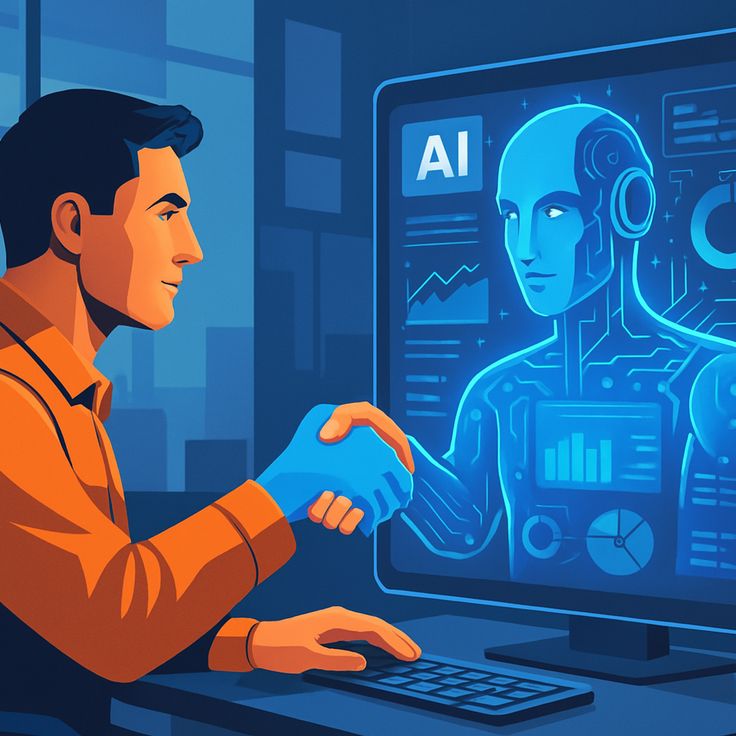
2. The Human-AI Handshake: Who Does What?
The most common fear is replacement, but the reality of 2026 is Augmentation. Think of your team as an orchestra. In the past, the human was the conductor and every single musician. Now, the Agentic AI takes over the “rhythm section”—the repetitive, high-volume, and data-heavy tasks—leaving the human to be the true conductor, focusing on interpretation, emotion, and strategy.
Human Strengths (The “Director”):
-
Contextual Nuance: Knowing that a client is going through a merger and needs a softer tone.
-
Ethical Judgment: Deciding if a specific data-driven decision aligns with the company’s core values.
-
Empathy: Managing the morale of the human team.
AI Strengths (The “Operator”):
-
Data Synthesis: Reading 1,000 pages of legal documents in seconds to find a single conflict.
-
24/7 Monitoring: Checking supply chains for disruptions while the rest of the team sleeps.
-
Pattern Recognition: Identifying that a specific software bug always appears when three specific conditions are met.
3. Real-World Scenarios: A Day in the Life of a Hybrid Team
Imagine a Marketing Team in 2026. Instead of a manager spending six hours a week on “admin,” they have an AI Agent named “Link.”
-
9:00 AM: Link scans the morning’s industry news and identifies a trending topic relevant to the brand.
-
9:30 AM: Link drafts three social media posts and a brief blog outline based on the trend.
-
10:00 AM: The Human Creative Director reviews Link’s work. They like the data but find the “voice” a bit dry. They ask Link to “Make it more adventurous and focus on the sustainability angle.”
-
10:05 AM: Link regenerates the content perfectly. It then schedules the posts and begins monitoring engagement in real-time.
4. The Architecture of Trust: How Teams Manage Autonomous Agents
One of the biggest hurdles in integrating a digital coworker is the “Trust Gap.” If an agent can make decisions, how do we ensure it doesn’t go rogue or misinterpret a brand’s values? In 2026, this is managed through Instructional Guardrails and Feedback Loops.
-
Defining the Sandbox: Just as you wouldn’t give a new human intern the keys to the corporate bank account on day one, Agentic AI operates within a defined “sandbox.” Managers set spending limits, API access permissions, and approval triggers.
-
The “Human-in-the-Loop” (HITL) Model: This is the gold standard for coworker collaboration. The agent performs the heavy lifting—researching, drafting, and organizing—but pauses for a “Human Handshake” before any external-facing action.
-
Transparent Reasoning: Modern agents now provide a “Chain of Thought.” Instead of just delivering a finished report, your AI coworker can show its work: “I prioritized Project X over Project Y because the Q2 deadline is closer and the resource gap is 15% higher.” This transparency is the foundation of a healthy team dynamic.
5. Re-architecting the Workflow: From “Doing” to “Reviewing”
The arrival of Agentic AI requires a fundamental shift in how we structure our workdays. We are moving from a Task-Based Economy to an Outcome-Based Economy.
In a traditional setup, a worker’s value was often measured by the hours spent “doing”—typing, coding, or filing. With an agentic coworker, the human’s value shifts toward:
-
Objective Setting: Clearly defining what “success” looks like for the agent.
-
Strategic Refinement: Taking the 80% finished work from the AI and adding the final 20% of “human soul”—the creativity, the empathy, and the unique brand voice.
-
Cross-Functional Orchestration: Coordinating between different AI agents and human departments to ensure everyone is moving toward the same North Star.
6. Overcoming the “Black Box” and Ethical Challenges
We cannot talk about AI coworkers without addressing the elephant in the room: Accountability. When an AI agent makes a mistake—perhaps it accidentally uses copyrighted material or misinterprets a data privacy regulation—who is responsible?
The 2026 workplace solves this through Algorithmic Accountability Frameworks. Companies are now appointing “AI Orchestrators”—humans whose entire job is to audit, tune, and mentor the company’s fleet of AI agents. This ensures that while the AI has agency, the human remains the ultimate moral and legal authority.
7. The Socio-Economic Impact: Will We Work Less?
The goal of the agentic coworker isn’t necessarily to make us work fewer hours, but to make those hours more meaningful. By offloading the “administrative tax” of modern life—the endless scheduling, the data entry, the basic drafting—we clear the mental space for high-level problem solving.
Teams that embrace this early are seeing a 40% increase in “Deep Work” time. This is where innovation happens. It’s the difference between a team that is constantly “putting out fires” and a team that is building fire-proof structures.
Conclusion: The Dawn of the Symbiotic Era
The transition to a workplace where AI acts as a coworker is not a distant sci-fi dream; it is the reality of our current digital transformation. We are entering a Symbiotic Era where the line between “software” and “staff” is becoming increasingly thin.
Agentic AI will not replace the human team. Instead, it will act as a force multiplier, taking on the burden of complexity so that humans can return to what they do best: Thinking, Dreaming, and Connecting.
As you integrate these digital colleagues into your team, remember that the most successful organizations won’t be the ones with the fastest AI, but the ones with the best Human-AI Collaboration. The future of work is a partnership—one where the machine provides the power, and the human provides the purpose