Introduction
Businesses are increasingly using artificial intelligence in customer support, software development, data analysis, automation, and decision-making. As AI systems become more important to daily business operations, organizations need better visibility into how these systems perform in real-world environments.
Traditional monitoring tools can track infrastructure, applications, and system availability, but AI systems introduce additional challenges. AI outputs can vary, model performance can change over time, and factors such as data quality, response time, cost, and reliability can directly affect business outcomes.
AI observability helps organizations understand what is happening inside their AI systems by monitoring model behavior, performance, inputs, outputs, and operational metrics. This visibility can help businesses identify problems, improve reliability, and manage AI systems more effectively as they scale.
What Is AI Observability?
AI observability is the ability to understand, monitor, and analyze how an AI system behaves in real-world operation. It provides visibility into factors such as model inputs, outputs, performance, response times, reliability, and resource usage.
Beyond Traditional System Monitoring
Traditional monitoring focuses primarily on infrastructure health, application availability, and technical metrics. AI observability goes further by helping organizations understand how AI models behave, whether their outputs remain useful and reliable, and how changes in data or usage affect overall performance.
Understanding AI System Behavior
AI systems can produce different outputs depending on the input, context, model configuration, and data available at the time of a request. AI observability helps businesses analyze these behaviors and identify unexpected patterns or performance issues.
Monitoring Inputs and Outputs
Monitoring AI inputs and outputs can help organizations understand how users and applications interact with AI systems. This visibility can support the detection of poor-quality inputs, unexpected responses, and patterns that may affect business performance.
Supporting Reliable AI Operations
As AI systems become part of important business workflows, reliability becomes increasingly important. AI observability can help teams identify potential issues earlier and maintain better visibility into how AI applications perform over time.
By combining operational monitoring with visibility into model behavior, inputs, outputs, and performance, AI observability helps organizations manage increasingly complex AI systems more effectively.
Why AI Observability Is Important for Businesses
As businesses move AI systems from experimentation into real-world applications, understanding how those systems perform becomes increasingly important. Without clear visibility, organizations may struggle to identify why AI outputs change, performance declines, costs increase, or user experiences become inconsistent.
AI Systems Can Change Over Time
AI performance can change as user behavior, data patterns, workloads, and business requirements evolve. AI observability helps organizations identify these changes and understand whether they are affecting the quality or reliability of AI applications.
AI Problems Are Not Always Infrastructure Problems
An AI application can appear technically available while still producing poor or unreliable results. Infrastructure monitoring may show that servers and APIs are working correctly, but AI observability can provide additional visibility into model outputs and application behavior.
Better Visibility for Business and Technical Teams
AI systems often involve technical teams, business teams, and end users. AI observability can provide useful information that helps different stakeholders understand system performance and identify areas that may require improvement.
Supporting AI at Scale
As AI applications handle more users, requests, models, and workflows, identifying problems manually becomes increasingly difficult. AI observability can help organizations maintain visibility as their AI environments become larger and more complex.
By providing a clearer view of how AI systems behave in production, AI observability can help businesses make more informed decisions about reliability, performance, cost, and future AI improvements.
What Businesses Should Monitor in AI Systems
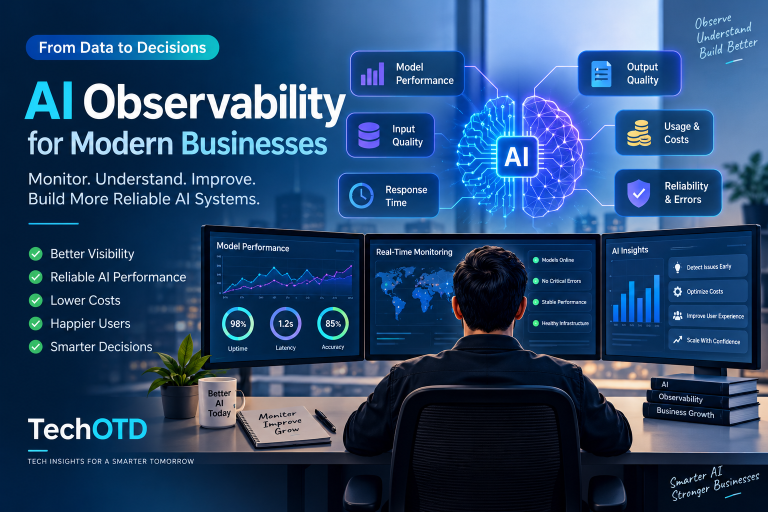
AI observability involves monitoring more than whether an application is online or offline. Businesses need visibility into different aspects of AI system behavior to understand whether their models and AI-powered applications are delivering reliable and useful results.
Model Performance
Businesses should monitor whether AI models continue to perform effectively for their intended tasks. Changes in model behavior or output quality can affect the reliability and usefulness of AI applications.
Input Quality and Data Patterns
The quality and characteristics of inputs can significantly influence AI outputs. Monitoring data patterns can help organizations identify unusual inputs, changing user behavior, or data issues that may affect model performance.
Output Quality
AI-generated outputs should be monitored to determine whether they remain accurate, relevant, consistent, and useful for the intended business use case. Unexpected output patterns may indicate a need for further investigation or improvement.
Response Time and Latency
Response speed can directly affect the user experience of AI applications. Monitoring latency helps businesses identify whether delays are caused by models, APIs, infrastructure, or other parts of the AI workflow.
AI Usage and Costs
Businesses should monitor how AI resources are being used and how costs change as workloads grow. Tracking model usage, requests, and resource consumption can support better AI cost management and help identify unexpected spending.
Errors and Reliability
Monitoring errors, failures, and system reliability can help organizations identify technical issues that affect AI applications. Reliable AI operations require visibility into both traditional system health and AI-specific performance.
By monitoring these areas together, businesses can develop a more complete understanding of how their AI systems perform and identify opportunities to improve reliability, efficiency, and business outcomes.
AI Observability vs Traditional Monitoring
Traditional monitoring and AI observability both help organizations understand how technology systems perform, but they focus on different types of information. Traditional monitoring primarily tracks infrastructure and application health, while AI observability provides additional visibility into model behavior, inputs, outputs, and AI-specific performance.
Traditional Monitoring
Traditional monitoring focuses on technical metrics such as server availability, CPU usage, memory consumption, application uptime, network performance, and error rates. These metrics help technical teams determine whether the underlying infrastructure and applications are operating correctly.
AI Observability
AI observability expands monitoring by examining how AI systems behave. It can provide visibility into model inputs, generated outputs, response quality, latency, usage patterns, and other factors that affect the performance of AI-powered applications.
Why Businesses May Need Both
An AI application depends on both reliable technical infrastructure and reliable AI behavior. A system may have healthy servers and APIs while still producing poor-quality outputs. Using traditional monitoring together with AI observability can provide a more complete view of overall system performance.
Different Questions They Answer
Traditional monitoring may answer questions such as whether an application is available or whether a server is experiencing errors. AI observability can help answer additional questions about whether an AI model is producing useful outputs, whether user inputs are changing, or whether AI performance is becoming less reliable.
As businesses deploy more AI-powered applications, combining traditional monitoring with AI observability can help teams identify both technical problems and AI-specific performance issues more effectively.
Key Benefits of AI Observability for Businesses
AI observability can help businesses gain greater visibility and control over AI systems as they move from experimentation to large-scale production environments. By understanding how models and AI applications behave, organizations can identify problems earlier and make better decisions about performance, reliability, and resource usage.
1. Faster Problem Detection
AI observability can help teams identify unusual model behavior, poor outputs, errors, or performance changes more quickly. Earlier detection can reduce the time required to investigate and address potential issues.
2. Improved AI Reliability
Continuous visibility into AI system behavior can help businesses maintain more reliable applications. Monitoring performance and outputs allows organizations to identify patterns that could affect the consistency of AI-powered services.
3. Better User Experience
AI applications directly affect users through generated responses, recommendations, and automated actions. Monitoring response quality and performance can help businesses identify issues that may negatively affect the user experience.
4. More Effective AI Cost Management
AI observability can provide useful insights into model usage, request volumes, response patterns, and resource consumption. This visibility can support better AI cost management by helping businesses identify unexpected usage and unnecessary spending.
5. Better Decision-Making
Clear visibility into AI performance can help technical and business teams make more informed decisions. Organizations can use operational data to improve AI workflows, evaluate models, and prioritize areas that require attention.
6. Easier AI Scaling
As AI applications grow, manual monitoring becomes more difficult. AI observability can help businesses maintain visibility across increasing numbers of users, models, requests, and workflows.
By providing continuous insights into AI behavior and performance, AI observability can help organizations build more reliable, efficient, and scalable AI systems.
Common Challenges of AI Observability
Although AI observability can provide valuable visibility into AI systems, monitoring AI environments can also create technical and operational challenges. As businesses use more models, applications, data sources, and workflows, collecting and interpreting meaningful information can become increasingly complex.
Monitoring Complex AI Workflows
AI applications may involve multiple models, APIs, databases, retrieval systems, and external tools. Understanding how all these components interact can make it more difficult to identify the source of a performance or reliability issue.
Defining Meaningful Performance Metrics
Unlike traditional applications, AI performance cannot always be measured using a single technical metric. Businesses may need to evaluate factors such as output quality, relevance, consistency, response time, and business usefulness.
Handling Large Volumes of AI Data
AI systems can generate large amounts of data through requests, responses, logs, and usage events. Organizations need effective ways to collect useful information without creating unnecessary storage costs or operational complexity.
Protecting Sensitive Data
AI observability may involve monitoring user inputs and generated outputs, which can contain sensitive business or customer information. Organizations need appropriate privacy, security, and data-handling controls when collecting observability data.
Avoiding Too Much Information
Collecting large amounts of monitoring data does not automatically improve AI operations. Businesses need to focus on meaningful metrics and alerts so that teams can identify important issues without being overwhelmed by unnecessary information.
A successful AI observability strategy requires businesses to balance detailed visibility with practical monitoring processes that support real operational and business decisions.
Best Practices for Implementing AI Observability
Businesses can get better results from AI observability by creating a clear monitoring strategy that focuses on both technical performance and AI-specific behavior. The goal should be to collect useful insights that help teams improve AI systems rather than simply generating large volumes of monitoring data.
Define Clear Monitoring Goals
Organizations should first determine what they need to understand about their AI systems. Monitoring goals may include improving output quality, reducing response times, controlling costs, identifying errors, or maintaining reliable business operations.
Track Both Technical and AI-Specific Metrics
Effective AI observability should combine traditional technical metrics with AI-specific information. Businesses can monitor infrastructure health alongside factors such as model behavior, input patterns, output quality, latency, and usage.
Focus on Meaningful Alerts
Teams should configure alerts around important changes that require attention. Too many notifications can make it difficult to identify serious issues, while meaningful alerts can help teams respond more quickly to significant performance or reliability problems.
Protect Observability Data
AI monitoring data may contain sensitive information from user requests, business workflows, or generated outputs. Organizations should apply appropriate security, privacy, access control, and data-handling practices when collecting and storing observability information.
Review AI Performance Regularly
AI systems should be evaluated regularly because models, workloads, data patterns, and business requirements can change over time. Regular reviews can help organizations identify performance trends and make improvements before problems become more significant.
By combining clear monitoring goals, meaningful metrics, strong data protection, and regular performance reviews, businesses can build an AI observability strategy that supports reliable and scalable AI operations.
The Future of AI Observability
As AI systems become more widely integrated into business operations, organizations will need stronger ways to understand how these systems perform over time. AI observability is likely to become an increasingly important part of managing reliable, efficient, and scalable AI environments.
More Automated AI Monitoring
Future AI observability systems may increasingly automate the detection of unusual behavior, performance changes, and potential reliability issues. Automated monitoring can help teams identify important changes more quickly as AI environments become larger and more complex.
Greater Focus on AI Output Quality
Businesses are likely to place greater emphasis on monitoring whether AI-generated outputs remain useful, relevant, and aligned with business requirements. Output quality may become an increasingly important part of AI performance management.
Integration With AI Model Management
AI observability may become more closely connected with AI model management, helping organizations evaluate model performance and make better decisions about when models should be updated, replaced, or used for different workloads.
Closer Connection With AI Cost Management
As AI usage grows, observability data can help businesses understand how model usage and workload patterns affect costs. This connection can support better AI cost management and more informed decisions about AI resource allocation.
Supporting More Complex AI Systems
As businesses use more AI models, agents, data sources, and automated workflows, maintaining visibility will become increasingly important. AI observability can help organizations manage this complexity and maintain greater confidence in AI operations.
The future of AI observability will likely focus on providing clearer and more actionable insights that help businesses maintain reliable AI systems while adapting to changing technologies and business requirements.
Conclusion
As artificial intelligence becomes more deeply integrated into business operations, organizations need more than traditional infrastructure monitoring to understand how AI systems perform. AI observability provides greater visibility into model behavior, inputs, outputs, performance, reliability, and resource usage.
By monitoring both technical and AI-specific metrics, businesses can identify problems earlier, improve AI reliability, manage costs more effectively, and make better decisions as their AI environments scale. As AI systems become more complex, AI observability can play an important role in building reliable and sustainable enterprise AI operations.
Frequently Asked Questions
What is AI observability?
AI observability is the ability to monitor and understand how AI systems behave by analyzing factors such as model inputs, outputs, performance, response times, reliability, usage, and operational metrics.
Why is AI observability important?
AI observability is important because AI systems can produce changing or unexpected results even when the underlying infrastructure is working correctly. Monitoring AI behavior helps businesses identify performance and reliability issues earlier.
What should businesses monitor in AI systems?
Businesses can monitor model performance, input quality, output quality, response time, errors, reliability, usage patterns, and AI-related costs.
How is AI observability different from traditional monitoring?
Traditional monitoring focuses primarily on infrastructure and application health, while AI observability also examines AI-specific behavior such as model inputs, generated outputs, response quality, and changes in AI performance.
Can AI observability help reduce AI costs?
Yes. By providing visibility into model usage, request volumes, resource consumption, and workload patterns, AI observability can help businesses identify unexpected spending and support better AI cost management.
Connect With us:- https://www.facebook.com/profile.php?id=61555452386126