
Beyond the Dashboard: How AI is Finally Humanizing Digital Analysis
For years, digital analysis felt like staring at a cold, gray wall of numbers. We spent our days obsessing over bounce rates, click-through percentages, and session durations, desperately trying to guess what our users actually wanted. We were “data-rich” but “insight-poor”—swimming in information but starving for a real connection.
Fast forward to 2026, and the script has finally flipped. The integration of Artificial Intelligence into our analytical toolkits hasn’t just made us faster; it has made our data feel remarkably “human.” We’re moving past the era of simply tracking clicks and into an era of understanding genuine human intent.
1. The Shift from Reactive to Predictive Analysis
In the old days, digital analysis was essentially a post-mortem exercise. You’d look at last month’s data to figure out why a campaign flopped, but by the time you had the answer, the market had already moved on. You were always playing catch-up.
AI has turned this reactive model on its head. Today, we use Predictive Analytics to see around corners. Modern models don’t just look at what happened; they analyze historical patterns and real-time social signals to forecast what a user is likely to do next. Instead of asking “What went wrong?”, we’re now asking “What’s about to happen?”, allowing us to be proactive partners to our users rather than defensive record-keepers.
2. Sentiment Analysis: Reading Between the Pixels
A “click” is just a data point; it doesn’t tell you if a user is happy, frustrated, or just bored out of their mind. Traditional analysis treated every interaction with the same weight, but AI-driven Sentiment Analysis has changed the game.
By leveraging Natural Language Processing (NLP), our tools can now “read” the room. They scan customer reviews, social mentions, and even those frantic “rage-clicks” on a landing page to gauge the audience’s emotional state. If an AI detects a spike in frustration on a checkout page, it doesn’t just sit there—it alerts the team immediately. This “emotional intelligence” allows brands to fix friction points before they turn into full-blown PR crises.
3. Hyper-Personalization at Scale
We’ve all heard the buzzword “personalization,” but in 2026, AI has taken it to a “segment of one.” We used to group people into broad, clumsy boxes like “Males, 25-34, interested in tech.”
Modern AI-powered analysis ignores these boxes entirely. It looks at the individual. It understands that a user might be a hardcore tech enthusiast on Monday morning but spends their Sunday afternoons researching sustainable gardening. AI allows digital platforms to pivot content, pricing, and layouts in real-time to match the specific “digital vibe” of the user in that moment. This isn’t just clever marketing; it’s a higher standard of service.
4. The Death of the “Average User”
If there’s one thing AI has taught us, it’s that the “average user” is a myth. Data averages often hide the most important truths. For example, if half your users love a new feature and half absolutely hate it, your “average” score looks mediocre. Without deeper insight, you might kill a feature that 50% of your audience found essential.
AI-driven clustering identifies these hidden polarities. It pulls out the “outliers” and shows us exactly who they are and why they see the world differently. This leads to Niche Optimization, where we can cater to specific sub-groups with surgical precision without alienating everyone else.
5. The Human-AI Synergy
There’s a common fear that AI will eventually replace the digital analyst. In my experience, the reality is the exact opposite: AI has liberated us. Before this shift, analysts spent 80% of their time cleaning messy spreadsheets and only 20% actually thinking.
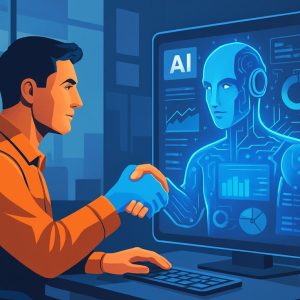
Now, the AI handles the data scrubbing, the pattern recognition, and the grunt work of reporting. This leaves the human analyst free to do what machines cannot: Strategy and Empathy. The AI can tell you what is happening with incredible accuracy, but it still takes a human heart to decide how to respond in a way that aligns with a brand’s soul.
Conclusion: Data with a Heartbeat
The future of digital analysis isn’t found in a colder, more robotic world. It’s found in a world where data finally helps us understand each other. By using AI to cut through the noise, we can get back to what really matters—building meaningful, authentic connections between brands and people.