Introduction
Custom healthcare app development helps hospitals, clinics, startups, and wellness brands build digital products around real patient and provider needs instead of forcing workflows into generic software. A strong healthcare app can improve appointment booking, remote care, clinical communication, patient monitoring, and record access, but it also has to meet strict privacy, security, and compliance requirements from day one.
This guide explains how custom healthcare app development works, what features matter most, how to plan an MVP, and what costs usually shape the project. It is important because healthcare apps handle sensitive data, often integrate with EHR systems, and must balance usability with HIPAA-grade safeguards, audit controls, and role-based access.
Custom healthcare app development creates tailored digital solutions for hospitals, clinics, private practices, telehealth startups, and wellness brands, solving real-world problems like appointment chaos, fragmented patient records, inefficient provider communication, and gaps in chronic care management. Unlike generic off-the-shelf software that forces workflows into rigid templates, custom apps adapt to specific needs—whether that’s streamlining triage for emergency departments, enabling remote monitoring for diabetes patients, or building provider collaboration tools that integrate with existing EHR systems.
In 2026, healthcare apps must deliver more than convenience; they handle protected health information (PHI), demanding HIPAA-compliant architecture from day one, seamless interoperability with standards like FHIR and HL7, and AI-powered features like predictive analytics, personalized care plans, and real-time clinical decision support. With trends like genomic personalization, blockchain-secured data sharing, AR/VR for medical training and patient education, and 5G-enabled remote monitoring, custom development positions providers and patients for continuous, proactive care beyond clinic walls. The global telemedicine market alone continues explosive growth, making now the ideal time to build apps that scale with rising demand for digital-first healthcare.
This comprehensive guide covers planning your app, essential features, compliance requirements, development costs, and proven strategies to launch a HIPAA-secure MVP that drives better outcomes and revenue. Whether you’re a clinic owner modernizing operations or a startup disrupting chronic care, custom healthcare app development delivers measurable ROI through efficiency gains, patient retention, and new service lines.
Planning the App
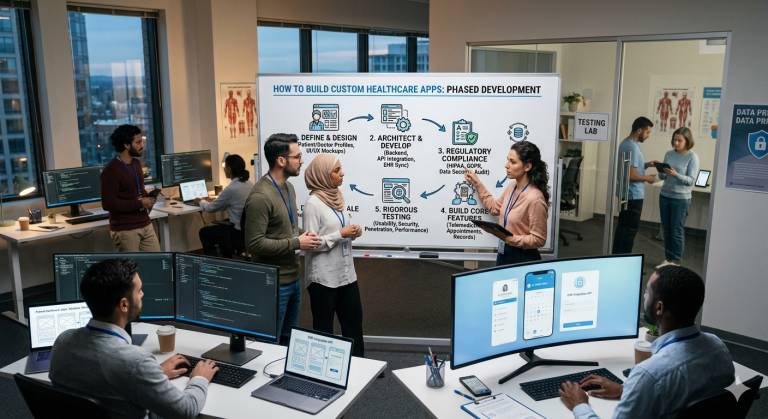
The first step in custom healthcare app development is defining the exact problem, audience, and workflow the app will serve, such as patient scheduling, telemedicine, chronic care monitoring, or provider-side care coordination. Successful projects usually start by identifying whether the primary users are patients, doctors, nurses, administrators, or a mix of stakeholders with different needs.
A practical planning process includes:
-
Define the core use case and success metric.
-
Build user personas for patients, clinicians, and admins.
-
Prioritize features with an MVP framework such as MoSCoW.
-
Map the core data objects, such as patients, appointments, providers, prescriptions, and reports.
Core features
Most custom healthcare apps need secure login, profile management, appointments, notifications, and protected data handling as a base layer. Telemedicine products often add doctor discovery, video visits, chat, reminders, and care follow-up tools to make remote consultations work smoothly.
Common feature groups include:
-
User authentication and role-based access.
-
Appointment booking and calendar management.
-
Video, voice, or chat consultations.
-
EHR or EMR integration using standards such as HL7 or FHIR.
-
Audit logs, consent handling, and secure document sharing.
Compliance and security
Compliance is not an add-on in healthcare app development; it shapes architecture, storage, access rules, and incident response from the beginning. If the app handles protected health information for a HIPAA-covered entity and the developeror vendor has persistent access to that data, HIPAA obligations and business associate requirements apply.
Security best practices typically include:
-
Encryption in transit and at rest.
-
Strong authentication and session controls.
-
Audit logging and activity tracking.
-
Minimum-necessary access rules.
-
Backup, recovery, and breach response procedures.
Cost and timeline
Cost depends on the feature set, platform choice, integrations, and compliance complexity. Published 2026-era estimates show that telemedicine-related builds can range from about $40,000 to $100,000 for a basic app and from $100,000 to $300,000 or more for feature-rich platforms, while individual modules such as appointment management or real-time communication add their own cost ranges.
A simple budget view is below:
Conclusion
Custom healthcare app development works best when you start with one clear use case, define the right user roles, and build an MVP around secure workflows instead of trying to launch every feature at once. The most reliable products combine patient-friendly UX, provider efficiency, standards-based interoperability, and strict compliance controls before scaling into broader healthcare ecosystems.
If you are turning this into a blog title, a cleaner SEO version would be: How to Build a Custom Healthcare App: Complete Development Guide for 2026.
FAQ
What is custom healthcare app development?
It is the process of building a healthcare app tailored to a specific workflow, audience, and compliance need rather than using off-the-shelf software.
Which features should come first in an MVP?
Secure login, user roles, appointments, messaging or consultations, and protected patient data workflows usually come first.
Does every healthcare app need HIPAA compliance?
Not every health app does, but apps developed for covered entities that collect or handle protected health information generally must meet HIPAA-related requirements.
How much does a custom healthcare app cost?
Basic healthcare or telemedicine apps can start around $40,000 to $100,000, while advanced custom platforms can exceed $300,000 depending on integrations and compliance scope.
<h2 id=”which-standards-matter-for-interoperability” class=”font-editorial font-bold mb-2 mt-4 [.has-inline-images_&]:clear-end text-base first:mt-0″>Which standards matter for interoperability?
HL7 and FHIR are commonly cited standards for healthcare data exchange and interoperability.