Introduction
In the world of mobile app development, the backend is the powerhouse that handles data storage, authentication, business logic, and integration with external services. While the frontend dazzles users with an intuitive interface, the backend ensures the app runs smoothly, securely, and scales as demand grows.
This guide provides an overview of mobile app backend development in 2025, covering core components, technology choices, and best practices to build robust and scalable backends for modern mobile applications
Mobile App Architecture Basics).
What is Mobile App Backend?
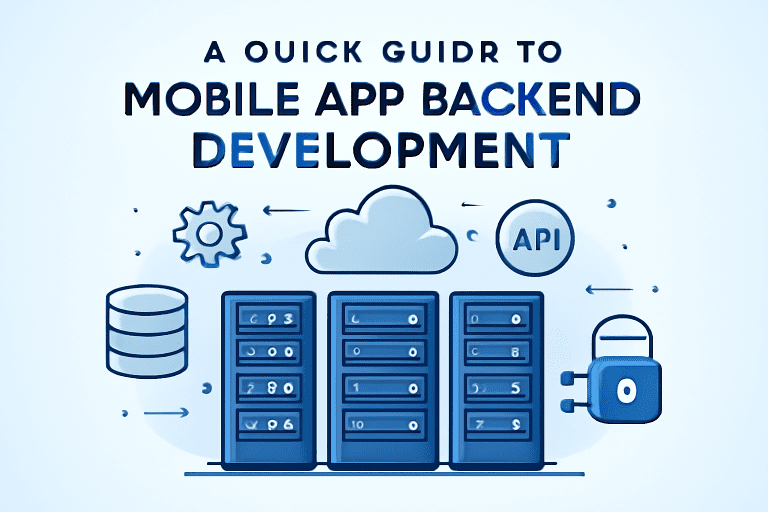
The backend is the hidden engine of an application. It handles communication between the frontend and the server. It includes databases, APIs, and cloud storage. (To understand how different database types impact your backend, check our article on SQL vs NoSQL Databases).
Key Components of Mobile App Backend
1. Server
The server processes requests from app users, runs the core business logic, communicates with databases, and manages third-party integrations. Developers may choose traditional dedicated servers, cloud-based virtual servers, or serverless architectures (like AWS Lambda) depending on scalability and budget needs.
2. Database
Databases store user data, app content, and transactional records. Choices vary from relational databases (MySQL, PostgreSQL) for structured data to NoSQL (MongoDB, Cassandra) for unstructured or rapidly changing data. In-memory databases like Redis enhance performance through caching.
3. APIs (Application Programming Interfaces)
APIs enable communication between the frontend and backend, as well as integration with external tools such as payment gateways, social logins, or third-party services.
4. Authentication and Security
Robust backend security includes user authentication mechanisms (OAuth, JWT), data encryption, secure session management, and protection against common vulnerabilities to safeguard user data and comply with regulations.
5. Push Notifications
Backend systems usually manage push notification services, sending timely alerts and updates to users to enhance engagement.
6. Scalability and Performance Management
Backends must handle growing user loads efficiently using load balancers, auto-scaling groups, and performance monitoring tools.
Popular Technology Stack Options
-
Programming Languages & Frameworks:
Node.js (Express), Python (Django, Flask), Ruby on Rails, Java Spring Boot, Go -
Databases:
PostgreSQL, MySQL, MongoDB, Cassandra, Redis -
Cloud Providers:
AWS, Google Cloud, Microsoft Azure, Firebase -
DevOps and Containerization:
Docker, Kubernetes, Jenkins, GitHub Actions
Backend Development Best Practices in 2025
-
Opt for cloud-native solutions to support flexibility and cost efficiency.
-
Embrace serverless architecture where suitable for event-driven workloads.
-
Prioritize security by design with encryption, secure APIs, and compliance.
-
Implement CI/CD pipelines for faster and reliable deployment.
-
Use monitoring and logging (e.g., Prometheus, New Relic) to debug and optimize performance.
-
Design scalable data storage considering future growth and data types.
Conclusion
A strong backend architecture is fundamental to mobile app success. It manages everything from data integrity and security to real-time interactions and scalability. Choosing the right mix of technologies, frameworks, and cloud services, while adopting modern development and security best practices, sets your app up for long-term stability and growth.
For expert guidance on backend development, cloud integration, AI-powered automation, and best practices, explore TechOTD AI Services and stay informed through the TechOTD Blog.