AI Governance in 2026: Balancing Innovation and Regulation
Artificial intelligence has rapidly evolved from an emerging technology into a critical business and societal tool. From automating business operations and improving healthcare outcomes to powering advanced research and enhancing customer experiences, AI is transforming nearly every industry. However, as AI systems become more powerful and influential, concerns surrounding transparency, accountability, privacy, bias, and security continue to grow.
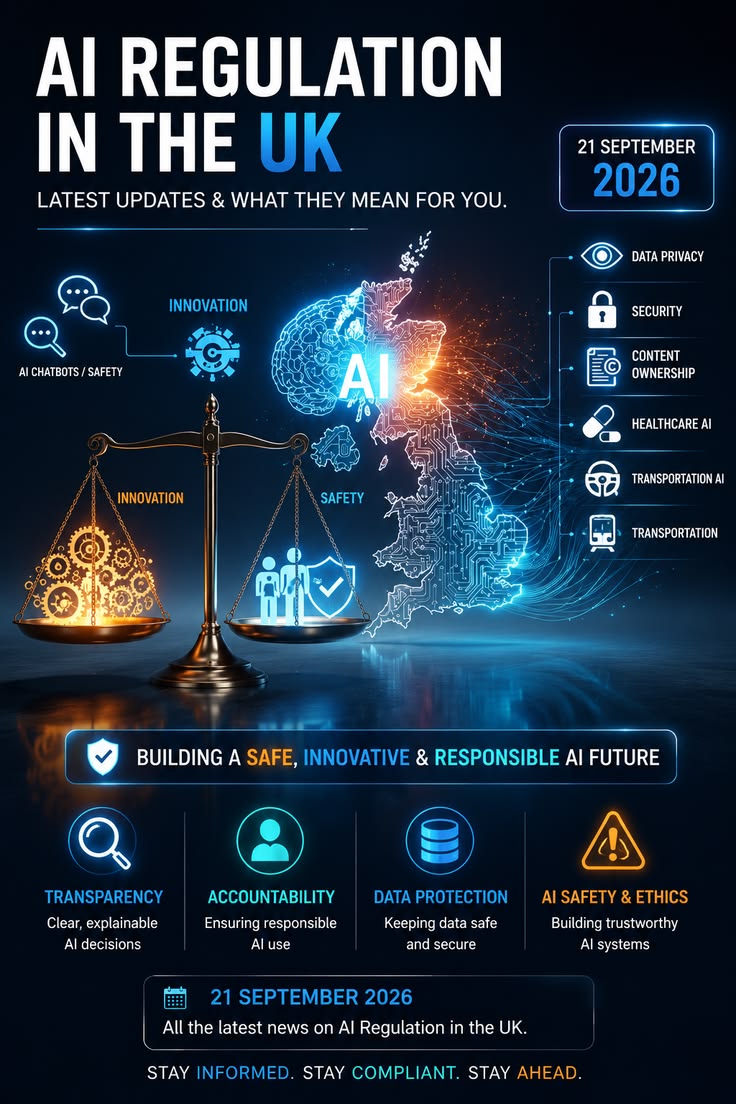
In 2026, AI governance has become one of the most important topics in the technology landscape. Governments, regulators, technology companies, and enterprises are working together to create frameworks that encourage innovation while ensuring AI is developed and deployed responsibly.
The challenge is clear: how can society unlock the enormous benefits of AI without exposing individuals, businesses, and governments to unnecessary risks?
The answer lies in effective AI governance.
What Is AI Governance?
AI governance refers to the policies, standards, regulations, and organizational practices used to guide the development, deployment, and management of artificial intelligence systems.
Its primary objectives include:
- Ensuring AI systems operate ethically
- Promoting transparency and accountability
- Protecting user privacy
- Reducing bias and discrimination
- Strengthening cybersecurity
- Maintaining regulatory compliance
- Building public trust
Unlike traditional software governance, AI governance must address unique challenges associated with machine learning, generative AI, autonomous decision-making, and continuously evolving algorithms.
As organizations increasingly rely on AI-powered systems for critical decisions, governance frameworks are becoming essential components of modern business operations.
Why AI Governance Matters More Than Ever
The rapid adoption of generative AI and autonomous systems has dramatically increased the importance of governance.
Organizations are now using AI for:
- Financial decision-making
- Hiring and recruitment
- Healthcare diagnostics
- Customer service automation
- Cybersecurity monitoring
- Supply chain optimization
- Legal research
- Business intelligence
While these applications offer significant benefits, they also introduce potential risks.
An AI system that generates inaccurate information can damage a company’s reputation. A biased algorithm can lead to discrimination claims. Weak AI security controls can expose sensitive data to cybercriminals.
Without proper governance, AI can become a liability instead of a competitive advantage.
Businesses are realizing that governance is not merely about compliance—it is about creating sustainable and trustworthy AI ecosystems.
The Global Push for AI Regulation
One of the biggest developments in 2026 is the increasing focus on AI regulation worldwide.
Governments recognize that artificial intelligence is reshaping economies, national security, labor markets, and public services. As a result, regulators are introducing policies designed to manage AI risks while encouraging innovation.
Several key areas are receiving attention:
Risk-Based AI Classification
Many governments are adopting risk-based approaches to AI oversight.
Under this model, AI applications are categorized according to their potential impact.
Examples include:
Low-Risk Systems
- Chatbots
- Recommendation engines
- Productivity assistants
Medium-Risk Systems
- Customer service automation
- Business analytics platforms
- Educational AI tools
High-Risk Systems
- Medical diagnosis systems
- Financial approval algorithms
- Law enforcement technologies
- Critical infrastructure management systems
The higher the risk level, the stricter the governance requirements become.
This approach helps regulators avoid unnecessary restrictions on innovation while focusing oversight where it is needed most.
Transparency Requirements
AI transparency has become a major regulatory priority.
Users increasingly want to know:
- How AI systems make decisions
- What data is being used
- Whether content was AI-generated
- How organizations monitor AI outputs
Transparency requirements are encouraging businesses to provide clearer explanations of AI-driven decisions and maintain detailed documentation of their AI models.
Data Protection and Privacy
AI systems require large amounts of data to function effectively.
This has raised concerns about:
- User consent
- Data ownership
- Personal information protection
- Cross-border data transfers
Governments are introducing stricter data governance rules to ensure AI systems respect privacy rights while still enabling innovation.
Organizations that fail to comply may face significant financial penalties and reputational damage.
Enterprise AI Governance Becomes a Strategic Priority
In 2026, AI governance is no longer just the responsibility of compliance departments.
It has become a boardroom issue.
Executives recognize that poorly managed AI initiatives can create legal, financial, and operational risks.
As a result, organizations are establishing dedicated AI governance programs that include:
- AI ethics committees
- Risk management teams
- Compliance officers
- Data governance specialists
- Cybersecurity professionals
- Legal advisors
These teams work together to ensure AI projects align with business objectives, regulatory requirements, and ethical standards.
Companies that implement robust governance frameworks are often able to deploy AI more confidently and at greater scale.
Ethical AI Takes Center Stage
Ethical AI has become one of the defining themes of AI governance.
Businesses understand that compliance alone is not enough. Users expect AI systems to operate fairly, responsibly, and transparently.
Ethical AI initiatives focus on several key principles.
Fairness
AI systems should treat all individuals fairly and avoid discriminatory outcomes.
Organizations are investing in bias detection tools and model auditing processes to identify and mitigate unfair decision-making.
Accountability
There must be clear responsibility for AI-generated outcomes.
Businesses are establishing governance structures that define who is accountable when AI systems make errors or produce harmful results.
Human Oversight
Despite significant advances in automation, human involvement remains critical.
Many organizations require human review for high-impact decisions involving:
- Employment
- Healthcare
- Financial services
- Legal matters
This ensures AI supports decision-making rather than replacing human judgment entirely.
Transparency
Users should understand when they are interacting with AI systems and how important decisions are made.
Transparent AI helps build trust and reduces concerns about hidden algorithms influencing outcomes.
The Rise of AI Audits
Just as financial audits help ensure accountability in business operations, AI audits are becoming increasingly common.
AI audits evaluate:
- Model performance
- Bias levels
- Security controls
- Regulatory compliance
- Data quality
- Decision-making processes
Organizations are conducting regular assessments to verify that AI systems continue operating as intended.
Independent third-party audits are also gaining popularity because they provide additional credibility and transparency.
In many industries, AI auditing is becoming a standard governance practice.
Managing Generative AI Risks
Generative AI remains one of the most transformative technologies of the decade.
Businesses are using AI tools to create:
- Marketing content
- Software code
- Product designs
- Business reports
- Customer communications
- Educational materials
However, generative AI introduces unique governance challenges.
Hallucinations
AI models can generate inaccurate or misleading information with high confidence.
Organizations are implementing validation mechanisms to verify outputs before publication.
Intellectual Property Concerns
Questions surrounding AI-generated content ownership continue to evolve.
Businesses must ensure AI-generated materials do not infringe on copyrights or violate licensing agreements.
Misinformation Risks
The ability to generate realistic text, audio, and video raises concerns about misinformation and manipulation.
Governance frameworks increasingly include policies governing the responsible use of synthetic media.
Security Threats
Generative AI can potentially be exploited for cyberattacks, phishing campaigns, and social engineering activities.
Organizations are introducing safeguards to prevent misuse.
AI Governance and Cybersecurity
Cybersecurity and AI governance are becoming deeply interconnected.
As AI systems gain access to sensitive information and critical business processes, protecting these systems becomes essential.
Key security priorities include:
Model Security
Organizations must protect AI models from unauthorized access, theft, and manipulation.
Data Security
Training datasets often contain valuable information that requires robust protection.
Adversarial Attacks
Attackers may attempt to manipulate AI systems by introducing malicious inputs designed to produce incorrect results.
Access Control
Only authorized personnel should be able to modify AI systems or access sensitive model data.
Strong cybersecurity practices are now considered foundational elements of AI governance programs.
The Role of Industry Standards
In addition to government regulations, industry standards are playing an increasingly important role.
Technology companies, academic institutions, and industry organizations are collaborating to establish best practices for AI development.
These standards help organizations:
- Improve consistency
- Enhance interoperability
- Strengthen security
- Demonstrate compliance
- Build stakeholder confidence
Standardized governance approaches also make it easier for multinational organizations to manage AI deployments across different regions.
Building Public Trust in AI
Trust remains one of the biggest challenges facing AI adoption.
Consumers are becoming more aware of how AI influences their lives and are asking important questions.
For example:
- Is my data secure?
- Is the AI system fair?
- Who is responsible for mistakes?
- Can decisions be explained?
- How is my information being used?
Organizations that answer these questions transparently are more likely to earn public confidence.
Trust is increasingly viewed as a competitive advantage.
Companies that demonstrate responsible AI practices often experience stronger customer loyalty and greater long-term success.
The Economic Impact of AI Governance
Some critics argue that regulation could slow innovation.
However, many experts believe effective governance actually supports economic growth.
Well-designed governance frameworks can:
- Reduce business risk
- Increase investor confidence
- Improve customer trust
- Encourage responsible innovation
- Accelerate enterprise adoption
- Create more stable AI ecosystems
Businesses are discovering that governance enables sustainable scaling rather than limiting technological progress.
Organizations that integrate governance early in the development process often avoid costly compliance issues later.
Future Trends Shaping AI Governance
Several emerging trends are expected to influence AI governance over the next few years.
Automated Governance Tools
AI-powered governance platforms are helping organizations monitor model performance, compliance, and risk in real time.
Explainable AI
Companies are investing heavily in technologies that make AI decision-making easier to understand and interpret.
Global Regulatory Alignment
Governments are increasingly collaborating to create consistent international AI standards.
Continuous Monitoring
AI governance is shifting from periodic reviews to ongoing oversight and risk assessment.
Responsible AI by Design
Organizations are embedding governance principles directly into AI development processes from the beginning rather than treating compliance as an afterthought.
These trends will help organizations manage increasingly complex AI environments.
Challenges That Still Need to Be Solved
Despite significant progress, several governance challenges remain.
These include:
- Balancing innovation with regulation
- Managing cross-border compliance requirements
- Addressing rapidly evolving AI capabilities
- Preventing algorithmic bias
- Protecting intellectual property
- Combating AI-generated misinformation
- Establishing global governance standards
As AI technology continues advancing, governance frameworks must evolve accordingly.
Flexibility and adaptability will be critical for long-term success.
Conclusion
AI governance in 2026 has become a cornerstone of responsible artificial intelligence adoption. As AI systems play larger roles in business operations, public services, healthcare, finance, and everyday life, the need for effective oversight continues to grow.
The most successful organizations are recognizing that governance is not a barrier to innovation—it is an enabler of sustainable growth. By implementing strong governance frameworks, promoting transparency, ensuring accountability, and prioritizing ethical AI practices, businesses can maximize the benefits of artificial intelligence while minimizing potential risks.
The future of AI will not be defined solely by technological breakthroughs. It will also be shaped by how effectively governments, enterprises, and society collaborate to ensure AI remains trustworthy, secure, and beneficial for everyone.
In the years ahead, organizations that successfully balance innovation and regulation will be best positioned to lead the next era of AI-driven transformation.