Introduction
The manufacturing industry has experienced several technological revolutions over the past century. From the introduction of mechanized production systems during the First Industrial Revolution to the emergence of automation and digital technologies in Industry 4.0, each phase has fundamentally changed how products are designed, manufactured, and delivered.
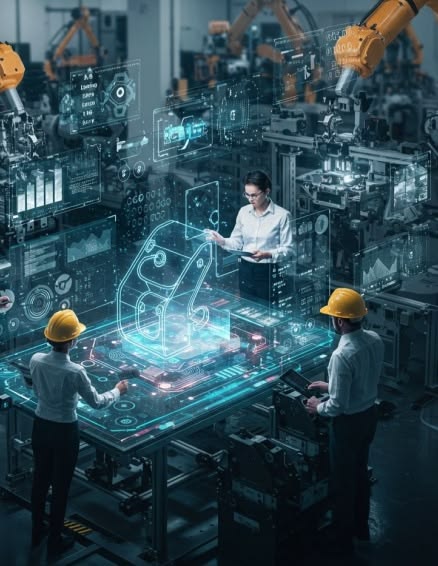
Today, the world is entering a new era known as Industry 5.0. Unlike Industry 4.0, which primarily focused on automation, connectivity, and efficiency, Industry 5.0 places humans back at the center of industrial operations. It emphasizes collaboration between people and advanced technologies such as artificial intelligence, robotics, machine learning, digital twins, and the Industrial Internet of Things (IIoT).
Smart factories are no longer designed to replace human workers. Instead, they are evolving into intelligent environments where humans and machines work together to achieve greater productivity, creativity, sustainability, and innovation.
This shift is reshaping the future of manufacturing and creating opportunities for organizations to build more resilient, adaptive, and human-centric production systems.
Understanding the Journey from Industry 4.0 to Industry 5.0
Industry 4.0 introduced technologies that transformed traditional factories into highly connected digital ecosystems. Sensors, cloud computing, big data analytics, and autonomous machines enabled manufacturers to automate repetitive tasks and optimize production processes.
While Industry 4.0 delivered significant efficiency improvements, many organizations discovered that complete automation was not always the ideal solution. Human expertise, creativity, problem-solving abilities, and emotional intelligence remained essential in many industrial environments.
Industry 5.0 emerged as a response to this realization.
Rather than focusing solely on automation, Industry 5.0 aims to create a balanced relationship between human workers and intelligent machines. The goal is not to replace people but to empower them with advanced technologies that enhance their capabilities and improve decision-making.
This approach recognizes that the most successful factories of the future will combine the strengths of both humans and machines.
What Is a Smart Factory?
A smart factory is a manufacturing facility that uses digital technologies to monitor, analyze, and optimize production processes in real time.
Unlike traditional factories, smart factories can continuously collect data from machines, equipment, and production lines. This data is then processed using AI and analytics tools to improve efficiency, reduce downtime, and support better decision-making.
Key characteristics of a smart factory include:
- Real-time data collection and monitoring
- Connected machines and devices
- Predictive maintenance systems
- Automated production workflows
- AI-powered analytics
- Digital twins and simulations
- Advanced robotics
- Cloud-based manufacturing platforms
With the introduction of Industry 5.0, smart factories are becoming more human-centric, enabling workers to collaborate effectively with intelligent systems.
The Core Principles of Industry 5.0
Industry 5.0 is built around three major principles:
Human-Centric Manufacturing
The human-centric approach focuses on improving the role of workers within industrial environments. Technology is designed to support people rather than replace them.
Employees are empowered with AI-driven tools, augmented reality systems, and collaborative robots that assist them in performing complex tasks more efficiently.
This creates a workplace where technology enhances human capabilities while improving job satisfaction and workplace safety.
Sustainability
Sustainability has become a critical priority for modern manufacturers. Industry 5.0 encourages organizations to reduce waste, optimize resource consumption, and minimize environmental impact.
Smart factories can use AI and analytics to monitor energy usage, reduce emissions, and improve production efficiency.
Sustainable manufacturing practices help businesses meet regulatory requirements while supporting global environmental goals.
Resilience
Recent global disruptions have highlighted the importance of resilient supply chains and manufacturing systems.
Industry 5.0 emphasizes adaptability and flexibility, enabling factories to respond quickly to changing market conditions, supply chain disruptions, and customer demands.
Advanced analytics and digital technologies allow manufacturers to identify potential risks and take proactive measures before problems escalate.
Human-Machine Collaboration: The Foundation of Industry 5.0
One of the most significant aspects of Industry 5.0 is the concept of human-machine collaboration.
Instead of operating independently, humans and machines work together as partners.
Machines excel at tasks involving speed, precision, data processing, and repetitive operations. Humans contribute creativity, innovation, critical thinking, and emotional intelligence.
When combined, these strengths create a highly efficient and adaptable manufacturing environment.
Examples of human-machine collaboration include:
- Robots assisting workers with heavy lifting
- AI systems supporting quality control inspections
- Augmented reality guiding technicians during maintenance
- Machine learning tools providing production recommendations
- Digital assistants helping operators make informed decisions
This collaborative approach enables organizations to achieve higher productivity while maintaining human oversight and expertise.
The Rise of Collaborative Robots (Cobots)
Collaborative robots, commonly known as cobots, are among the most important technologies driving Industry 5.0.
Unlike traditional industrial robots that operate within isolated safety cages, cobots are designed to work directly alongside human employees.
Cobots can perform repetitive, physically demanding, or dangerous tasks while allowing workers to focus on higher-value activities.
Benefits of cobots include:
- Improved worker safety
- Increased productivity
- Reduced physical strain
- Faster production cycles
- Greater operational flexibility
- Easier deployment and programming
Manufacturers across industries are adopting cobots to create safer and more efficient work environments.
As technology continues to advance, cobots are becoming more intelligent and capable of adapting to changing production requirements.
Artificial Intelligence in Smart Factories
Artificial intelligence serves as the brain of modern smart factories.
AI systems can analyze massive amounts of operational data and identify patterns that would be difficult for humans to detect.
Applications of AI in manufacturing include:
Predictive Maintenance
AI algorithms can predict equipment failures before they occur.
By analyzing machine performance data, manufacturers can schedule maintenance proactively, reducing downtime and repair costs.
Quality Control
Computer vision systems powered by AI can inspect products with remarkable accuracy.
Defects can be identified in real time, ensuring higher product quality and reducing waste.
Production Optimization
AI can continuously evaluate production processes and recommend improvements.
This helps manufacturers maximize efficiency while minimizing resource consumption.
Demand Forecasting
Machine learning models can predict market demand and optimize production schedules accordingly.
This reduces inventory costs and improves supply chain management.
AI is becoming an essential component of Industry 5.0, helping organizations make smarter and faster decisions.
Digital Twins and Virtual Manufacturing
Digital twin technology is transforming how manufacturers design and manage industrial operations.
A digital twin is a virtual representation of a physical asset, production line, or entire factory.
By creating digital replicas, manufacturers can:
- Simulate production scenarios
- Test process improvements
- Monitor equipment performance
- Predict maintenance needs
- Optimize workflows
Digital twins provide valuable insights without disrupting actual production operations.
As Industry 5.0 evolves, digital twins will play an increasingly important role in enabling collaboration between humans and intelligent systems.
Augmented Reality and Workforce Empowerment
Augmented reality (AR) is another technology contributing to human-machine collaboration.
AR systems overlay digital information onto the physical environment, providing workers with real-time guidance and instructions.
Applications include:
- Equipment maintenance support
- Assembly guidance
- Employee training
- Remote expert assistance
- Safety monitoring
Workers can access critical information instantly, improving productivity and reducing errors.
AR technology is particularly valuable in complex manufacturing environments where precision and accuracy are essential.
The Role of Industrial Internet of Things (IIoT)
The Industrial Internet of Things connects machines, sensors, devices, and production systems within a manufacturing environment.
IIoT enables real-time communication and data sharing across the factory floor.
Benefits include:
- Improved visibility into operations
- Real-time performance monitoring
- Faster decision-making
- Enhanced predictive maintenance
- Better resource management
The vast amount of data generated by IIoT devices serves as the foundation for AI-driven manufacturing systems.
Together, these technologies create intelligent and responsive production environments.
Sustainability Through Smart Manufacturing
Environmental sustainability is becoming a major competitive advantage for manufacturers.
Industry 5.0 encourages organizations to integrate sustainable practices into every aspect of production.
Smart factories support sustainability through:
- Energy-efficient equipment
- Waste reduction strategies
- Resource optimization
- Carbon emission monitoring
- Circular economy initiatives
AI-powered systems can identify opportunities to reduce energy consumption and improve operational efficiency.
This not only benefits the environment but also lowers operating costs and enhances corporate reputation.
Benefits of Industry 5.0 for Businesses
Organizations adopting Industry 5.0 can experience numerous advantages.
Increased Productivity
Human-machine collaboration improves operational efficiency by combining automation with human expertise.
Enhanced Innovation
Employees can focus on creative and strategic activities while machines handle repetitive tasks.
Improved Employee Satisfaction
Technology supports workers rather than replacing them, creating more engaging and meaningful roles.
Better Product Quality
AI-driven monitoring and quality control systems help ensure consistent product standards.
Greater Operational Flexibility
Smart factories can adapt quickly to changing customer demands and market conditions.
Stronger Sustainability Performance
Resource optimization and waste reduction contribute to long-term environmental goals.
Challenges in Implementing Industry 5.0
Despite its benefits, Industry 5.0 adoption presents several challenges.
Skills Gap
Employees must develop new digital skills to work effectively alongside advanced technologies.
High Initial Investment
Implementing AI, robotics, and smart factory infrastructure can require significant financial resources.
Cybersecurity Risks
Connected manufacturing systems create new security challenges that must be addressed proactively.
Integration Complexity
Many organizations operate legacy systems that can be difficult to integrate with modern technologies.
Change Management
Successful implementation requires strong leadership and employee engagement.
Organizations must create a culture that embraces innovation and continuous learning.
Industries Leading the Industry 5.0 Revolution
Several industries are actively embracing Industry 5.0 principles.
Automotive Manufacturing
Automotive companies are using cobots, AI, and digital twins to improve production efficiency and product quality.
Electronics Manufacturing
Advanced automation and precision technologies support the production of increasingly complex electronic devices.
Aerospace Industry
Manufacturers are leveraging AI and digital simulations to enhance quality control and operational safety.
Healthcare Manufacturing
Medical device manufacturers are using smart factory technologies to improve precision and regulatory compliance.
Consumer Goods Production
Industry 5.0 enables greater product customization while maintaining cost-effective manufacturing processes.
The Future of Human-Machine Collaboration
The future of manufacturing will be defined by deeper collaboration between humans and intelligent technologies.
Emerging innovations such as advanced AI agents, autonomous mobile robots, edge computing, quantum computing, and next-generation robotics will further transform industrial operations.
Workers will increasingly serve as supervisors, innovators, and decision-makers while intelligent systems handle routine processes.
Factories of the future will become more adaptive, sustainable, and resilient than ever before.
Rather than viewing automation as a replacement for human labor, Industry 5.0 demonstrates that technology and people can achieve greater success when they work together.
Conclusion
The evolution of smart factories from Industry 4.0 to Industry 5.0 marks a significant shift in the future of manufacturing. While automation remains important, the focus is now on creating meaningful collaboration between humans and machines.
By integrating artificial intelligence, collaborative robots, digital twins, augmented reality, and Industrial IoT technologies, organizations can build manufacturing environments that are more productive, innovative, sustainable, and resilient.
Industry 5.0 represents a future where technology enhances human potential rather than replacing it. As businesses continue to embrace this new manufacturing paradigm, human-machine collaboration will become the driving force behind the next generation of industrial innovation.
Digital Sovereignty: Why Countries Want Greater Control Over Their Data