Introduction
Customer Relationship Management (CRM) implementation has become the backbone of modern businesses aiming to improve customer satisfaction, streamline processes, and boost revenues. However, the success of CRM implementation depends on adopting a structured, step-by-step approach. Without it, CRM projects can lead to cost overruns, poor user adoption, and unrealized business benefits.
This blog provides a step-by-step CRM implementation guide, covering best practices, potential challenges, and the role of AI and analytics, with references to TechOTD Blog and TechOTD AI Services.
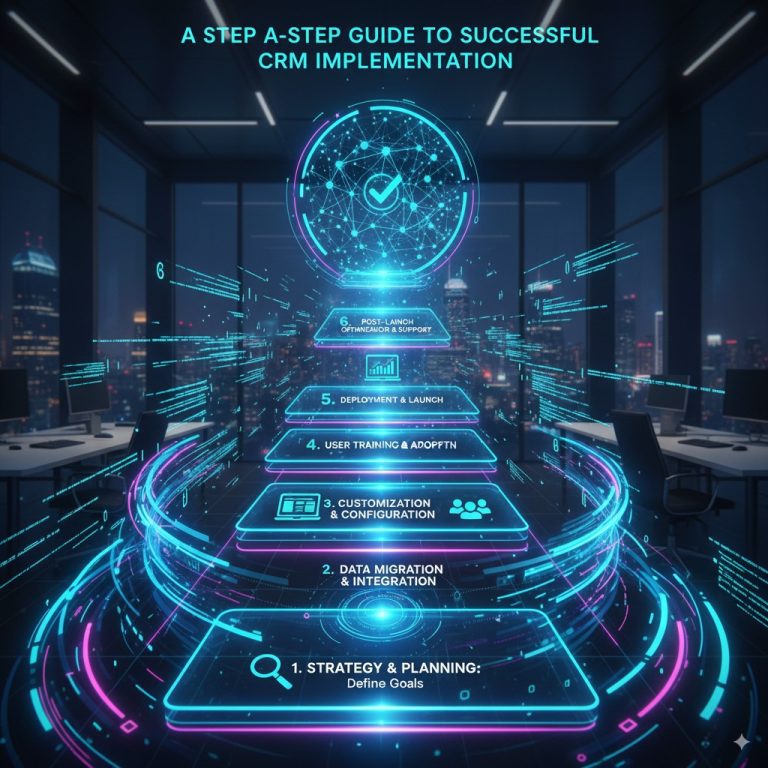
Step 1: Define Clear Objectives and Business Needs
- Identify the core challenges your CRM should solve — lead management, customer service, or marketing automation.
- Align CRM implementation goals with overall business strategy.
- Set measurable KPIs for success.
Step 2: Choose the Right CRM Solution
- Select a CRM platform that fits your business size, industry, and goals.
- Consider customization, scalability, integrations, and vendor support.
- Popular choices include
Salesforce,
HubSpot,
Microsoft Dynamics, and
Zoho CRM.
Step 3: Plan Implementation and Build Your Team
- Create a detailed project plan with timelines, resources, and budget.
- Appoint a CRM project manager and cross-functional team.
- Secure executive sponsors to drive successful CRM implementation.
Step 4: Data Preparation and Migration
- Audit, clean, and standardize customer data for accuracy and completeness.
- Define migration processes with validation checks.
- Ensure secure data transfer with minimal downtime.
Step 5: Customize and Integrate
- Configure CRM workflows to match business needs.
- Integrate with ERP, marketing automation, and support systems.
- Use APIs and automation to maximize efficiency.
Step 6: Training and Change Management
- Conduct role-based training for different teams.
- Provide resources and promote a culture of data-driven customer management.
- Communicate benefits to drive higher adoption.
Step 7: Testing and Quality Assurance
- Test all features before go-live.
- Perform user acceptance testing (UAT).
- Ensure compliance with security standards.
Step 8: Deployment and Go-Live
- Choose between phased rollout or full deployment.
- Provide strong technical support post-launch.
- Gather user feedback and monitor adoption.
Step 9: Continuous Improvement and Optimization
- Treat CRM implementation as an ongoing process.
- Regularly analyze KPIs and refine workflows.
- Leverage AI and predictive analytics with TechOTD AI Solutions for advanced automation.
Common Challenges in CRM Implementation and How to Overcome Them
- Data Silos: Establish strong data governance.
- User Resistance: Engage users early and show quick wins.
- Scope Creep: Maintain strict project controls.
- Technical Issues: Invest in expert consulting and infrastructure.
Conclusion
A successful CRM implementation requires a strategic blend of technology, people, and processes. By following this step-by-step CRM implementation guide, businesses can avoid pitfalls, improve customer relationships, and achieve sustainable growth. With the power of AI and analytics, organizations can take CRM to the next level and unlock its full potential.