How Edge AI Is Powering the Next Generation of Smart Devices
Artificial Intelligence has become one of the most influential technologies of the modern digital era. Over the past few years, AI applications have evolved from cloud-based systems to more efficient and responsive solutions capable of operating directly on devices. This shift has given rise to Edge AI, a transformative technology that is changing the way smart devices function and interact with users.
From smartphones and smart speakers to industrial robots and healthcare monitoring systems, Edge AI is enabling devices to process information locally instead of relying entirely on remote cloud servers. This approach is making devices faster, smarter, more secure, and capable of delivering real-time experiences that were previously difficult to achieve.
As businesses and consumers continue to demand intelligent technologies that provide instant responses while protecting sensitive data, Edge AI is emerging as a critical component of next-generation smart devices. Understanding how this technology works and why it matters can help organizations and individuals prepare for the future of connected technology.
What Is Edge AI?
Edge AI refers to the deployment of artificial intelligence algorithms directly on hardware devices located at the “edge” of a network. Instead of sending data to cloud data centers for processing, the device itself performs AI computations locally.
The term “edge” refers to devices positioned close to where data is generated. Examples include:
- Smartphones
- Smart cameras
- Smartwatches
- Industrial sensors
- Autonomous vehicles
- Medical devices
- Smart home appliances
- Retail monitoring systems
By integrating AI capabilities directly into these devices, organizations can significantly reduce the need for constant cloud communication while improving performance and responsiveness.
For example, when a smartphone uses facial recognition to unlock instantly, much of the processing happens directly on the device rather than being sent to a remote server. This local processing is a practical example of Edge AI in action.
Why Edge AI Is Gaining Momentum
Several technological developments are driving the rapid adoption of Edge AI across industries.
The growth of Internet of Things (IoT) devices has resulted in billions of connected systems generating enormous amounts of data every day. Sending all this information to centralized cloud environments can create bandwidth limitations, increase costs, and introduce delays.
At the same time, consumers have become more concerned about privacy and data security. Organizations are looking for ways to process information without exposing sensitive data to external servers.
Advancements in AI chips, neural processing units (NPUs), and specialized hardware accelerators have also made it possible to run sophisticated AI models on compact devices with limited power consumption.
These factors have created the ideal environment for Edge AI to flourish.
How Edge AI Works
Edge AI combines machine learning models with specialized hardware capable of performing complex calculations efficiently.
The process generally follows these steps:
Data Collection
Sensors, cameras, microphones, and connected components collect information from the surrounding environment.
Local Processing
The device processes the data using embedded AI models. Instead of transmitting raw data to a cloud server, the analysis occurs locally.
Decision Making
Based on the processed information, the AI model makes decisions or predictions in real time.
Action Execution
The device performs the necessary action immediately, such as sending alerts, adjusting settings, recognizing objects, or responding to voice commands.
Optional Cloud Synchronization
Some devices periodically connect to cloud platforms for updates, training improvements, or data backups while keeping most real-time operations local.
This architecture dramatically improves efficiency while reducing dependency on internet connectivity.
Key Benefits of Edge AI
The increasing popularity of Edge AI is largely driven by the advantages it offers over traditional cloud-based AI systems.
Faster Response Times
One of the biggest advantages of Edge AI is reduced latency.
When data must travel to a cloud server and back, delays can occur. In applications such as autonomous vehicles or industrial automation, even a few milliseconds can be critical.
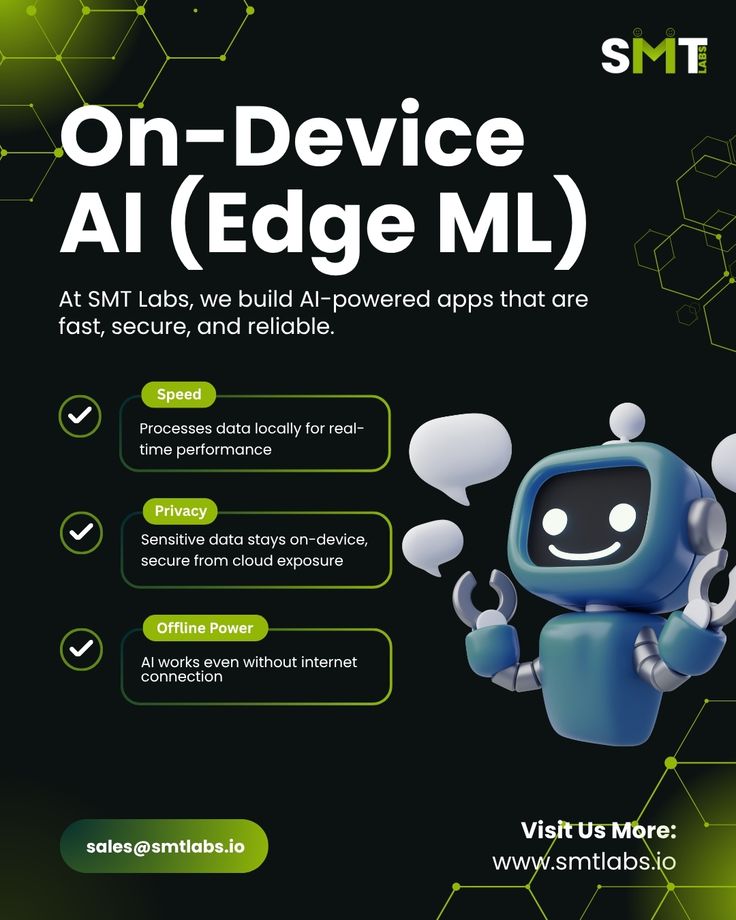
By processing data directly on the device, Edge AI delivers immediate responses that improve user experiences and operational efficiency.
Enhanced Privacy and Security
Data privacy has become a major concern for businesses and consumers.
Edge AI helps address these concerns by keeping sensitive information on the device rather than transmitting it across networks.
For example:
- Medical devices can analyze patient data locally.
- Security cameras can identify threats without storing footage in the cloud.
- Smartphones can process biometric information without external servers.
This approach reduces exposure to cyber threats and helps organizations comply with data protection regulations.
Reduced Bandwidth Usage
Transmitting large amounts of data to cloud platforms requires significant network resources.
Edge AI minimizes bandwidth consumption because only relevant insights or summarized information need to be transmitted.
This capability is particularly valuable in remote environments where network connectivity may be limited or expensive.
Improved Reliability
Many smart devices operate in environments where internet connectivity is inconsistent.
Since Edge AI functions locally, devices can continue working even when network access is unavailable.
This reliability is essential for industries such as manufacturing, transportation, healthcare, and defense.
Lower Operational Costs
Cloud computing costs can increase rapidly as organizations process larger volumes of data.
By performing AI tasks at the edge, companies can reduce cloud storage, bandwidth expenses, and server processing requirements.
This cost efficiency makes AI deployment more accessible for businesses of all sizes.
Edge AI in Smartphones
Modern smartphones are among the most common examples of Edge AI.
Manufacturers increasingly incorporate AI accelerators that enable advanced features such as:
- Facial recognition
- Voice assistants
- Real-time translation
- Photography enhancement
- Predictive text suggestions
- Battery optimization
- Spam call detection
Because these capabilities run directly on the device, users experience faster performance while maintaining greater privacy.
The latest generation of smartphones continues to demonstrate how Edge AI can improve everyday digital experiences without relying heavily on cloud infrastructure.
Smart Homes Powered by Edge AI
The smart home ecosystem is rapidly evolving thanks to Edge AI technologies.
Smart devices can now make intelligent decisions locally rather than waiting for cloud instructions.
Examples include:
Smart Security Systems
AI-powered cameras can detect suspicious activities, recognize faces, and differentiate between humans, animals, and vehicles.
Voice-Controlled Devices
Smart speakers can process voice commands more efficiently and respond faster.
Energy Management
Smart thermostats can analyze usage patterns and optimize energy consumption in real time.
Home Automation
Connected appliances can learn user preferences and automate tasks without constant internet communication.
As Edge AI becomes more sophisticated, smart homes will become increasingly autonomous and personalized.
The Role of Edge AI in Healthcare
Healthcare is one of the industries benefiting most from Edge AI innovation.
Medical professionals require rapid access to accurate information, and Edge AI enables real-time analysis at the point of care.
Applications include:
- Wearable health monitors
- Continuous glucose monitoring systems
- Smart diagnostic equipment
- Remote patient monitoring
- Medical imaging analysis
- Emergency response systems
For example, a wearable device can continuously monitor heart activity and detect abnormalities instantly without waiting for cloud processing.
This capability can improve patient outcomes and support faster medical intervention.
Industrial Edge AI and Smart Manufacturing
Manufacturing facilities are increasingly adopting Edge AI to support Industry 4.0 initiatives.
Smart factories rely on connected sensors and machines that continuously generate operational data.
Edge AI helps manufacturers:
- Monitor equipment performance
- Predict machine failures
- Improve quality control
- Reduce downtime
- Enhance worker safety
- Optimize production processes
Real-time analytics allow companies to identify problems before they become costly disruptions.
As a result, organizations achieve greater productivity, efficiency, and operational resilience.
Edge AI in Autonomous Vehicles
Self-driving vehicles generate enormous amounts of data from cameras, radar systems, lidar sensors, and onboard computers.
Relying solely on cloud processing would be impractical due to latency concerns.
Edge AI enables vehicles to:
- Detect obstacles
- Recognize traffic signs
- Monitor road conditions
- Predict pedestrian movement
- Make driving decisions instantly
Every second, autonomous systems must process vast amounts of information and respond immediately to changing environments.
Edge AI provides the computational speed necessary to make autonomous transportation safer and more reliable.
Retail Transformation Through Edge AI
Retail businesses are using Edge AI to enhance customer experiences and streamline operations.
Applications include:
- Smart checkout systems
- Inventory management
- Customer behavior analysis
- Personalized promotions
- Loss prevention
- Queue monitoring
By analyzing information locally, retailers can gain real-time insights while reducing dependence on cloud infrastructure.
This capability helps businesses improve efficiency and deliver more personalized shopping experiences.
Edge AI and Wearable Technology
Wearable devices continue to become more intelligent thanks to Edge AI capabilities.
Smartwatches, fitness trackers, and health-monitoring devices can now perform advanced analytics directly on the device.
Examples include:
- Sleep tracking
- Heart rate monitoring
- Activity recognition
- Stress detection
- Fitness coaching
- Health alerts
Local processing enables faster insights while preserving user privacy.
As wearable technology evolves, Edge AI will play an increasingly important role in delivering personalized health and wellness experiences.
Challenges Facing Edge AI Adoption
Despite its advantages, Edge AI still faces several challenges.
Hardware Limitations
Edge devices typically have fewer computing resources than cloud data centers.
Developers must optimize AI models to operate efficiently on limited hardware.
Power Consumption
Balancing performance with battery life remains an important consideration, particularly for mobile and wearable devices.
Model Updates
Keeping AI models updated across thousands or millions of distributed devices can be complex.
Security Risks
Although Edge AI improves privacy, edge devices themselves can become targets for cyberattacks if not properly secured.
Development Complexity
Designing AI systems that operate effectively across diverse hardware environments requires specialized expertise.
Addressing these challenges will be essential for widespread Edge AI adoption.
Emerging Technologies Supporting Edge AI
Several technological innovations are accelerating Edge AI development.
These include:
- AI-specific processors
- Neural Processing Units (NPUs)
- TinyML frameworks
- 5G connectivity
- Advanced semiconductor technologies
- Low-power machine learning chips
- Federated learning systems
Together, these advancements are making it easier to deploy powerful AI models on compact devices.
The combination of Edge AI and next-generation connectivity technologies will unlock entirely new categories of intelligent applications.
The Future of Edge AI in Smart Devices
The future of smart devices will be increasingly defined by intelligence at the edge.
As AI hardware becomes more powerful and energy-efficient, smart devices will be capable of performing tasks that currently require cloud infrastructure.
Future developments may include:
- Fully autonomous smart homes
- Advanced personal AI assistants
- Intelligent healthcare monitoring systems
- Self-optimizing industrial equipment
- Smarter transportation networks
- Real-time augmented reality experiences
- Hyper-personalized consumer devices
Organizations across industries are investing heavily in Edge AI because it enables faster decision-making, stronger security, and better user experiences.
As technology continues to evolve, Edge AI is expected to become a foundational element of the digital ecosystem.
Conclusion
Edge AI is transforming the capabilities of modern smart devices by bringing artificial intelligence closer to where data is created. Instead of relying solely on distant cloud servers, devices can now process information locally, enabling real-time insights, faster responses, enhanced privacy, and improved reliability.
From smartphones and wearables to autonomous vehicles, healthcare systems, and industrial machinery, Edge AI is reshaping how technology interacts with the world around us. Its ability to deliver intelligent decision-making directly on devices is opening new opportunities for innovation across virtually every industry.
While challenges related to hardware, security, and deployment remain, ongoing advancements in AI chips, connectivity, and machine learning optimization are rapidly addressing these obstacles. As a result, Edge AI is positioned to become one of the most important technologies powering the next generation of smart devices and connected experiences.