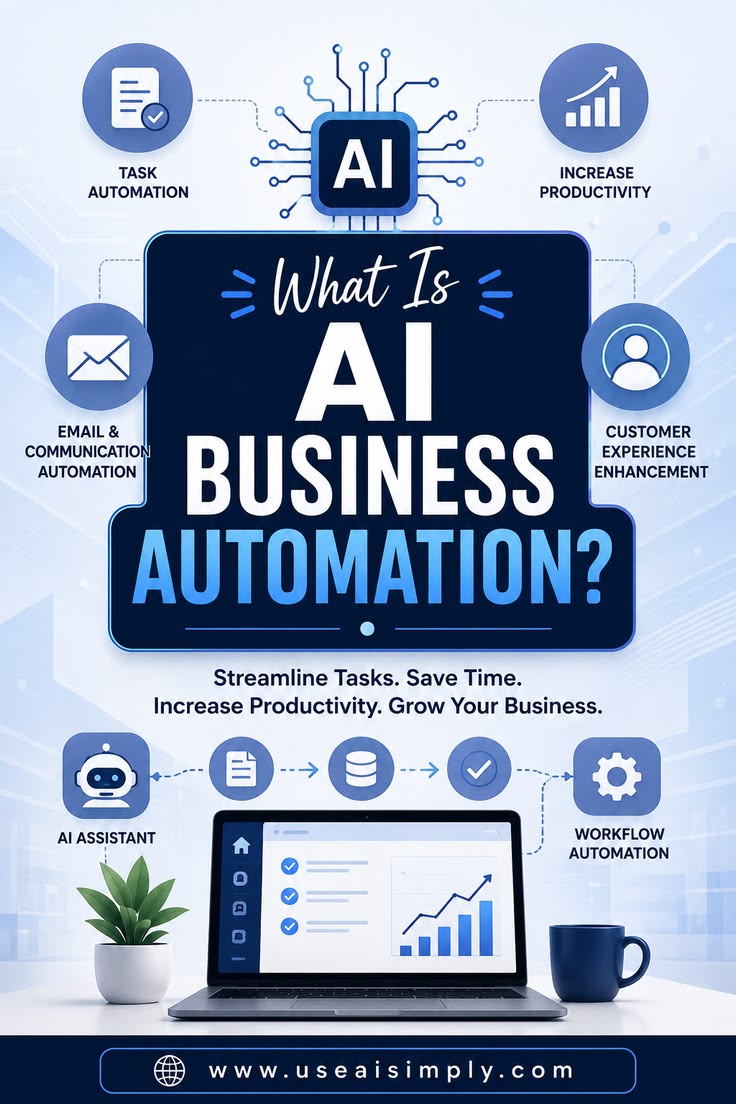
Beyond the Hype: How AI Automation Helps Businesses Scale, Save, and Out-Compete
There is a massive shift happening in the corporate world right now, and it has nothing to do with flashy sci-fi tropes. Instead, it is unfolding quietly inside spreadsheets, customer service queues, supply chain logs, and marketing workflows.
We have officially moved past the era of viewing Artificial Intelligence as a speculative tech experiment. Today, it is an operational engine.
For modern enterprises and growing startups alike, the question is no longer, “What is AI?” but rather, “How exactly does AI automation help businesses survive and thrive in a hyper-competitive market?”
If you are a business leader looking to cut through the industry buzzwords and understand the tangible, bottom-line impact of deploying smart automation, you are in the right place. Let’s break down exactly how AI automation is transforming modern business frameworks, reducing overhead, and unlocking entirely new revenue streams.
1. Redefining Human Productivity: Eradicating the “Busywork Tax”
The average employee spends an alarming percentage of their workday on repetitive, administrative tasks—data entry, scheduling, sorting emails, and cross-referencing files. This is what operational experts call the “Busywork Tax.” It drains employee morale and wastes expensive human capital on tasks that require zero critical thinking.
AI automation acts as a digital tirelessness layer that handles these tasks at scale.
Intelligent Document Processing (IDP)
Traditional software can read data if it is structured perfectly. AI goes a step further. Using Natural Language Processing (NLP), AI can ingest unstructured documents—like unstructured PDF invoices, handwritten receipts, or messy client emails—extract the relevant figures, categorize them, and instantly push them into your ERP or accounting software.
Smart Scheduling and Operations
Instead of a human spending hours coordinating calendars across internal teams and external clients, autonomous AI agents manage scheduling, anticipate time-zone friction, and even prepare meeting briefs by analyzing the participants’ public profiles and past touchpoints.
The Human Shift: When you automate the mundane, you don’t replace your staff; you upgrade them. A data-entry clerk becomes a data analyst. A customer support agent becomes a customer success strategist.
2. Revolutionizing Customer Experience (CX) with 24/7 Contextual Care
We’ve all experienced the frustration of legacy chatbots. You type a complex question, and it responds with: “I didn’t quite catch that. Did you mean ‘Track Order’?” It’s a broken user experience.
AI automation has fundamentally rewritten the rules of customer engagement by introducing true context, empathy, and speed.
Instant, Hyper-Personalized Resolving
Modern AI customer service agents don’t just pull from a static FAQ document. They connect securely to your internal databases. When a customer messages your platform, the AI instantly reviews their entire purchase history, recognizes their subscription tier, understands their emotional sentiment (detecting frustration or urgency), and crafts a bespoke response within seconds.
Multi-Channel Ubiquity
AI automation allows a lean support team to operate across web chat, WhatsApp, email, and social media DMs simultaneously without a drop-off in response times.
| Customer Service Metric | Legacy Framework | AI-Automated Framework |
| Average Response Time | 2 to 4 Hours | Less than 15 Seconds |
| Availability | Fixed Business Hours | 24/7/365 |
| First-Contact Resolution | 45% – 60% | 80%+ (For routine tier-1 queries) |
3. Transforming Data into Prescriptive, Real-Time Strategy
Most businesses are drowning in data but starving for insights. They have access to Google Analytics, CRM logs, and sales numbers, but by the time a human team compiles these reports at the end of the month, the insights are already outdated.
AI automation changes your business orientation from reactive to predictive and prescriptive.
[ Raw Data Streams ] ---> [ AI Automation Analytics Engine ] ---> [ Predictive Forecasting ] | v [ Prescriptive Action Taken ] (Automated Inventory Orders / Ad Adjustments)Predictive Inventory and Supply Chain Management
For e-commerce and manufacturing businesses, AI monitors micro-trends, weather forecasts, social media velocity, and historical sales patterns to predict exactly when a product will spike in demand. It can then automatically adjust supply chain orders to prevent stockouts without over-purchasing warehouse space.
Dynamic Financial Modeling
AI-driven financial tools continuously run thousands of “Monte Carlo” simulations against your business’s burn rate and revenue pipeline. This gives leadership real-time updates on cash flow runways and flags financial vulnerabilities months before they appear on a traditional balance sheet.
4. Hyper-Accelerating the Creative Pipeline and Marketing ROI
Marketing teams are under constant pressure to produce more content, run more ad variants, and target tighter demographics. Doing this manually is an expensive, slow process of trial and error. AI automation serves as a force multiplier for creative output.
Automated A/B Testing at Scale
Instead of a marketer manually designing three ad variations and waiting two weeks for results, AI tools can generate hundreds of hyper-targeted ad copy variations, deploy them across ad networks, analyze real-time performance indicators, and automatically shift budgets toward winning creative assets in minutes.
Hyper-Personalization Outbound
AI allows businesses to send marketing emails that feel completely bespoke. Instead of blasting an entire list with the same promotion, the AI customizes the subject line, product recommendations, and call-to-action based entirely on individual user behavior profiles.
5. Safeguarding Enterprises with Automated Cybersecurity & Risk Mitigation
As digital infrastructure grows, so do the threats against it. Human IT teams simply cannot monitor every network log, login attempt, or database query occurring across a global enterprise.
AI automation acts as an immune system for corporate networks.
Anomaly Detection over Static Rules
Legacy cybersecurity relies on fixed rules (e.g., block an IP if it enters the wrong password five times). Hackers know how to bypass these. AI automation monitors behavioral baselines. If an employee who normally accesses data from Chicago suddenly logs in from a machine performing atypical database queries out of Germany, the AI flags the anomaly, freezes the access endpoint, and alerts the security team instantly.
Automated Compliance Auditing
In highly regulated fields like healthcare (HIPAA) or finance, AI compliance engines continuously monitor internal communication channels, data storage, and external transfers to guarantee zero sensitive compliance infractions occur, preventing millions in regulatory fines.
The Roadmap to Implementing AI Automation Safely
If you are ready to bring AI automation into your organization, avoid the temptation to rewrite your entire operations layout overnight. Instead, adopt a calculated, phased approach:
-
Audit for High-Volume, Low-Complexity Tasks: Find the bottlenecks where your team spends hours doing repetitive work. Start your automation efforts there to secure quick wins.
-
Prioritize Data Cleanliness: AI models are only as good as the data they ingest. Ensure your internal databases and CRMs are clean and structured before connecting them to AI workflows.
-
Keep Humans in the Loop (HITL): Especially in the beginning, treat AI as an assistant, not an autonomous executive. Have a human review high-stakes AI outputs to maintain quality assurance.
Summary: The Competitive Imperative
AI automation isn’t about replacing the human element of business; it’s about liberating it. By automating the mechanical, data-heavy, and repetitive tasks, businesses give their human capital the freedom to focus on what matters most: innovation, relationship building, and strategic vision. In today’s landscape, adopting AI automation is no longer a luxury—it is the baseline for survival.