Introduction
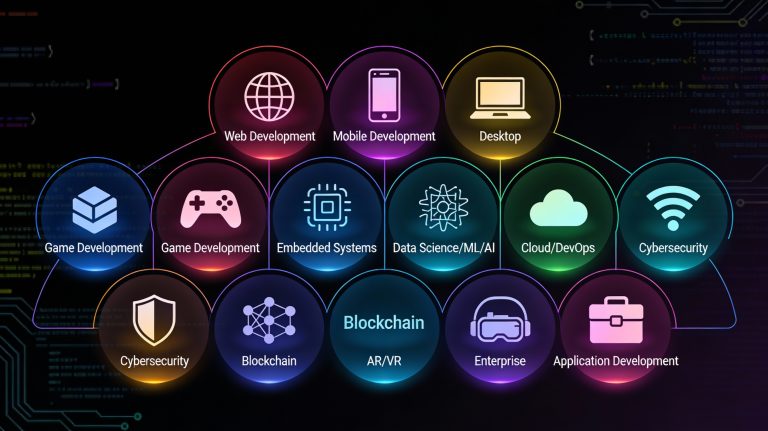
Software development is not a one-size-fits-all discipline. Depending on business goals, user needs, platforms, and technologies, software solutions are built in different ways. From websites and mobile apps to enterprise systems and embedded software, each type of software development serves a unique purpose.
Understanding the types of software development helps businesses choose the right approach and enables developers to specialize in the areas that best align with their skills and career goals. As digital transformation accelerates across industries, the demand for diverse software solutions continues to grow.
In this blog, we’ll explore the major types of software development, their characteristics, use cases, and how they contribute to modern technology ecosystems.
Web Application Development
Web development focuses on building applications that run in web browsers. These applications are accessible across devices without requiring installation.
Key Characteristics
-
Browser-based access
-
Platform-independent
-
Easy updates and maintenance
Technologies Used
-
Frontend: HTML, CSS, JavaScript, React, Angular
-
Backend: Node.js, Python, Java, PHP
-
Databases: MySQL, PostgreSQL, MongoDB
Use Cases
-
Business websites
-
E-commerce platforms
-
Content management systems
-
Web portals
Web development remains one of the most popular and in-demand software development types.
Mobile Application Development
Mobile software development involves creating applications for smartphones and tablets.
Types of Mobile Development
-
Native Development: Platform-specific (Swift for iOS, Kotlin for Android)
-
Cross-Platform Development: Single codebase for multiple platforms (React Native, Flutter)
Use Cases
-
Social media apps
-
Banking and fintech apps
-
Fitness and healthcare apps
-
On-demand services
Mobile development focuses on performance, usability, and device-specific features.
Desktop Software Development
Desktop software development involves building applications that run on operating systems like Windows, macOS, and Linux.
Key Features
-
Offline functionality
-
High performance
-
Direct access to system resources
Examples
-
Productivity tools
-
Graphic design software
-
Accounting systems
Although cloud and web apps are growing, desktop applications are still essential in many industries.
Enterprise Software Development
Enterprise software development focuses on building large-scale applications for organizations.
Key Characteristics
-
High scalability
-
Complex workflows
-
Integration with existing systems
Examples
-
ERP systems
-
CRM platforms
-
HR management software
Enterprise software improves efficiency, data management, and operational control.
Cloud Software Development
Cloud development involves building applications designed to run on cloud infrastructure.
Benefits
-
Scalability on demand
-
High availability
-
Cost efficiency
Popular Platforms
-
Amazon Web Services (AWS)
-
Microsoft Azure
-
Google Cloud Platform
Cloud-native development supports modern architectures like microservices and serverless computing.
Embedded Software Development
Embedded software runs on hardware devices rather than traditional computers.
Examples
-
IoT devices
-
Automotive systems
-
Medical equipment
-
Smart appliances
Embedded software must be efficient, reliable, and often real-time.
Custom Software Development
Custom software development involves building solutions tailored to specific business needs.
Advantages
-
Full control over features
-
Better integration with business processes
-
Competitive advantage
Custom software is often preferred over off-the-shelf solutions for unique requirements.
Game Development
Game development combines software engineering with creativity.
Technologies Used
-
Game engines (Unity, Unreal Engine)
-
Graphics and physics libraries
Applications
-
Mobile games
-
Console games
-
VR and AR experiences
Game development emphasizes performance, graphics, and user engagement.
AI and Machine Learning Software Development
AI-driven software development focuses on intelligent systems.
Use Cases
-
Recommendation engines
-
Chatbots
-
Predictive analytics
AI development requires specialized skills and data-driven approaches.
Choosing the Right Type of Software Development
Selecting the right development type depends on:
-
Business goals
-
Target users
-
Budget and timeline
-
Scalability requirements
Making the right choice ensures long-term success.
Conclusion
Software development encompasses a wide range of approaches, each designed to solve specific problems. Understanding the different types of software development allows businesses to make informed decisions and developers to focus their skills effectively.
As technology continues to evolve, the diversity of software development will only expand, offering endless opportunities for innovation.
Frequently Asked Questions (FAQs)
1. What are the main types of software development?
The main types include web, mobile, desktop, enterprise, cloud, embedded, and custom software development.
2. Which type of software development is most in demand?
Web and mobile development are currently the most in-demand due to widespread digital adoption.
3. What is custom software development?
Custom software development involves building applications tailored to specific business needs rather than generic solutions.
4. Is cloud software development different from web development?
Yes, cloud development focuses on scalability and cloud infrastructure, while web development focuses on browser-based applications.
5. Which type of software development is best for startups?
Web and cross-platform mobile development are often ideal for startups due to lower costs and faster time-to-market.
6. Can one project involve multiple types of software development?
Yes, many modern projects combine web, mobile, cloud, and backend development.
Connect with us: https://www.facebook.com/profile.php?id=61555452386126