In modern enterprise data environments, the traditional paradigm of nightly batch processing is rapidly becoming an operational liability. As business domains demand instantaneous decision-making—ranging from high-frequency fraud detection in financial clearinghouses to predictive telemetry in autonomous IoT fleets—data must be computed continuously at the moment of creation. Implementing distributed stream processing allows organizations to transition from passive historical reporting to proactive, low-latency execution engines operating on continuous data streams.
Part 1: The Paradigm Shift from Batch Decoupling to Continuous Streams
Historically, enterprise data architectures relied on monolithic Extract, Transform, Load (ETL) pipelines that executed on scheduled intervals. While batch systems like MapReduce or traditional SQL data warehouses served historical analytics well, they introduced a structural latency window ranging from hours to days. In high-velocity environments, this temporal delay dilutes the operational value of telemetry data.
According to market intelligence from International Data Corporation (IDC), over 30% of global data generated across connected networks is real-time in nature. Furthermore, financial sector benchmark studies demonstrate that credit card fraud detection models lose up to 70% of their predictive utility if analytical scoring exceeds a 200-millisecond window. The core challenge of Big Data is no longer merely managing massive volume; it is solving for extreme velocity without compromising transactional correctness.
Transitioning from static datasets to continuous event streams requires moving away from disk-bound tabular storage toward append-only log primitives. Rather than querying state that sits at rest, distributed stream processing flips the computing paradigm: queries remain persistent and long-running within memory while unbounded data flows continuously through them.
Part 2: The Core Anatomy of Distributed Stream Processing
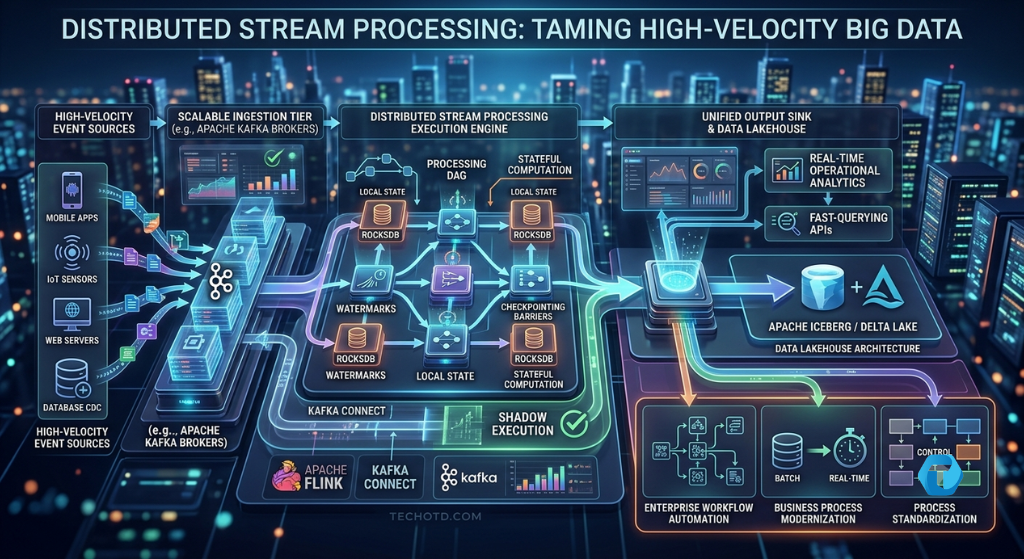
To process millions of incoming events per second with sub-second response times, streaming platforms decouple ingestion, compute, and state management into specialized distributed tiers.
At the ingestion boundaries, high-throughput partitioned message logs—such as Apache Kafka or Apache Pulsar—serve as the durable event bus. These brokers utilize sequential append-only disk writes to achieve multi-gigabyte ingestion speeds while providing deterministic offset management for message replays.
Directly downstream sits the execution engine. Modern distributed stream processing engines utilize Directed Acyclic Graph (DAG) query planners to distribute partition-level workloads across worker clusters. Unlike stateless microservices, streaming compute nodes maintain local physical state in high-performance key-value stores (such as RocksDB embedded directly within host memory).
By retaining local state buffers, stream engines eliminate the network round-trip overhead traditionally incurred when querying remote databases during event enrichment. This enables stateful compute operations—such as sliding temporal aggregations, multi-stream joins, and sessionization—to execute with microsecond locality.
Part 3: Overcoming Latency, Out-of-Order Events, and State Consistency
Operating a continuous compute engine across non-deterministic distributed networks presents severe architectural trade-offs, specifically regarding time domains, network jitter, and node failures.
1. Disentangling Event Time from Processing Time
In distributed networks, the moment an event occurs in the physical world (Event Time) rarely aligns perfectly with the moment it arrives at the processing server (Processing Time). Network latency, device disconnects, and mobile queue backups cause messages to arrive out of order.
Advanced distributed stream processing frameworks resolve this by utilizing watermarks—heuristic markers embedded into the stream stream that signal temporal completeness. Watermarks allow stateful windows to progress deterministically based on event timestamps rather than volatile wall-clock server times.
2. Guaranteeing Exactly-Once Processing Semantics
In the event of hardware failures or worker crashes, stream processing systems must recover state without dropping events (at-most-once failure) or duplicating calculations (at-least-once failure). Achieving true exactly-once semantics (EOS) requires two structural synchronization mechanisms:
Asynchronous Barrier Checkpointing: Based on variants of the Chandy-Lamport algorithm, lightweight snapshot barriers flow alongside data records through the DAG, persisting execution state to durable object storage without blocking pipeline throughput.
Two-Phase Commit (2PC) Sink Operators: Ensuring that state writes to external sinks (such as transactional databases or storage layers) commit synchronously with the engine’s internal checkpoint offsets.
Part 4: Architectural Blueprint: Integrating Kafka, Flink, and the Data Lakehouse
Building a enterprise-grade real-time analytical ecosystem requires orchestrating message brokers, stream processors, and unified storage formats into a cohesive topology.
A battle-tested production blueprint structures data flow across four decoupled layers:
Ingestion Tier: Edge telemetry, application logs, and database Change Data Capture (CDC) streams are published to partitioned topics in Apache Kafka.
Stream Processing Tier: Distributed engines like Apache Flink or Spark Structured Streaming consume topic partitions, applying windowed transformations, machine learning inference models, and real-time alerts.
Speed Layer Storage: Low-latency key-value stores (such as Redis or Apache Cassandra) store the immediate results of streaming aggregations for real-time dashboarding and API querying.
Unified Storage Tier: Stream sinks flush immutably transformed event logs into open table formats like Apache Iceberg or Delta Lake. This unifies streaming and batch analytics under a cohesive Data Lakehouse architecture.
By deploying this decoupled topology, enterprise data teams eliminate brittle point-to-point integrations and establish a unified streaming backbone capable of serving both operational applications and offline machine learning pipelines.
Key Takeaways for Distributed Stream Processing
Unlocking real-time intelligence requires moving beyond ad-hoc data pipelines toward disciplined architectural patterns. Adopting scalable distributed stream processing allows engineering organizations to process unbounded event streams with mathematical correctness, guaranteeing state consistency despite cluster failures.
By coupling stateful streaming compute with open table storage formats, enterprises can systematically eliminate operational latency, reduce infrastructure overhead, and drive automated decision systems at scale.
Frequently Asked Questions (FAQ)
What is the difference between batch processing and distributed stream processing?
Batch processing executes queries on bounded, historical datasets stored at rest on fixed time schedules. In contrast, distributed stream processing executes long-running, continuous queries over unbounded event data in motion, delivering low-latency results within milliseconds of event generation.
How do stateful stream processors maintain recovery during node failures?
Stateful stream engines maintain internal state locally in high-performance embedded key-value stores (e.g., RocksDB) while periodically taking distributed, non-blocking snapshots using checkpoint algorithms. If a worker node crashes, the system recovers state by resetting execution offsets to the latest valid checkpoint and replaying subsequent message logs.
Why is event time critical in real-time streaming pipelines?
Event time reflects the exact epoch timestamp when an action occurred at the source device. Relying on event time rather than server ingestion time guarantees that out-of-order logs, network delays, or batch backfills produce consistent, repeatable analytical results regardless of infrastructure performance.
Conclusion
As organizational data volumes scale exponentially, the ability to analyze and react to high-velocity information in real time has transitioned from a competitive advantage to an imperative baseline. Enterprise data architects must look past traditional batch architectures and invest in resilient streaming infrastructure.
By establishing a robust foundation in distributed stream processing, modern organizations can conquer temporal latency, unify operational and analytical domain logic, and convert raw data telemetry into immediate business value.
 In modern enterprise data environments, the traditional paradigm of nightly batch processing is rapidly becoming an operational liability. As business domains demand instantaneous decision-making—ranging from high-frequency fraud detection in financial clearinghouses to predictive telemetry in autonomous IoT fleets—data must be computed continuously at the moment of creation. Implementing distributed stream processing allows organizations to transition from passive historical reporting to proactive, low-latency execution engines operating on continuous data streams.