What Is GEO (Generative Engine Optimization)? The Complete Guide to AI-First Search
The digital marketing landscape is facing its most disruptive shift since the inception of the commercial internet. For decades, search engine optimization (SEO) has been the undisputed king of organic visibility. Businesses mastered the art of appealing to Google’s PageRank and crawler bots to land a spot on the coveted first page of “10 blue links.”
However, user behavior is fundamentally changing. With the massive integration of Artificial Intelligence into our daily search habits—via Google’s AI Overviews, OpenAI’s SearchGPT, and conversational answer engines like Perplexity AI—users no longer want a list of websites to click through. They want direct, synthesized, and immediate answers to complex questions.
To survive this transition, brands must pivot from traditional SEO to GEO (Generative Engine Optimization).
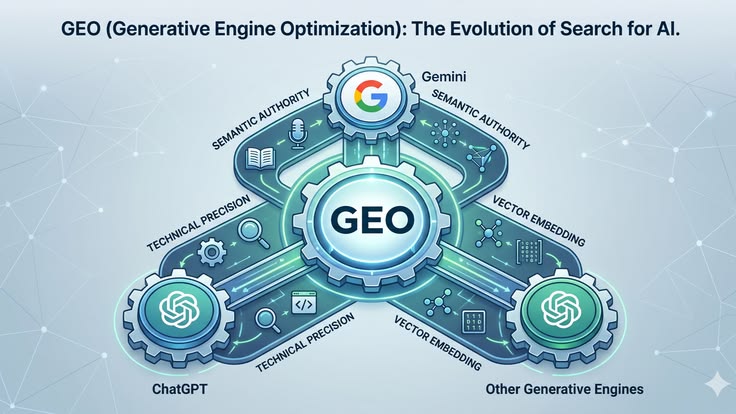
GEO is the strategic practice of optimizing digital content so that Large Language Models (LLMs) and generative search systems pick your brand, cite your website, and recommend your products when answering a user’s conversational prompt.
1. How Generative Search Works: Under the Hood
To optimize for an AI engine, you must understand how it retrieves information. Traditional engines map keywords to a massive database index. Generative engines use an architecture called Retrieval-Augmented Generation (RAG).
[ User Complex Prompt ] │ ▼ [ RAG Search Layer ] ──> Scrapes & Aggregates Authoritative Web Sources │ ▼ [ LLM Context Window ] ──> Synthesizes & Formulates Cohesive Response │ ▼ [ Output: Conversational Answer + In-Text Citations ]When a user submits a complex prompt, the AI search engine doesn’t just guess an answer.
-
It uses a RAG system to perform a lightning-fast web search for high-quality, relevant articles.
-
It pulls the text from those top-performing pages and feeds them into the LLM’s context window.
-
The LLM reads that aggregated data, synthesizes it, and formats a humanlike response, complete with in-text citations linking back to the source material.
Your entire goal with GEO is to ensure your content is structured so perfectly that the RAG system extracts it, and the LLM trusts it enough to cite it.
2. Core Pillars of Generative Engine Optimization (GEO)
According to empirical research on AI search visibility, standard keyword stuffing will actively hurt your performance in generative results. Instead, AI engines favor specific content characteristics:
A. Authoritative and Statistical Inclusion
LLMs are designed to minimize hallucinations (making things up). Because of this, their retrieval layers actively hunt for concrete facts, verified statistics, and primary research data.
-
The Blueprint: Instead of writing vague statements like “Many companies use remote work software,” write with precision: “According to a 2026 Stanford study, 42% of the US labor force now works from home full-time.”
B. Structural Fluency & Information Density
AI models read text exponentially faster when it is organized logically. Messy walls of text make it difficult for the retrieval system to pull key facts cleanly.
-
The Blueprint: Use explicit markdown formatting. Break down data into clear comparison tables, use highly descriptive H2 and H3 headings, and present actionable takeaways in bulleted lists.
C. Direct Answer Architecture (The TL;DR Block)
Generative engines want to answer the user as quickly as possible. If your article hides the main answer at the very bottom of a 2,000-word post, an AI bot will pass it over for a site that delivers immediate value.
-
The Blueprint: Implement a “Direct Answer Block” or a summary box right beneath your main article title. Give the AI the exact definition or solution it needs to scrape instantly, then provide the deep-dive context below.
3. SEO vs. GEO: A Deep Comparison Matrix
| Feature / Metric | Traditional SEO | Generative Engine Optimization (GEO) |
| User Search Style | Short, fragmented phrases (e.g., “best wireless headphones”) | Long, contextual prompts (e.g., “what are the best noise-canceling headphones for a small head on a 6-hour flight?”) |
| Primary Goal | Rank #1 in the organic search results list | Become the primary cited source or product recommendation inside the AI response |
| Content Focus | Target keyword volume, search intent, and comprehensive topic coverage | High information density, first-party data, and expert quotes |
| Technical Driver | XML sitemaps, clean URLs, and basic meta tags | Advanced Schema Markup (Product, FAQ, Organization) and unblocked AI bots |
| Primary Metric | Search engine ranking positions (SERP) and raw organic clicks | Share of Voice (SoV) in AI answers and referral traffic from AI subdomains |
4. How to Optimize Your Website for the Big Three AI Engines
Each major player in the AI search race handles data extraction slightly differently. A robust GEO strategy accounts for these unique preferences.
1. Google AI Overviews (Gemini)
Google’s AI capabilities are native extensions of its core web index.
-
Leverage EEAT: Experience, Expertise, Authoritativeness, and Trustworthiness are non-negotiable. Ensure your content features clear author biographies, links to verified social profiles, and expert credentials.
-
Keep Core Web Vitals Flawless: If your page takes too long to load or render, Google’s real-time RAG engine will skip past your site to maintain its conversational speed.
2. OpenAI SearchGPT / ChatGPT Search
OpenAI heavily weights real-time web discovery alongside its deeply integrated premium publisher partnerships.
-
Digital PR and Third-Party Reviews: SearchGPT often pulls brand recommendations by looking at web sentiment. To show up as a recommended product, ensure your brand has consistent, positive mentions on third-party review platforms (like G2, Trustpilot, or industry forums).
-
Verify Robot Permissions: Check your
robots.txtfile and make sure you haven’t blocked search crawlers likeOAI-SearchBot.
3. Perplexity AI
Perplexity operates as an aggressive real-time citation machine, aiming to act as the internet’s definitive bibliography.
-
Be the Original Source: Perplexity prioritizes primary data over secondary aggregators. Focus on publishing original research, proprietary data sets, or case studies.
-
Participate in Community Hubs: Perplexity frequently looks at Reddit and niche forums to gather real-world human consensus. Maintaining an active brand presence on these channels can pull your business directly into Perplexity’s citation loop.
5. Critical Mistakes to Avoid
-
Relying on Generic AI Content Swarms: Mass-producing basic AI-generated text to build a massive blog footprint backfires in GEO. If your content offers nothing unique beyond what the LLM already knows from its training data, it will never be chosen as a verified citation source.
-
Blocking All AI Agents Globally: While it is smart to block offline scraper bots from stealing your data to train future models, accidentally blocking real-time search-enabled bots (like
OAI-SearchBotorGoogle-Extended) will render your website completely invisible to conversational search users. -
Forgetting Schema Markup: If you run an e-commerce or review site, failing to use structured data schemas makes it incredibly hard for an AI engine to extract real-time details like product pricing, review ratings, or stock availability accurately.
Final Thoughts: The Future of Your Digital Footprint
Generative Engine Optimization is not a replacement for traditional SEO—it is its evolution. For the foreseeable future, the internet will remain a hybrid ecosystem where traditional search queries and conversational AI overviews exist side-by-side.
By shifting your content creation strategy toward high information density, structural scannability, unique authoritative data, and transparent digital PR, you can ensure that your brand remains prominent, trusted, and heavily cited across every machine and human engine on the web.